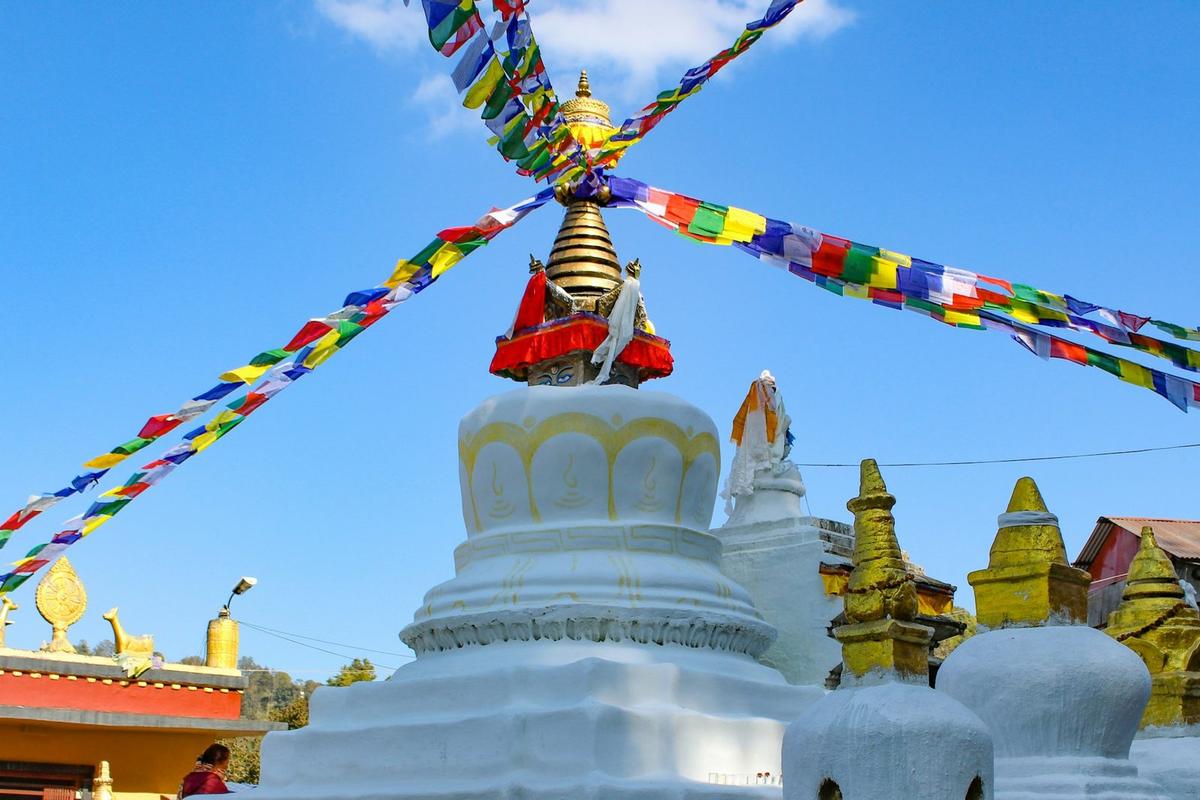
Stalls selling incense and ghee lamps crowd the approach to the stupa at Namo Buddha, and prayer wheels run around the edge of its platform. Higher up the same hill stands Thrangu Tashi Yangtse Monastery, and on a clear day the ridge looks out across a line of snow peaks.
Namo Buddha Stupa is a Buddhist pilgrimage site on a hilltop in Kavrepalanchok district, about 40 km south-east of Kathmandu by the monastery's figure and about 1,750 m (5,741 ft) high. Tradition holds that a prince gave his body to a starving tigress here. The monastery says entry is free, and the drive takes about two hours.
It is one of the places in our guide to hill stations in Nepal, and the one with the strongest story. This guide covers the legend, the hill, the monastery, getting there by road or on foot, and when to go.
Last checked: 18 November 2026
In this guide
- Where it is and how high
- The legend of the prince and the tigress
- The stupa, the tigress shrine and the monastery
- Entry, etiquette and mountain views
- Getting there by road, and the walks from Dhulikhel and Panauti
- Best time to go and the Namo Buddha Mela
- Where to stay and how much time you need
- Frequently asked questions
Key facts
- Where
- Namobuddha Municipality, Kavrepalanchok district, Bagmati Province (Thrangu Tashi Yangtse Monastery; Wikipedia, checked 18 Nov 2026)
- Height
- About 1,750 m (5,741 ft); no official survey figure; one local source gives 1,600 m (Republica, 1 Mar 2013; UncoverNepal map reading; Buddha Air blog, checked 18 Nov 2026)
- Distance from Kathmandu
- About 40 km south-east (Thrangu Tashi Yangtse Monastery, checked 18 Nov 2026)
- Drive time
- About two hours, ending with a short stair climb (Thrangu Tashi Yangtse Monastery, checked 18 Nov 2026)
- Entry fee
- Free, says the monastery; no opening hours published (Thrangu Tashi Yangtse Monastery; NTB, checked 18 Nov 2026)
- Walk from Dhulikhel
- About three hours (NTB); three to five hours (monastery) (NTB; Thrangu Tashi Yangtse Monastery, checked 18 Nov 2026)
- Walk from Panauti
- About three hours (NTB); two to three hours (monastery) (NTB; Thrangu Tashi Yangtse Monastery, checked 18 Nov 2026)
- Monastery
- Karma Kagyu; founded 1978 by its own account; temple consecrated 2008 (Thrangu Tashi Yangtse Monastery; The Kathmandu Post, 22 Mar 2019, checked 18 Nov 2026)
- Clearest months
- October and November (NTB climate page, checked 18 Nov 2026)
- Namo Buddha Mela
- Kartik full moon: Tuesday 24 November 2026 (Hamro Patro; timeanddate.com; Onlinekhabar and eKantipur (2025 mela), checked 18 Nov 2026)
Where is Namo Buddha Stupa and how high is it?
Namo Buddha Stupa stands on a hilltop in Namobuddha Municipality, Kavrepalanchok district, about 40 km south-east of Kathmandu, according to the monastery. We give its height as about 1,750 m (5,741 ft). No official survey figure is published, and one local source gives 1,600 m, so treat any height as approximate.
On its Visit page the monastery measures that distance "from Boudhanath", which is handy if you stay near the Boudhanath Stupa; other published figures run from 38 km to 52 km. The height comes from a 2013 Republica report and matches our own satellite map reading. It puts Namo Buddha a little higher than Dhulikhel at 1,550 m (5,085 ft), and well below about 2,450 m, where the US CDC says altitude sickness becomes a concern.
The monastery calls the hill "Gandha Malla Hill". The Tibetan name is Takmo Lüjin, "tigress body-giving", and both Namo Buddha and Namobuddha are in use.
What is the legend of Namo Buddha?
The legend tells of Prince Mahasattva, in Buddhist tradition an earlier life of the Buddha. Walking in a forest with his two brothers, he found a tigress so weak from hunger that she might eat her own cubs, and gave her his own body. Tradition at Namo Buddha holds that this hill is the place.
The best-known written version is chapter 26, "The Gift of the Body to a Tigress", of The Sūtra of the Sublime Golden Light, translated by Peter Alan Roberts for 84000. King Mahāratha's three sons wander into a forest, where they find her:
"they saw a tigress who had given birth six or seven days before, encircled by her five cubs. She was so hungry and thirsty and exhausted that her body was completely weakened."
84000, The Sūtra of the Sublime Golden Light, chapter 26, translated by Peter Alan Roberts
The youngest prince sends his brothers on, goes back alone and, when the tigress is too weak even to move, wounds himself so that she can feed. His parents later place his bones in a stupa. Then the Buddha tells his disciple Ānanda: "At that time, I was the prince called Mahāsattva".
The sutra sets the story in "the Pañcāla land" and never names Namo Buddha. Placing it here is local tradition, which identifies the prince's kingdom with Panauti, the old Newar town below the ridge; the monastery describes Panauti's "palace ruins linked to the Jataka story". The Nepal Tourism Board tells a shorter version, in which "one of the earlier Buddhas" offered "his own flesh to the tigress to keep her and the cubs alive".
The name. The monastery says the Buddha "named the area Namobuddha, meaning 'Homage to the Buddha'"; another local telling, reported by Onlinekhabar, links it to pilgrims chanting "Namo Buddhaya". Both are tradition.
What can you see at the stupa and on the hill?
The hill holds three sights: the old stupa, a small shrine where the sacrifice is said to have happened, and the monastery on the summit. The stupa lies down the hill on the other side of the monastery, reached by a stone path and stairs, so allow time for the walk.
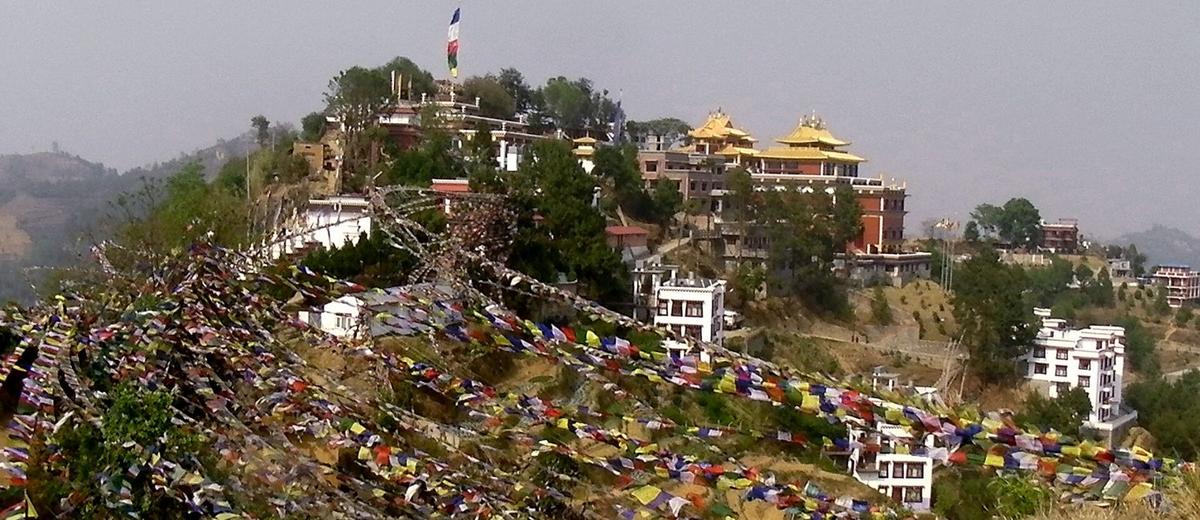
The stupa. The monastery says "the original Namobuddha Stupa was erected to enshrine the prince's remaining bones and hair". The Kathmandu Post calls it "One of the three most important stupas in Nepal", and the secretary of the stupa's guthi writes that Tibetans hold three stupas in special regard: Swayambhunath, Boudhanath and Namo Buddha. Our guide to the Swayambhunath monkey temple covers another of the three. A stupa is a dome-shaped Buddhist shrine that holds relics; this one is cared for by a local guthi (a traditional trust).
History, by tradition. The monastery says King Mana Deva I of the Licchavi dynasty expanded the sanctuary in the 5th century, and The Annapurna Express says a merchant from Ashon, Kathmandu, renovated the main temple in 1916.
The tigress shrine. The site of the sacrifice, "a small cave with a stone Buddha, tigress and cubs", is no more than 200 metres from the monastery's main hall, The Kathmandu Post reported. The Annapurna Express says lamas carved the scene on a small slate-like stone about four centuries ago, now covered by a larger image.
What is Thrangu Tashi Yangtse Monastery?
Thrangu Tashi Yangtse Monastery is the large Tibetan Buddhist monastery on the hilltop, of the Karma Kagyu lineage, founded by the Ninth Khenchen Thrangu Rinpoche. Rinpoche began building a retreat centre here in 1976, the monastery gives 1978 as its founding year, and the large temple was consecrated in 2008.
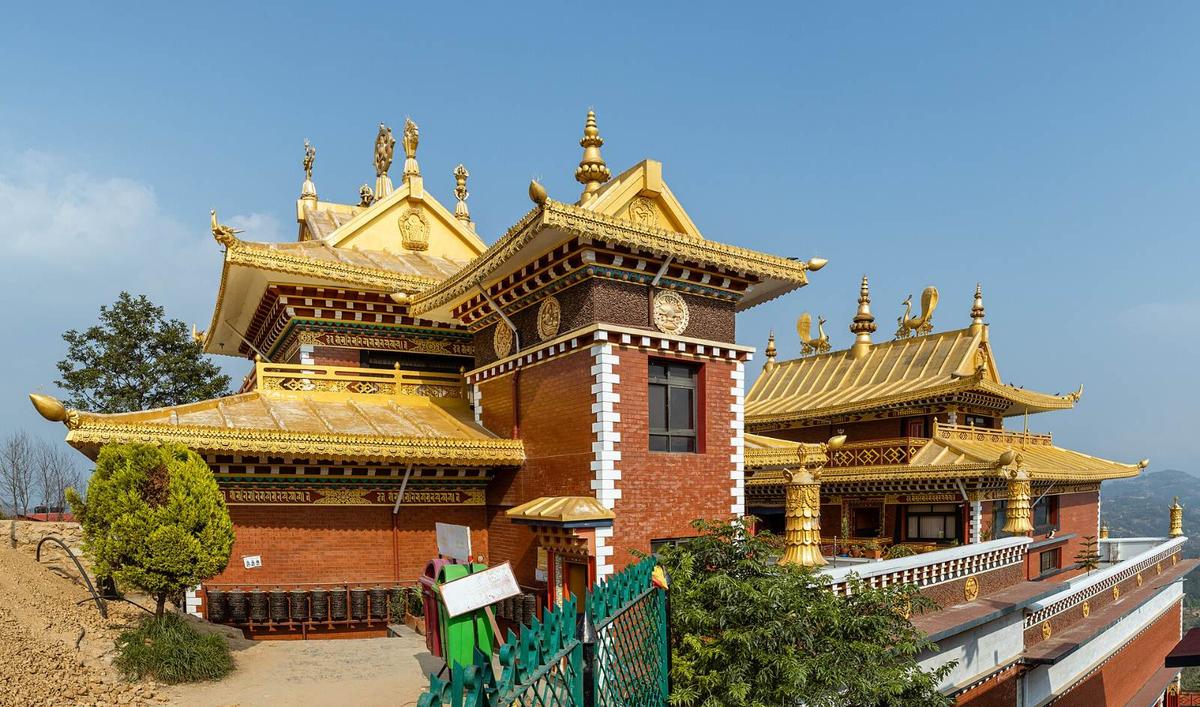
The 16th Karmapa had suggested a monastery at Namo Buddha on a pilgrimage in 1974. Thrangu Rinpoche, born in Kham in eastern Tibet in 1933, built the retreat centre first, then a monastic college, a school for young monks and the new temple. He died on 4 June 2023 and was cremated at Namo Buddha on 4 November 2023.
Today the monastery lists a shedra (college) for higher studies, a school for young monks, the Phende Clinic, a guest house and a café. The clinic, founded in 1992, serves monks, visitors and "over 3,000 villagers in close proximity", and the café supports it. In 2019 The Kathmandu Post put the community at between 250 and 400.
"On the hill where a prince once gave his body to a starving tigress, a living community now offers education, healthcare, and refuge to all who come."
Thrangu Tashi Yangtse Monastery, home page, 2026
In 2016 Onlinekhabar found visitors welcome at a prayer session, and in 2019 The Kathmandu Post described an early morning puja (prayer ceremony) and an afternoon one. The monastery publishes no times, so ask on arrival.
Is there an entry fee, and when is it open?
The monastery's Visit page says "Entry is free". Neither the monastery nor NTB publishes opening hours, so visit in daylight and ask at the gate about prayer times. Carry cash in small notes: the monastery notes that small vendors do not take cards.
How should you behave at Namo Buddha?
Namo Buddha is a working monastery and a place of worship. The monastery asks visitors to dress modestly, covering shoulders and knees, to stay quiet during prayers and ceremonies, to ask before taking photos inside shrine halls, and not to climb on monuments or relics.
Two more habits help:
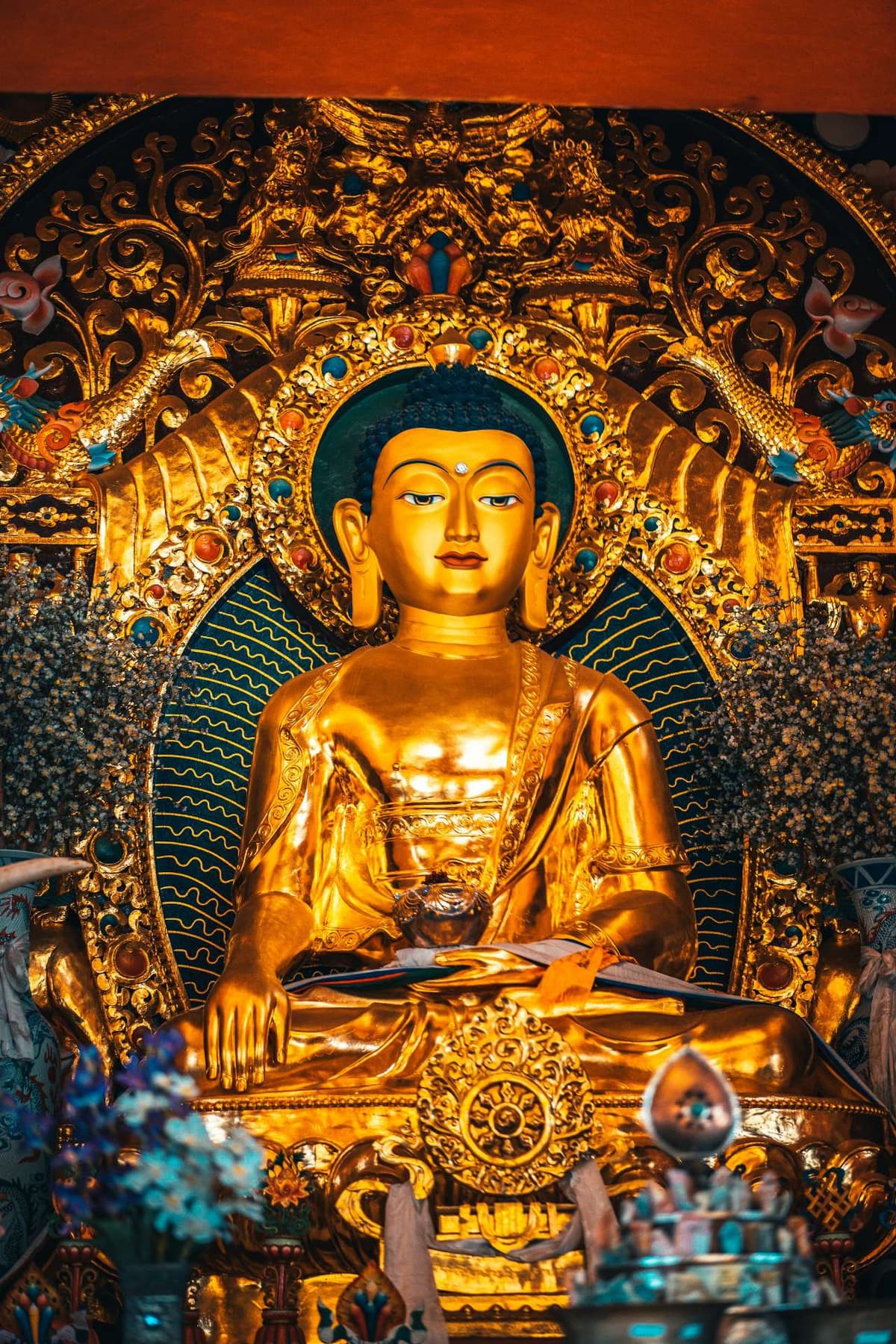
- Shoes: take them off when asked before entering a shrine hall. NTB notes that before entering a temple or a house "you will often be asked to take off your shoes".
- Walking direction: walk around the stupa and turn the prayer wheels clockwise, keeping the stupa on your right. Britannica describes this rite, pradakshina, as circumambulating "in a clockwise direction an image, relic, shrine, or other sacred object". It is general Buddhist and Hindu practice rather than a rule posted at Namo Buddha.
Which mountains can you see from Namo Buddha?
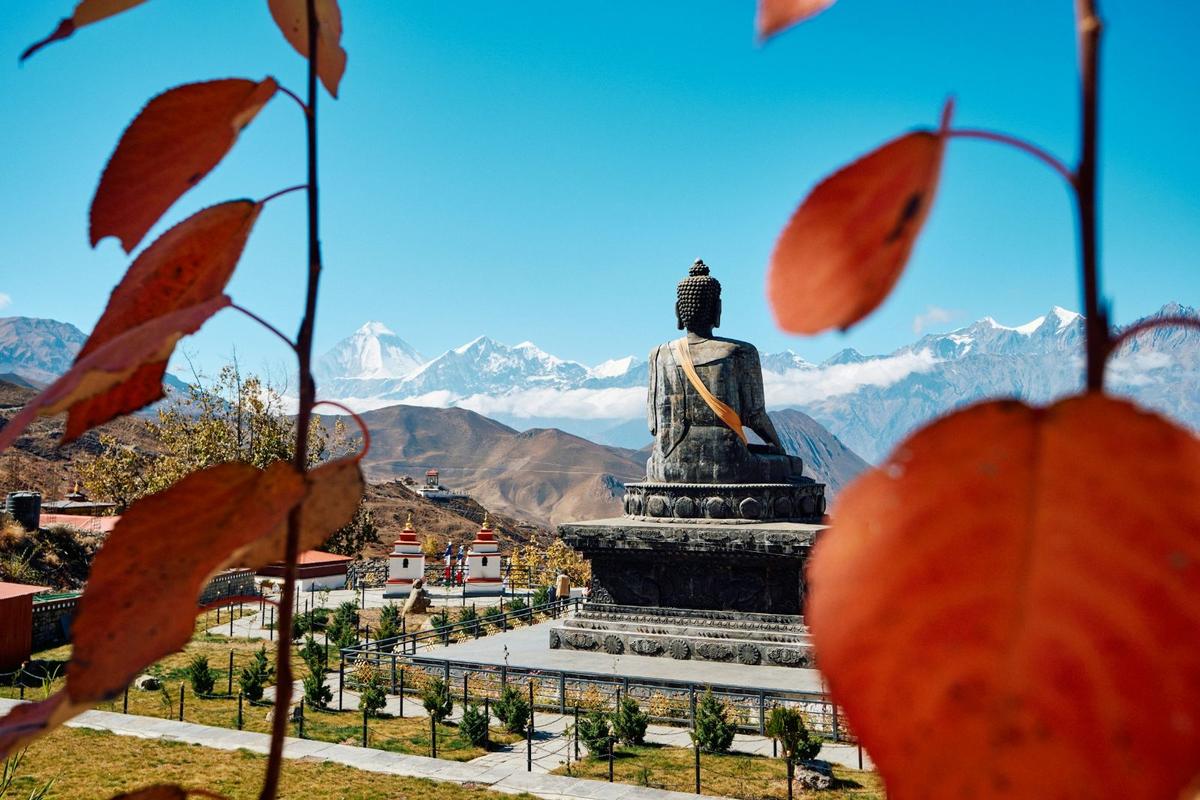
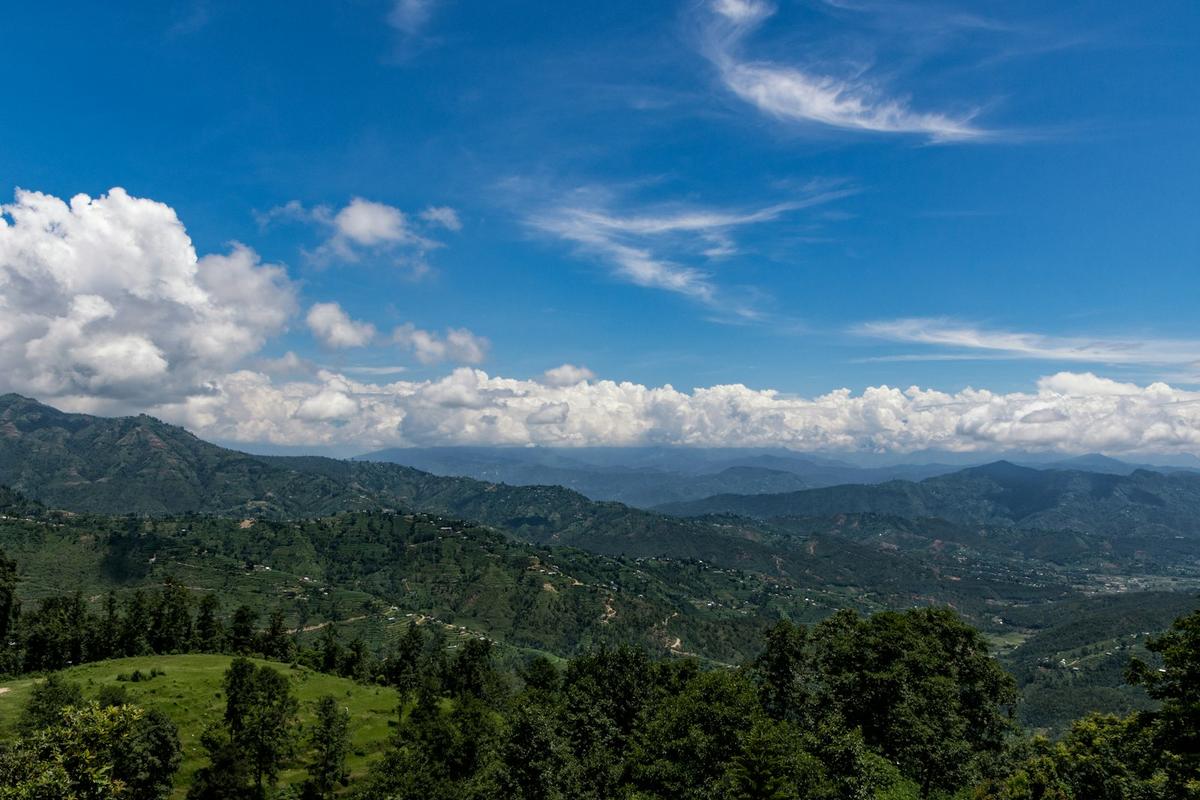
On a clear day the ridge looks out across a stretch of the Himalaya. The monastery names Gaurishankar, Dorje Lakpa, Langtang, Manaslu and Ganesh Himal among the peaks. Haze and cloud can hide all of them, so treat the view as a bonus, not a promise.
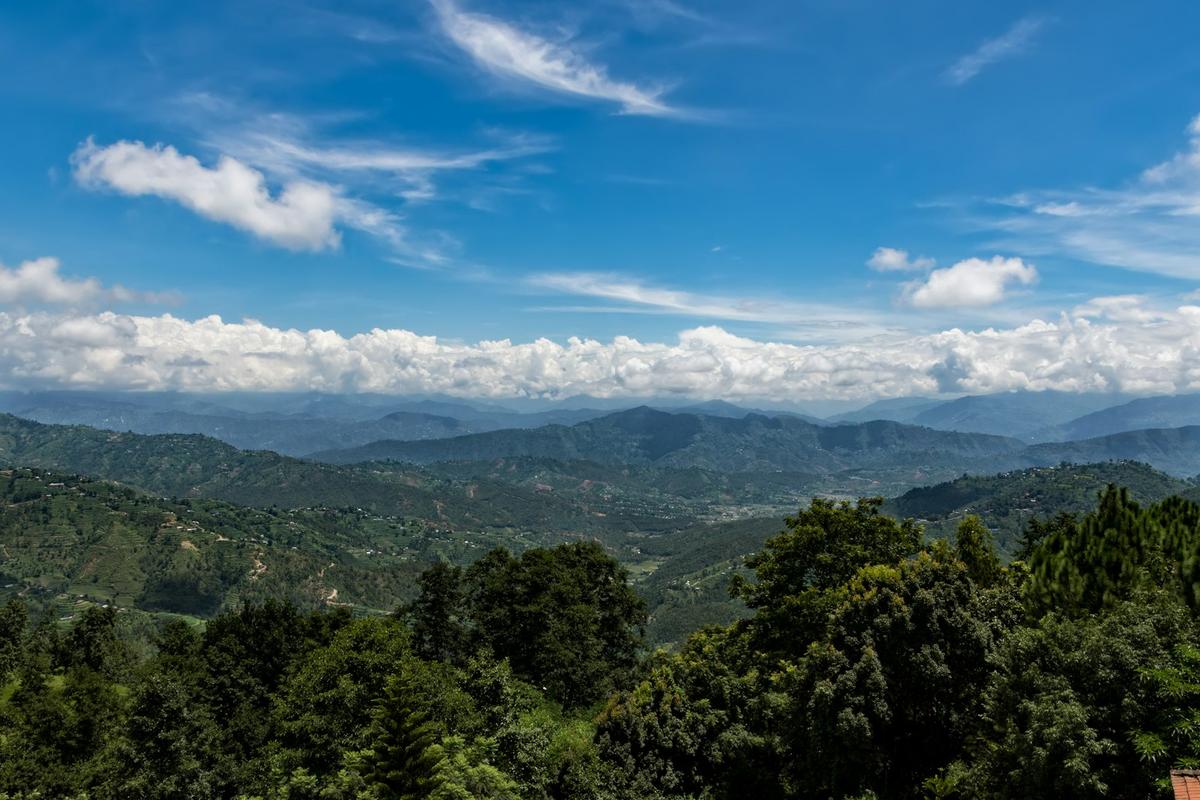
If a mountain view is the main point of your day, compare the higher viewpoint in our Nagarkot guide.
How do you get to Namo Buddha from Kathmandu and Dhulikhel?
By car, Namo Buddha is about two hours from Kathmandu, the monastery says. The road runs via Bhaktapur and Banepa to Dhulikhel, then about 8 km on the BP Highway to Kavre Bhanjyang, where you turn right onto Namo Buddha Road for about 4.5 km to the entrance. A short stair climb ends the trip.
By car or taxi. This is the easiest way. The BP Highway is also called the Banepa to Bardibas highway, and the monastery calls it the Sindhuli Highway. Blacktopped roads reach Namo Buddha from Kavre Bhanjyang and from Panauti, according to the secretary of the stupa's guthi.
From Dhulikhel. Dhulikhel is 30 km south-east of Kathmandu, about an hour's drive, and the road on to Namo Buddha is the 8 km and 4.5 km above. We found no published drive time for that stretch. Our Dhulikhel guide covers the town and its sunrise hill.
By bus. The monastery suggests a local bus from Ratna Park in Kathmandu to Banepa, then a connecting bus towards Namo Buddha or Panauti, roughly 2 hours from Banepa, with a 10-minute walk from the final stop. It is slow, so check the time of the last bus back.
How long is the hike from Dhulikhel or Panauti?
NTB gives about three hours on foot from Dhulikhel or from Panauti. The monastery allows three to five hours from Dhulikhel and two to three hours from Panauti. The figures differ with pace, stops and route, so plan on the longer one and start early.
"Namobuddha can be reached by a three-hour trek from Dhulikhel or Panauti."
Nepal Tourism Board, Namobuddha, Kavre page
| Source | Dhulikhel to Namo Buddha | Panauti and Namo Buddha |
|---|---|---|
| Nepal Tourism Board | About three hours | About three hours |
| Dhulikhel Municipality | About three hours | Not given |
| Thrangu Tashi Yangtse Monastery | Three to five hours | Two to three hours, uphill from Panauti |
| Republica, 2013 | Three to four hours | About three hours, downhill to Panauti |
From Dhulikhel. The monastery's "classic route" climbs to the Kali Temple above Dhulikhel, the same hill as the town's sunrise viewpoint, the Bhagawati Temple. It drops to Kavre Bhanjyang, crosses the highway, runs through pine forest to the villages of Phaskot and Chisapani, then climbs the last trail to the monastery. This Chisapani is a village near Namo Buddha, not the one on the Shivapuri trail north of Kathmandu. Republica called it "an easy to moderate hike".
From Panauti. The monastery calls this the gentler way, via Shankhu through farmland and villages, and says that on clear days you can see the monastery from Panauti itself. Panauti's old core has been on the UNESCO Tentative List since 1996.
Walking the whole line, Dhulikhel up to Namo Buddha and then about three hours down to Panauti as Republica describes it, makes a long day. For more walks near the city, see our Kathmandu hiking guide.
Carry what the monastery advises:
- Water and snacks
- Sun protection for the exposed ridge
- Cash in small notes
When is the best time to visit Namo Buddha?
October and November give the clearest skies, according to NTB, with spring a second choice, as the monastery suggests. The monsoon brings cloud and heavy rain; in a normal year it runs from about mid-June to early October. Winter months are dry, with cold nights.
We found no published climate figures for Namo Buddha, so expect conditions between the nearest stations, Kathmandu airport (1,337 m) and Nagarkot (2,147 m).
| Month | Kathmandu airport: mean high / low, rain | Nagarkot: mean high / low, rain |
|---|---|---|
| October | 27.2°C / 13.9°C, 43.3 mm | 20.6°C / 11.3°C, 65.8 mm |
| November | 23.6°C / 8.4°C, 6.4 mm | 17.5°C / 7.3°C, 9.1 mm |
| December | 20.2°C / 4.2°C, 7.8 mm | 14.3°C / 4.3°C, 11.9 mm |
| January | 19.2°C / 2.8°C, 15.2 mm | 12.9°C / 2.9°C, 19.3 mm |
| July (monsoon) | 28.7°C / 20.3°C, 384.1 mm | 22.2°C / 15.6°C, 473.7 mm |
Sources: WMO and DHM normals for Kathmandu airport (1991 to 2020); DHM for Nagarkot (temperatures 1991 to 2020, rain 1976 to 2005), via Wikipedia.
We found no reliable source on whether mornings are clearer here. Daylight matters more: with about two hours' drive each way or a long walk, start early, or stay the night for the morning puja.
When is the Namo Buddha Mela?
The Namo Buddha Mela, a festival fair also called a jatra, is held at the stupa at the Kartik full moon, when families light lamps for their ancestors. In 2026 that full moon falls on Tuesday 24 November, and the national news agency RSS reported on 18 November 2026 that the three-day jatra starts on Monday 23 November. Expect crowds and slow traffic on the Dhulikhel road, and confirm locally before you go.
In 2025 the lamp lighting began on the evening before the full moon and went on through the full moon day and night, according to Onlinekhabar and eKantipur. Their reports disagree on when it ended, so plan around the eve and the full moon itself. The secretary of the stupa's guthi has written that "If puja is offered in the names of the dead ancestors on Kartik Shukla Purnima, they receive salvation".
The monastery also hosts an annual seminar of Buddhist teachings; the 2027 one is set for 8 to 14 June 2027. For places pilgrims pair with Namo Buddha, see our guide to Buddhist pilgrimage sites in Nepal.
Where can you stay at Namo Buddha?
The monastery runs its own guest house: a newer block with twin rooms and private bathrooms, and an older one of 4 blocks with 3 rooms each and shared bathrooms. Meals are cooked in the monastery kitchen. It lists its rates and phone or WhatsApp booking details on its guest-house page.
The Kathmandu Post wrote in 2019 that staying lets guests "take part in, rather than simply observing, monastic life", and that many visitors use guesthouses in the surrounding area instead. A 2016 Onlinekhabar report found the guest house "usually full", so book ahead, especially around the full moon. The other choice is Dhulikhel, with more hotels and a sunrise hill of its own.
How much time do you need?
A long half-day covers the drive and the three sights on the hill. A full day lets you walk one way from Dhulikhel or Panauti, and a night in the monastery guest house adds the early puja and a second chance at the view.
| Plan | What fits in | Getting there |
|---|---|---|
| Long half-day | Stupa, tigress shrine, monastery, tea at the café | Car both ways, about two hours each way |
| Full day | Walk from Dhulikhel (three to five hours) or Panauti (two to three hours), then the hilltop | Car to the start, car back from Namo Buddha |
| Overnight | Monastery guest house or Dhulikhel, early puja, another chance at the view | Car or on foot, as above |
Our Kathmandu day trips guide compares Namo Buddha with other outings by time and effort.
Frequently asked questions
How far is Namo Buddha from Kathmandu?
Namo Buddha is about 40 km south-east of Kathmandu, according to the monastery. By car it takes about two hours, via Bhaktapur, Banepa, Dhulikhel and Kavre Bhanjyang. Other published figures run from 38 to 52 km.
Is there an entrance fee for Namo Buddha, and what are the opening times?
There is no entrance fee: the monastery says "Entry is free". Neither the monastery nor NTB publishes opening hours. Visit in daylight and ask about prayer times at the gate.
Can you stay at Namo Buddha Monastery?
Yes. The monastery's guest house has twin rooms with private bathrooms in its newer block and rooms with shared bathrooms in its older one, with meals from the monastery kitchen. Rates and booking details are on its guest-house page.
How long is the hike from Dhulikhel to Namobuddha?
NTB and Dhulikhel Municipality give about three hours. The monastery allows three to five hours for its route via the Kali Temple, Kavre Bhanjyang, Phaskot and Chisapani.
What is the story of Namo Buddha?
Tradition holds that Prince Mahasattva, an earlier life of the Buddha, found a starving tigress and her cubs here and gave her his own body. The story is chapter 26 of The Sūtra of the Sublime Golden Light, which sets it in the Pañcāla land. Local tradition places it on this hill.
What is the height of Namobuddha?
Namo Buddha stands at about 1,750 m (5,741 ft). No official survey figure is published, and one local source gives 1,600 m. Either way it is well below the height where altitude sickness becomes a concern.
Plan your visit
To see how it fits with the other hill places around the valley, go back to our guide to hill stations in Nepal.
If you would like us to arrange it, our Dhulikhel and Namobuddha tour pairs it with a night in Dhulikhel, and the Namobuddha and Nagarkot tour adds a night with a higher view. A licensed guide walks with you on our Namo Buddha trips. Message us on WhatsApp or use the enquiry form on either trip page.