
Explore by activity
Not listed yet

We run Motorbiking & Overland trips — we just haven’t put the itinerary on the site yet. Tell us your dates and we’ll send a costed day-by-day plan.

Explore by experience
Explore by region
by gomayu
Search Tours or Places

Swayambhunath (Monkey Temple): A Visitor's Guide

21 min read Posted 27 Oct 2026Updated 27 Oct 2026
Swayambhunath (Monkey Temple): A Visitor's Guide

By Uncover Nepal Team · Checked by our Kathmandu travel team · Last checked 27 October 2026

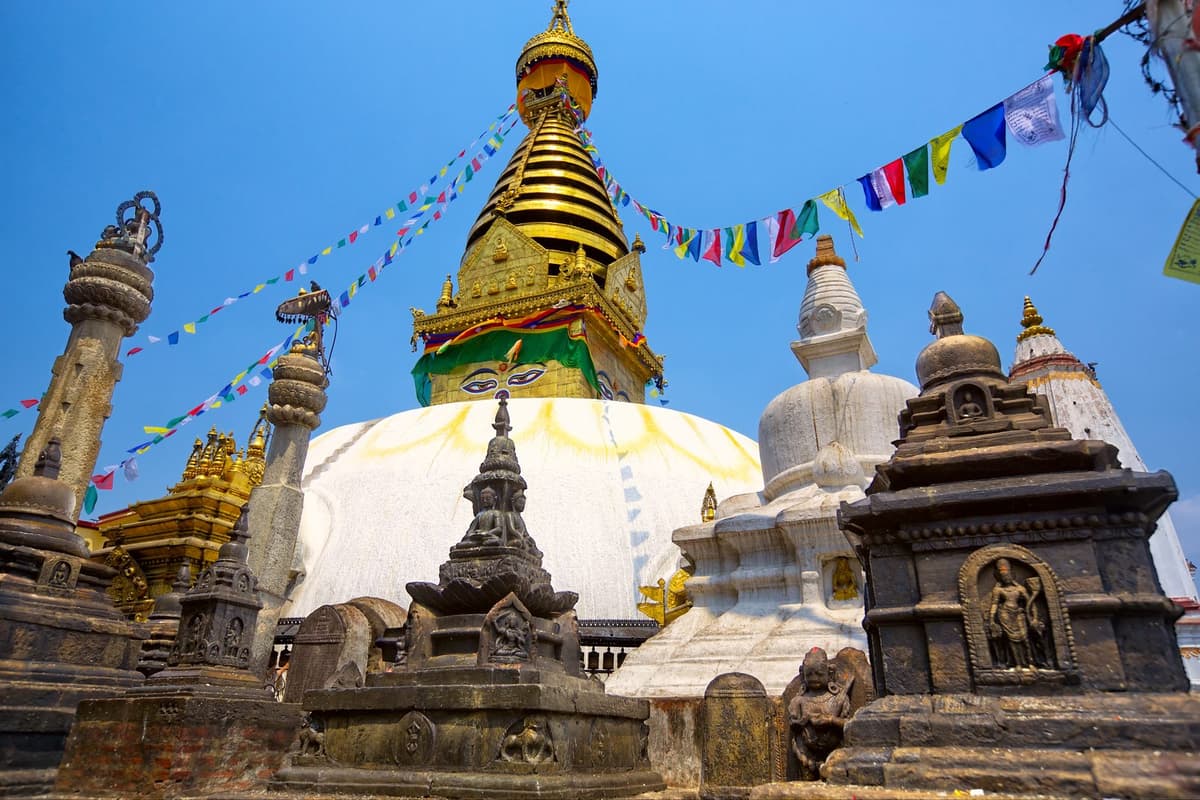
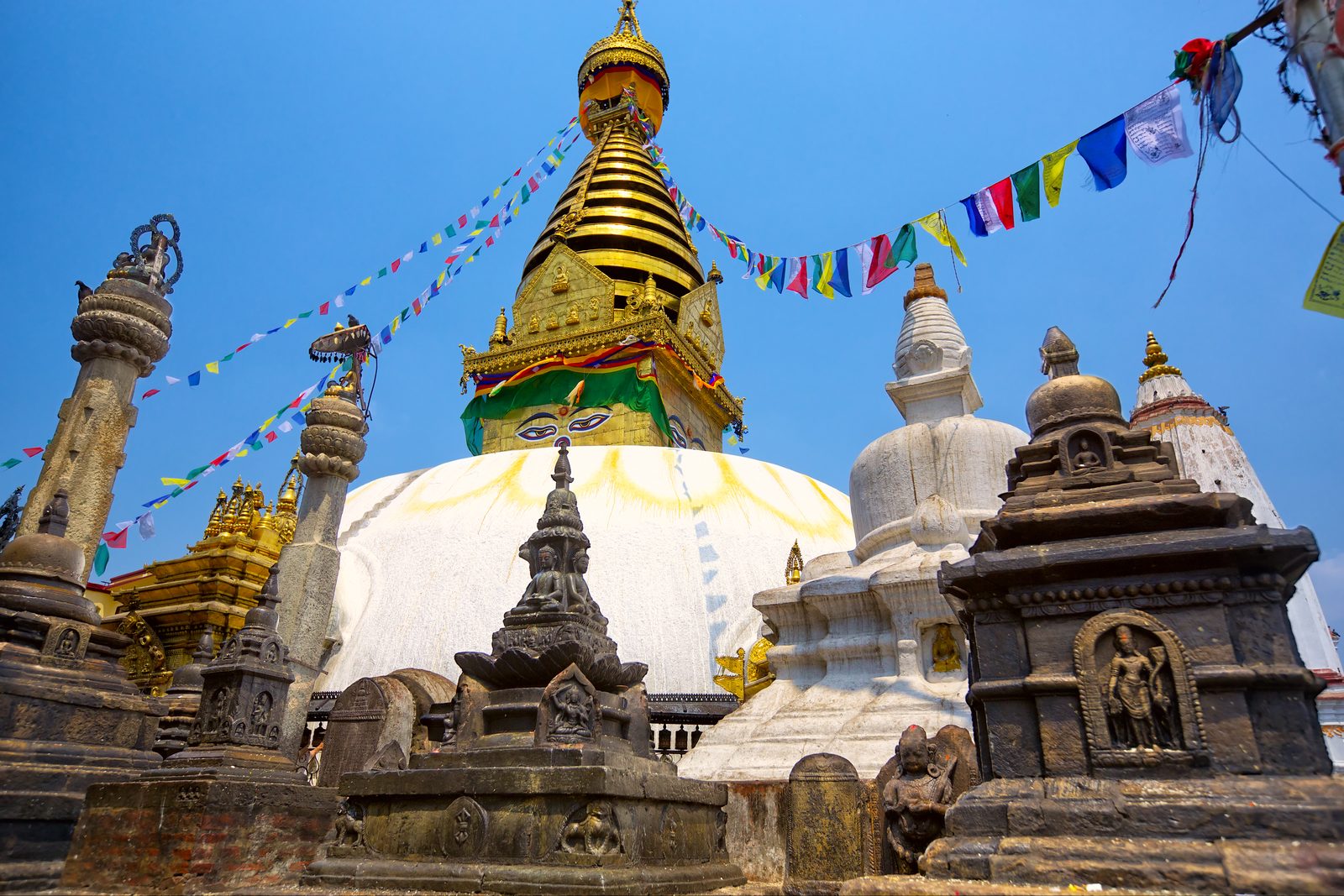
At the foot of the eastern stairway stands a collection of brightly painted Buddha statues, and macaques slide down the handrails. At the top of the steep stone steps, the first thing you see is a gilded vajra, and behind it the stupa's painted eyes look out in all four directions.

The Monkey Temple in Kathmandu is Swayambhunath, a Buddhist stupa on a hillock 3 km west of the city and one of the seven monument zones of the Kathmandu Valley World Heritage property. Foreign visitors pay NPR 200 at the entry point. You can climb the steep eastern stairway or take the road up the west side.

Our guide to places to visit in Kathmandu sets Swayambhu beside the city's squares and other temples. This guide covers the hill itself: what you see, the legend and history, the way up, the fee, the monkeys, and the best days to go.

In this guide

  • Key facts
  • Where is the Monkey Temple in Kathmandu?
  • Why is Swayambhunath called the Monkey Temple?
  • The legend and the history
  • What do you see at the top?
  • How do you get to the Monkey Temple in Kathmandu?
  • Entry fee and opening hours
  • Are the monkeys dangerous? Staying safe, step by step
  • When is the best time to visit?
  • Festivals at Swayambhu
  • The 2015 earthquake and the repairs
  • How to plan your visit, step by step
  • Frequently asked questions

Key facts

What it is
A Buddhist stupa and shrine complex; UNESCO: "the oldest Buddhist monument (a stupa) in the Valley" (UNESCO World Heritage Centre, 27 Oct 2026)
World Heritage
One of seven monument zones of the Kathmandu Valley property, inscribed in 1979 (UNESCO World Heritage Centre, 27 Oct 2026)
Location
On a hillock 3 km west of Kathmandu (Nepal Tourism Board, 27 Oct 2026)
Age
Believed to date back to 460 AD, built by King Manadeva (Nepal Tourism Board, 27 Oct 2026)
Entry fee
NPR 200 foreigners (including Chinese nationals); NPR 50 SAARC nationals; Nepalis and children under 10 free (Nepal Tourism Board, 27 Oct 2026)
Opening hours
None published; NTB says devotees circle the stupa "at all times" (Nepal Tourism Board, 27 Oct 2026)
Steps
Often said to be 365; published counts differ, from 318 to 424 (ECS Nepal, 27 Oct 2026)
Monkeys
Rhesus macaques; about 400, in a study published in 2006 (fieldwork May 2003) (Emerging Infectious Diseases (CDC journal), 27 Oct 2026)
Busiest day
Buddha Jayanti, usually in May; expected 20 May 2027 (Nepal Tourism Board; Office Holidays, 27 Oct 2026)
2015 earthquake
Badly damaged on 25 April 2015; approved for reopening to visitors from 15 June 2015 (USGS; Nepali Times, 27 Oct 2026)

Where is the Monkey Temple in Kathmandu?

The Monkey Temple sits on a hillock 3 km west of Kathmandu, according to the Nepal Tourism Board. Its proper name is Swayambhunath, also written Swoyambhu or Svayambhu, and NTB explains "Swayambhu" as "self-existent one".

It is one of seven groups of monuments in the Kathmandu Valley World Heritage property, inscribed by UNESCO in 1979. UNESCO says the Swayambhu ensemble "includes the oldest Buddhist monument (a stupa) in the Valley".

The hill is more than one stupa. Around the main stupa stand smaller stupas called chaityas, two 17th-century shikhara towers, a temple to the goddess Harati, a monastery and the shrine of Shantipur. On the west side, by the Ring Road, stand three giant statues. Tribhuvan University's Natural History Museum sits "on the lap of Swayambhu stupa", in the university's words.

Why is Swayambhunath called the Monkey Temple?

Because of the monkeys. The hill is home to rhesus macaques, and NTB says visitors have called it the Monkey Temple since the 1970s.

A study published in a CDC journal in 2006, based on fieldwork in May 2003, put their number at about 400, in five to seven groups. We found no newer count; a 2023 report in The Kathmandu Post simply says "hundreds". Lonely Planet says the eastern staircase "is mobbed by troops of rhesus macaques, who have made an artform of sliding down the steep handrails".

There is a story told locally about where they came from. Manjushri, who in legend drained the valley's lake, let his hair grow long, and the lice he later discarded turned into the monkeys you see today. Nepal Traveller magazine, which retells it, adds that the monkeys "are considered holy by Buddhists". Treat it as a story: we found no written source for it in the Swayambhu Purana.

The monkeys leave their mark. When the main stupa's pinnacle was repaired in December 2023, OnlineKhabar reported local people as saying that a storm had damaged it and that it "was already unstable after monkeys shook it". In August 2026 Kathmandu Metropolitan City began talks on managing monkeys in the Swayambhu, Tripureshwor and Thapathali areas.

The legend and the history

The lake and the lotus

According to the Swayambhu Purana, the Kathmandu Valley was once a lake where mythical serpents lived. Legend says a past Buddha sowed the seed of a lotus in it, which grew into "a lotus flower with thousand petals". Manjushri came to worship the lotus, flying "across the mountains of China and Tibet upon his blue lion", in the words of the priests' site. In the retelling cited by Wikipedia, he then drained the lake "by cutting the mountains with his indestructible sword". NTB says the shrine "is said to have evolved spontaneously when the valley was created out of a primordial lake more than 2,000 years ago". That is legend, not a building date.

What the records say

NTB says the stupa is "believed to date back to 460 A.D." and was built by King Manadeva. The site run by Swayambhu's priestly Buddhacharya family says inscriptions on stones around the stupa show it "had already been an important Buddhist pilgrimage destination by the 5th century AD". By the 13th century, NTB adds, it "had become an important center of Buddhism".

In the 17th century King Pratap Malla added the two shikhara towers, Pratappur and Anantapur, the second named after his queen, Ananta Priya. The priests' site counts the work of 1921 as the stupa's 14th renovation, and the next major renovation came in 2010.

Keith Dowman's guide to the valley's sacred places, as cited by Wikipedia, counts Swayambhu among the three most sacred Buddhist pilgrimage sites for the Newars, and for Tibetan Buddhists "second only to Boudha". That is Boudhanath.

Is Swayambhunath Hindu or Buddhist?

It is a Buddhist site where Hindus worship too. UNESCO links the valley's monuments to "the unique coexistence and amalgamation of Hinduism and Buddhism with animist rituals and Tantrism". Here you see it at the Harati temple, where "many Buddhist as well as Hindu devotees come to worship her", and at the temple NTB names for "Manjusri or Saraswati".

"This shrine is perhaps the best place to observe religious harmony in Nepal."

Nepal Tourism Board, Swayambhunath page

For Hindu and Buddhist sites across the country, read our Nepal pilgrimage guide.

What do you see at the top?

The first sight at the top of the eastern stairway is what NTB calls "the huge gold plated Vajra 'thunderbolt' set in the east side of the stupa". Walk round with the stupa on your right, as local people do, and you pass the rest.

What to look for What it is Where
The Buddha's eyes Painted on all four sides "to symbolize the Buddha's wisdom seeing all things in all four cardinal directions" Main stupa
The "nose" A curl shaped like the Devanagari numeral one, said to stand for unity Main stupa
The dot between the eyes The urna, one of the thirty-two marks of a great man in Buddhist tradition Main stupa
The thirteen rings Gilded tiers of the spire, "representing the thirteen stages before reaching Nirvana" Main stupa
Pratappur and Anantapur Two shikhara towers built by King Pratap Malla, rebuilt after the 2015 earthquake Beside the main stupa
Harati temple The temple of "the goddess of all children", in NTB's words On the platform
Shantipur One of the oldest shrines on the hill; visitors do not enter the inner sanctum North-east of the main stupa
Manjushri or Saraswati temple A temple to "Manjusri or Saraswati" Behind the hilltop
Dewa Dharma Monastery Noted "for a bronze icon of Buddha and traditional Tibetan paintings" On the hill
Giant Buddha statues Three statues, including what NTB calls the largest image of the Sakyamuni Buddha in Nepal West side, beside the Ring Road

Harati. NTB says Harati was an ogress before the Buddha converted her. In the priests' version, the Buddha hid her son in his alms bowl to teach her compassion, and she "is sometimes called Sitalamaju, the deity of smallpox".

Shantipur. The priests' site calls it "one of the oldest" sacred places on the hill, first called Akashpur. The tantric sage Shantikar Acharya "is still believed to be living here", and the inner walls carry paintings of the Swayambhu Purana.

The chaityas. After the 2015 earthquake, a UNESCO-funded dig at the Mangal Bahudwar chaitya in front of the main stupa found about 120,000 small votive tsa tsas, coins and a gold leaf, and a casket that dated the chaitya to 1875.

The west side. NTB lists a Sleeping Buddha and "the largest image of the Sakyamuni Buddha in Nepal" on a high pedestal beside the Ring Road. Nepal Traveller describes three giant statues there: the Buddha, Chenrezig and Guru Rinpoche. We found no reliable source for their heights. We also could not confirm the Natural History Museum's hours or fees, so check locally.

How do you get to the Monkey Temple in Kathmandu?

There are three ways up: the long eastern staircase to the main platform, a road round the hill from the south to the south-west entrance, and a quieter stairway to the same entrance. NTB confirms "a motor road going up almost to the top".

Route What it is like Suits
Eastern stairway Steep stone steps lined with carved animals, ending at the vajra Anyone happy with a long, steep climb
Road to the west side On our day tour we park by the World Peace Pond, about a five-minute walk from the stupa Older travellers, families, anyone short of time
South-west stairway A less used stairway to the south-west entrance A quieter climb

The eastern stairway

NTB is blunt: "Exceedingly steep stone steps that lead up to the shrine is quite a challenge". Lonely Planet notes the pairs of Garudas, lions, elephants, horses and peacocks that line the top of the steps, the vehicles of the Dhyani Buddhas, and credits the stairway to King Pratap Malla in the 17th century. ECS Nepal says instead that Tirthraj, a resident of Makhan Tole, commissioned the stairway in 1912; we found no record that settles the two. Take it slowly and stop to look back over the city.

How many steps are there?

The eastern stairway is often said to have 365 steps, one for each day of the year, but published counts differ. ECS Nepal collected figures from 318 to 424, including 417 before the 2015 earthquake and 424 after the repairs, without naming who counted. We have not found a count we trust, so plan for a long, steep climb rather than a number.

Driving to the west side

On our day tour the vehicle stops by the World Peace Pond, about a five-minute walk from the stupa, so guests "do not need to climb the long stone staircase on the eastern side".

Crossing the Ring Road on foot here takes care. In 2019 The Kathmandu Post reported on elderly devotees who cross it daily:

"Every day, I cross the Ring Road to worship at Swayambhunath, but it scares me."

Khamsung Gurung, 72, to The Kathmandu Post, 15 November 2019

We have not checked the crossing as it is today, so cross where local people cross.

From Thamel

NTB puts the hill 3 km west of Kathmandu. We do not quote a taxi fare or a fixed time, because both depend on traffic and where you start. Agree the fare before you get in.

Entry fee and opening hours

The entry fee is NPR 200 for foreign nationals, according to the Nepal Tourism Board's heritage-site fee table. You pay at the entry point.

Visitor Fee
Foreign nationals NPR 200
Chinese nationals NPR 200
SAARC nationals NPR 50
Nepali citizens Free
Children under 10 Free

The fee has stood at NPR 200 and NPR 50 since at least 2016. NTB does not say whether a ticket covers one entry or a whole day, so plan your visit in one go. The committee that manages the site waived the fee for foreigners on Buddha Jayanti in 2016 as a special offer; we found nothing to show that it does so every year. Entry fees are not included in the price of the three trips we link below.

Opening hours. No official opening hours are published, by NTB or by the priests' site. NTB says "devotees can be seen circumambulating the stupa at all times", and local people walk the kora from early morning. For a very early or late visit, ask your hotel or phone the numbers on NTB's fee table to check when tickets are sold.

Are the monkeys dangerous? Staying safe, step by step

They are bold, they grab bags, and some visitors are bitten. A bite or scratch needs first aid the same day.

We found no published count of bites at Swayambhu. A doctor at Kathmandu's tropical disease hospital in Teku wrote in 2023 that some monkey bite victims from Swayambhunath "regularly come to STIDH to get vaccinated, but not all". His hospital's data over 14 years showed that monkey bites usually peak in July and August.

"In fact, as per the hospital's data, monkeys are the second most common cause of animal bites in Nepal, after dogs."

Dr Sher Bahadur Pun, Sukraraj Tropical and Infectious Disease Hospital, The Kathmandu Post, 12 July 2023

He added: "So far, no rabies cases from monkey bites have been reported/documented in Nepal". That is reassuring, but it is no reason to skip treatment. A 2006 study of the temple's macaques found that many carried antibodies to viruses that can pass to people. One, B virus, is serious, but the CDC says "B virus infection is extremely rare". Its advice is that visitors to areas with free-ranging macaques "should avoid close contact with these animals".

Before you go up

  1. Put all food and drink inside a closed bag. Keep food out of sight, because the monkeys grab bags.
  2. Keep your hands free of snacks and plastic bags, and do not feed the monkeys.

On the hill

  1. Give monkeys room on the stairway and handrails, and do not touch them or pose with them.
  2. Keep children close on the steps.
  3. If a monkey grabs your bag, let it go rather than pull it back.

If you are bitten or scratched

  1. Wash the wound straight away for 15 minutes with povidone-iodine, chlorhexidine or detergent soap, as the CDC advises.
  2. Then rinse it under running water for a further 15 to 20 minutes, as a CDC report recommends.
  3. If saliva gets in your eyes or mouth, rinse with water for 15 minutes.
  4. See a doctor the same day and say it was a macaque. Some bite victims from Swayambhunath go to the tropical disease hospital in Teku for vaccination. The doctor will decide if you need rabies treatment.

If you are on a tour with us, tell your guide straight away.

When is the best time to visit?

Come early or late. At dawn local people walk the kora, the walk round the stupa, before the tour groups arrive. Late in the day, Swayambhu is a good last stop for the view over the valley and the evening light. We do not print sunrise or sunset times; check them for your date.

NTB says the clearest skies come after the monsoon, in October and November, and that about four-fifths of Nepal's rain falls from June to September. In the monsoon, cloud can hide the view and wet stone steps are slippery. Buddha Jayanti brings the year's largest crowds: avoid it for calm, or go early to see the hill at its busiest.

Festivals at Swayambhu

Dates come from the official holiday list where one exists; check them before you plan.

Festival Next date What happens at Swayambhu
Tihar Public holidays 8 to 12 November 2026 NTB recommends the hill for the view of the lit-up city
Tamu Lhosar (Gurung new year) 30 December 2026 Gurung communities hang new prayer flags at Svayambhu, the Rubin Museum notes
Sonam Lhosar (Tamang new year) 7 February 2027 A Lhosar on the official holiday list
Gyalpo Lhosar (Tibetan new year) 9 March 2027 OnlineKhabar names Lhosar, in February or March, as one of the hill's two main festivals
Buddha Jayanti Expected 20 May 2027; confirm on the official calendar The year's largest crowds; special prayers at the stupa
Gunla August or September; no 2027 date published OnlineKhabar calls it "the month-long Gunla celebration"

Tihar. NTB's festival page says: "A great view can be had of the brightly lit-up Kathmandu city from the Swoyambhunath Stupa". If you are in Kathmandu from 8 to 12 November 2026, spend an evening on the hill.

Buddha Jayanti. NTB says "the largest crowds of people are seen here on Buddha's birthday which usually falls in May each year". In 2026 it fell on 1 May, and crowds came from early morning. In 2025 The Kathmandu Post reported special prayers at the Buddha temple inside the main stupa complex, and a sacred relic of the Buddha shown at Anandakuti Vihar, within the Swayambhunath premises, once a year on this day.

Lhosar. OnlineKhabar says monks paint a lotus pattern on the dome with saffron paint at the main festivals. The priests' site also lists Gunla Dharma, Jataka tale readings, Panchataal and Charya dance among the hill's rituals.

The 2015 earthquake and the repairs

On 25 April 2015 a magnitude 7.8 earthquake struck central Nepal, causing close to 9,000 deaths and severely injuring more than 21,000 people, according to the USGS. Nepali Times reported that at Swayambhu it "badly damaged the stupa, chaityas and some of the stone sculptures of gods and goddesses". In June 2015 a UNESCO consultant estimated that up to 70 per cent of Swayambhu might have to be rebuilt.

"There are 195 people living here, and 27 houses have collapsed, who is going to rebuild those?"

Amrit Man Buddhacharya, Swayambhu's head priest, Nepali Times, 5 June 2015

"These people are intangible heritage that keeps the tangible heritage alive."

David Andolfatto, UNESCO consultant, Nepali Times, 5 June 2015

Date What happened
25 April 2015 Magnitude 7.8 earthquake; stupa, chaityas and sculptures badly damaged
15 June 2015 Date the Department of Archaeology approved for reopening to visitors
18 January 2017 Pratappur, cracked by the quake and aftershocks, pulled down to be rebuilt "in its old structure"
25 May 2017 Renovation of Anantapur begins
December 2017 UNESCO-funded dig at the Mangal Bahudwar chaitya reported
2018 Pratappur and Anantapur rebuilt and reopened
14 November 2018 The management committee reports 19 monuments restored
18 December 2023 Repair of the storm-damaged pinnacle of the main stupa reported complete

The committee that manages Swayambhu reported the 19 restorations, with the Department of Archaeology helping on the two towers and UNESCO supporting the Mangal Bahudwar chaitya. By late 2023 Shantipur had also been renovated. The towers you walk past today are the rebuilt ones.

How to plan your visit, step by step

  1. Pick your time: dawn for the kora, late afternoon for the evening light.
  2. Choose your way up: the eastern stairway for the climb, the west side road if not.
  3. Bring the fee: NPR 200 for foreign visitors, NPR 50 for SAARC nationals.
  4. Dress for a place of worship: cover shoulders and knees.
  5. Pack food away in a closed bag before you start.
  6. Walk round with the stupa on your right, and turn prayer wheels clockwise.
  7. Take your shoes off where others do, and ask before you photograph people at prayer.
  8. Know the bite routine: 15 minutes of washing, then a doctor the same day.

What to pair it with. Our walking tour and our two-day tour both pair Swayambhu with Kathmandu Durbar Square, which our Kathmandu Durbar Square guide covers. For the Hindu side of the valley, see our Pashupatinath temple guide. For trips beyond the city, see our Kathmandu day trips guide, and for longer walks with a view, our guide to hiking around Kathmandu.

Visiting with us. Many of our Kathmandu trips include Swayambhunath. Three examples:

  • On our Kathmandu UNESCO World Heritage Sites day tour, it is the first stop, and the vehicle parks by the World Peace Pond on the west side so you do not need to climb the eastern stairway. On this tour we expect around forty to forty-five minutes' drive to this first stop; the pickup time depends on how far your hotel is.
  • Our Kathmandu old city walking tour walks from Thamel through Ason to Kathmandu Durbar Square, then finishes with a short drive up to Swayambhunath.
  • Our Kathmandu 7 UNESCO sites in 2 days tour visits it on day 1, after Kathmandu Durbar Square.

Frequently asked questions

Why is Swayambhunath called the Monkey Temple?

Because hundreds of rhesus macaques live on the hill, and visitors have called it the Monkey Temple since the 1970s, according to the Nepal Tourism Board. A 2006 study put their number at about 400. A story told locally says the monkeys grew from lice in the hair of Manjushri, the figure who in legend drained the valley's lake. Its real name, Swayambhu, means "self-existent one".

What is the entry fee for Swayambhunath?

Foreign nationals pay NPR 200, SAARC nationals NPR 50 and Chinese nationals NPR 200, according to the Nepal Tourism Board's fee table. Nepalis and children under 10 enter free. You pay at the entry point. NTB does not say whether the ticket covers one entry or a full day, so plan your visit in one go.

How many steps are there to the top of Swayambhunath?

The eastern stairway is often said to have 365 steps, one for each day of the year, but published counts differ. ECS Nepal gathered figures from 318 to 424, with 424 counted after the earthquake repairs. Whatever the number, it is a long, steep climb. If it does not suit you, a road goes up almost to the top on the west side.

What time does Swayambhunath open?

No official opening hours are published. The Nepal Tourism Board says devotees can be seen circling the stupa "at all times", and local people walk the kora from early morning. For a very early or late visit, ask your hotel or phone the numbers on NTB's fee table to check when tickets are sold.

Are the monkeys at Swayambhunath dangerous?

They are bold: they grab bags, and some visitors are bitten. Keep food out of sight, do not feed or touch them, and keep children close. If you are bitten or scratched, wash the wound for 15 minutes with soap, detergent or iodine, then see a doctor the same day and say it was a macaque. A doctor at the Teku hospital wrote in 2023 that no rabies case from a monkey bite had been documented in Nepal.

How do you get to Swayambhunath from Thamel?

Take a taxi or join a tour. NTB puts the hill 3 km west of Kathmandu, and traffic decides how long the drive takes. Agree the fare first, then either climb the eastern stairway or ask to be dropped on the west side, where a road goes almost to the top. Our old city walking tour starts in Thamel and ends there with a short drive up.

Plan your visit with us

Swayambhu fits easily into a day in Kathmandu, and it is on many of our Kathmandu trips. A licensed guide can explain the eyes, the towers and the legend as you walk the kora, and steer you round the monkeys. To see how it fits with the rest of the city, read our guide to places to visit in Kathmandu. Send us your dates on WhatsApp or through our enquiry form, and we will tell you honestly which visit suits you.
Tags
SwayambhunathMonkey TempleKathmanduUNESCO World HeritageBuddhist stupasKathmandu Valley
Share
U
Uncover Nepal Team
Writer at Uncover Nepal
More in Temples & cultureSee all Temples & culture

Swayambhunath (Monkey Temple): A Visitor's Guide

21 min read Posted 27 Oct 2026Updated 27 Oct 2026
Swayambhunath (Monkey Temple): A Visitor's Guide

By Uncover Nepal Team · Checked by our Kathmandu travel team · Last checked 27 October 2026

At the foot of the eastern stairway stands a collection of brightly painted Buddha statues, and macaques slide down the handrails. At the top of the steep stone steps, the first thing you see is a gilded vajra, and behind it the stupa's painted eyes look out in all four directions.

The Monkey Temple in Kathmandu is Swayambhunath, a Buddhist stupa on a hillock 3 km west of the city and one of the seven monument zones of the Kathmandu Valley World Heritage property. Foreign visitors pay NPR 200 at the entry point. You can climb the steep eastern stairway or take the road up the west side.

Our guide to places to visit in Kathmandu sets Swayambhu beside the city's squares and other temples. This guide covers the hill itself: what you see, the legend and history, the way up, the fee, the monkeys, and the best days to go.

In this guide

  • Key facts
  • Where is the Monkey Temple in Kathmandu?
  • Why is Swayambhunath called the Monkey Temple?
  • The legend and the history
  • What do you see at the top?
  • How do you get to the Monkey Temple in Kathmandu?
  • Entry fee and opening hours
  • Are the monkeys dangerous? Staying safe, step by step
  • When is the best time to visit?
  • Festivals at Swayambhu
  • The 2015 earthquake and the repairs
  • How to plan your visit, step by step
  • Frequently asked questions

Key facts

What it is
A Buddhist stupa and shrine complex; UNESCO: "the oldest Buddhist monument (a stupa) in the Valley" (UNESCO World Heritage Centre, 27 Oct 2026)
World Heritage
One of seven monument zones of the Kathmandu Valley property, inscribed in 1979 (UNESCO World Heritage Centre, 27 Oct 2026)
Location
On a hillock 3 km west of Kathmandu (Nepal Tourism Board, 27 Oct 2026)
Age
Believed to date back to 460 AD, built by King Manadeva (Nepal Tourism Board, 27 Oct 2026)
Entry fee
NPR 200 foreigners (including Chinese nationals); NPR 50 SAARC nationals; Nepalis and children under 10 free (Nepal Tourism Board, 27 Oct 2026)
Opening hours
None published; NTB says devotees circle the stupa "at all times" (Nepal Tourism Board, 27 Oct 2026)
Steps
Often said to be 365; published counts differ, from 318 to 424 (ECS Nepal, 27 Oct 2026)
Monkeys
Rhesus macaques; about 400, in a study published in 2006 (fieldwork May 2003) (Emerging Infectious Diseases (CDC journal), 27 Oct 2026)
Busiest day
Buddha Jayanti, usually in May; expected 20 May 2027 (Nepal Tourism Board; Office Holidays, 27 Oct 2026)
2015 earthquake
Badly damaged on 25 April 2015; approved for reopening to visitors from 15 June 2015 (USGS; Nepali Times, 27 Oct 2026)

Where is the Monkey Temple in Kathmandu?

The Monkey Temple sits on a hillock 3 km west of Kathmandu, according to the Nepal Tourism Board. Its proper name is Swayambhunath, also written Swoyambhu or Svayambhu, and NTB explains "Swayambhu" as "self-existent one".

It is one of seven groups of monuments in the Kathmandu Valley World Heritage property, inscribed by UNESCO in 1979. UNESCO says the Swayambhu ensemble "includes the oldest Buddhist monument (a stupa) in the Valley".

The hill is more than one stupa. Around the main stupa stand smaller stupas called chaityas, two 17th-century shikhara towers, a temple to the goddess Harati, a monastery and the shrine of Shantipur. On the west side, by the Ring Road, stand three giant statues. Tribhuvan University's Natural History Museum sits "on the lap of Swayambhu stupa", in the university's words.

Why is Swayambhunath called the Monkey Temple?

Because of the monkeys. The hill is home to rhesus macaques, and NTB says visitors have called it the Monkey Temple since the 1970s.

A study published in a CDC journal in 2006, based on fieldwork in May 2003, put their number at about 400, in five to seven groups. We found no newer count; a 2023 report in The Kathmandu Post simply says "hundreds". Lonely Planet says the eastern staircase "is mobbed by troops of rhesus macaques, who have made an artform of sliding down the steep handrails".

There is a story told locally about where they came from. Manjushri, who in legend drained the valley's lake, let his hair grow long, and the lice he later discarded turned into the monkeys you see today. Nepal Traveller magazine, which retells it, adds that the monkeys "are considered holy by Buddhists". Treat it as a story: we found no written source for it in the Swayambhu Purana.

The monkeys leave their mark. When the main stupa's pinnacle was repaired in December 2023, OnlineKhabar reported local people as saying that a storm had damaged it and that it "was already unstable after monkeys shook it". In August 2026 Kathmandu Metropolitan City began talks on managing monkeys in the Swayambhu, Tripureshwor and Thapathali areas.

The legend and the history

The lake and the lotus

According to the Swayambhu Purana, the Kathmandu Valley was once a lake where mythical serpents lived. Legend says a past Buddha sowed the seed of a lotus in it, which grew into "a lotus flower with thousand petals". Manjushri came to worship the lotus, flying "across the mountains of China and Tibet upon his blue lion", in the words of the priests' site. In the retelling cited by Wikipedia, he then drained the lake "by cutting the mountains with his indestructible sword". NTB says the shrine "is said to have evolved spontaneously when the valley was created out of a primordial lake more than 2,000 years ago". That is legend, not a building date.

What the records say

NTB says the stupa is "believed to date back to 460 A.D." and was built by King Manadeva. The site run by Swayambhu's priestly Buddhacharya family says inscriptions on stones around the stupa show it "had already been an important Buddhist pilgrimage destination by the 5th century AD". By the 13th century, NTB adds, it "had become an important center of Buddhism".

In the 17th century King Pratap Malla added the two shikhara towers, Pratappur and Anantapur, the second named after his queen, Ananta Priya. The priests' site counts the work of 1921 as the stupa's 14th renovation, and the next major renovation came in 2010.

Keith Dowman's guide to the valley's sacred places, as cited by Wikipedia, counts Swayambhu among the three most sacred Buddhist pilgrimage sites for the Newars, and for Tibetan Buddhists "second only to Boudha". That is Boudhanath.

Is Swayambhunath Hindu or Buddhist?

It is a Buddhist site where Hindus worship too. UNESCO links the valley's monuments to "the unique coexistence and amalgamation of Hinduism and Buddhism with animist rituals and Tantrism". Here you see it at the Harati temple, where "many Buddhist as well as Hindu devotees come to worship her", and at the temple NTB names for "Manjusri or Saraswati".

"This shrine is perhaps the best place to observe religious harmony in Nepal."

Nepal Tourism Board, Swayambhunath page

For Hindu and Buddhist sites across the country, read our Nepal pilgrimage guide.

What do you see at the top?

The first sight at the top of the eastern stairway is what NTB calls "the huge gold plated Vajra 'thunderbolt' set in the east side of the stupa". Walk round with the stupa on your right, as local people do, and you pass the rest.

What to look for What it is Where
The Buddha's eyes Painted on all four sides "to symbolize the Buddha's wisdom seeing all things in all four cardinal directions" Main stupa
The "nose" A curl shaped like the Devanagari numeral one, said to stand for unity Main stupa
The dot between the eyes The urna, one of the thirty-two marks of a great man in Buddhist tradition Main stupa
The thirteen rings Gilded tiers of the spire, "representing the thirteen stages before reaching Nirvana" Main stupa
Pratappur and Anantapur Two shikhara towers built by King Pratap Malla, rebuilt after the 2015 earthquake Beside the main stupa
Harati temple The temple of "the goddess of all children", in NTB's words On the platform
Shantipur One of the oldest shrines on the hill; visitors do not enter the inner sanctum North-east of the main stupa
Manjushri or Saraswati temple A temple to "Manjusri or Saraswati" Behind the hilltop
Dewa Dharma Monastery Noted "for a bronze icon of Buddha and traditional Tibetan paintings" On the hill
Giant Buddha statues Three statues, including what NTB calls the largest image of the Sakyamuni Buddha in Nepal West side, beside the Ring Road

Harati. NTB says Harati was an ogress before the Buddha converted her. In the priests' version, the Buddha hid her son in his alms bowl to teach her compassion, and she "is sometimes called Sitalamaju, the deity of smallpox".

Shantipur. The priests' site calls it "one of the oldest" sacred places on the hill, first called Akashpur. The tantric sage Shantikar Acharya "is still believed to be living here", and the inner walls carry paintings of the Swayambhu Purana.

The chaityas. After the 2015 earthquake, a UNESCO-funded dig at the Mangal Bahudwar chaitya in front of the main stupa found about 120,000 small votive tsa tsas, coins and a gold leaf, and a casket that dated the chaitya to 1875.

The west side. NTB lists a Sleeping Buddha and "the largest image of the Sakyamuni Buddha in Nepal" on a high pedestal beside the Ring Road. Nepal Traveller describes three giant statues there: the Buddha, Chenrezig and Guru Rinpoche. We found no reliable source for their heights. We also could not confirm the Natural History Museum's hours or fees, so check locally.

How do you get to the Monkey Temple in Kathmandu?

There are three ways up: the long eastern staircase to the main platform, a road round the hill from the south to the south-west entrance, and a quieter stairway to the same entrance. NTB confirms "a motor road going up almost to the top".

Route What it is like Suits
Eastern stairway Steep stone steps lined with carved animals, ending at the vajra Anyone happy with a long, steep climb
Road to the west side On our day tour we park by the World Peace Pond, about a five-minute walk from the stupa Older travellers, families, anyone short of time
South-west stairway A less used stairway to the south-west entrance A quieter climb

The eastern stairway

NTB is blunt: "Exceedingly steep stone steps that lead up to the shrine is quite a challenge". Lonely Planet notes the pairs of Garudas, lions, elephants, horses and peacocks that line the top of the steps, the vehicles of the Dhyani Buddhas, and credits the stairway to King Pratap Malla in the 17th century. ECS Nepal says instead that Tirthraj, a resident of Makhan Tole, commissioned the stairway in 1912; we found no record that settles the two. Take it slowly and stop to look back over the city.

How many steps are there?

The eastern stairway is often said to have 365 steps, one for each day of the year, but published counts differ. ECS Nepal collected figures from 318 to 424, including 417 before the 2015 earthquake and 424 after the repairs, without naming who counted. We have not found a count we trust, so plan for a long, steep climb rather than a number.

Driving to the west side

On our day tour the vehicle stops by the World Peace Pond, about a five-minute walk from the stupa, so guests "do not need to climb the long stone staircase on the eastern side".

Crossing the Ring Road on foot here takes care. In 2019 The Kathmandu Post reported on elderly devotees who cross it daily:

"Every day, I cross the Ring Road to worship at Swayambhunath, but it scares me."

Khamsung Gurung, 72, to The Kathmandu Post, 15 November 2019

We have not checked the crossing as it is today, so cross where local people cross.

From Thamel

NTB puts the hill 3 km west of Kathmandu. We do not quote a taxi fare or a fixed time, because both depend on traffic and where you start. Agree the fare before you get in.

Entry fee and opening hours

The entry fee is NPR 200 for foreign nationals, according to the Nepal Tourism Board's heritage-site fee table. You pay at the entry point.

Visitor Fee
Foreign nationals NPR 200
Chinese nationals NPR 200
SAARC nationals NPR 50
Nepali citizens Free
Children under 10 Free

The fee has stood at NPR 200 and NPR 50 since at least 2016. NTB does not say whether a ticket covers one entry or a whole day, so plan your visit in one go. The committee that manages the site waived the fee for foreigners on Buddha Jayanti in 2016 as a special offer; we found nothing to show that it does so every year. Entry fees are not included in the price of the three trips we link below.

Opening hours. No official opening hours are published, by NTB or by the priests' site. NTB says "devotees can be seen circumambulating the stupa at all times", and local people walk the kora from early morning. For a very early or late visit, ask your hotel or phone the numbers on NTB's fee table to check when tickets are sold.

Are the monkeys dangerous? Staying safe, step by step

They are bold, they grab bags, and some visitors are bitten. A bite or scratch needs first aid the same day.

We found no published count of bites at Swayambhu. A doctor at Kathmandu's tropical disease hospital in Teku wrote in 2023 that some monkey bite victims from Swayambhunath "regularly come to STIDH to get vaccinated, but not all". His hospital's data over 14 years showed that monkey bites usually peak in July and August.

"In fact, as per the hospital's data, monkeys are the second most common cause of animal bites in Nepal, after dogs."

Dr Sher Bahadur Pun, Sukraraj Tropical and Infectious Disease Hospital, The Kathmandu Post, 12 July 2023

He added: "So far, no rabies cases from monkey bites have been reported/documented in Nepal". That is reassuring, but it is no reason to skip treatment. A 2006 study of the temple's macaques found that many carried antibodies to viruses that can pass to people. One, B virus, is serious, but the CDC says "B virus infection is extremely rare". Its advice is that visitors to areas with free-ranging macaques "should avoid close contact with these animals".

Before you go up

  1. Put all food and drink inside a closed bag. Keep food out of sight, because the monkeys grab bags.
  2. Keep your hands free of snacks and plastic bags, and do not feed the monkeys.

On the hill

  1. Give monkeys room on the stairway and handrails, and do not touch them or pose with them.
  2. Keep children close on the steps.
  3. If a monkey grabs your bag, let it go rather than pull it back.

If you are bitten or scratched

  1. Wash the wound straight away for 15 minutes with povidone-iodine, chlorhexidine or detergent soap, as the CDC advises.
  2. Then rinse it under running water for a further 15 to 20 minutes, as a CDC report recommends.
  3. If saliva gets in your eyes or mouth, rinse with water for 15 minutes.
  4. See a doctor the same day and say it was a macaque. Some bite victims from Swayambhunath go to the tropical disease hospital in Teku for vaccination. The doctor will decide if you need rabies treatment.

If you are on a tour with us, tell your guide straight away.

When is the best time to visit?

Come early or late. At dawn local people walk the kora, the walk round the stupa, before the tour groups arrive. Late in the day, Swayambhu is a good last stop for the view over the valley and the evening light. We do not print sunrise or sunset times; check them for your date.

NTB says the clearest skies come after the monsoon, in October and November, and that about four-fifths of Nepal's rain falls from June to September. In the monsoon, cloud can hide the view and wet stone steps are slippery. Buddha Jayanti brings the year's largest crowds: avoid it for calm, or go early to see the hill at its busiest.

Festivals at Swayambhu

Dates come from the official holiday list where one exists; check them before you plan.

Festival Next date What happens at Swayambhu
Tihar Public holidays 8 to 12 November 2026 NTB recommends the hill for the view of the lit-up city
Tamu Lhosar (Gurung new year) 30 December 2026 Gurung communities hang new prayer flags at Svayambhu, the Rubin Museum notes
Sonam Lhosar (Tamang new year) 7 February 2027 A Lhosar on the official holiday list
Gyalpo Lhosar (Tibetan new year) 9 March 2027 OnlineKhabar names Lhosar, in February or March, as one of the hill's two main festivals
Buddha Jayanti Expected 20 May 2027; confirm on the official calendar The year's largest crowds; special prayers at the stupa
Gunla August or September; no 2027 date published OnlineKhabar calls it "the month-long Gunla celebration"

Tihar. NTB's festival page says: "A great view can be had of the brightly lit-up Kathmandu city from the Swoyambhunath Stupa". If you are in Kathmandu from 8 to 12 November 2026, spend an evening on the hill.

Buddha Jayanti. NTB says "the largest crowds of people are seen here on Buddha's birthday which usually falls in May each year". In 2026 it fell on 1 May, and crowds came from early morning. In 2025 The Kathmandu Post reported special prayers at the Buddha temple inside the main stupa complex, and a sacred relic of the Buddha shown at Anandakuti Vihar, within the Swayambhunath premises, once a year on this day.

Lhosar. OnlineKhabar says monks paint a lotus pattern on the dome with saffron paint at the main festivals. The priests' site also lists Gunla Dharma, Jataka tale readings, Panchataal and Charya dance among the hill's rituals.

The 2015 earthquake and the repairs

On 25 April 2015 a magnitude 7.8 earthquake struck central Nepal, causing close to 9,000 deaths and severely injuring more than 21,000 people, according to the USGS. Nepali Times reported that at Swayambhu it "badly damaged the stupa, chaityas and some of the stone sculptures of gods and goddesses". In June 2015 a UNESCO consultant estimated that up to 70 per cent of Swayambhu might have to be rebuilt.

"There are 195 people living here, and 27 houses have collapsed, who is going to rebuild those?"

Amrit Man Buddhacharya, Swayambhu's head priest, Nepali Times, 5 June 2015

"These people are intangible heritage that keeps the tangible heritage alive."

David Andolfatto, UNESCO consultant, Nepali Times, 5 June 2015

Date What happened
25 April 2015 Magnitude 7.8 earthquake; stupa, chaityas and sculptures badly damaged
15 June 2015 Date the Department of Archaeology approved for reopening to visitors
18 January 2017 Pratappur, cracked by the quake and aftershocks, pulled down to be rebuilt "in its old structure"
25 May 2017 Renovation of Anantapur begins
December 2017 UNESCO-funded dig at the Mangal Bahudwar chaitya reported
2018 Pratappur and Anantapur rebuilt and reopened
14 November 2018 The management committee reports 19 monuments restored
18 December 2023 Repair of the storm-damaged pinnacle of the main stupa reported complete

The committee that manages Swayambhu reported the 19 restorations, with the Department of Archaeology helping on the two towers and UNESCO supporting the Mangal Bahudwar chaitya. By late 2023 Shantipur had also been renovated. The towers you walk past today are the rebuilt ones.

How to plan your visit, step by step

  1. Pick your time: dawn for the kora, late afternoon for the evening light.
  2. Choose your way up: the eastern stairway for the climb, the west side road if not.
  3. Bring the fee: NPR 200 for foreign visitors, NPR 50 for SAARC nationals.
  4. Dress for a place of worship: cover shoulders and knees.
  5. Pack food away in a closed bag before you start.
  6. Walk round with the stupa on your right, and turn prayer wheels clockwise.
  7. Take your shoes off where others do, and ask before you photograph people at prayer.
  8. Know the bite routine: 15 minutes of washing, then a doctor the same day.

What to pair it with. Our walking tour and our two-day tour both pair Swayambhu with Kathmandu Durbar Square, which our Kathmandu Durbar Square guide covers. For the Hindu side of the valley, see our Pashupatinath temple guide. For trips beyond the city, see our Kathmandu day trips guide, and for longer walks with a view, our guide to hiking around Kathmandu.

Visiting with us. Many of our Kathmandu trips include Swayambhunath. Three examples:

  • On our Kathmandu UNESCO World Heritage Sites day tour, it is the first stop, and the vehicle parks by the World Peace Pond on the west side so you do not need to climb the eastern stairway. On this tour we expect around forty to forty-five minutes' drive to this first stop; the pickup time depends on how far your hotel is.
  • Our Kathmandu old city walking tour walks from Thamel through Ason to Kathmandu Durbar Square, then finishes with a short drive up to Swayambhunath.
  • Our Kathmandu 7 UNESCO sites in 2 days tour visits it on day 1, after Kathmandu Durbar Square.

Frequently asked questions

Why is Swayambhunath called the Monkey Temple?

Because hundreds of rhesus macaques live on the hill, and visitors have called it the Monkey Temple since the 1970s, according to the Nepal Tourism Board. A 2006 study put their number at about 400. A story told locally says the monkeys grew from lice in the hair of Manjushri, the figure who in legend drained the valley's lake. Its real name, Swayambhu, means "self-existent one".

What is the entry fee for Swayambhunath?

Foreign nationals pay NPR 200, SAARC nationals NPR 50 and Chinese nationals NPR 200, according to the Nepal Tourism Board's fee table. Nepalis and children under 10 enter free. You pay at the entry point. NTB does not say whether the ticket covers one entry or a full day, so plan your visit in one go.

How many steps are there to the top of Swayambhunath?

The eastern stairway is often said to have 365 steps, one for each day of the year, but published counts differ. ECS Nepal gathered figures from 318 to 424, with 424 counted after the earthquake repairs. Whatever the number, it is a long, steep climb. If it does not suit you, a road goes up almost to the top on the west side.

What time does Swayambhunath open?

No official opening hours are published. The Nepal Tourism Board says devotees can be seen circling the stupa "at all times", and local people walk the kora from early morning. For a very early or late visit, ask your hotel or phone the numbers on NTB's fee table to check when tickets are sold.

Are the monkeys at Swayambhunath dangerous?

They are bold: they grab bags, and some visitors are bitten. Keep food out of sight, do not feed or touch them, and keep children close. If you are bitten or scratched, wash the wound for 15 minutes with soap, detergent or iodine, then see a doctor the same day and say it was a macaque. A doctor at the Teku hospital wrote in 2023 that no rabies case from a monkey bite had been documented in Nepal.

How do you get to Swayambhunath from Thamel?

Take a taxi or join a tour. NTB puts the hill 3 km west of Kathmandu, and traffic decides how long the drive takes. Agree the fare first, then either climb the eastern stairway or ask to be dropped on the west side, where a road goes almost to the top. Our old city walking tour starts in Thamel and ends there with a short drive up.

Plan your visit with us

Swayambhu fits easily into a day in Kathmandu, and it is on many of our Kathmandu trips. A licensed guide can explain the eyes, the towers and the legend as you walk the kora, and steer you round the monkeys. To see how it fits with the rest of the city, read our guide to places to visit in Kathmandu. Send us your dates on WhatsApp or through our enquiry form, and we will tell you honestly which visit suits you.
Tags
SwayambhunathMonkey TempleKathmanduUNESCO World HeritageBuddhist stupasKathmandu Valley
Share
U
Uncover Nepal Team
Writer at Uncover Nepal
More in Temples & cultureSee all Temples & culture