

Explore by activity
Not listed yet

We run Motorbiking & Overland trips — we just haven’t put the itinerary on the site yet. Tell us your dates and we’ll send a costed day-by-day plan.

Explore by experience
Explore by region
by gomayu
Search Tours or Places

Kathmandu Day Trips: Where to Go in One Day

28 min read Posted 15 Oct 2026Updated 29 Oct 2026
Kathmandu Day Trips: Where to Go in One Day

By Uncover Nepal Team · Checked by our Kathmandu travel team · Last checked 15 October 2026

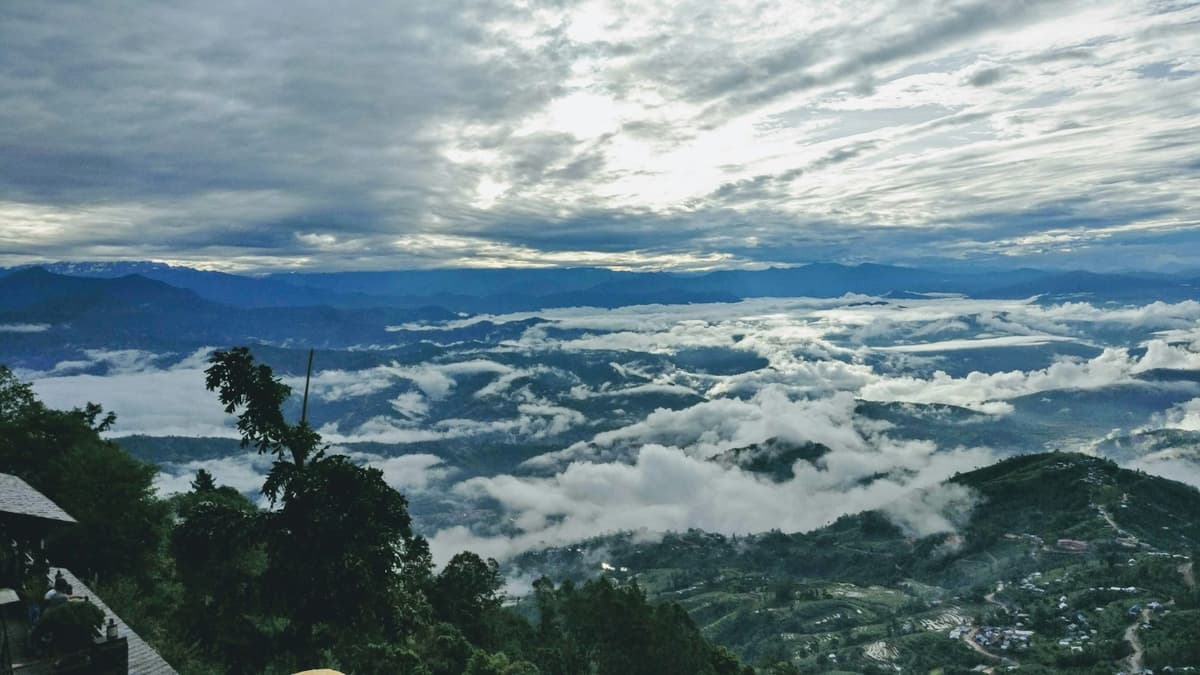
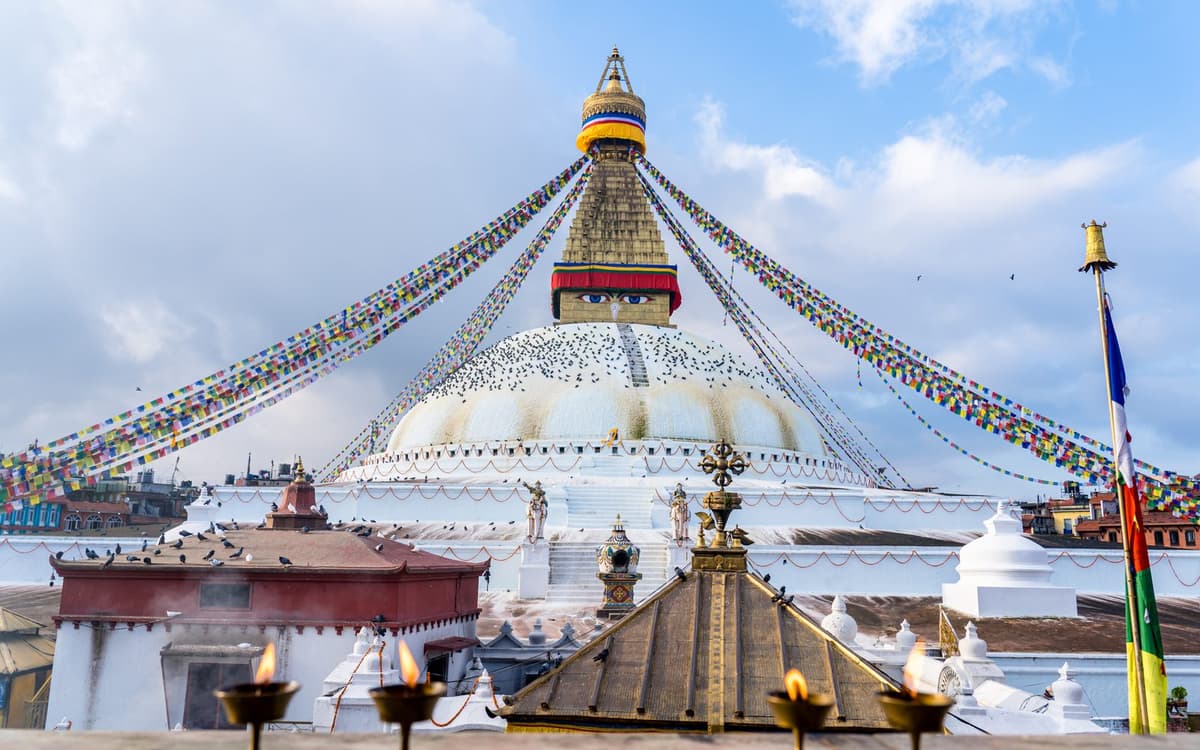
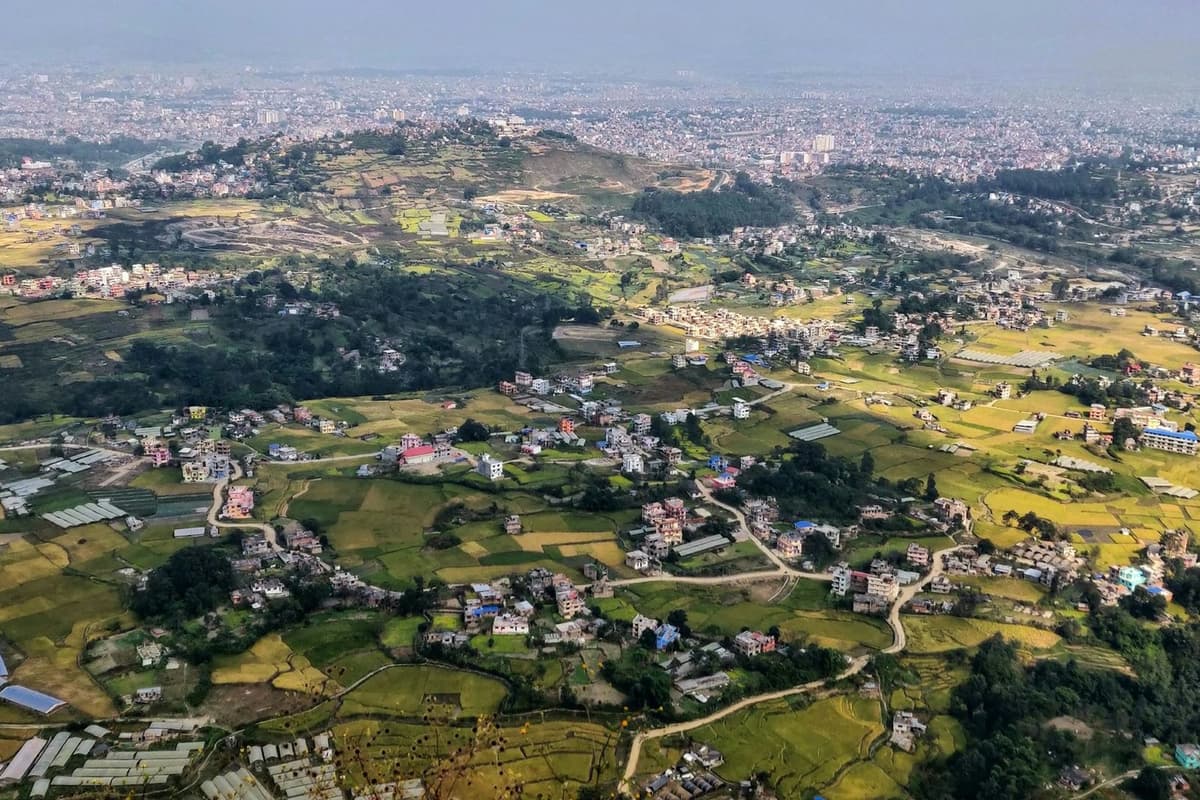
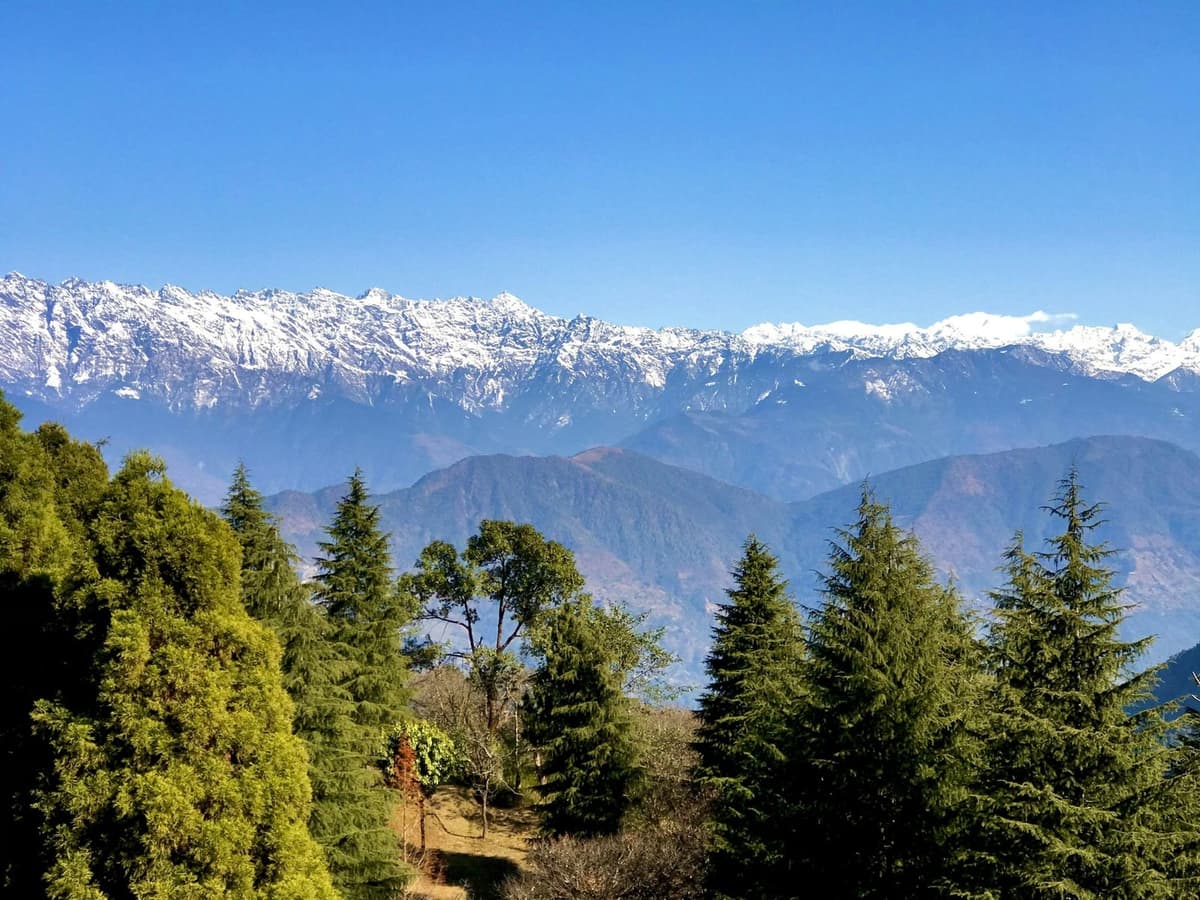
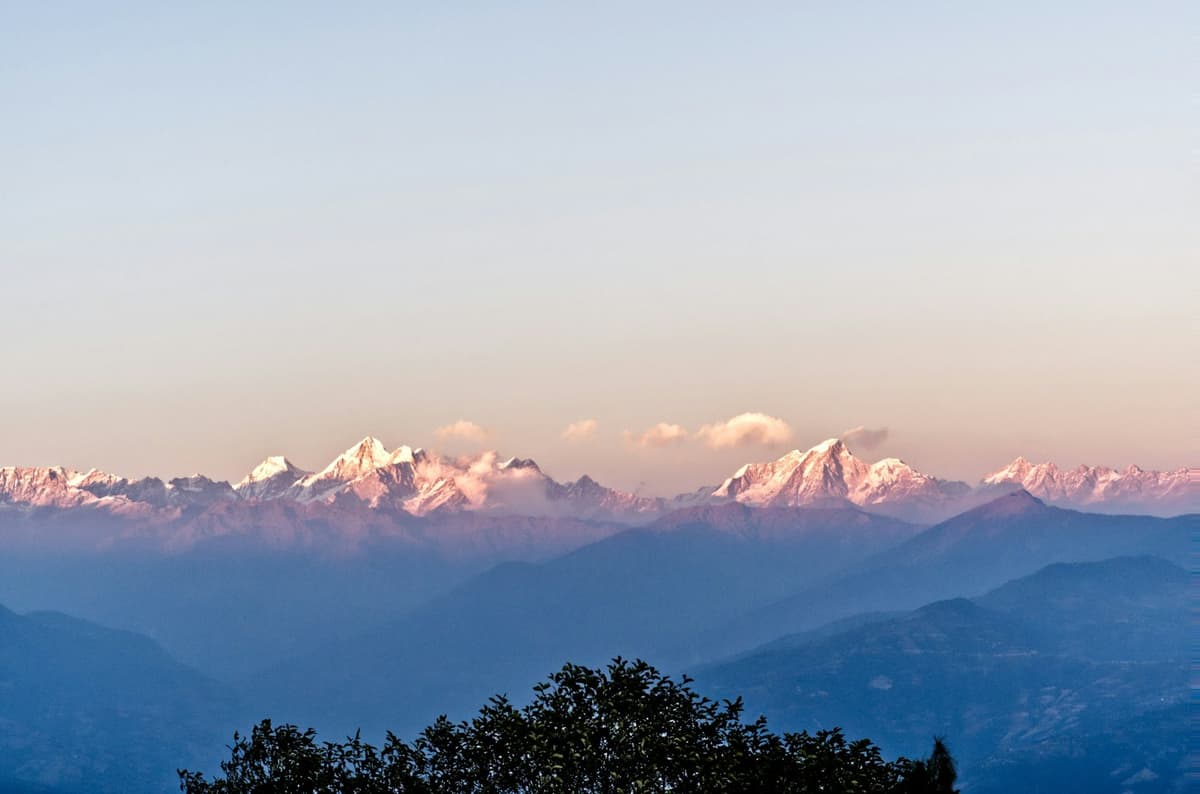
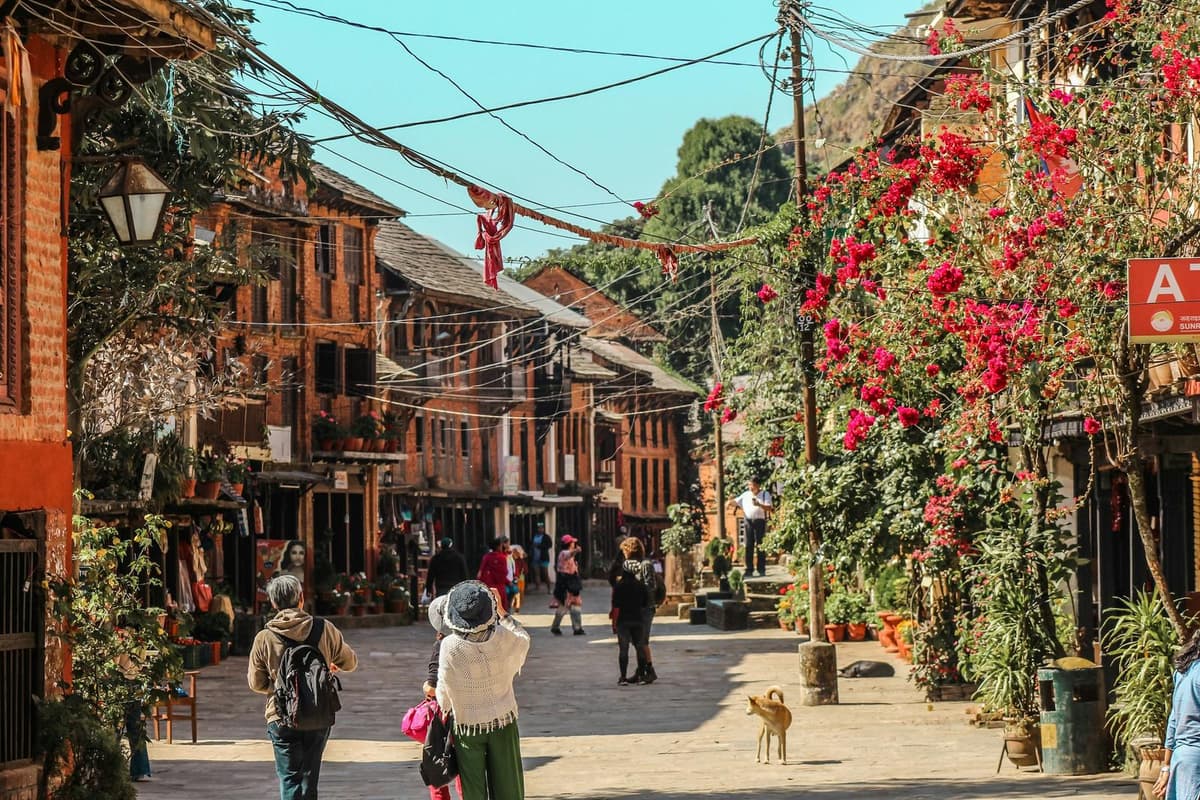
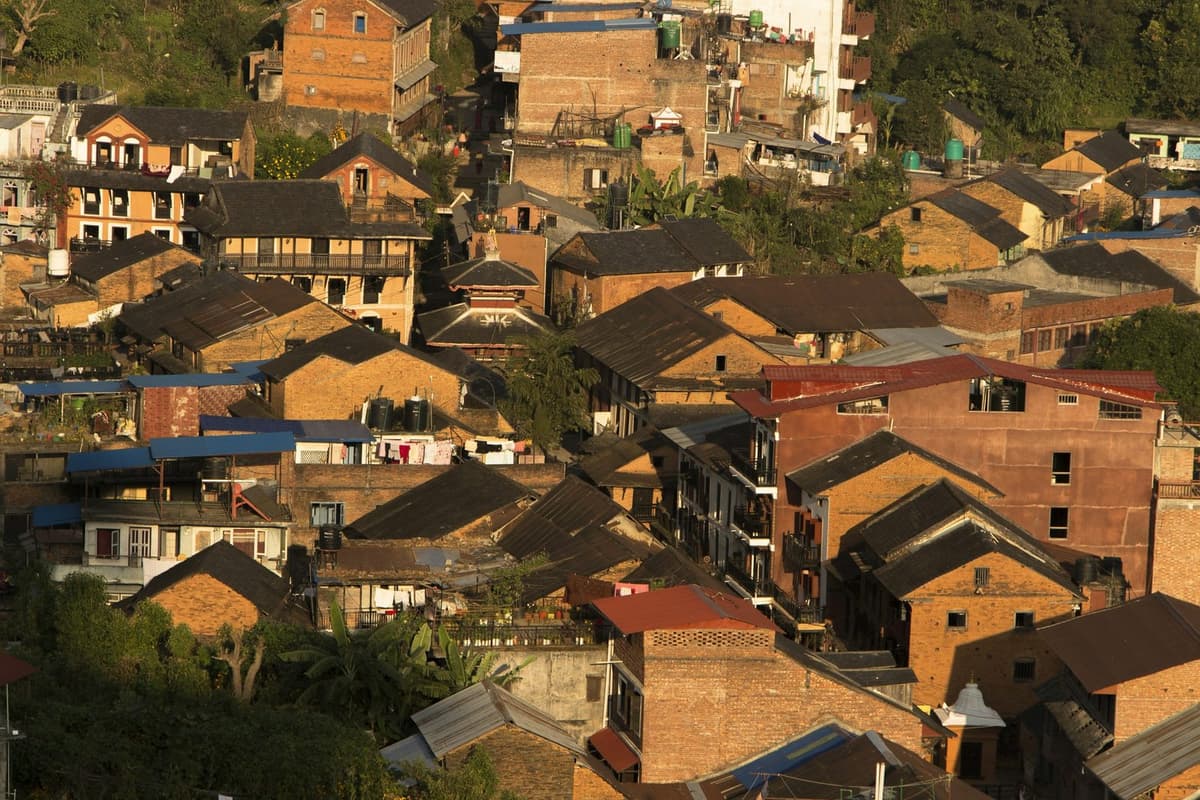
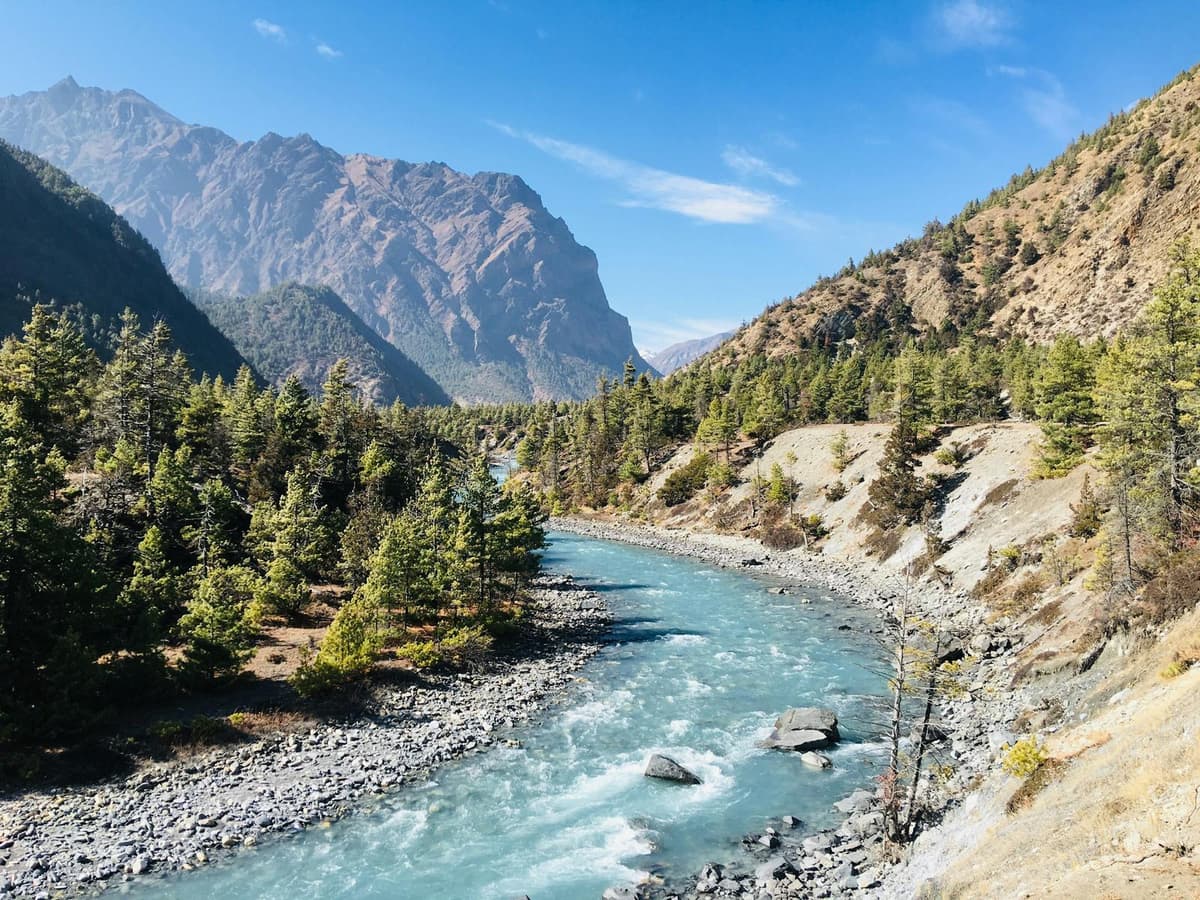
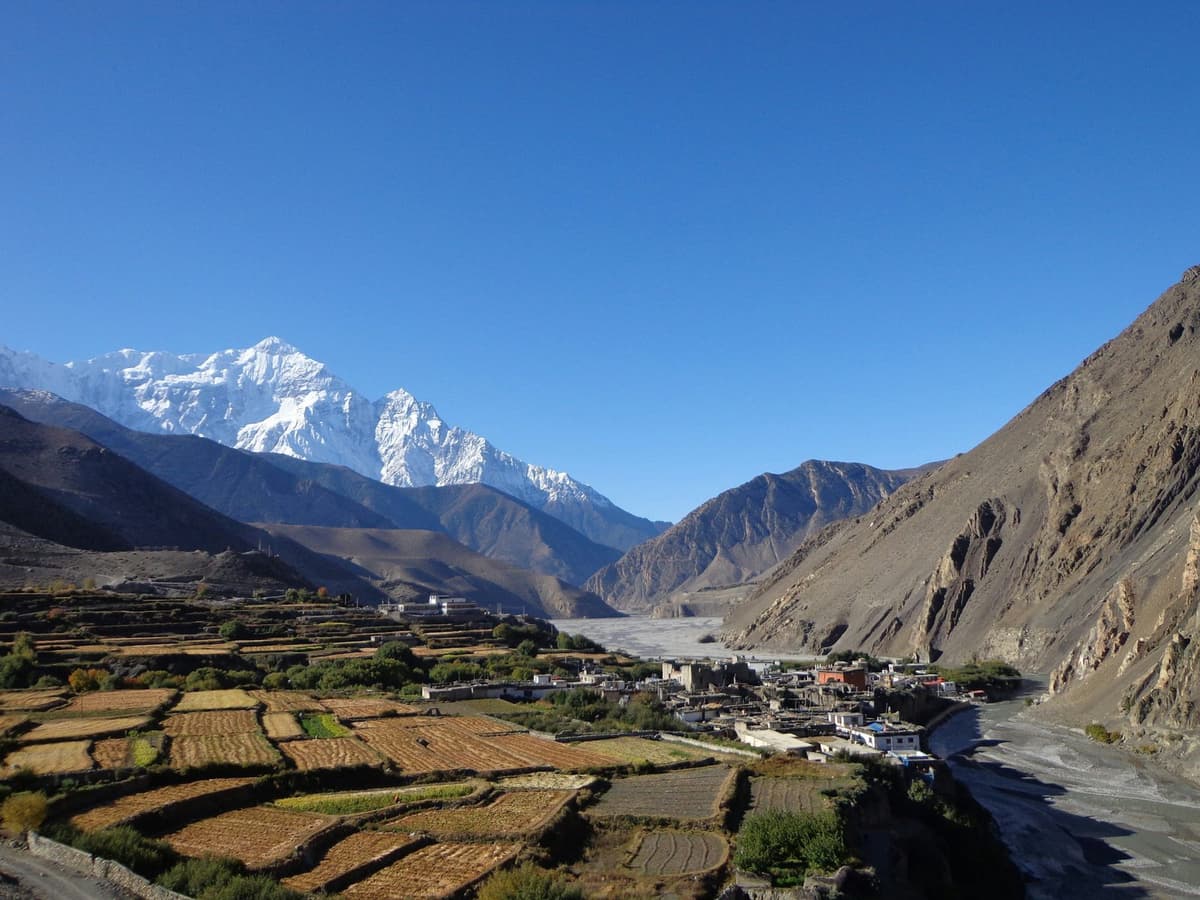
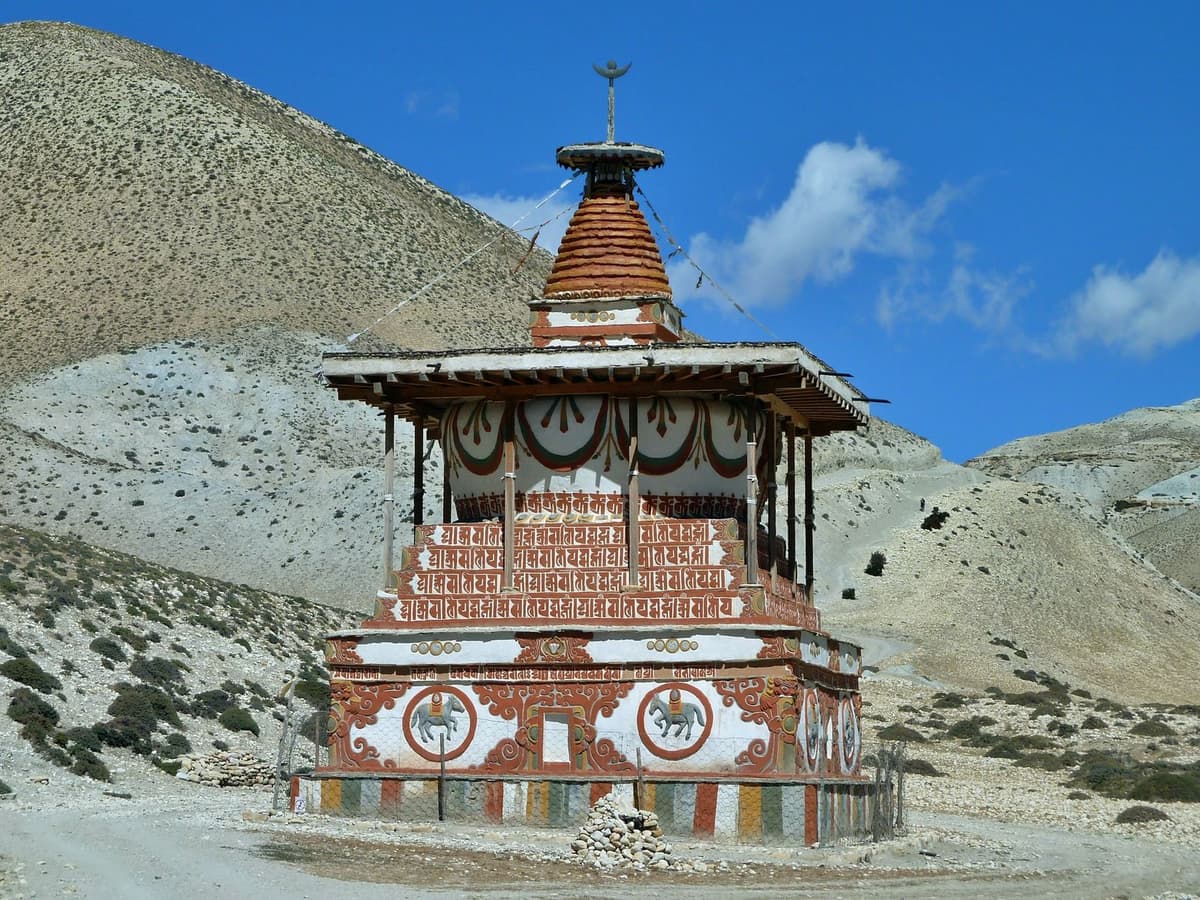
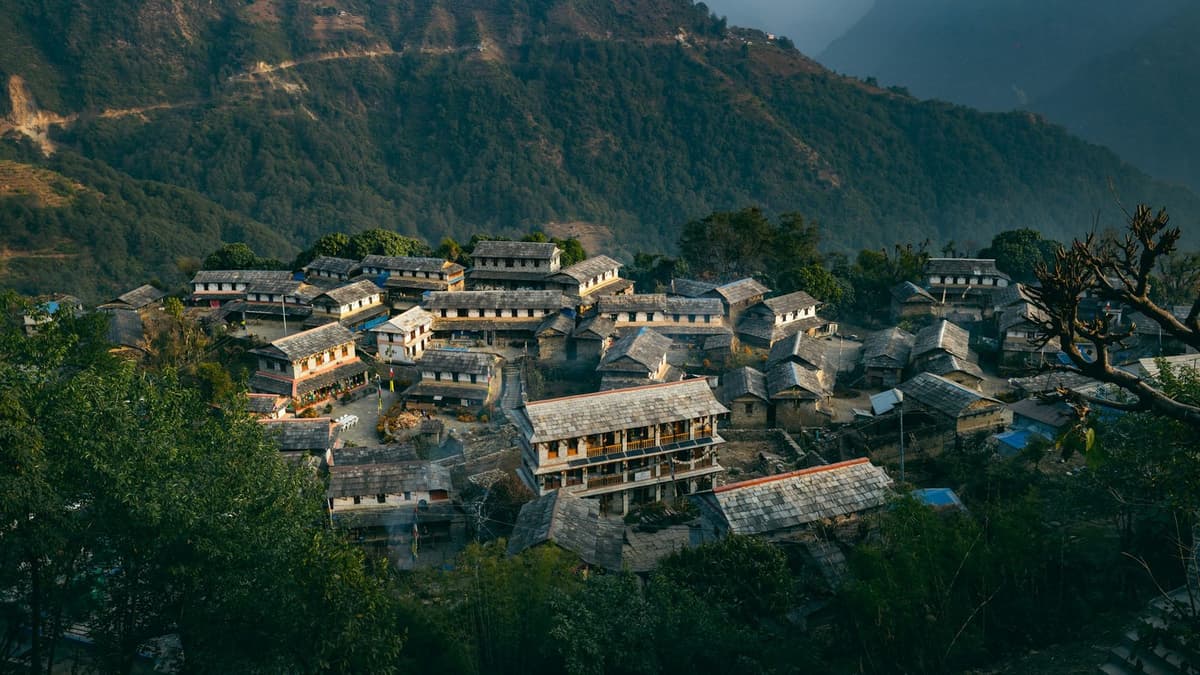
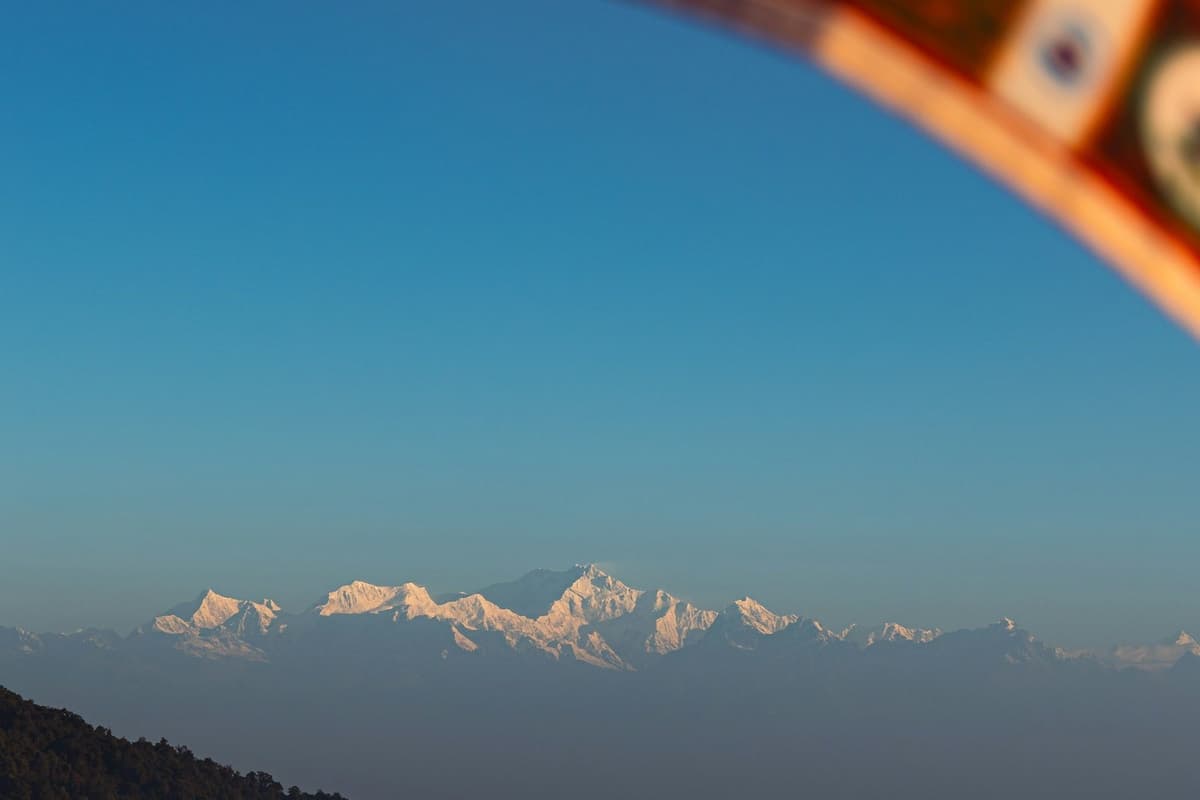
Leave Kathmandu early and the brick city soon gives way to terraced fields, temple roofs and pine ridges. Bhaktapur, famous for its pottery and woodcarving, keeps its old palace squares. On a clear autumn morning from Kakani, the snow of the Ganesh Himal and Langtang stands above the green hills to the north.

The best place to go near Kathmandu for a single day is Bhaktapur, 12 km east, paired with Changu Narayan on the ridge above it. For mountain views, go to Nagarkot, Dhulikhel or Kakani. For quiet Newar villages, go south to Kirtipur, Bungamati or Khokana. Manakamana is a long day; Kalinchowk is not a day trip.

If you would rather sleep in the hills, our guide to hill stations in Nepal covers the overnight options. This article sticks to what fits between breakfast and dinner.

In this guide

  • Day trips at a glance and key facts
  • Which place to go near Kathmandu suits you?
  • Heritage towns to the east
  • Hill viewpoints
  • South of the city
  • Valley-rim hikes
  • Longer days: Manakamana and the Bhote Koshi
  • Is Kalinchowk a day trip?
  • Planning your day: timing, Dashain, roads and transport
  • Visiting Dakshinkali respectfully
  • Frequently asked questions

Day trips from Kathmandu at a glance

Distances are from central Kathmandu. Drive times change with traffic and roadworks; where we have no sourced time, the table says so. Fees are for foreign visitors unless stated.

Day trip Distance from Kathmandu Drive time Best for Entry fee (foreign visitor) One day?
Bhaktapur 12 km east Varies with traffic Newar squares, temples, pottery and woodcarving NPR 2,000 or USD 15; SAARC NPR 500 Yes, easily
Changu Narayan About 12 km east Varies with traffic One of the oldest pagoda temples in the valley Published as NPR 300 or NPR 400: check at the gate Yes; pair it with Bhaktapur
Panauti About 30 to 32 km About an hour by regular bus A quiet temple town at a river confluence We found no entry fee Yes
Dhulikhel 30 km south-east About an hour Mountain views from a town on the Araniko Highway None we could confirm Yes; sunrise needs a night
Namobuddha Reached from Dhulikhel or Panauti About an hour to either town, then a three-hour walk Buddhist pilgrimage and a farmland walk None we could confirm Yes, as a long day
Nagarkot About 32 km Usually 1.5 to 2 hours Sunset over the Himalaya None we could confirm Yes for sunset; sunrise needs a night
Chandragiri About 13 km Varies with traffic Cable car to a ridge-top station at 2,551 m Cable car ticket: see our Chandragiri guide Yes
Kakani About 23 to 28 km, depending on where you start Varies with traffic Views of the Ganesh Himal and Langtang Not confirmed; carry cash Yes
Kirtipur 8 km south-west About 30 minutes An old hilltop Newar town No published visitor fee found Yes, half a day
Bungamati and Khokana On the southern edge of Lalitpur Varies with traffic Village life, temple rebuilding, mustard-oil heritage No official fee found Yes, half a day
Pharping and Dakshinkali 18 km and 22 km south Varies with traffic Pilgrimage caves and the Kali temple No ticket that we know of Yes
Shivapuri and Nagarjun On the northern rim Varies with traffic Forest hikes in the national park Park fee NPR 1,000 Yes, a full day of walking
Manakamana 104 km to the Kurintar cable car base About 2.5 to 3 hours in normal traffic Cable car to a hilltop temple Cable car USD 20 return A long day; check the road first
Bhote Koshi About 97 km to The Last Resort Three to four hours each way Bungee and rafting Activity price, set by the operator A very long day; we run it over two days
Kalinchowk Too far for a day Six to seven hours each way on our trip Snow and the temple above 3,700 m Not covered here No

Key facts

Kathmandu Valley World Heritage Site
Inscribed 1979 as seven Monument Zones, two of them, Bhaktapur and Changu Narayan, outside the city to the east (UNESCO World Heritage Centre, 12 Oct 2026)
Bhaktapur entry fee
NPR 2,000 or USD 15 non-SAARC foreign; NPR 500 SAARC; NPR 500 Chinese nationals with passport; Nepali citizens free; in force since 17 July 2025 (Bhaktapur municipality tourist page; The Tourism Times, 14 Oct 2026)
Changu Narayan entry fee
Two published figures: NPR 300 foreign / NPR 100 SAARC (NTB table) and NPR 400 / NPR 300 (municipal tourism centre, July 2025). Check at the gate (NTB; OnlineKhabar, 14 Oct 2026)
Nagarkot
About 32 km, usually 1.5 to 2 hours by road, about 2,100 to 2,200 m (NTB; our team, 12 Oct 2026)
Dhulikhel
1,550 m, 30 km south-east of Kathmandu (Dhulikhel Municipality, 12 Oct 2026)
Namobuddha
A three-hour walk from Dhulikhel or Panauti; 1,750 m (NTB; our team, 12 Oct 2026)
Shivapuri Nagarjun National Park fee
NPR 1,000 foreign, NPR 600 SAARC, NPR 100 Nepali, per person per entry (Park office; NTB, 14 Oct 2026)
Manakamana cable car
8:00 am to 5:00 pm, break 12:00 to 1:30 pm; USD 20 return for foreign adults (Manakamana Darshan Pvt Ltd, 14 Oct 2026)
Dakshinkali sacrifice days
Tuesdays and Saturdays (NTB, 12 Oct 2026)
Dashain 2026
Phulpati 17 Oct, Maha Ashtami 18 Oct, Navami 20 Oct, Vijaya Dashami (tika) 21 Oct (The Rising Nepal, quoting the national calendar committee, 14 Oct 2026)
Clearest skies
October and November (NTB climate page, 30 Sep 2026)

Which place to go near Kathmandu suits you?

The right place to go near Kathmandu depends on what you want from the day. For heritage, go east to Bhaktapur and Changu Narayan. For mountains, go up to Nagarkot, Dhulikhel or Kakani. For quiet villages, go south to Kirtipur, Bungamati and Khokana. With a car and an early start, Manakamana also fits.

By traveller:

  • First trip out of the city: Bhaktapur, close by, with Changu Narayan above it.
  • Mountain views: Nagarkot for sunset, Dhulikhel or Kakani for quieter views, ideally in October or November.
  • Families with young children: Chandragiri, where the cable car does the climbing, or Kirtipur, about 30 minutes from the city.
  • Pilgrims: Dakshinkali and Pharping on the southern rim, Namobuddha for Buddhists, and Manakamana for a longer day.
  • Walkers: the valley rim (see the hiking section below).
  • Short on time: Kirtipur, or Bungamati and Khokana, as half days.

Patan, 5 km south-east of the centre and known as "the city of artisans", is close enough to count as part of the city. Our guide to places to visit in Kathmandu covers it along with the sights inside the ring road.

Practical takeaway: pick one direction per day. East, south and north are different roads, and stitching them together spends the day in traffic.

Heritage towns to the east

East of Kathmandu, the Araniko Highway runs past Bhaktapur and Dhulikhel towards the Tibet border at Kodari. Two of the seven Monument Zones of the Kathmandu Valley World Heritage Site, inscribed in 1979, lie out this way: Bhaktapur and Changu Narayan.

"The seven include the Durbar Squares of Hanuman Dhoka (Kathmandu), Patan and Bhaktapur, the Buddhist stupas of Swayambhu and Bauddhanath and the Hindu temples of Pashupati and Changu Narayan."

UNESCO World Heritage Centre, Kathmandu Valley

Bhaktapur, Kathmandu and Patan were, in NTB's words, "once independent states ruled by the Malla kings from the 12th to the 18th centuries". That is why Bhaktapur has its own palace square and feels like a separate city.

Bhaktapur

Bhaktapur is the easiest of the day trips from Kathmandu and a good first choice. It lies 12 km east of the city on the Araniko Highway, at 1,401 m.

What to see. The main squares sit close together. Around Durbar Square are the 15th-century Palace of 55 Windows and the gilded Golden Gate; in Taumadhi Square stands Nyatapola, the five-storey temple that came through the 1933 earthquake, beside the Bhairavnath temple. NTB also lists the Batsala bell, erected by King Ranjit Malla in 1737, and, further east, Dattatreya Square. NTB notes that the town is "famous for pottery and woodcarving".

On the way. Thimi, a pottery town about 8 km east of Kathmandu, sits on the same road.

Fee. Non-SAARC foreign visitors pay NPR 2,000 or USD 15; SAARC nationals pay NPR 500; Chinese nationals pay NPR 500 with a passport; Nepali citizens enter free. The fee has applied since 17 July 2025. The current official fee page lists no child category, so ask about child rates at the gate. If you want to come back another day, ask for the ticket to be extended when you buy it, for up to seven days.

Getting there. A taxi or hired car is the simplest option. Sajha buses and other local buses run on the main valley roads, stopping only at designated stops.

Time and season. Give it a morning at least, or a full day with Changu Narayan. It suits any season, because it does not depend on a mountain view.

Practical takeaway: keep your ticket with you all day, as you may be asked to show it, and eat lunch inside the town so you can walk the quieter squares after the tour groups leave.

Changu Narayan

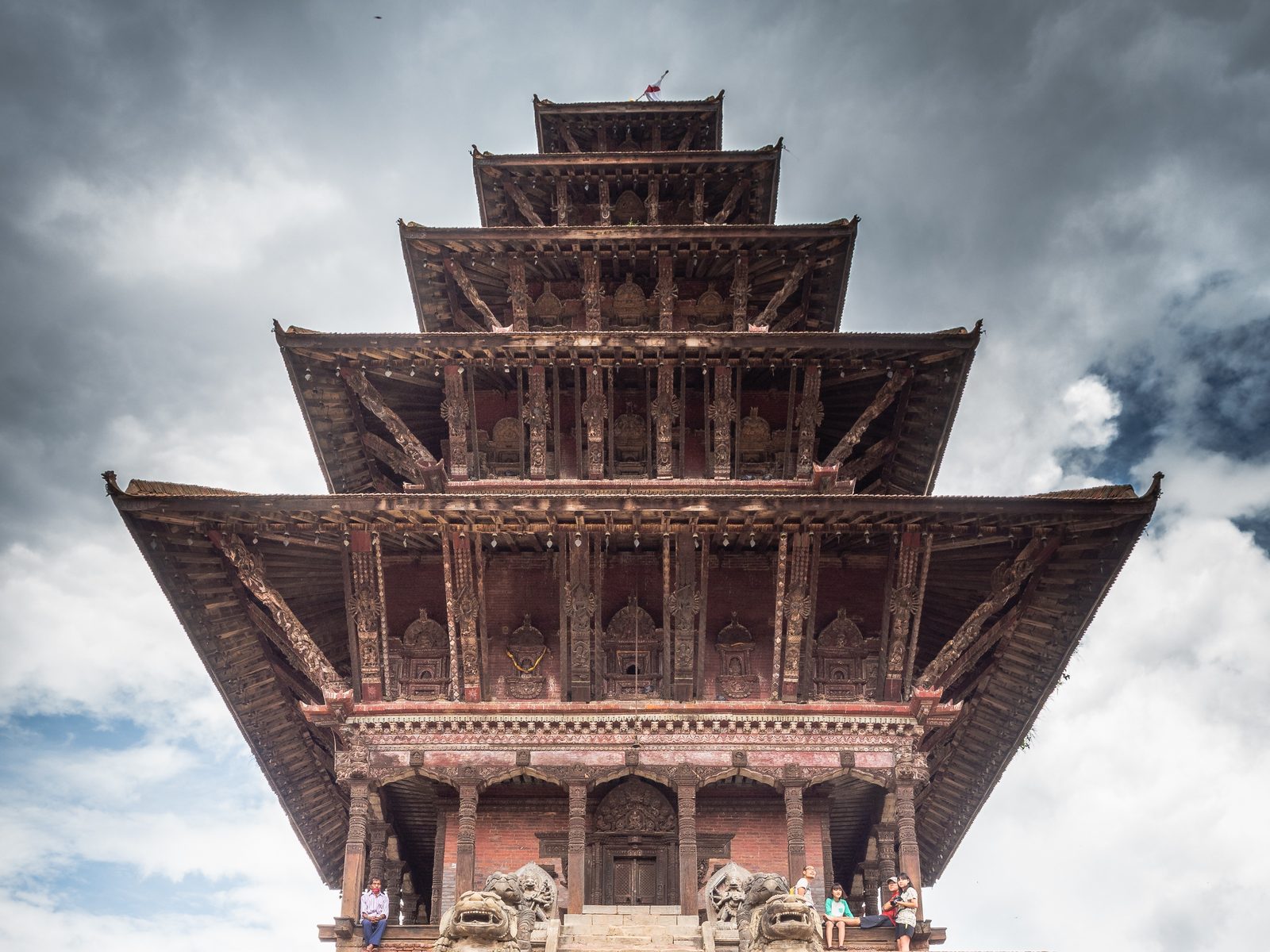
Changu Narayan stands on a ridge overlooking Bhaktapur, about 12 km east of Kathmandu. It is dedicated to Vishnu and, says NTB, is "one of the oldest specimens of pagoda architecture in the valley", dating from the Licchavi period. UNESCO notes that the temple complex holds one of the earliest inscriptions in the valley, from the fifth century AD.
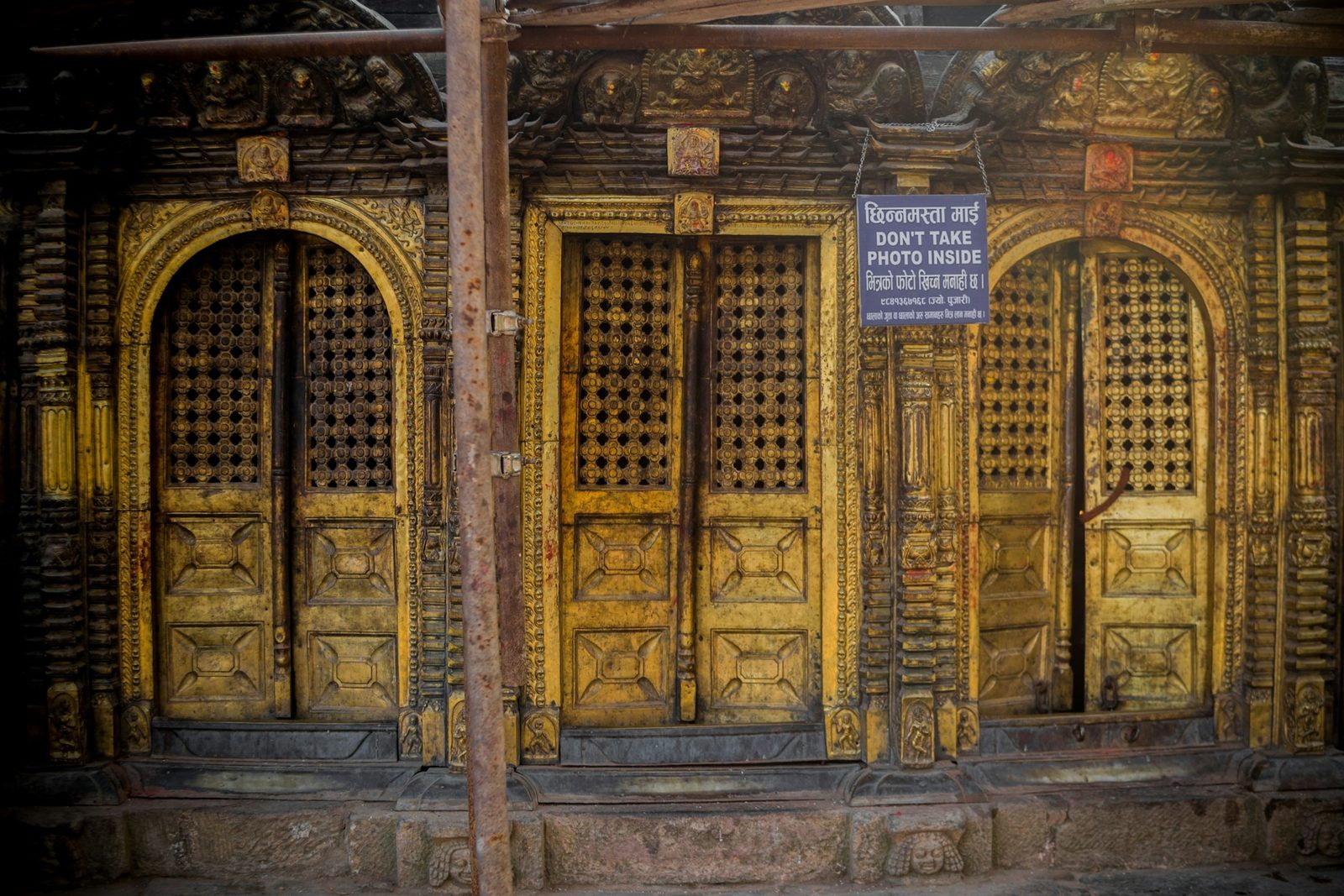
Carved doors of the Changu Narayan temple on its ridge above Bhaktapur
Changu Narayan, one of the oldest pagoda temples in the Kathmandu Valley.

Fee. Two figures are published. NTB's heritage-fee table gives NPR 300 for foreign visitors and NPR 100 for SAARC nationals. The municipal tourism centre, reported in July 2025, gave NPR 400 for other countries and NPR 300 for SAARC. Carry enough cash for the higher figure and check at the gate.

Getting there and pairing. Changu Narayan pairs naturally with Bhaktapur: the road climbs from Bhaktapur to the ridge. Strong walkers can continue on foot to Nagarkot in about four to five hours.

Practical takeaway: go to Changu Narayan in the morning while the ridge is cool, then drop to Bhaktapur for lunch and the afternoon.

Panauti

Panauti is the quietest of the eastern towns, in Kavre district, about 30 to 32 km from Kathmandu. Regular buses take about an hour. It has been on UNESCO's Tentative List since 23 May 1996, which describes the town as sitting "at the junction of the sacred confluence of the Roshi Khola and Punyamati Khola". Local belief adds a third, invisible river.

What to see. The centre of the town is the Indreshwar Mahadev temple, which UNESCO dates to 1294. Inside the Indreshwar complex is a small museum, the district's only one; we found no fee or opening hours for it. Since 2024, the Panauti Tourism Development Centre has offered a free "Sampada-Passport", a heritage permit with trail maps and QR codes. Ask there whether it still runs.

Festival. Panauti's Makar Mela is held once every 12 years, in the month of Magh (January to February). The last one ran from 15 January to 12 February 2022.

Fee. We found no entry fee for Panauti in any official or press source.

Practical takeaway: pair Panauti with the walk to Namobuddha (see below).

Dhulikhel and Namobuddha

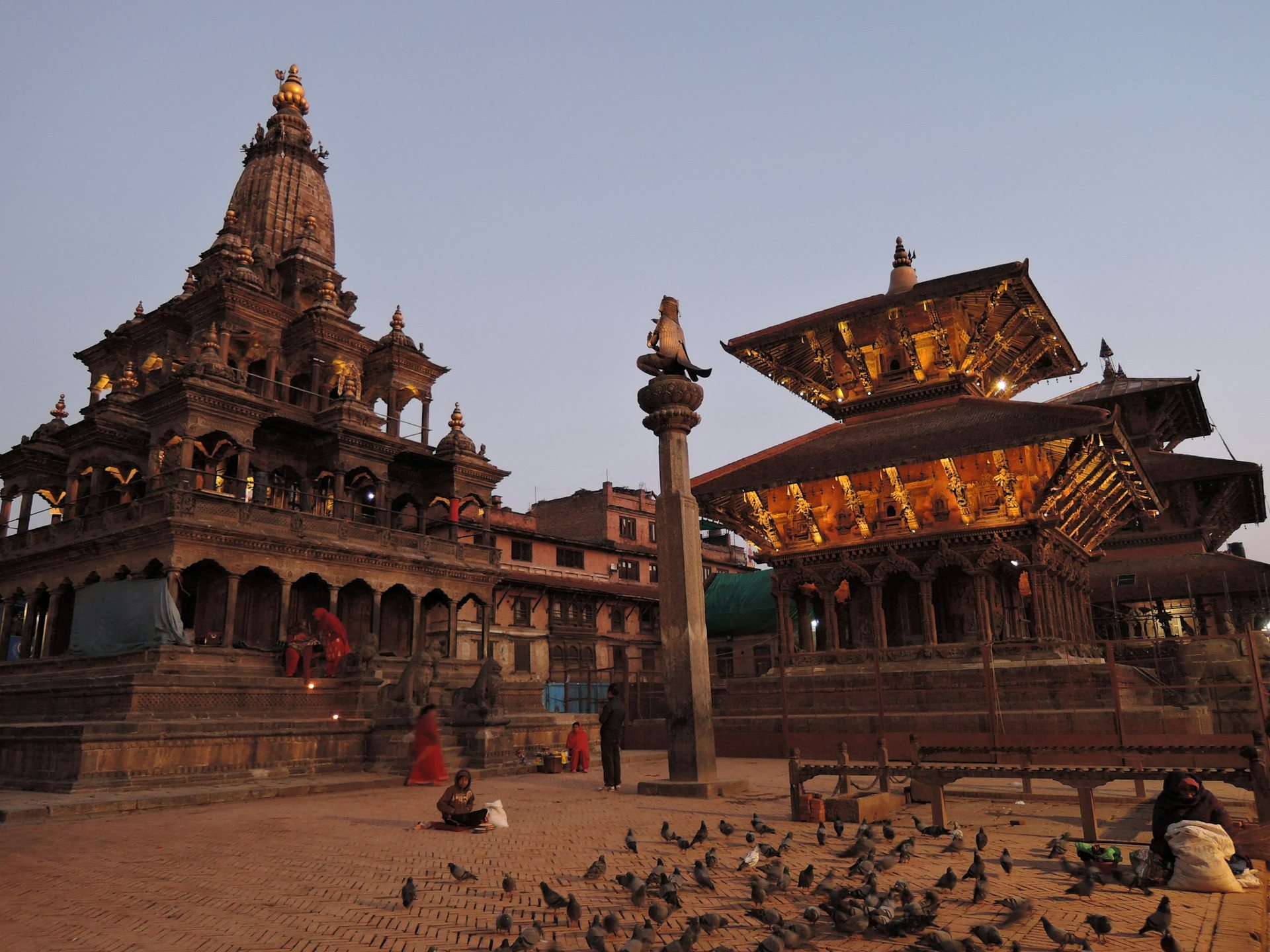
Dhulikhel is a hill town at 1,550 m, 30 km south-east of Kathmandu, "approximately an hour's drive east of Kathmandu" according to NTB. It sits on the Araniko Highway, the road that continues to the Tibet border at Kodari. NTB recommends it for panoramic views "which includes the Langtang range", and suggests staying a night to see both sunrise and sunset.
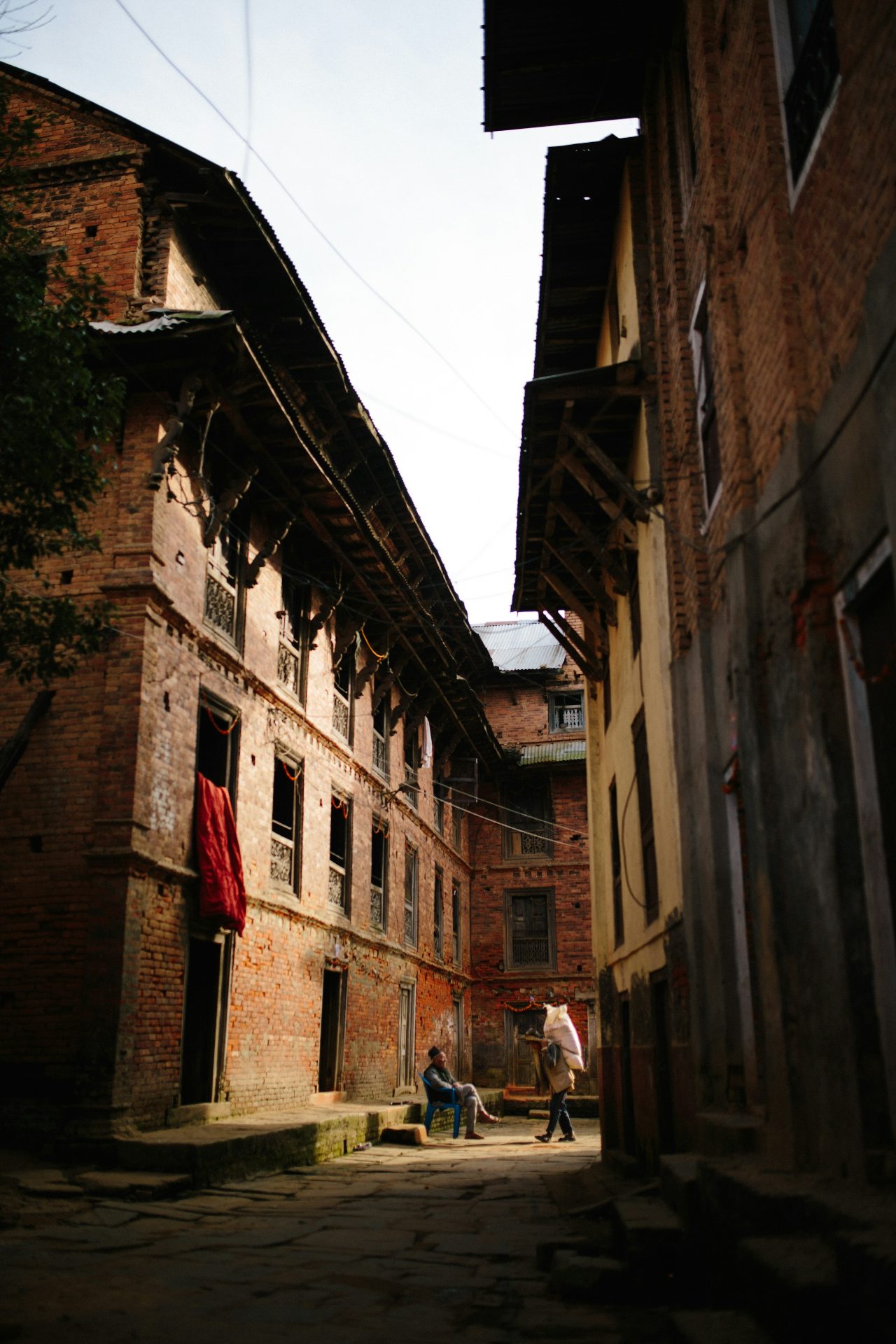
An old Newar street in Dhulikhel, east of Kathmandu
Old Dhulikhel, on the Araniko Highway east of Kathmandu.

As a day trip, Dhulikhel suits a slow lunch with a view. If the mountains matter most, stay over for the morning light.

Namobuddha is a Buddhist pilgrimage site "near Panauti in Kavre district", at 1,750 m. NTB tells the legend: one of the earlier Buddhas offered his own flesh to a starving tigress and her cubs, and a small stupa marks the place. Above it stands Thrangu Tashi Yangtse, a Kagyu monastery founded by Khenchen Thrangu Rinpoche and consecrated in 2008.

Getting there. NTB describes Namobuddha as "a three-hour trek from Dhulikhel or Panauti", and both towns are "about an hour's drive by regular bus services from Kathmandu".

Fee. We could confirm no fee for Dhulikhel or Namobuddha.

Practical takeaway: walk one way only. Drive to Dhulikhel, walk to Namobuddha, and have your car meet you there, or reverse it from Panauti.

Hill viewpoints

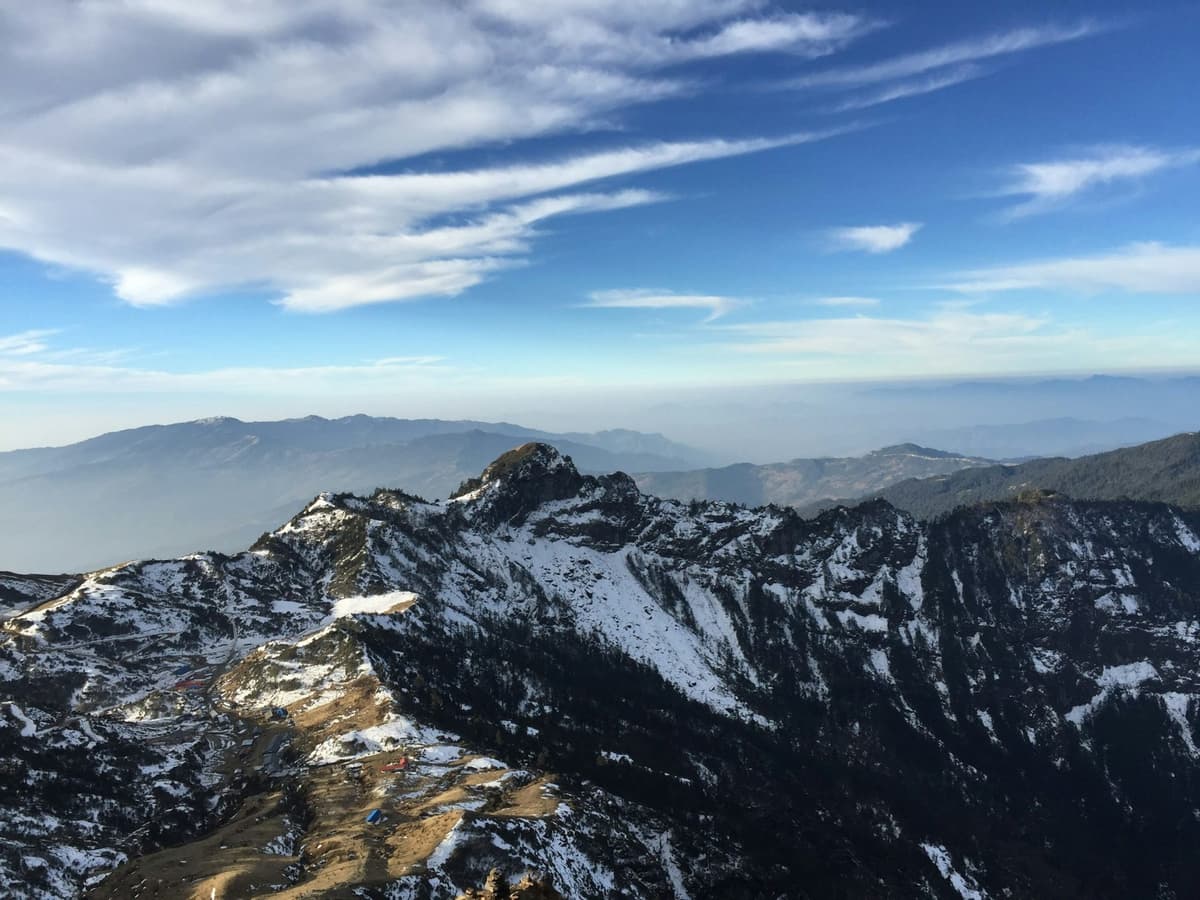
Three hills give you the Himalaya without a trek: Nagarkot, Chandragiri and Kakani. All three are colder than the city. In October, Kakani averages a high of 20.8 °C and a low of 11.7 °C, against 27.2 °C and 13.9 °C on the valley floor, so bring a layer.

Nagarkot

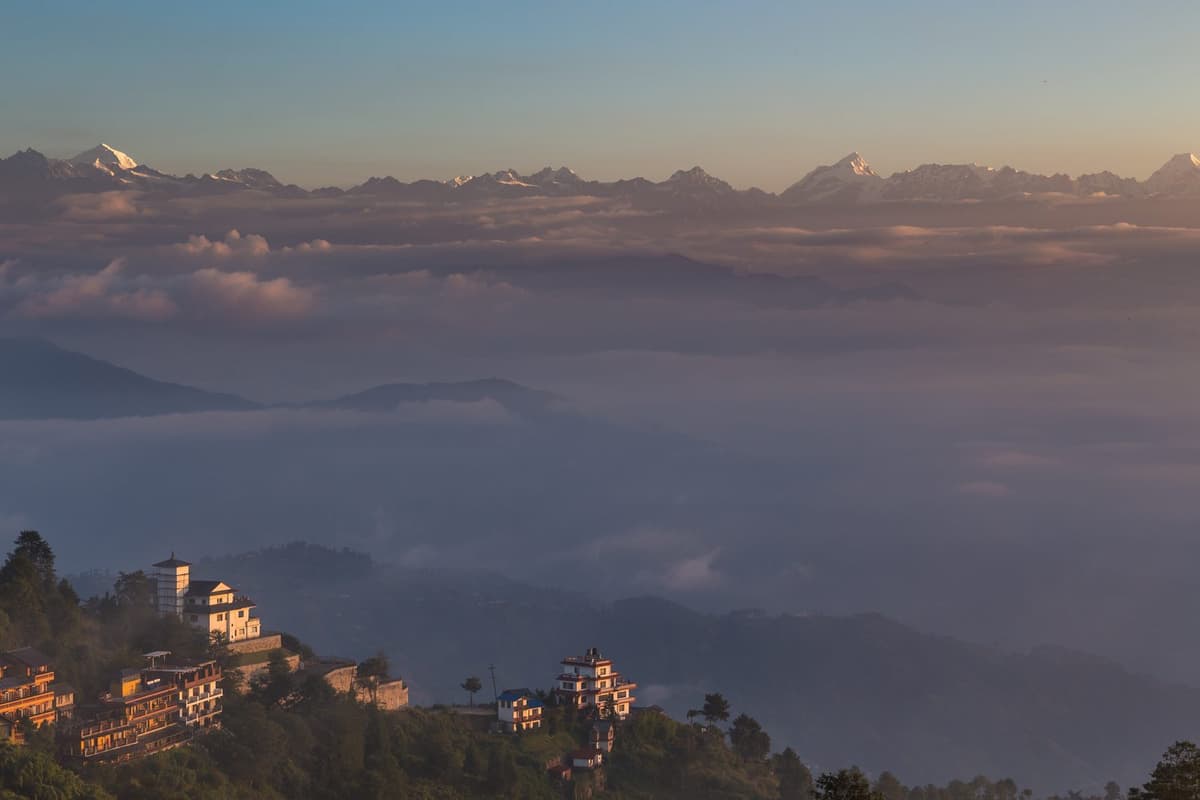
Nagarkot is the classic sunset hill, about 32 km from Kathmandu and usually 1.5 to 2 hours by road, at about 2,100 to 2,200 m. As a day trip, it works for the afternoon and sunset: in mid-October the sun sets around 5:36 pm in Kathmandu, so you are driving back down in the dark.
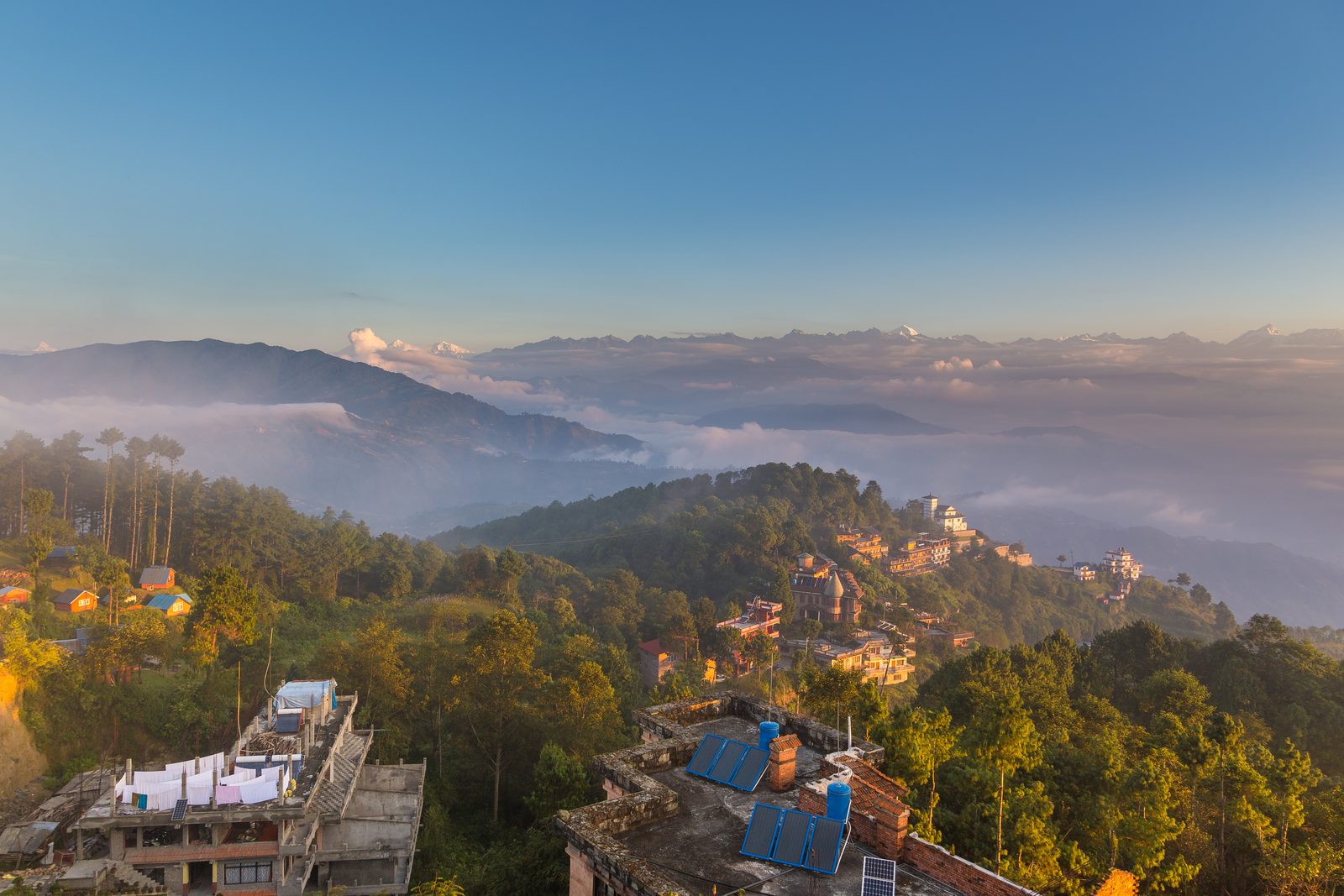
The Himalaya seen beyond the hillsides at Nagarkot
Nagarkot works best as an afternoon and sunset trip.

Sunrise is a different matter. Local buses run from Kamal Binayak in Bhaktapur in daytime only, and there is no tourist bus, so a sunrise visit needs a night in Nagarkot or a car leaving Kathmandu before dawn. Expect roadworks on the Bhaktapur to Nagarkot road, which has been under upgrade since 2025.

Our Nagarkot guide covers where to stay, the viewpoints and the clearest months.

Practical takeaway: combine Nagarkot with Bhaktapur or Changu Narayan on the way up, and arrive with daylight to spare.

Chandragiri

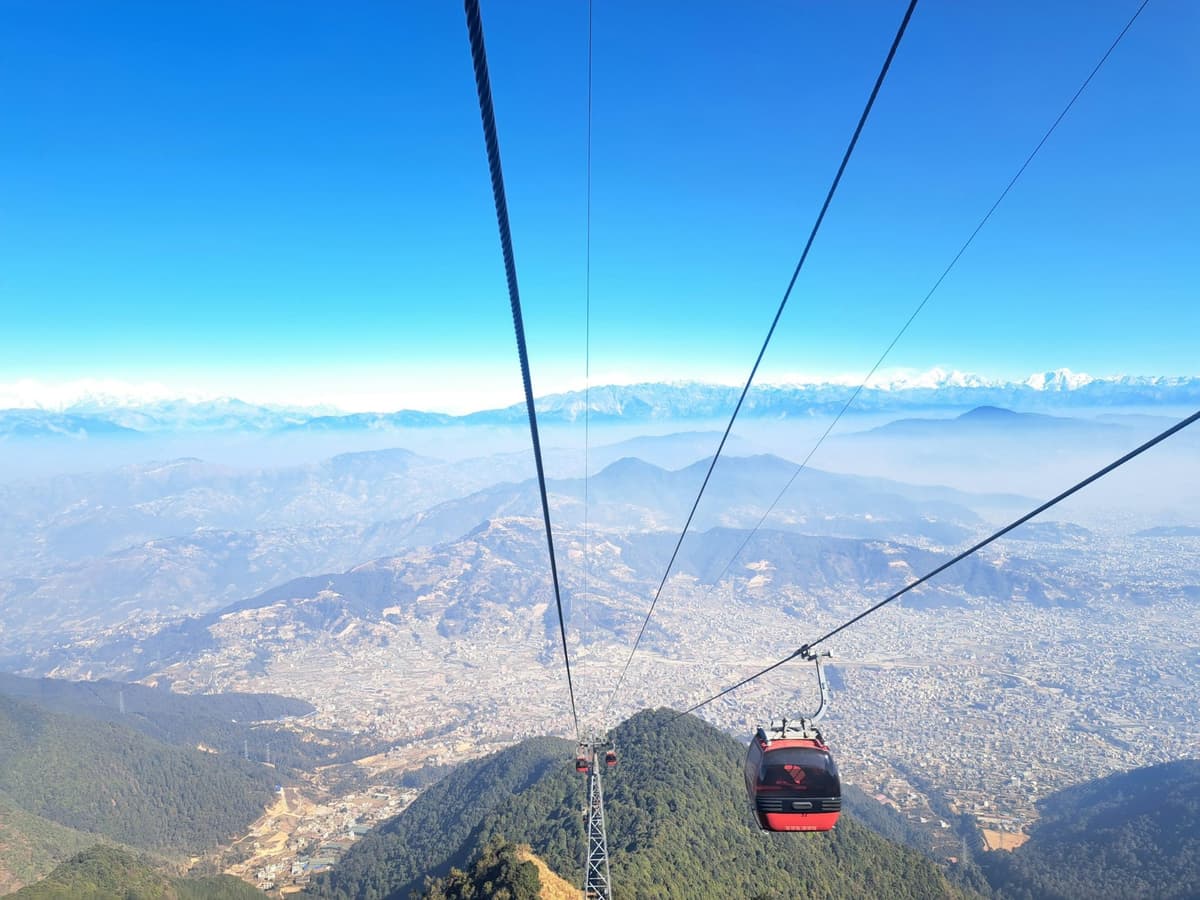
Chandragiri is the easiest mountain view from the city. The cable car base at Thankot is about 13 km from Kathmandu. The ride climbs 2.5 km in about 10 minutes, from 1,550 m to the top station at 2,551 m.

Fares and opening hours change, so check them before you go; our Chandragiri cable car guide has the details. If you want to walk on the ridge, go with a licensed guide or someone who knows the trail.

Chitlang beyond the pass. Chitlang, at about 1,740 m, lies beyond the Chandragiri ridge. NTB describes two ways in: pick-up vehicles leave Godam above Thankot in the morning and cross the pass in "about an hour", or you can ride the Chandragiri cable car and take "an easy hike down". Kulekhani, with buses back to Kathmandu, is about two hours' walk beyond Chitlang. It can be done as a long day, but it is much better with a night.

Practical takeaway: go up early on a clear day; the ticket costs the same whether or not the mountains show.

Kakani

Kakani is the quiet viewpoint north-west of the city, about 23 to 28 km away depending on where you start, on a ridge just over 2,000 m high. From the top you look north to the Ganesh Himal and Langtang. You can reach Kakani Bazaar by car, taxi or bus.
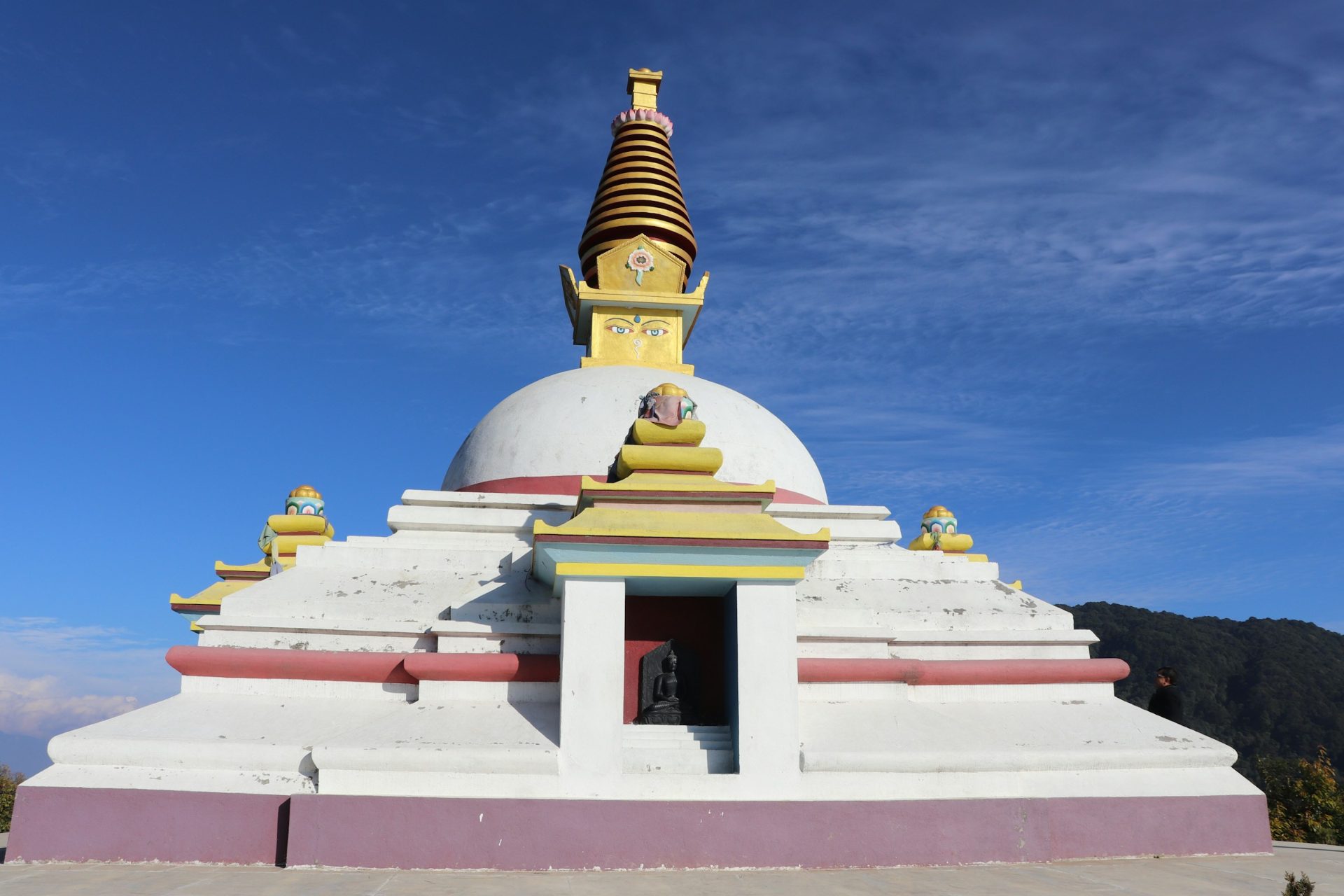
A white stupa at Kakani on the ridge north-west of Kathmandu
Kakani, the quiet viewpoint north-west of the city.

Kakani also holds a memorial park to the victims of a 1992 air crash. On 31 July 1992, Thai Airways International Flight 311 crashed at Ghyangphedi in Langtang National Park, killing all 113 people on board. It is a quiet place; please treat it as one.

Best time. The Kakani weather station records an average of 737.5 mm of rain in July and 9.0 mm in November. Go in autumn or early winter.

Fee. We could not confirm whether a park or local fee is charged at the Kakani viewpoint, so carry some cash.

Practical takeaway: choose Kakani over Nagarkot for a quieter view, and go in the morning.

South of the city

The southern day trips are short drives from the city. Kirtipur, Chobhar Gorge and Taudaha Lake lie on the way to Pharping and Dakshinkali on the southern rim, so they combine well. Bungamati and Khokana lie on a separate road south of Patan.

Kirtipur

Kirtipur is an old Newar town "about 30 minutes from Kathmandu on a ridge 8 kilometers southwest of the city", in NTB's words. Prithvi Narayan Shah annexed it in 1767, after the Battle of Kirtipur.

What to see. The best-known sights are Chilamchu Stupa and the Bagh Bhairab temple, which NTB calls "the most well-known temple with Gurkha weapons on display". NTB also lists Aadinath Temple, Lohan Dega, Manjushree Park, Chobhar Gorge and Taudaha Lake, a birdwatching spot. "Nepal's oldest university, Tribhuvan University, is in the foothills of Kirtipur," NTB notes.

Festivals. Indrayani Jatra falls in November to December and Bagh Bhairab Jatra in August.

Fee. We have not found a published visitor fee.

Practical takeaway: Kirtipur is a half day on its own. Add Chobhar and Taudaha on the way south, and keep going to Pharping if you want a full day.

Bungamati and Khokana

Bungamati, in ward 22 of Lalitpur Metropolitan City, is the home of Rato Machhindranath, also called Bunga Dyo. It was among the villages hit hardest by the 2015 earthquakes, and its temple was damaged. Reconstruction by a users' committee began on 6 July 2020, monitored by the Department of Archaeology. In June 2025 the deity was reinstalled in the rebuilt temple, ten years after the earthquake, and Diplomat Nepal reported that the work had "reached the final stage".

Khokana lies on the southern edge of Lalitpur, next to Bungamati. It has been on UNESCO's Tentative List since 23 May 1996 as "Khokana, the vernacular village and its mustard-oil seed industrial heritage". In UNESCO's words: "The mustard-oil seed industry has become the living heritage of the village." The village temple is dedicated to the goddess Rudrayani.

Getting there. Local buses run from Jawalakhel in Patan; a taxi is quicker. The two villages sit side by side, so you can walk between them.

Fee. We found no official entry fee for either village. Small local charges may apply, so check on the day.

Practical takeaway: walk slowly, ask before photographing people at work, and buy something small in the village.

Pharping and Dakshinkali

Pharping lies 18 km south of Kathmandu on the valley rim. It has a 17th-century temple with a gilded image of Bajra Jogini, and a cave where a hand-print of Padmasambhava is shown on the rock over the entrance.

Dakshinkali, 22 km from Kathmandu on the southern rim, is "one of the most famous Shakti Peeths in Kathmandu dedicated to Goddess Kali". It is a working temple, and NTB says crowds come "especially on Tuesdays and Saturdays when ritual animal sacrifices are performed". Read the respectful-visiting note further down before you go.

Getting there. NTB lists "tourist buses, taxis, and public transport". We have no current fare to give you.

Fee. There is no ticket at Dakshinkali that we know of.

Nearby walk. Champadevi, a summit on the southern rim, starts near Pharping; our hiking guide covers it.

Practical takeaway: do Pharping first, while it is quiet, then Dakshinkali.

Valley-rim hikes

For a forest trail and a summit, NTB counts "over 50 hiking trails" in the Kathmandu Valley alone. Shivapuri Peak, at 2,732 m, and the forest of Nagarjun both lie in Shivapuri Nagarjun National Park. The park charges NPR 1,000 for foreign visitors, NPR 600 for SAARC nationals and NPR 100 for Nepali citizens. The park office's fee schedule says foreign and SAARC visitors must be accompanied by a park-certified guide, and visitors "must leave the National Park" before sunset. Routes, walking times and the park rules are in our Kathmandu hiking guide.

Longer days: Manakamana and the Bhote Koshi

These two fit a day only with a car, an early start and an open road. Read the road-conditions box below first.

Manakamana

Manakamana is a hilltop temple reached by cable car from Kurintar on the Prithvi Highway, the road towards Pokhara and Chitwan. Kurintar is 104 km from Kathmandu, about two and a half to three hours in normal traffic. The cable car covers "3 KM in just 10 minutes" in cabins that carry six, from the base at 258 m to a top station at about 1,300 m near the temple. From the temple area you can see the Manaslu and Annapurna peaks on clear days.

Hours. The cable car runs from 8:00 am to 5:00 pm, with a break from 12:00 to 1:30 pm. Arrive before the midday break or plan around it.

Fares. These are the operator's official adult fares, checked 14 October 2026:

Visitor One way Return
Nepali NPR 450 NPR 770
Indian nationals INR 400 INR 670
SAARC and Chinese nationals USD 6 USD 10
Other foreign visitors USD 11 USD 20
Child, foreign (above 3 ft up to 4 ft tall) USD 8 USD 15

Tickets are valid for seven days and are non-refundable, and 15 kg of baggage travels free. The operator adds: "Rate are subject to change without prior notice."

Busy days. NTB warns: "Especially Saturdays and Tuesdays see maximum rush when it takes hours just to get a glimpse of the goddess." Go on another day if you can.

The road. Gajuri, where part of the Prithvi Highway collapsed on 9 October 2026, lies between Kathmandu and Kurintar; see the road box below.

Practical takeaway: Manakamana is a fair day trip only by private car on a clear road. By bus from the New Bus Park at Gongabu, the timing is tight; consider a night on the way to Pokhara or Chitwan instead.

Bhote Koshi bungee and rafting

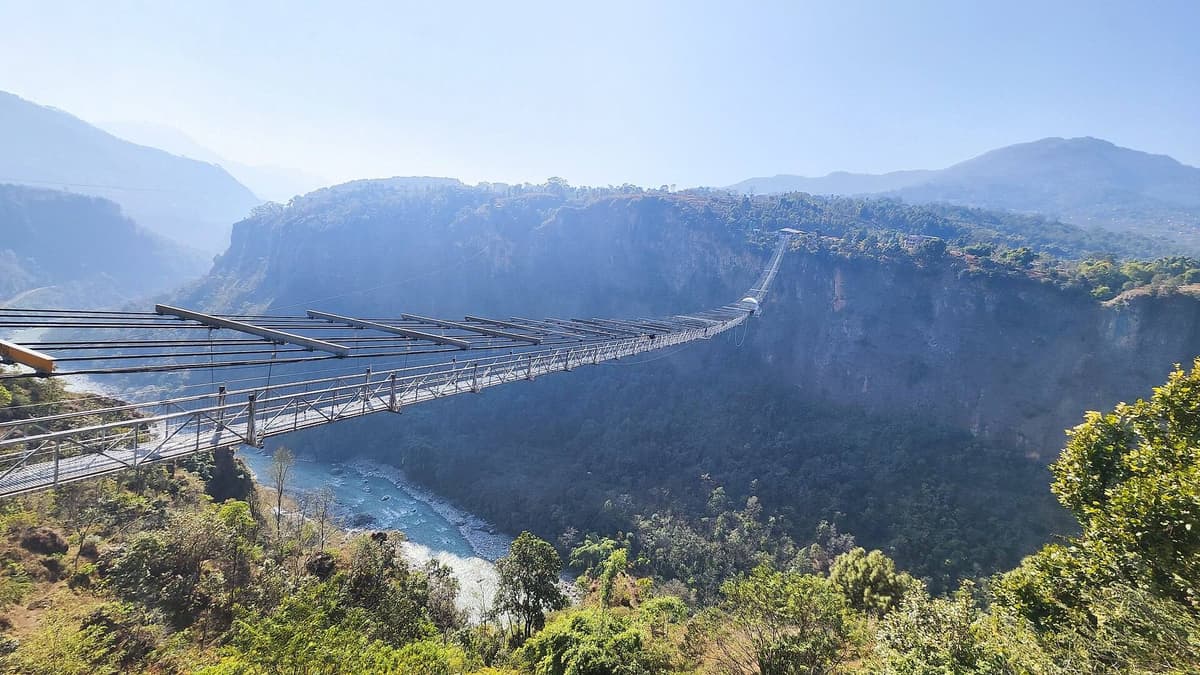
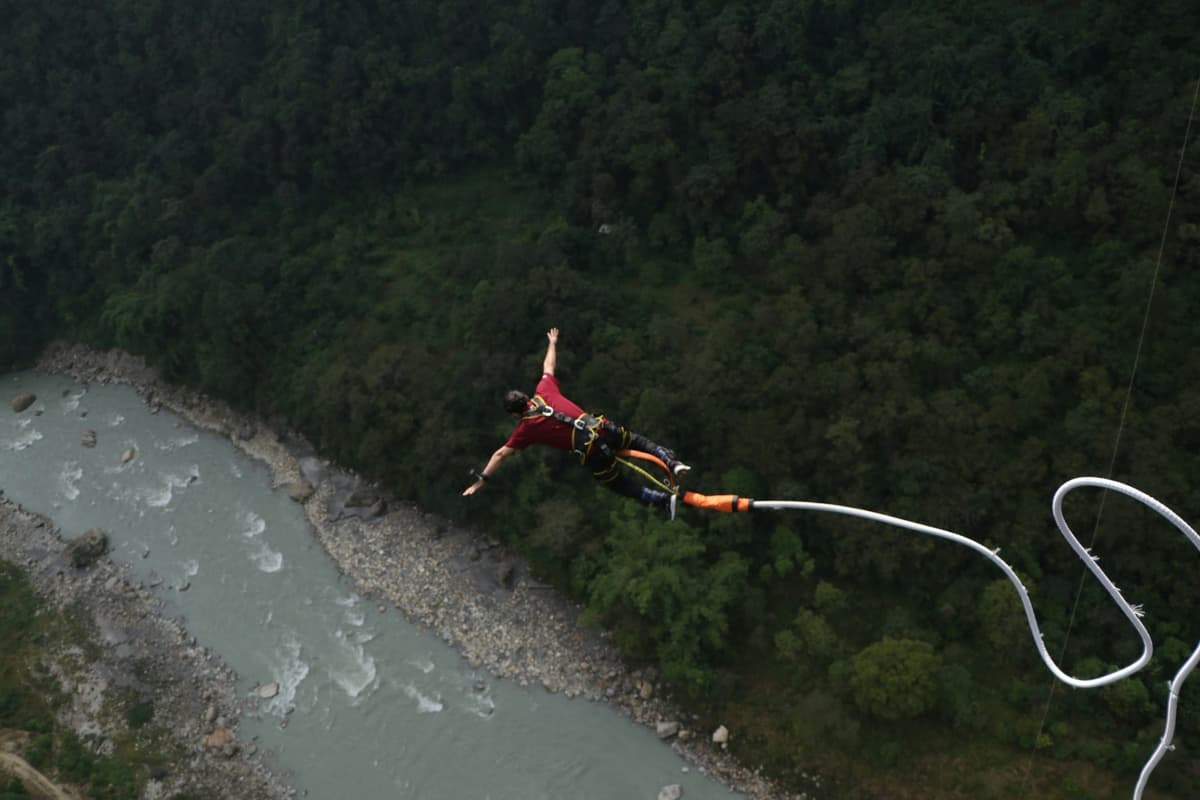
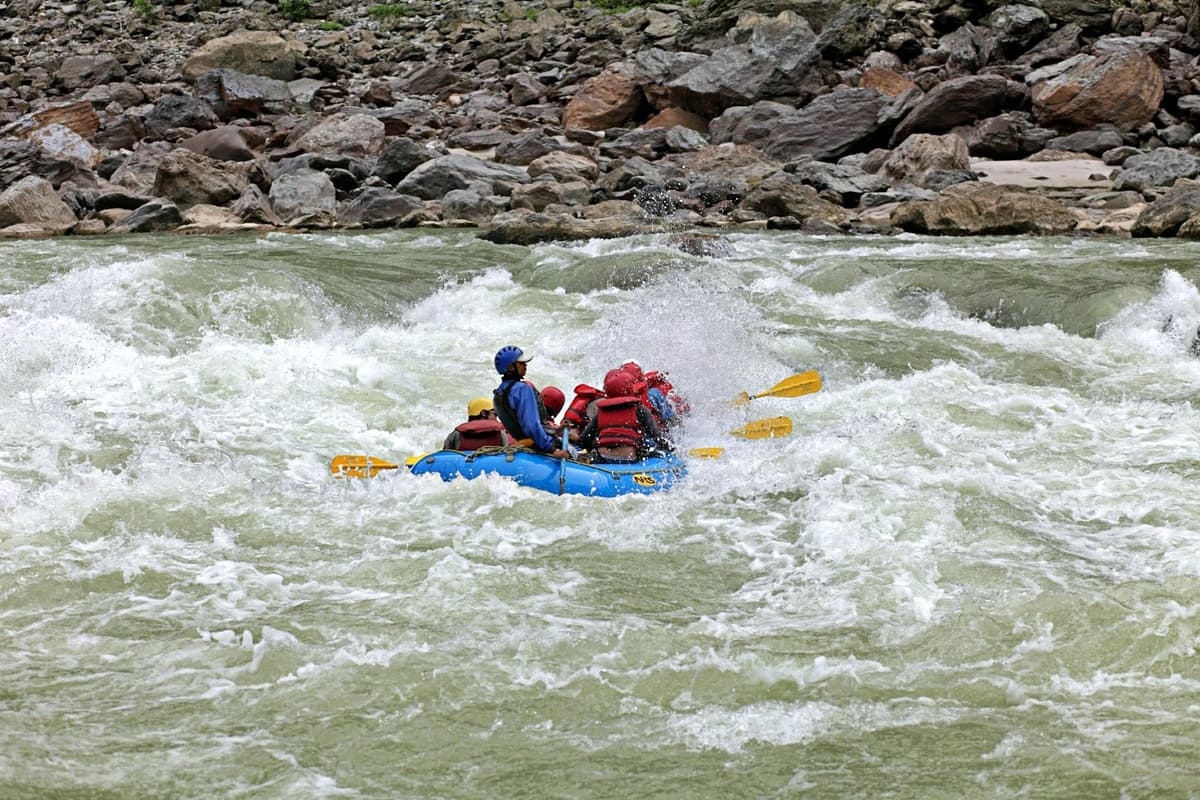
The bungee over the Bhote Koshi is what NTB calls "Nepal's first Bungee": you jump from a 166 m steel suspension bridge "to plunge 160 m towards the Bhote Kosi River", at The Last Resort on the Araniko Highway. NTB also lists the Bhote Koshi among the country's rafting rivers.

NTB calls it "only a three hour drive from Kathmandu". Our own measurement puts The Last Resort about 97 km from Thamel, three to four hours by road. Return the same day and you spend six to seven hours in the car for a short jump or a few hours on the river, which is why our trip runs over two days. On the jump and on the river, you are in the hands of the operator's crew.

Before you go. Check the Araniko Highway in the road box below, and confirm that the jump is running.

Note: the flash flood of 26 August 2026 was on a different Bhote Koshi, in Rasuwa district on the Pasang Lhamu Highway, not on the Sindhupalchok river where the bungee is.

Practical takeaway: treat the Bhote Koshi as an overnight trip.

Is Kalinchowk a day trip from Kathmandu?

No. Kalinchowk is not a sensible day trip from Kathmandu. Our own trip takes six to seven hours each way by road to Kuri, via the Araniko Highway and Charikot, so a round trip in one day means 12 to 14 hours of driving. The temple also stands above 3,700 m.

Altitude is the second reason. The US Centers for Disease Control and Prevention (CDC) says unacclimatised travellers who sleep at about 2,450 m or higher are at risk of altitude illness, and Kalinchowk is well above that. From Kuri, a cable car has run since 2018 (check that it is running before you go), or you can walk up to the temple in about an hour, longer in snow. We run Kalinchowk as a two-day trip.

Practical takeaway: if you want snow and a mountain temple, give Kalinchowk two days. If you only have one, choose Nagarkot or Kakani.

Planning your day: timing, Dashain, roads and transport

Start early

Traffic builds through the morning, and the mountains are often clearest early. Daylight is short. These are calculated sunrise and sunset times for Kathmandu:

Date Sunrise Sunset
15 October 2026 6:02 am 5:36 pm
15 November 2026 6:23 am 5:13 pm
15 December 2026 6:45 am 5:12 pm

When to go. NTB says "the clearest skies are found after the monsoon in October and November". The monsoon normally withdraws around 2 October. In 2026 it withdrew from the western provinces on 3 and 4 October and from the whole country on 14 October, 12 days later than normal, according to the weather office bulletin reported by Nepalnews.

Valley-floor averages at Kathmandu airport (1,337 m, 1991 to 2020). The hill viewpoints are colder.

Month Average high / low Rain
October 27.2 / 13.9 °C 43.3 mm
November 23.6 / 8.4 °C 6.4 mm
December 20.2 / 4.2 °C 7.8 mm
January 19.2 / 2.8 °C 15.2 mm
February 22.1 / 5.3 °C 23.6 mm
March 26.0 / 8.8 °C 38.0 mm
April 28.6 / 12.3 °C 62.9 mm

Dashain 2026: what it means for your day

Dashain, the long autumn festival, falls in the middle of the 2026 season. Ghatasthapana, the first day, was on 11 October. The key dates still ahead are Phulpati on 17 October, Maha Ashtami on 18 October, Navami on 20 October and Vijaya Dashami, the day of tika, on 21 October, with the auspicious time set at 10:26 am.

What this means for a day trip:

  • City roads get quieter. NTB notes that "the population of Kathmandu is greatly reduced as many head home".
  • Long-distance buses fill up. Route permits were opened nationwide from Ghatasthapana to Purnima, the full moon after the festival, so expect full buses out of the valley. Book a car for Manakamana or the Bhote Koshi rather than relying on a bus seat.
  • Dakshinkali is at its busiest. Animal sacrifices there are "especially seen during the Dashain festival".
  • Closures. We found no official notice closing any site in this guide for Dashain. If you plan a trip on tika day, 21 October, ask your hotel or driver the day before what will be open.

On the weather, DHM meteorologist Sanjeev Adhikari told the Kathmandu Post on 4 October: "We do not see any significant new weather systems developing during the core festival days." The same report said weather models showed conditions could briefly deteriorate between 16 and 19 October.

Road conditions: check before you go

Hiring a car or taking the bus

A car with a driver is the practical choice for most day trips from Kathmandu. You can leave before dawn, link two places, or wait out the Manakamana midday break. Ask us if you would like a car and driver arranged.

Taxis are recognised by the taxi sign on the roof and the black licence plate, and NTB adds that "No tip is expected". Agree the fare before you set off.

Local buses are cheap but slow:

  • Sajha buses, the government-run green buses, run on the main valley roads and stop only at designated stops.
  • Buses out of the valley, for Kurintar or the Bhote Koshi, leave from the New Bus Park at Gongabu, on the Ring Road near Balaju.
  • Regular buses serve Dhulikhel and Panauti, about an hour each.
  • Local buses climb to Nagarkot from Kamal Binayak in Bhaktapur, in daytime only.
  • Local buses run to Bungamati from Jawalakhel in Patan, and buses reach Kakani Bazaar.

We found no current official fare table for buses or taxis on these routes, so we give no fares here.

Altitude on a day trip

Altitude is not a concern on most day trips from Kathmandu. Chandragiri's top station, at 2,551 m, is above the CDC's line of about 2,450 m, but that line is about where you sleep, and a day visit is different. Kalinchowk, where you sleep high, is the exception.

Visiting Dakshinkali respectfully

Dakshinkali is a Shakti Peeth dedicated to Kali, and on Tuesdays and Saturdays, NTB notes, "ritual animal sacrifices are performed", especially during Dashain. For the families who come, it is an act of worship.

If you go:

  • Choose your day. On Tuesdays, Saturdays and during Dashain you will see sacrifices and long queues. On other days the temple is calmer.
  • Dress modestly, with shoulders and knees covered.
  • Keep your camera down near the shrine, and ask before photographing anyone. We suggest no photos of the sacrifices at all.
  • Stand back from the queue of worshippers and let them make their offering first.
  • If you would rather not see it, visit Pharping's caves and temple instead. They are close by and much quieter.

Read next: Kalinchowk guide, Kathmandu to Kalinchowk by road, Nepal pilgrimage guide, Bhaktapur city guide and Patan Durbar Square guide.

Frequently asked questions

What is the best place to go near Kathmandu for one day?

Bhaktapur is the best all-round choice: it is 12 km east of the city, the old town is compact, and Changu Narayan sits on the ridge above it. For mountain views, choose Nagarkot, Dhulikhel or Kakani. For quiet villages, choose Kirtipur, Bungamati and Khokana. Manakamana works as a long day by car.

Can you do Nagarkot as a day trip from Kathmandu?

Yes, for the afternoon and sunset. Nagarkot is about 32 km away, usually 1.5 to 2 hours by road. Sunrise is harder: local buses run only in daytime, and there is no tourist bus, so a sunrise visit needs a night in Nagarkot or a car leaving Kathmandu before dawn.

Can you see the Himalayas on a day trip from Kathmandu?

Yes, on clear days. Nagarkot, Dhulikhel, Kakani and Chandragiri all face the mountains, and Kakani looks straight at the Ganesh Himal and Langtang. NTB says the clearest skies come after the monsoon, in October and November. Go early, and keep a heritage town in mind as a back-up if the sky is hazy.

Do you need a guide for day trips from Kathmandu?

Not for the heritage towns. We found no official rule requiring a guide at Bhaktapur, Changu Narayan, Panauti, Kirtipur, Bungamati or Khokana, though a licensed guide helps with the history. Inside Shivapuri Nagarjun National Park, the park office's fee schedule says foreign and SAARC visitors must be accompanied by a park-certified guide.

Can I visit Pokhara as a day trip from Kathmandu?

Not sensibly by road. Kathmandu to Pokhara is most of a day by road, often six to nine hours with traffic and roadworks, so you would spend the whole day driving. For a long day out by road, Manakamana is the furthest practical option, and Pokhara deserves at least one night.

What days are animal sacrifices held at Dakshinkali?

Tuesdays and Saturdays. NTB says crowds come "especially on Tuesdays and Saturdays when ritual animal sacrifices are performed", especially during Dashain. If you would rather not see them, visit on another day, or go to the quieter caves and temple at Pharping nearby.

Plan your day out

The towns and hills around Kathmandu give you a full change of scene in a day. Pick one direction, start early, and check the road before you go. To stay a night instead, our guide to hill stations in Nepal picks up where this one ends.

For a guided day out, browse our day tours and day hikes. Walkers can join our Shivapuri Peak hike, or link several rim villages over a few days on the Kathmandu valley rim hike. Each page lists what is included.

Message us on WhatsApp or send an enquiry with your date, group size and what you want from the day. We will tell you honestly which place fits, what the roads are like that week, and send a quote.

Last checked: 15 October 2026
Tags
Kathmandu day tripsPlaces near KathmanduBhaktapurNagarkotManakamanaKathmandu Valley
Share
U
Uncover Nepal Team
Writer at Uncover Nepal
More in PlacesSee all Places

Kathmandu Day Trips: Where to Go in One Day

28 min read Posted 15 Oct 2026Updated 29 Oct 2026
Kathmandu Day Trips: Where to Go in One Day

By Uncover Nepal Team · Checked by our Kathmandu travel team · Last checked 15 October 2026

Leave Kathmandu early and the brick city soon gives way to terraced fields, temple roofs and pine ridges. Bhaktapur, famous for its pottery and woodcarving, keeps its old palace squares. On a clear autumn morning from Kakani, the snow of the Ganesh Himal and Langtang stands above the green hills to the north.

The best place to go near Kathmandu for a single day is Bhaktapur, 12 km east, paired with Changu Narayan on the ridge above it. For mountain views, go to Nagarkot, Dhulikhel or Kakani. For quiet Newar villages, go south to Kirtipur, Bungamati or Khokana. Manakamana is a long day; Kalinchowk is not a day trip.

If you would rather sleep in the hills, our guide to hill stations in Nepal covers the overnight options. This article sticks to what fits between breakfast and dinner.

In this guide

  • Day trips at a glance and key facts
  • Which place to go near Kathmandu suits you?
  • Heritage towns to the east
  • Hill viewpoints
  • South of the city
  • Valley-rim hikes
  • Longer days: Manakamana and the Bhote Koshi
  • Is Kalinchowk a day trip?
  • Planning your day: timing, Dashain, roads and transport
  • Visiting Dakshinkali respectfully
  • Frequently asked questions

Day trips from Kathmandu at a glance

Distances are from central Kathmandu. Drive times change with traffic and roadworks; where we have no sourced time, the table says so. Fees are for foreign visitors unless stated.

Day trip Distance from Kathmandu Drive time Best for Entry fee (foreign visitor) One day?
Bhaktapur 12 km east Varies with traffic Newar squares, temples, pottery and woodcarving NPR 2,000 or USD 15; SAARC NPR 500 Yes, easily
Changu Narayan About 12 km east Varies with traffic One of the oldest pagoda temples in the valley Published as NPR 300 or NPR 400: check at the gate Yes; pair it with Bhaktapur
Panauti About 30 to 32 km About an hour by regular bus A quiet temple town at a river confluence We found no entry fee Yes
Dhulikhel 30 km south-east About an hour Mountain views from a town on the Araniko Highway None we could confirm Yes; sunrise needs a night
Namobuddha Reached from Dhulikhel or Panauti About an hour to either town, then a three-hour walk Buddhist pilgrimage and a farmland walk None we could confirm Yes, as a long day
Nagarkot About 32 km Usually 1.5 to 2 hours Sunset over the Himalaya None we could confirm Yes for sunset; sunrise needs a night
Chandragiri About 13 km Varies with traffic Cable car to a ridge-top station at 2,551 m Cable car ticket: see our Chandragiri guide Yes
Kakani About 23 to 28 km, depending on where you start Varies with traffic Views of the Ganesh Himal and Langtang Not confirmed; carry cash Yes
Kirtipur 8 km south-west About 30 minutes An old hilltop Newar town No published visitor fee found Yes, half a day
Bungamati and Khokana On the southern edge of Lalitpur Varies with traffic Village life, temple rebuilding, mustard-oil heritage No official fee found Yes, half a day
Pharping and Dakshinkali 18 km and 22 km south Varies with traffic Pilgrimage caves and the Kali temple No ticket that we know of Yes
Shivapuri and Nagarjun On the northern rim Varies with traffic Forest hikes in the national park Park fee NPR 1,000 Yes, a full day of walking
Manakamana 104 km to the Kurintar cable car base About 2.5 to 3 hours in normal traffic Cable car to a hilltop temple Cable car USD 20 return A long day; check the road first
Bhote Koshi About 97 km to The Last Resort Three to four hours each way Bungee and rafting Activity price, set by the operator A very long day; we run it over two days
Kalinchowk Too far for a day Six to seven hours each way on our trip Snow and the temple above 3,700 m Not covered here No

Key facts

Kathmandu Valley World Heritage Site
Inscribed 1979 as seven Monument Zones, two of them, Bhaktapur and Changu Narayan, outside the city to the east (UNESCO World Heritage Centre, 12 Oct 2026)
Bhaktapur entry fee
NPR 2,000 or USD 15 non-SAARC foreign; NPR 500 SAARC; NPR 500 Chinese nationals with passport; Nepali citizens free; in force since 17 July 2025 (Bhaktapur municipality tourist page; The Tourism Times, 14 Oct 2026)
Changu Narayan entry fee
Two published figures: NPR 300 foreign / NPR 100 SAARC (NTB table) and NPR 400 / NPR 300 (municipal tourism centre, July 2025). Check at the gate (NTB; OnlineKhabar, 14 Oct 2026)
Nagarkot
About 32 km, usually 1.5 to 2 hours by road, about 2,100 to 2,200 m (NTB; our team, 12 Oct 2026)
Dhulikhel
1,550 m, 30 km south-east of Kathmandu (Dhulikhel Municipality, 12 Oct 2026)
Namobuddha
A three-hour walk from Dhulikhel or Panauti; 1,750 m (NTB; our team, 12 Oct 2026)
Shivapuri Nagarjun National Park fee
NPR 1,000 foreign, NPR 600 SAARC, NPR 100 Nepali, per person per entry (Park office; NTB, 14 Oct 2026)
Manakamana cable car
8:00 am to 5:00 pm, break 12:00 to 1:30 pm; USD 20 return for foreign adults (Manakamana Darshan Pvt Ltd, 14 Oct 2026)
Dakshinkali sacrifice days
Tuesdays and Saturdays (NTB, 12 Oct 2026)
Dashain 2026
Phulpati 17 Oct, Maha Ashtami 18 Oct, Navami 20 Oct, Vijaya Dashami (tika) 21 Oct (The Rising Nepal, quoting the national calendar committee, 14 Oct 2026)
Clearest skies
October and November (NTB climate page, 30 Sep 2026)

Which place to go near Kathmandu suits you?

The right place to go near Kathmandu depends on what you want from the day. For heritage, go east to Bhaktapur and Changu Narayan. For mountains, go up to Nagarkot, Dhulikhel or Kakani. For quiet villages, go south to Kirtipur, Bungamati and Khokana. With a car and an early start, Manakamana also fits.

By traveller:

  • First trip out of the city: Bhaktapur, close by, with Changu Narayan above it.
  • Mountain views: Nagarkot for sunset, Dhulikhel or Kakani for quieter views, ideally in October or November.
  • Families with young children: Chandragiri, where the cable car does the climbing, or Kirtipur, about 30 minutes from the city.
  • Pilgrims: Dakshinkali and Pharping on the southern rim, Namobuddha for Buddhists, and Manakamana for a longer day.
  • Walkers: the valley rim (see the hiking section below).
  • Short on time: Kirtipur, or Bungamati and Khokana, as half days.

Patan, 5 km south-east of the centre and known as "the city of artisans", is close enough to count as part of the city. Our guide to places to visit in Kathmandu covers it along with the sights inside the ring road.

Practical takeaway: pick one direction per day. East, south and north are different roads, and stitching them together spends the day in traffic.

Heritage towns to the east

East of Kathmandu, the Araniko Highway runs past Bhaktapur and Dhulikhel towards the Tibet border at Kodari. Two of the seven Monument Zones of the Kathmandu Valley World Heritage Site, inscribed in 1979, lie out this way: Bhaktapur and Changu Narayan.

"The seven include the Durbar Squares of Hanuman Dhoka (Kathmandu), Patan and Bhaktapur, the Buddhist stupas of Swayambhu and Bauddhanath and the Hindu temples of Pashupati and Changu Narayan."

UNESCO World Heritage Centre, Kathmandu Valley

Bhaktapur, Kathmandu and Patan were, in NTB's words, "once independent states ruled by the Malla kings from the 12th to the 18th centuries". That is why Bhaktapur has its own palace square and feels like a separate city.

Bhaktapur

Bhaktapur is the easiest of the day trips from Kathmandu and a good first choice. It lies 12 km east of the city on the Araniko Highway, at 1,401 m.

What to see. The main squares sit close together. Around Durbar Square are the 15th-century Palace of 55 Windows and the gilded Golden Gate; in Taumadhi Square stands Nyatapola, the five-storey temple that came through the 1933 earthquake, beside the Bhairavnath temple. NTB also lists the Batsala bell, erected by King Ranjit Malla in 1737, and, further east, Dattatreya Square. NTB notes that the town is "famous for pottery and woodcarving".

On the way. Thimi, a pottery town about 8 km east of Kathmandu, sits on the same road.

Fee. Non-SAARC foreign visitors pay NPR 2,000 or USD 15; SAARC nationals pay NPR 500; Chinese nationals pay NPR 500 with a passport; Nepali citizens enter free. The fee has applied since 17 July 2025. The current official fee page lists no child category, so ask about child rates at the gate. If you want to come back another day, ask for the ticket to be extended when you buy it, for up to seven days.

Getting there. A taxi or hired car is the simplest option. Sajha buses and other local buses run on the main valley roads, stopping only at designated stops.

Time and season. Give it a morning at least, or a full day with Changu Narayan. It suits any season, because it does not depend on a mountain view.

Practical takeaway: keep your ticket with you all day, as you may be asked to show it, and eat lunch inside the town so you can walk the quieter squares after the tour groups leave.

Changu Narayan

Changu Narayan stands on a ridge overlooking Bhaktapur, about 12 km east of Kathmandu. It is dedicated to Vishnu and, says NTB, is "one of the oldest specimens of pagoda architecture in the valley", dating from the Licchavi period. UNESCO notes that the temple complex holds one of the earliest inscriptions in the valley, from the fifth century AD.

Carved doors of the Changu Narayan temple on its ridge above Bhaktapur
Changu Narayan, one of the oldest pagoda temples in the Kathmandu Valley.

Fee. Two figures are published. NTB's heritage-fee table gives NPR 300 for foreign visitors and NPR 100 for SAARC nationals. The municipal tourism centre, reported in July 2025, gave NPR 400 for other countries and NPR 300 for SAARC. Carry enough cash for the higher figure and check at the gate.

Getting there and pairing. Changu Narayan pairs naturally with Bhaktapur: the road climbs from Bhaktapur to the ridge. Strong walkers can continue on foot to Nagarkot in about four to five hours.

Practical takeaway: go to Changu Narayan in the morning while the ridge is cool, then drop to Bhaktapur for lunch and the afternoon.

Panauti

Panauti is the quietest of the eastern towns, in Kavre district, about 30 to 32 km from Kathmandu. Regular buses take about an hour. It has been on UNESCO's Tentative List since 23 May 1996, which describes the town as sitting "at the junction of the sacred confluence of the Roshi Khola and Punyamati Khola". Local belief adds a third, invisible river.

What to see. The centre of the town is the Indreshwar Mahadev temple, which UNESCO dates to 1294. Inside the Indreshwar complex is a small museum, the district's only one; we found no fee or opening hours for it. Since 2024, the Panauti Tourism Development Centre has offered a free "Sampada-Passport", a heritage permit with trail maps and QR codes. Ask there whether it still runs.

Festival. Panauti's Makar Mela is held once every 12 years, in the month of Magh (January to February). The last one ran from 15 January to 12 February 2022.

Fee. We found no entry fee for Panauti in any official or press source.

Practical takeaway: pair Panauti with the walk to Namobuddha (see below).

Dhulikhel and Namobuddha

Dhulikhel is a hill town at 1,550 m, 30 km south-east of Kathmandu, "approximately an hour's drive east of Kathmandu" according to NTB. It sits on the Araniko Highway, the road that continues to the Tibet border at Kodari. NTB recommends it for panoramic views "which includes the Langtang range", and suggests staying a night to see both sunrise and sunset.

An old Newar street in Dhulikhel, east of Kathmandu
Old Dhulikhel, on the Araniko Highway east of Kathmandu.

As a day trip, Dhulikhel suits a slow lunch with a view. If the mountains matter most, stay over for the morning light.

Namobuddha is a Buddhist pilgrimage site "near Panauti in Kavre district", at 1,750 m. NTB tells the legend: one of the earlier Buddhas offered his own flesh to a starving tigress and her cubs, and a small stupa marks the place. Above it stands Thrangu Tashi Yangtse, a Kagyu monastery founded by Khenchen Thrangu Rinpoche and consecrated in 2008.

Getting there. NTB describes Namobuddha as "a three-hour trek from Dhulikhel or Panauti", and both towns are "about an hour's drive by regular bus services from Kathmandu".

Fee. We could confirm no fee for Dhulikhel or Namobuddha.

Practical takeaway: walk one way only. Drive to Dhulikhel, walk to Namobuddha, and have your car meet you there, or reverse it from Panauti.

Hill viewpoints

Three hills give you the Himalaya without a trek: Nagarkot, Chandragiri and Kakani. All three are colder than the city. In October, Kakani averages a high of 20.8 °C and a low of 11.7 °C, against 27.2 °C and 13.9 °C on the valley floor, so bring a layer.

Nagarkot

Nagarkot is the classic sunset hill, about 32 km from Kathmandu and usually 1.5 to 2 hours by road, at about 2,100 to 2,200 m. As a day trip, it works for the afternoon and sunset: in mid-October the sun sets around 5:36 pm in Kathmandu, so you are driving back down in the dark.

The Himalaya seen beyond the hillsides at Nagarkot
Nagarkot works best as an afternoon and sunset trip.

Sunrise is a different matter. Local buses run from Kamal Binayak in Bhaktapur in daytime only, and there is no tourist bus, so a sunrise visit needs a night in Nagarkot or a car leaving Kathmandu before dawn. Expect roadworks on the Bhaktapur to Nagarkot road, which has been under upgrade since 2025.

Our Nagarkot guide covers where to stay, the viewpoints and the clearest months.

Practical takeaway: combine Nagarkot with Bhaktapur or Changu Narayan on the way up, and arrive with daylight to spare.

Chandragiri

Chandragiri is the easiest mountain view from the city. The cable car base at Thankot is about 13 km from Kathmandu. The ride climbs 2.5 km in about 10 minutes, from 1,550 m to the top station at 2,551 m.

Fares and opening hours change, so check them before you go; our Chandragiri cable car guide has the details. If you want to walk on the ridge, go with a licensed guide or someone who knows the trail.

Chitlang beyond the pass. Chitlang, at about 1,740 m, lies beyond the Chandragiri ridge. NTB describes two ways in: pick-up vehicles leave Godam above Thankot in the morning and cross the pass in "about an hour", or you can ride the Chandragiri cable car and take "an easy hike down". Kulekhani, with buses back to Kathmandu, is about two hours' walk beyond Chitlang. It can be done as a long day, but it is much better with a night.

Practical takeaway: go up early on a clear day; the ticket costs the same whether or not the mountains show.

Kakani

Kakani is the quiet viewpoint north-west of the city, about 23 to 28 km away depending on where you start, on a ridge just over 2,000 m high. From the top you look north to the Ganesh Himal and Langtang. You can reach Kakani Bazaar by car, taxi or bus.

A white stupa at Kakani on the ridge north-west of Kathmandu
Kakani, the quiet viewpoint north-west of the city.

Kakani also holds a memorial park to the victims of a 1992 air crash. On 31 July 1992, Thai Airways International Flight 311 crashed at Ghyangphedi in Langtang National Park, killing all 113 people on board. It is a quiet place; please treat it as one.

Best time. The Kakani weather station records an average of 737.5 mm of rain in July and 9.0 mm in November. Go in autumn or early winter.

Fee. We could not confirm whether a park or local fee is charged at the Kakani viewpoint, so carry some cash.

Practical takeaway: choose Kakani over Nagarkot for a quieter view, and go in the morning.

South of the city

The southern day trips are short drives from the city. Kirtipur, Chobhar Gorge and Taudaha Lake lie on the way to Pharping and Dakshinkali on the southern rim, so they combine well. Bungamati and Khokana lie on a separate road south of Patan.

Kirtipur

Kirtipur is an old Newar town "about 30 minutes from Kathmandu on a ridge 8 kilometers southwest of the city", in NTB's words. Prithvi Narayan Shah annexed it in 1767, after the Battle of Kirtipur.

What to see. The best-known sights are Chilamchu Stupa and the Bagh Bhairab temple, which NTB calls "the most well-known temple with Gurkha weapons on display". NTB also lists Aadinath Temple, Lohan Dega, Manjushree Park, Chobhar Gorge and Taudaha Lake, a birdwatching spot. "Nepal's oldest university, Tribhuvan University, is in the foothills of Kirtipur," NTB notes.

Festivals. Indrayani Jatra falls in November to December and Bagh Bhairab Jatra in August.

Fee. We have not found a published visitor fee.

Practical takeaway: Kirtipur is a half day on its own. Add Chobhar and Taudaha on the way south, and keep going to Pharping if you want a full day.

Bungamati and Khokana

Bungamati, in ward 22 of Lalitpur Metropolitan City, is the home of Rato Machhindranath, also called Bunga Dyo. It was among the villages hit hardest by the 2015 earthquakes, and its temple was damaged. Reconstruction by a users' committee began on 6 July 2020, monitored by the Department of Archaeology. In June 2025 the deity was reinstalled in the rebuilt temple, ten years after the earthquake, and Diplomat Nepal reported that the work had "reached the final stage".

Khokana lies on the southern edge of Lalitpur, next to Bungamati. It has been on UNESCO's Tentative List since 23 May 1996 as "Khokana, the vernacular village and its mustard-oil seed industrial heritage". In UNESCO's words: "The mustard-oil seed industry has become the living heritage of the village." The village temple is dedicated to the goddess Rudrayani.

Getting there. Local buses run from Jawalakhel in Patan; a taxi is quicker. The two villages sit side by side, so you can walk between them.

Fee. We found no official entry fee for either village. Small local charges may apply, so check on the day.

Practical takeaway: walk slowly, ask before photographing people at work, and buy something small in the village.

Pharping and Dakshinkali

Pharping lies 18 km south of Kathmandu on the valley rim. It has a 17th-century temple with a gilded image of Bajra Jogini, and a cave where a hand-print of Padmasambhava is shown on the rock over the entrance.

Dakshinkali, 22 km from Kathmandu on the southern rim, is "one of the most famous Shakti Peeths in Kathmandu dedicated to Goddess Kali". It is a working temple, and NTB says crowds come "especially on Tuesdays and Saturdays when ritual animal sacrifices are performed". Read the respectful-visiting note further down before you go.

Getting there. NTB lists "tourist buses, taxis, and public transport". We have no current fare to give you.

Fee. There is no ticket at Dakshinkali that we know of.

Nearby walk. Champadevi, a summit on the southern rim, starts near Pharping; our hiking guide covers it.

Practical takeaway: do Pharping first, while it is quiet, then Dakshinkali.

Valley-rim hikes

For a forest trail and a summit, NTB counts "over 50 hiking trails" in the Kathmandu Valley alone. Shivapuri Peak, at 2,732 m, and the forest of Nagarjun both lie in Shivapuri Nagarjun National Park. The park charges NPR 1,000 for foreign visitors, NPR 600 for SAARC nationals and NPR 100 for Nepali citizens. The park office's fee schedule says foreign and SAARC visitors must be accompanied by a park-certified guide, and visitors "must leave the National Park" before sunset. Routes, walking times and the park rules are in our Kathmandu hiking guide.

Longer days: Manakamana and the Bhote Koshi

These two fit a day only with a car, an early start and an open road. Read the road-conditions box below first.

Manakamana

Manakamana is a hilltop temple reached by cable car from Kurintar on the Prithvi Highway, the road towards Pokhara and Chitwan. Kurintar is 104 km from Kathmandu, about two and a half to three hours in normal traffic. The cable car covers "3 KM in just 10 minutes" in cabins that carry six, from the base at 258 m to a top station at about 1,300 m near the temple. From the temple area you can see the Manaslu and Annapurna peaks on clear days.

Hours. The cable car runs from 8:00 am to 5:00 pm, with a break from 12:00 to 1:30 pm. Arrive before the midday break or plan around it.

Fares. These are the operator's official adult fares, checked 14 October 2026:

Visitor One way Return
Nepali NPR 450 NPR 770
Indian nationals INR 400 INR 670
SAARC and Chinese nationals USD 6 USD 10
Other foreign visitors USD 11 USD 20
Child, foreign (above 3 ft up to 4 ft tall) USD 8 USD 15

Tickets are valid for seven days and are non-refundable, and 15 kg of baggage travels free. The operator adds: "Rate are subject to change without prior notice."

Busy days. NTB warns: "Especially Saturdays and Tuesdays see maximum rush when it takes hours just to get a glimpse of the goddess." Go on another day if you can.

The road. Gajuri, where part of the Prithvi Highway collapsed on 9 October 2026, lies between Kathmandu and Kurintar; see the road box below.

Practical takeaway: Manakamana is a fair day trip only by private car on a clear road. By bus from the New Bus Park at Gongabu, the timing is tight; consider a night on the way to Pokhara or Chitwan instead.

Bhote Koshi bungee and rafting

The bungee over the Bhote Koshi is what NTB calls "Nepal's first Bungee": you jump from a 166 m steel suspension bridge "to plunge 160 m towards the Bhote Kosi River", at The Last Resort on the Araniko Highway. NTB also lists the Bhote Koshi among the country's rafting rivers.

NTB calls it "only a three hour drive from Kathmandu". Our own measurement puts The Last Resort about 97 km from Thamel, three to four hours by road. Return the same day and you spend six to seven hours in the car for a short jump or a few hours on the river, which is why our trip runs over two days. On the jump and on the river, you are in the hands of the operator's crew.

Before you go. Check the Araniko Highway in the road box below, and confirm that the jump is running.

Note: the flash flood of 26 August 2026 was on a different Bhote Koshi, in Rasuwa district on the Pasang Lhamu Highway, not on the Sindhupalchok river where the bungee is.

Practical takeaway: treat the Bhote Koshi as an overnight trip.

Is Kalinchowk a day trip from Kathmandu?

No. Kalinchowk is not a sensible day trip from Kathmandu. Our own trip takes six to seven hours each way by road to Kuri, via the Araniko Highway and Charikot, so a round trip in one day means 12 to 14 hours of driving. The temple also stands above 3,700 m.

Altitude is the second reason. The US Centers for Disease Control and Prevention (CDC) says unacclimatised travellers who sleep at about 2,450 m or higher are at risk of altitude illness, and Kalinchowk is well above that. From Kuri, a cable car has run since 2018 (check that it is running before you go), or you can walk up to the temple in about an hour, longer in snow. We run Kalinchowk as a two-day trip.

Practical takeaway: if you want snow and a mountain temple, give Kalinchowk two days. If you only have one, choose Nagarkot or Kakani.

Planning your day: timing, Dashain, roads and transport

Start early

Traffic builds through the morning, and the mountains are often clearest early. Daylight is short. These are calculated sunrise and sunset times for Kathmandu:

Date Sunrise Sunset
15 October 2026 6:02 am 5:36 pm
15 November 2026 6:23 am 5:13 pm
15 December 2026 6:45 am 5:12 pm

When to go. NTB says "the clearest skies are found after the monsoon in October and November". The monsoon normally withdraws around 2 October. In 2026 it withdrew from the western provinces on 3 and 4 October and from the whole country on 14 October, 12 days later than normal, according to the weather office bulletin reported by Nepalnews.

Valley-floor averages at Kathmandu airport (1,337 m, 1991 to 2020). The hill viewpoints are colder.

Month Average high / low Rain
October 27.2 / 13.9 °C 43.3 mm
November 23.6 / 8.4 °C 6.4 mm
December 20.2 / 4.2 °C 7.8 mm
January 19.2 / 2.8 °C 15.2 mm
February 22.1 / 5.3 °C 23.6 mm
March 26.0 / 8.8 °C 38.0 mm
April 28.6 / 12.3 °C 62.9 mm

Dashain 2026: what it means for your day

Dashain, the long autumn festival, falls in the middle of the 2026 season. Ghatasthapana, the first day, was on 11 October. The key dates still ahead are Phulpati on 17 October, Maha Ashtami on 18 October, Navami on 20 October and Vijaya Dashami, the day of tika, on 21 October, with the auspicious time set at 10:26 am.

What this means for a day trip:

  • City roads get quieter. NTB notes that "the population of Kathmandu is greatly reduced as many head home".
  • Long-distance buses fill up. Route permits were opened nationwide from Ghatasthapana to Purnima, the full moon after the festival, so expect full buses out of the valley. Book a car for Manakamana or the Bhote Koshi rather than relying on a bus seat.
  • Dakshinkali is at its busiest. Animal sacrifices there are "especially seen during the Dashain festival".
  • Closures. We found no official notice closing any site in this guide for Dashain. If you plan a trip on tika day, 21 October, ask your hotel or driver the day before what will be open.

On the weather, DHM meteorologist Sanjeev Adhikari told the Kathmandu Post on 4 October: "We do not see any significant new weather systems developing during the core festival days." The same report said weather models showed conditions could briefly deteriorate between 16 and 19 October.

Road conditions: check before you go

Hiring a car or taking the bus

A car with a driver is the practical choice for most day trips from Kathmandu. You can leave before dawn, link two places, or wait out the Manakamana midday break. Ask us if you would like a car and driver arranged.

Taxis are recognised by the taxi sign on the roof and the black licence plate, and NTB adds that "No tip is expected". Agree the fare before you set off.

Local buses are cheap but slow:

  • Sajha buses, the government-run green buses, run on the main valley roads and stop only at designated stops.
  • Buses out of the valley, for Kurintar or the Bhote Koshi, leave from the New Bus Park at Gongabu, on the Ring Road near Balaju.
  • Regular buses serve Dhulikhel and Panauti, about an hour each.
  • Local buses climb to Nagarkot from Kamal Binayak in Bhaktapur, in daytime only.
  • Local buses run to Bungamati from Jawalakhel in Patan, and buses reach Kakani Bazaar.

We found no current official fare table for buses or taxis on these routes, so we give no fares here.

Altitude on a day trip

Altitude is not a concern on most day trips from Kathmandu. Chandragiri's top station, at 2,551 m, is above the CDC's line of about 2,450 m, but that line is about where you sleep, and a day visit is different. Kalinchowk, where you sleep high, is the exception.

Visiting Dakshinkali respectfully

Dakshinkali is a Shakti Peeth dedicated to Kali, and on Tuesdays and Saturdays, NTB notes, "ritual animal sacrifices are performed", especially during Dashain. For the families who come, it is an act of worship.

If you go:

  • Choose your day. On Tuesdays, Saturdays and during Dashain you will see sacrifices and long queues. On other days the temple is calmer.
  • Dress modestly, with shoulders and knees covered.
  • Keep your camera down near the shrine, and ask before photographing anyone. We suggest no photos of the sacrifices at all.
  • Stand back from the queue of worshippers and let them make their offering first.
  • If you would rather not see it, visit Pharping's caves and temple instead. They are close by and much quieter.

Read next: Kalinchowk guide, Kathmandu to Kalinchowk by road, Nepal pilgrimage guide, Bhaktapur city guide and Patan Durbar Square guide.

Frequently asked questions

What is the best place to go near Kathmandu for one day?

Bhaktapur is the best all-round choice: it is 12 km east of the city, the old town is compact, and Changu Narayan sits on the ridge above it. For mountain views, choose Nagarkot, Dhulikhel or Kakani. For quiet villages, choose Kirtipur, Bungamati and Khokana. Manakamana works as a long day by car.

Can you do Nagarkot as a day trip from Kathmandu?

Yes, for the afternoon and sunset. Nagarkot is about 32 km away, usually 1.5 to 2 hours by road. Sunrise is harder: local buses run only in daytime, and there is no tourist bus, so a sunrise visit needs a night in Nagarkot or a car leaving Kathmandu before dawn.

Can you see the Himalayas on a day trip from Kathmandu?

Yes, on clear days. Nagarkot, Dhulikhel, Kakani and Chandragiri all face the mountains, and Kakani looks straight at the Ganesh Himal and Langtang. NTB says the clearest skies come after the monsoon, in October and November. Go early, and keep a heritage town in mind as a back-up if the sky is hazy.

Do you need a guide for day trips from Kathmandu?

Not for the heritage towns. We found no official rule requiring a guide at Bhaktapur, Changu Narayan, Panauti, Kirtipur, Bungamati or Khokana, though a licensed guide helps with the history. Inside Shivapuri Nagarjun National Park, the park office's fee schedule says foreign and SAARC visitors must be accompanied by a park-certified guide.

Can I visit Pokhara as a day trip from Kathmandu?

Not sensibly by road. Kathmandu to Pokhara is most of a day by road, often six to nine hours with traffic and roadworks, so you would spend the whole day driving. For a long day out by road, Manakamana is the furthest practical option, and Pokhara deserves at least one night.

What days are animal sacrifices held at Dakshinkali?

Tuesdays and Saturdays. NTB says crowds come "especially on Tuesdays and Saturdays when ritual animal sacrifices are performed", especially during Dashain. If you would rather not see them, visit on another day, or go to the quieter caves and temple at Pharping nearby.

Plan your day out

The towns and hills around Kathmandu give you a full change of scene in a day. Pick one direction, start early, and check the road before you go. To stay a night instead, our guide to hill stations in Nepal picks up where this one ends.

For a guided day out, browse our day tours and day hikes. Walkers can join our Shivapuri Peak hike, or link several rim villages over a few days on the Kathmandu valley rim hike. Each page lists what is included.

Message us on WhatsApp or send an enquiry with your date, group size and what you want from the day. We will tell you honestly which place fits, what the roads are like that week, and send a quote.

Last checked: 15 October 2026
Tags
Kathmandu day tripsPlaces near KathmanduBhaktapurNagarkotManakamanaKathmandu Valley
Share
U
Uncover Nepal Team
Writer at Uncover Nepal
More in PlacesSee all Places