

Explore by activity
Not listed yet

We run Motorbiking & Overland trips — we just haven’t put the itinerary on the site yet. Tell us your dates and we’ll send a costed day-by-day plan.

Explore by experience
Explore by region
by gomayu
Search Tours or Places

Bhaktapur: Things to Do in the Valley's Old Newar City

23 min read Posted 29 Oct 2026Updated 29 Oct 2026
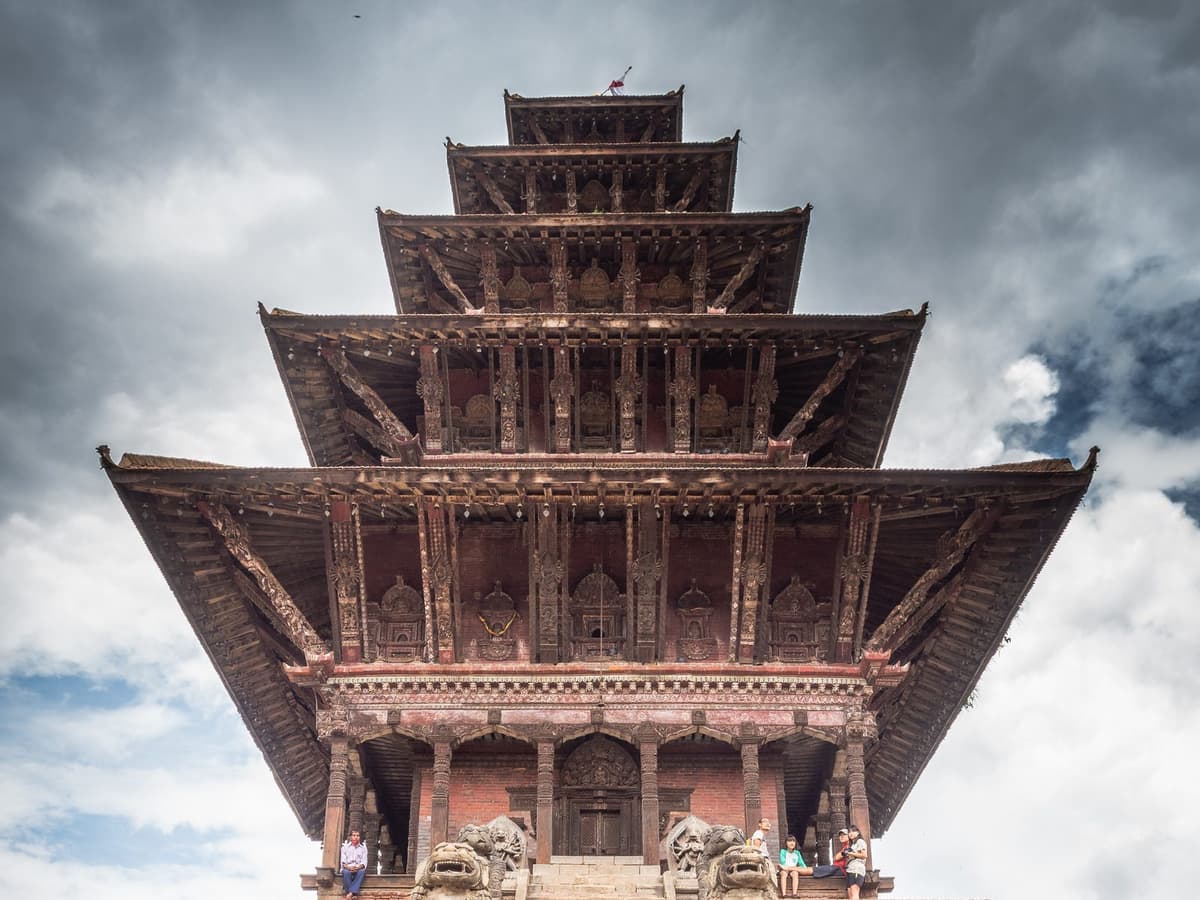
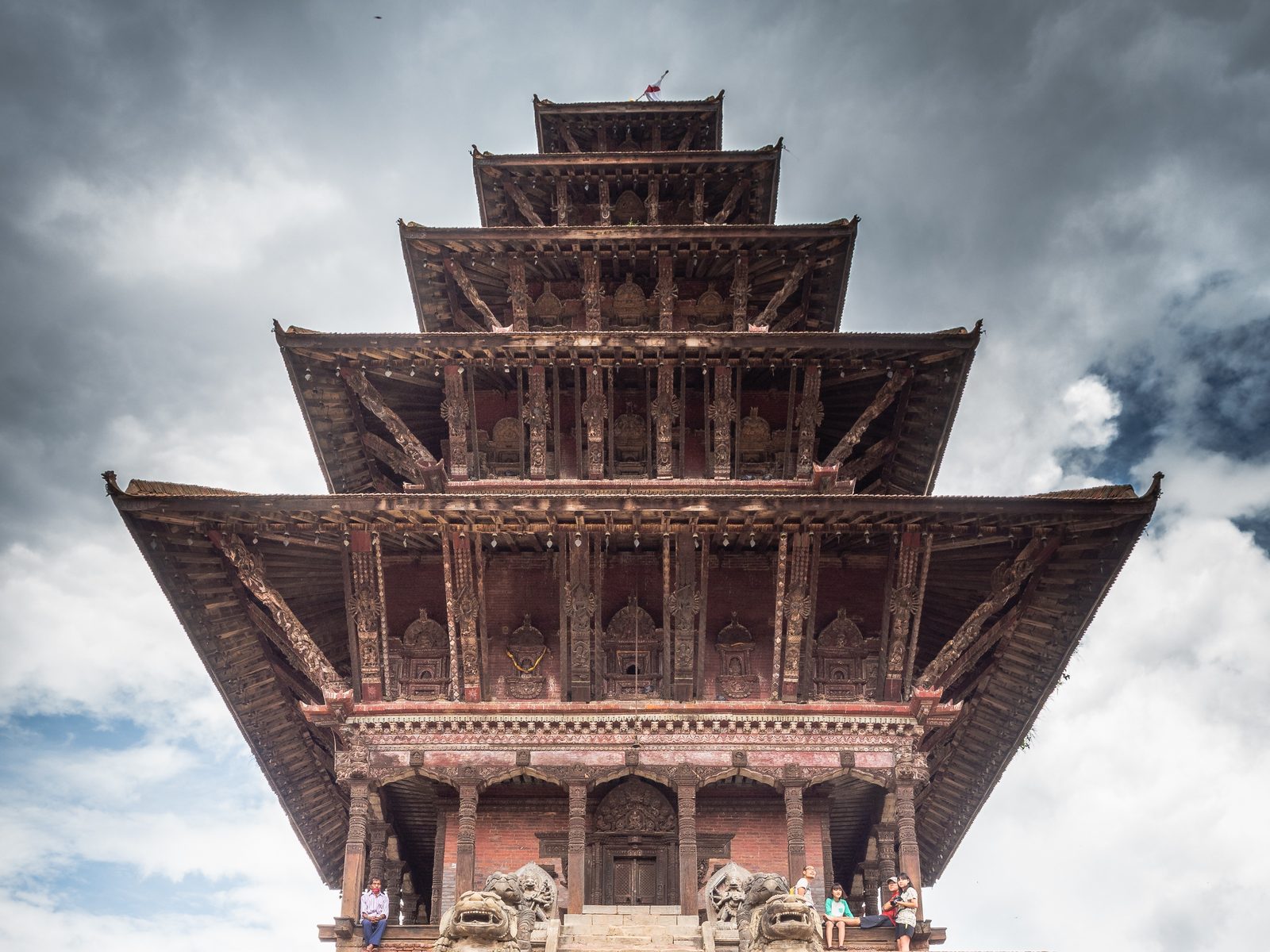
Nyatapola temple in Taumadhi Square, Bhaktapur

By Uncover Nepal Team · Checked by our Kathmandu travel team · Last checked 30 October 2026

Early in the morning, before the first cars arrive from Kathmandu, Bhaktapur's brick lanes belong to the people who live in them. Shutters go up, someone stops at a shrine on the way to work, and in Pottery Square the first rows of clay pots go out to dry.

Bhaktapur is the old Newar royal city 12 km east of Kathmandu and one of the seven Monument Zones of the Kathmandu Valley World Heritage Site. The best things to do in Bhaktapur are walking its three old squares, watching the potters, eating juju dhau and staying on after the day-trippers leave. Foreign visitors pay NPR 2,000 to enter.

Bhaktapur is one of the core stops in our guide to places to visit in Kathmandu. This article covers the whole city: squares and temples, potters and woodcarvers, food, festivals, trips up to Changu Narayan and Nagarkot, and whether to stay the night. For the palace square monument by monument, read our Bhaktapur Durbar Square guide.

Key facts

What it is
One of three old royal cities of the Kathmandu Valley, and one of the seven Monument Zones of its World Heritage Site (UNESCO World Heritage Centre, 30 Oct 2026)
World Heritage listing
Kathmandu Valley inscribed in 1979 (UNESCO World Heritage Centre, 28 Oct 2026)
Location
12 km east of Kathmandu on the Arniko Highway (Nepal Tourism Board, 30 Oct 2026)
Altitude and area
1,401 m; 6.4 sq km (Nepal Tourism Board, 30 Oct 2026)
Entry fee, foreign visitors
NPR 2,000 per person (Bhaktapur Municipality, as reported by The Rising Nepal, 30 Oct 2026)
Entry fee, SAARC nationals and visitors from China
NPR 500 per person (Bhaktapur Municipality, as reported by The Rising Nepal, 30 Oct 2026)
Fees in force since
17 July 2025 (Bhaktapur Municipality, 28 Oct 2026)
Ticket validity
Ask at the ticket counter (Our Kathmandu team, 30 Oct 2026)
Nyatapola temple
Five-storeyed temple, completed in 1702 under King Bhupatindra Malla (Wikipedia, Nyatapola, 28 Oct 2026)
Changu Narayan fee
Sources disagree; check at the gate (Nepal Tourism Board and municipal tourism centre, 30 Oct 2026)

In this guide

  • What is Bhaktapur, and how is it different from Kathmandu?
  • What is the Bhaktapur entry fee, and what does it cover?
  • What are the best things to do in Bhaktapur?
  • Which Bhaktapur temples and squares should you see?
  • Where can you watch Bhaktapur's potters and woodcarvers?
  • What should you eat in Bhaktapur?
  • Which festivals are held in Bhaktapur?
  • How did Bhaktapur come through the 2015 earthquake?
  • How do you get to Bhaktapur from Kathmandu?
  • How long should you spend in Bhaktapur, and should you stay overnight?
  • Can you combine Bhaktapur with Changu Narayan and Nagarkot?
  • How do you visit Bhaktapur respectfully?
  • Frequently asked questions

What is Bhaktapur, and how is it different from Kathmandu?

Bhaktapur is one of the three old royal cities of the Kathmandu Valley, alongside Kathmandu and Patan. It sits at 1,401 m, covers 6.4 sq km and is a Newar town, built and still lived in by the valley's long-settled townspeople. Its old centre is one heritage area of squares, temples, ponds and brick lanes.

It feels like a separate town because it was one. Kathmandu, Patan and Bhaktapur were, in the Nepal Tourism Board's words, "once independent states ruled by the Malla kings from the 12th to the 18th centuries". Each had its own palace and its own Durbar Square: a durbar is a royal court or palace, and the square in front of it is filled with temples and shrines.

In our experience, what sets Bhaktapur apart is how much daily life still happens in the open. Potters shape and dry their pots outdoors, people stop at shrines on the way to work, and the temples are used for worship as much as they are photographed. Kathmandu's old centre sits inside a busy capital; Bhaktapur's sits inside a town you can cross on foot.

A short Bhaktapur history

The city was the capital of the Malla kingdom from the 12th century to 1482. King Yaksha Malla, who reigned from 1428 to 1482, is linked to the Dattatreya temple in the east of the old town. Later, King Bhupatindra Malla built Nyatapola, and his statue still sits on a stone column in Durbar Square. Earthquakes have knocked the city down more than once. The great Nepal-Bihar earthquake struck on 15 January 1934, though the Nepal Tourism Board's page gives 1933.

Date What happened
12th century to 1482 Bhaktapur is the capital of the Malla kingdom
1428 to 1482 Reign of King Yaksha Malla; the Dattatreya temple dates from his reign
1702 Nyatapola completed under King Bhupatindra Malla
1934 Great Nepal-Bihar earthquake destroys the palace's top floor; Nyatapola survives
1979 Kathmandu Valley inscribed on the UNESCO World Heritage List
2006 UNESCO accepts a modification of the property's boundaries
25 April 2015 Magnitude 7.8 earthquake; Nyatapola and the Bhairavnath temple stay standing
17 July 2025 Current entry fees take effect

Sources: Wikipedia (Bhaktapur, Nyatapola); UNESCO World Heritage Centre; US Geological Survey; Bhaktapur Municipality. Checked 28 to 30 Oct 2026.

Part of a UNESCO World Heritage Site

The Kathmandu Valley was inscribed on the World Heritage List in 1979, under criteria (iii), (iv) and (vi). UNESCO treats it as one property "inscribed as seven Monument Zones": the Durbar Squares of Hanuman Dhoka (Kathmandu), Patan and Bhaktapur, and the religious ensembles of Swayambhu, Bauddhanath, Pashupati and Changu Narayan. Two of the seven, Bhaktapur and Changu Narayan, sit close together east of the capital, which is why they share a day so well.

"The seven monument ensembles represent an exceptional testimony to the traditional civilization of the Kathmandu Valley."

UNESCO World Heritage Centre, Kathmandu Valley listing, criterion (iii), read October 2026

What is the Bhaktapur entry fee, and what does it cover?

Foreign visitors pay NPR 2,000 per person, and SAARC nationals and visitors from China pay NPR 500, to enter Bhaktapur's old city, at rates in force since 17 July 2025. Bhaktapur Municipality, the city government, collects the fee, and the ticket covers the heritage area of the old city, not only the palace square.

SAARC nationals are citizens of Afghanistan, Bangladesh, Bhutan, India, Maldives, Nepal, Pakistan and Sri Lanka. Because the fee is charged to enter the old city, one ticket covers your walk between Durbar Square, Taumadhi Square and Dattatreya Square. Buy it at the first counter you reach.

Some national and travel websites still show older fees. The foreign fee rose from Rs 1,500 to Rs 1,800 at the start of 2023, as Radio Nepal reported, and to NPR 2,000 in July 2025, so go by the municipality's current figures. The fee pays for a busy town: in fiscal year 2024/25 Bhaktapur received 244,868 foreign visitors, according to municipality figures reported by The Rising Nepal.

We could not confirm the ticket's validity from the municipality's own page for this update, so we do not give a number of days. Ask at the counter how long it is valid and whether it can be extended if you stay overnight, how children are charged, and whether the National Art Gallery inside the palace charges separately. Carry Nepali rupees in cash, in small notes.

What are the best things to do in Bhaktapur?

The best things to do in Bhaktapur are unhurried: walk the three squares, sit below Nyatapola in Taumadhi Square, watch the potters, look for the carved peacock windows near Dattatreya, eat juju dhau and Newar snacks, and stay until the late-afternoon light. Then, if you have time, go up to Changu Narayan on the ridge above the city.

Here are the things to see in Bhaktapur, in a sensible walking order:

  1. Walk Durbar Square. See the 55 Window Palace, the Golden Gate and the column statue of King Bhupatindra Malla.
  2. Sit in Taumadhi Square. Nyatapola, the five-storeyed temple, and the Bhairavnath temple stand across the square from each other.
  3. Hear the Bhairav legend. Ask why only the god's head is said to be kept inside the Bhairavnath temple.
  4. Watch the potters. In Pottery Square, in the Talako area, clay is shaped on the wheel and pots dry in rows in the open.
  5. Walk east to Dattatreya Square for a temple said to be built from a single tree, and the carved peacock windows next to it.
  6. Look up at the woodwork. Carved windows and doors are everywhere once you start looking.
  7. Eat juju dhau, the "king of curd", set in a clay pot.
  8. Try Newar food such as bara, chatamari and, in winter, yomari.
  9. Wander the lanes and ponds, including Siddha Pokhari by the bus stop, which NTB dates to the Licchavi period.
  10. Stay for the late afternoon, when the crowds thin and warm light falls on brick and wood.
  11. Time your visit to a festival: Bisket Jatra in April or Gai Jatra in August or September.
  12. Go up to Changu Narayan, a separate Monument Zone on the ridge above Bhaktapur.

Which Bhaktapur temples and squares should you see?

The Bhaktapur temples most people come for are Nyatapola and the Bhairavnath temple in Taumadhi Square, the Dattatreya temple in Dattatreya Square, and the temples around the palace in Durbar Square. All three squares are inside the area your ticket covers, and you walk between them through the old lanes.
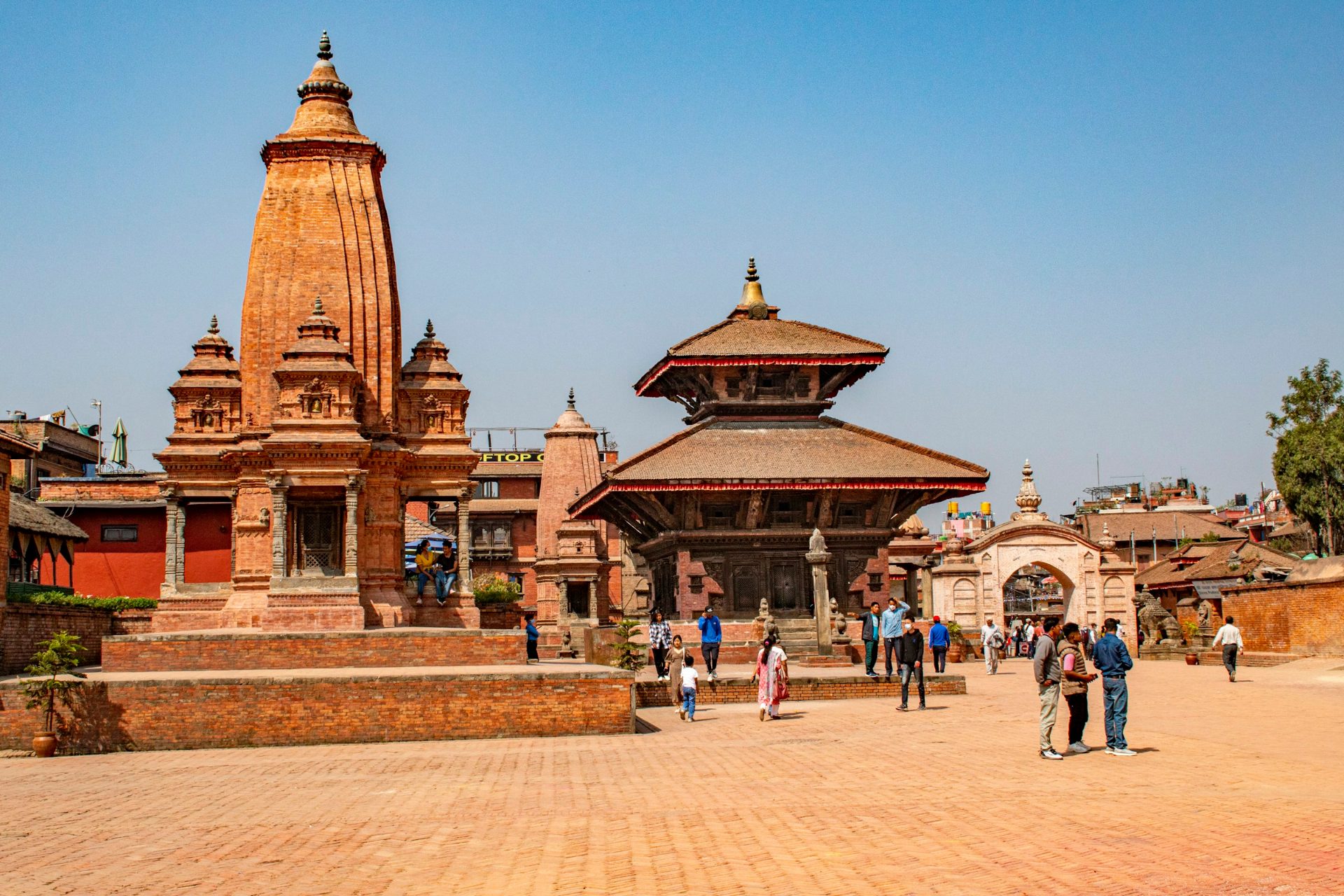
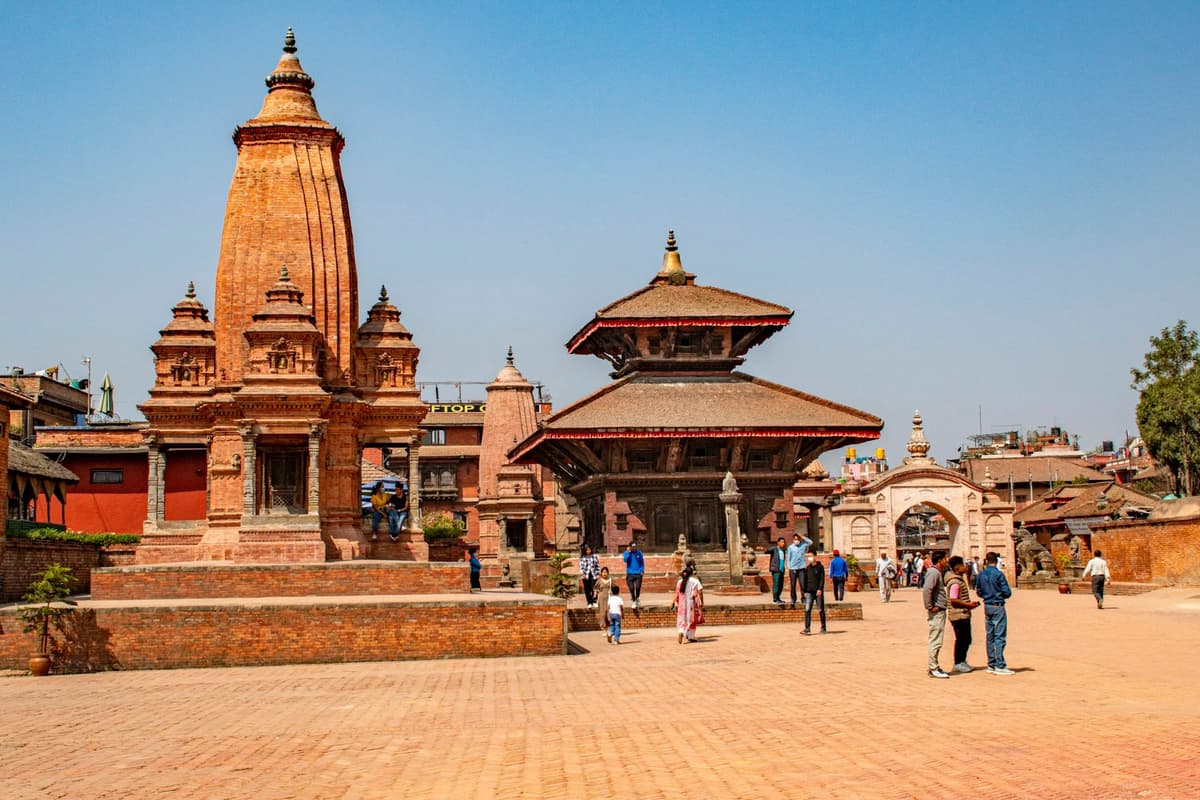
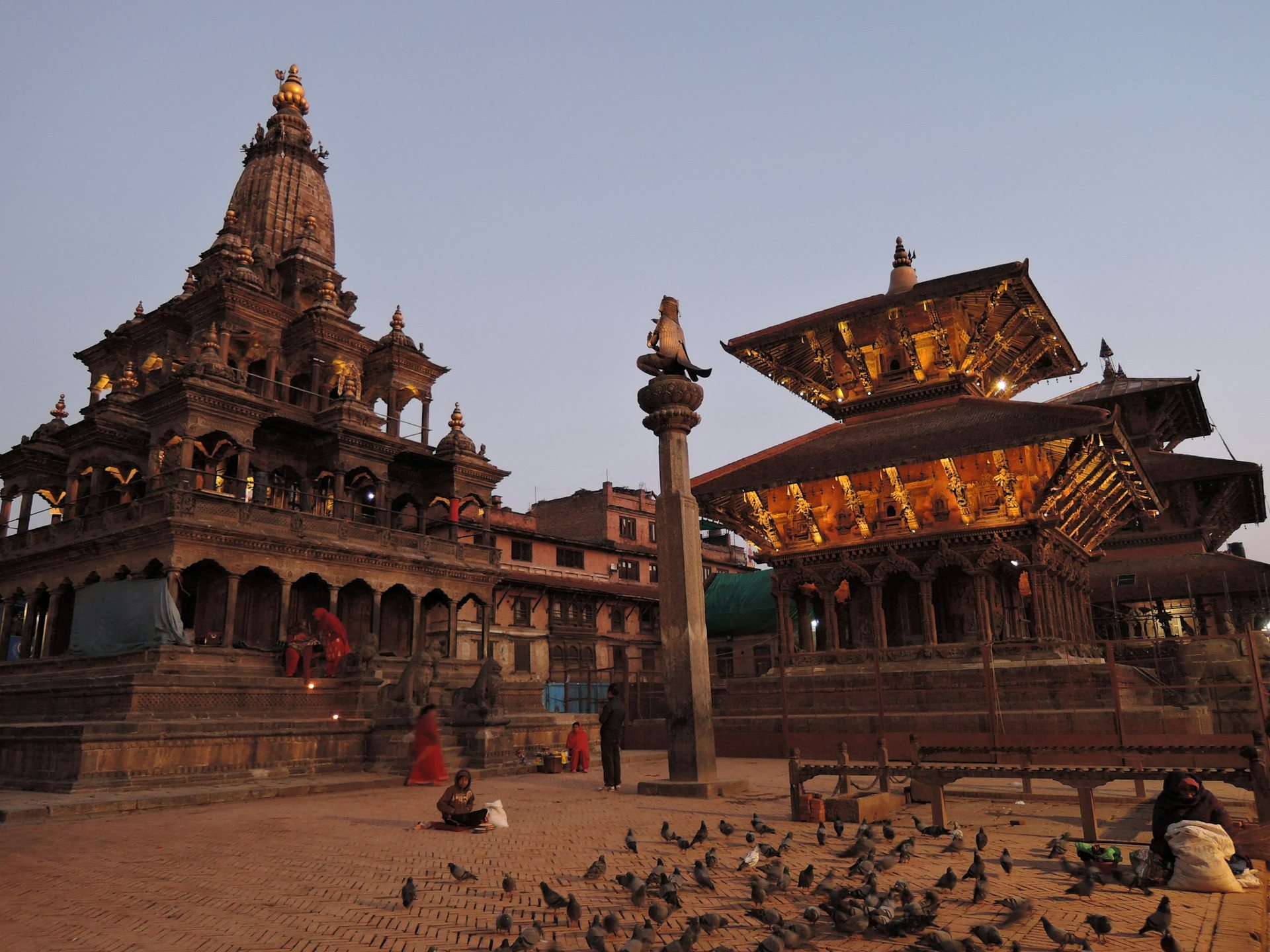
Vatsala Durga temple and a pagoda on Bhaktapur Durbar Square
Vatsala Durga and a pagoda on Bhaktapur Durbar Square.

Durbar Square: the palace square

Durbar Square is the open square in front of the old royal palace, the 55 Window Palace, known in Nepali as Pachpanna Jhyale Durbar. The ornate Golden Gate leads into the palace courtyards; parts of the palace and some shrines are closed to visitors, so follow the signs. Around the square are the Taleju Bell, the statue of King Bhupatindra Malla, and stone temples including Vatsala Durga, which collapsed in 2015, and Siddhi Lakshmi, rebuilt after the 2015 earthquake.

Our Bhaktapur Durbar Square guide goes through each monument and its dates, so we keep this short. If you are also visiting Patan Durbar Square, Bhaktapur makes a good comparison: two royal squares from the same Malla world, each with its own feel.
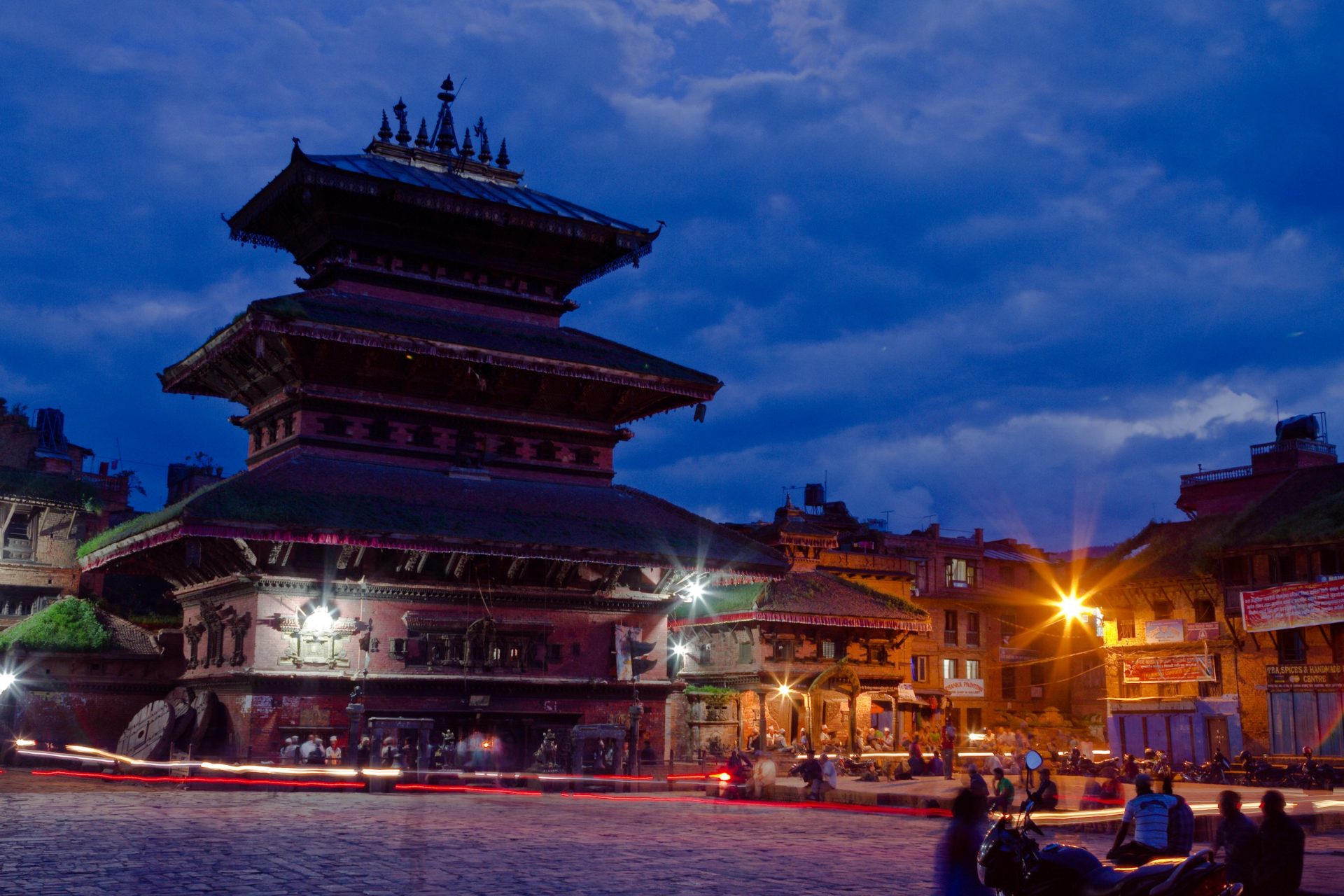
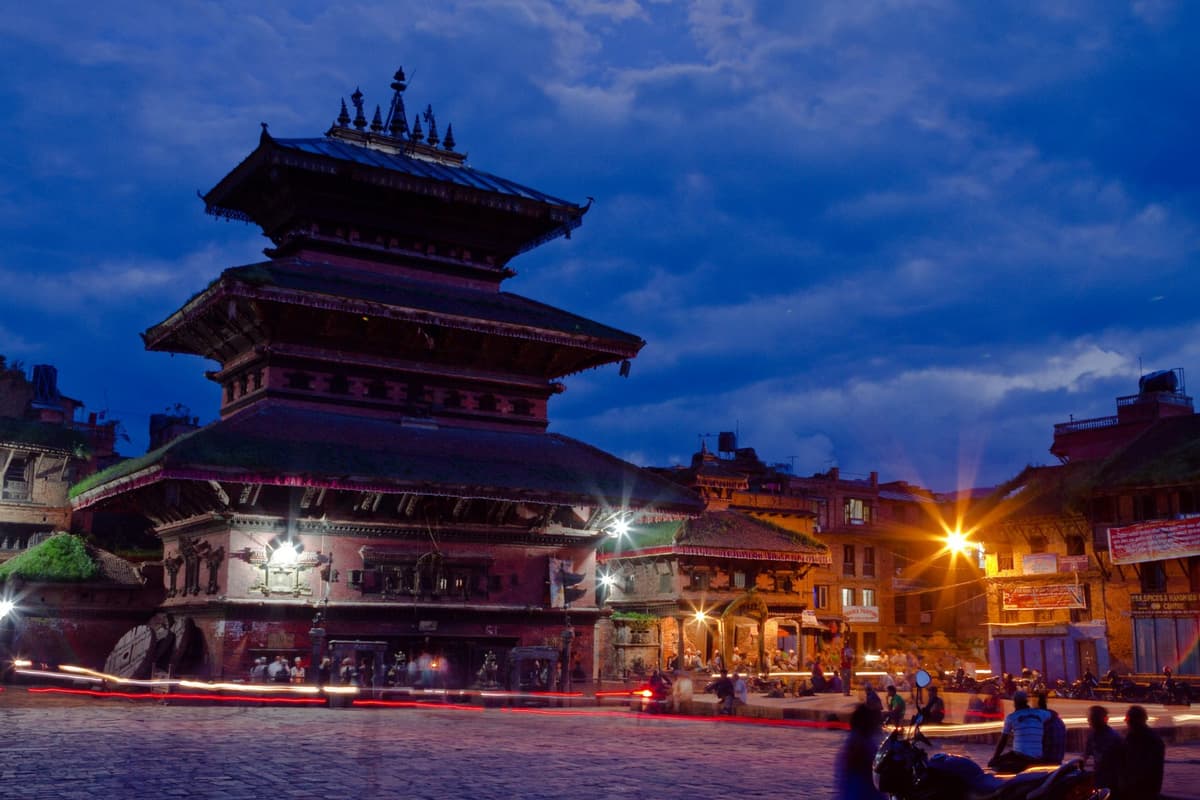
Bhairavnath temple in Taumadhi Square, Bhaktapur, in the evening
The Bhairavnath temple in Taumadhi Square in the evening.

Taumadhi Square: Nyatapola and Bhairavnath

Taumadhi Square, next to Durbar Square, is where many people end up sitting longest. Nyatapola was built by King Bhupatindra Malla and completed in 1702. In Nepal Bhasa, the Newar language of the valley's old towns, "nyata" means five storeys and "pola" means roof. You will see heights quoted for it, but the sources we checked disagree, so we do not print one.

The temple is dedicated to the Tantric goddess Siddhi Lakshmi, whose image inside is hidden; only priests go in. Its stairway climbs past pairs of stone guardians: wrestlers, elephants, lions, griffins and goddesses. Nyatapola survived the 1934 earthquake and the 2015 earthquake, and was repaired after 2015. If you sit on the steps, leave room for worshippers and keep a hand on small children, because the old steps are steep.

Across the square stands the three-storeyed Bhairavnath temple, which also came through 2015. NTB tells the legend: Bhairav came to Bhaktapur, and a Tantric expert cut off his head to keep him in the city, so only the god's head is in the inner sanctum. It explains why Bhairav matters so much here, and why his chariot is at the heart of the town's main festival.

Dattatreya Square: the eastern square

Further east, Dattatreya Square is quieter than the other two. The Dattatreya temple dates from the reign of King Yaksha Malla (1428 to 1482), though its exact construction date is uncertain. NTB says it "is said to have been built from the trunk of a single tree", a story to enjoy rather than test.

Next to it is a monastery, the Pujari Math, with what NTB calls "exquisitely carved peacock windows", a fine example of the woodcarving Bhaktapur is known for. Ask your way if you lose the route, because the lanes twist.

Where can you watch Bhaktapur's potters and woodcarvers?

You can watch Bhaktapur's potters at work in Pottery Square, in the Talako area, where clay is shaped on the wheel and pots dry in rows in the open. Woodcarving is everywhere in the old town, from the palace windows to the peacock windows by Dattatreya Square. NTB sums the city up as "famous for pottery and woodcarving".
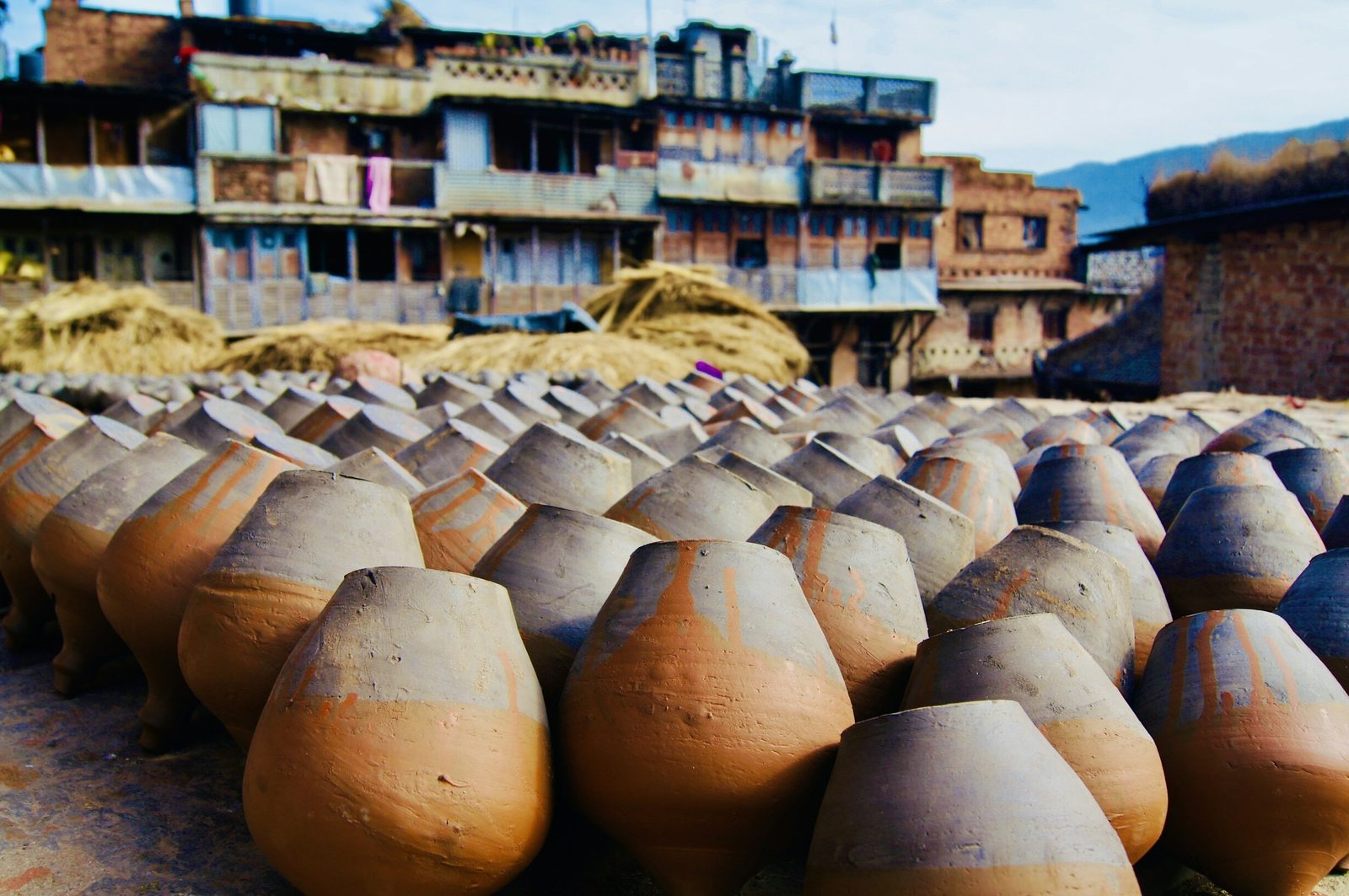
Pottery drying in rows in Pottery Square, Bhaktapur
Pots drying in Pottery Square.

Pottery Square (Talako)

Pottery Square is a working space, not a show. Walk slowly, keep off the rows of drying pots and always ask before you photograph a potter. If you buy a piece, ask how to pack it, because unglazed clay is fragile. If you would like to try a wheel yourself, our Nepali cooking class with pottery, a half day based in Kathmandu, pairs a market visit and a Nepali cooking session with a turn at the potter's wheel.

Woodcarving and crafts

Look up as you walk: some of the best carving is above eye level, on ordinary houses as well as temples. Shops and workshops around the squares sell carved pieces and pottery. We do not quote prices, because they vary by piece and workshop. Buy where you can see the work being done, ask what a piece is made from, and do not feel rushed.

Thimi, the pottery town on the way

Thimi, a pottery town about 8 km east of Kathmandu, sits on the same road as Bhaktapur. NTB notes that "most of the households here are engaged in pottery", so a short stop on the way in pairs well with Pottery Square.

What should you eat in Bhaktapur?

Eat juju dhau. The name means "king of curd", and it is yoghurt made from fermented milk and set in a clay pot, sold in small shops around the squares. Then try the Newar dishes of the valley, such as bara, chatamari and, in winter, yomari. Vegetarians should ask before ordering, because several Newar dishes include egg or meat.

Dish What it is Good to know
Juju dhau Yoghurt from fermented milk, set in a clay pot Bhaktapur's own dessert
Bara Fried cake of spiced lentil paste May include egg, meat or vegetables
Wo A flat, bread-like dish of the same lentil paste Ask what is in it
Chatamari Thin, crepe-like rice-flour base Often topped with egg or minced meat
Yomari Steamed rice-flour dumpling filled with chaku (jaggery taffy) and sesame, or with khuwa (milk solids) Eaten at Yomari Punhi, a full moon in December
Choila Spiced boiled or grilled meat Meat dish
Kachila Raw minced buffalo meat with Newa spices, mustard oil and spring onion Raw meat; skip it if that worries you

Sources: OnlineKhabar English (Newa food); Kathmandu Post (yomari, 17 Jul 2020). Checked 30 Oct 2026.

The clay pot that holds juju dhau links the food to the potters you have just watched, so save it for the end of your walk. Buy it where it is clearly fresh and selling quickly, drink bottled or filtered water, and if you avoid egg, meat, onion or garlic, ask before you order. We do not give food prices, because we have no checked figures and they vary by place.

Which festivals are held in Bhaktapur?

Bhaktapur's main festival is Bisket Jatra, held over nine days around Nepali New Year in April, when Bhairav's chariot is pulled through the town and a wooden pole, the lingo, is raised and then lowered. Gai Jatra, in August or September, is the other one to know. Festival dates follow the lunar calendar, so check them before you plan around one.

Bisket Jatra

A jatra is a festival with a procession. During Bisket Jatra, also spelled Biska Jatra, a wooden chariot carrying an image of Bhairav is pulled through the town, young people haul a second chariot carrying the goddess Bhadrakali, and the lingo is pulled down on the final day. In 2026, Nepali New Year fell on 14 April, and India's state broadcaster reported Bisket Jatra under way in Bhaktapur on 10 April. Dates for 2027 are not yet confirmed by an official calendar, so ask us before you book around it.

Gai Jatra and Ghintang Ghisi

Gai Jatra honours relatives who have died in the past year. In Bhaktapur, families carry bamboo-and-cloth chariots called taha-macha with a photograph of the person who died, and the Ghintang Ghisi stick dance carries on for almost a week, from Gai Jatra to Krishna Janmashtami. It is remembrance as well as celebration, so ask before you photograph families.

Yomari Punhi and Tihar

Yomari Punhi, a full moon in December, is the day for yomari across the valley's Newar towns; in 2026 it falls on 24 December, a public holiday. Tihar, the festival of lights, brings public holidays from 8 to 12 November 2026.

Festival crowds are dense and chariots can move suddenly. Stand well back from the ropes, keep to the edges of the square, agree a meeting point in case you get separated, and follow instructions from police, organisers and your guide. If it feels too crowded, leave; the squares will still be there on a quieter day.

How did Bhaktapur come through the 2015 earthquake?

The earthquake of 25 April 2015, magnitude 7.8, damaged dozens of monuments in Bhaktapur and brought down the Vatsala Durga temple in Durbar Square, while Nyatapola and the Bhairavnath temple stayed standing. Much has been rebuilt since, but you may still see scaffolding or fences around a temple under repair.

By May 2025, the Department of Archaeology counted 174 damaged structures in the World Heritage zones of Kathmandu, Lalitpur and Bhaktapur: 134 rebuilt, 16 under way and 24 not yet started, as reported by The Rising Nepal. In Bhaktapur's Durbar Square, the Siddhi Lakshmi temple is one of the clearest examples of a temple brought back after 2015.

Ask your guide what is original and what was rebuilt. Respect any barrier, and do not climb on plinths that are fenced off.

How do you get to Bhaktapur from Kathmandu?

Bhaktapur lies 12 km east of Kathmandu on the Arniko Highway, according to the Nepal Tourism Board; Bhaktapur Municipality, as cited on Wikipedia, gives about 13 km. Most visitors come by private car with a driver, by taxi or on a guided day tour. Drive time depends on where you start and on traffic, so ask us for a realistic estimate.

A private car with a driver is easiest for families and anyone adding Changu Narayan or Nagarkot, and you set the start time. With a taxi, agree the fare, and whether the driver will wait, before you set off.

The road east passes Thimi, the pottery town. Siddha Pokhari, the old pond by the bus stop, is a useful landmark if you arrange to meet a driver.

How long should you spend in Bhaktapur, and should you stay overnight?

Give Bhaktapur a morning at least, or a full day if you add Changu Narayan on the ridge above it. A morning covers Durbar Square, Taumadhi, Pottery Square and Dattatreya at a steady pace, ending with juju dhau. A full day lets you slow down and eat properly. A night in town lets you see the squares early and late, when most visitors have gone.

For a full day, start at Changu Narayan in the morning while the ridge is cool, then drop to Bhaktapur for lunch and the afternoon. Or reverse it. Either way, keep the late afternoon for Taumadhi Square.

Staying overnight in Bhaktapur

Staying overnight is the best way to see Bhaktapur as a town rather than a sight. In the early morning the squares belong to people on their way to work and worship, and in the evening the day-trippers have gone. There are places to stay in and around the old town; tell us what you are looking for and we will suggest options. Ask at the ticket counter what you need if your stay runs past a single day.

A night here also puts you closer to the hills. For sunrise, though, a night in Nagarkot itself is the surer choice, and our Nagarkot guide covers where to stay up there and the clearest months.

Can you combine Bhaktapur with Changu Narayan and Nagarkot?

Yes. Changu Narayan sits on the ridge above Bhaktapur, and the road climbs from the city to the temple, so the two share a day easily. Nagarkot, the hill village known for its sunrise and sunset views, is further up and works best as an afternoon trip for sunset, or with a night there for sunrise.
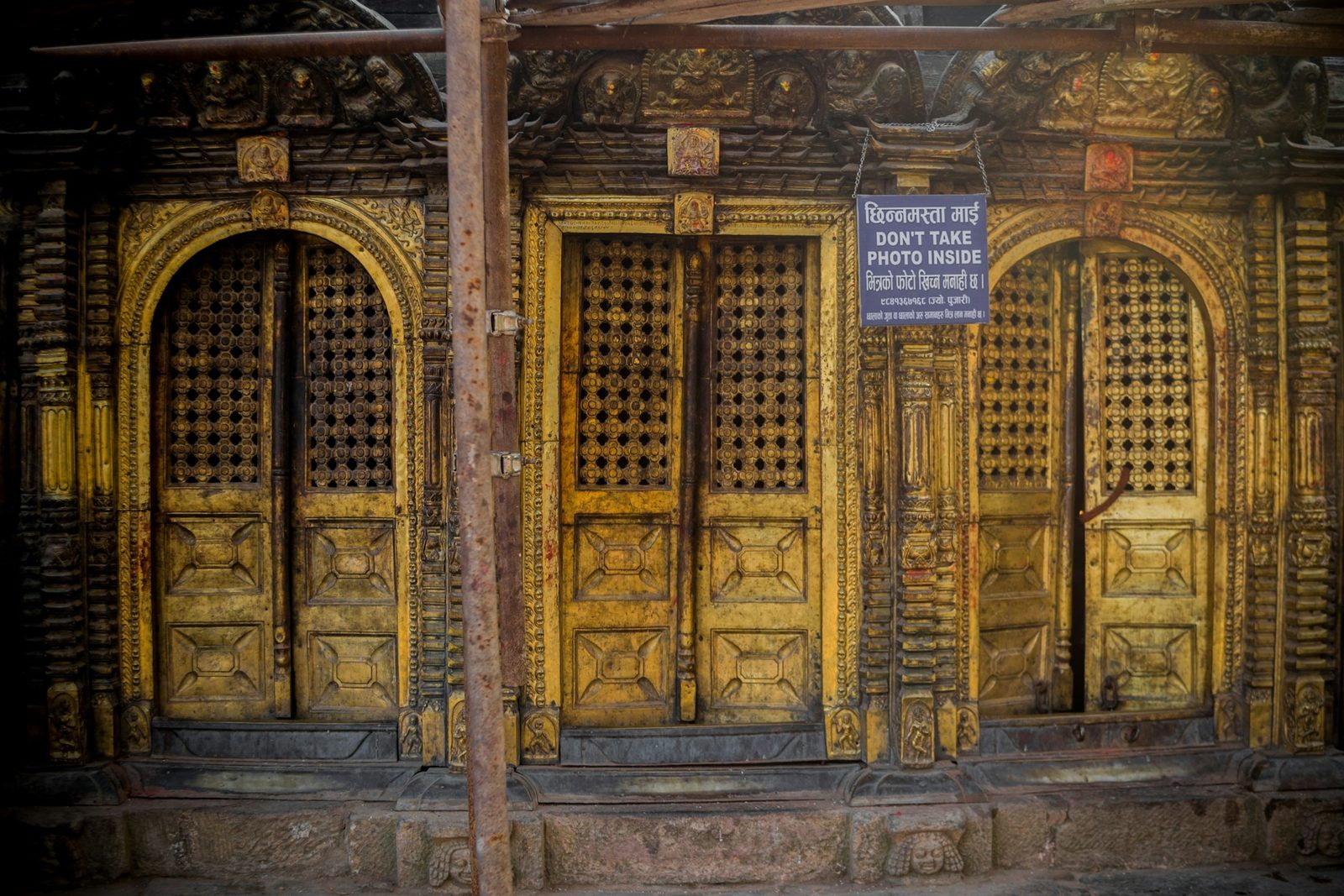
The carved golden doors of Changu Narayan temple near Bhaktapur
The carved doors of Changu Narayan, a short drive from Bhaktapur.

Changu Narayan

Changu Narayan is a temple to Vishnu and one of the seven Monument Zones. NTB dates it to the Licchavi period, the age of the valley's earliest kings, and UNESCO notes that the temple complex holds one of the earliest inscriptions in the valley, from the fifth century AD. Look for the inscription, the carved stone and wood, and the view down over Bhaktapur. The fee is separate from Bhaktapur's, and the sources we checked give different figures, so check at the gate.

Nagarkot

Nagarkot is about 32 km from Kathmandu, usually 1.5 to 2 hours by road. Local buses climb to Nagarkot from Kamal Binayak in Bhaktapur in daytime only, so a sunrise visit needs either a night in Nagarkot or a car leaving before dawn. Expect roadworks on the Bhaktapur to Nagarkot road, which has been under upgrade since 2025. Strong walkers can go on foot from Changu Narayan to Nagarkot in about four to five hours.

For more ideas east, south and north of the city, read our guide to day trips from Kathmandu.

How do you visit Bhaktapur respectfully?

Bhaktapur is a living town and a place of worship. Cover shoulders and knees at temples, take your shoes off where signs ask, walk clockwise around shrines, leave offerings such as flowers, rice, coloured powder and food alone, and ask before photographing people, especially at worship and in Pottery Square. Follow the signs at the palace, and keep to the edges when a procession or ritual is under way.

Do you need a guide? We found no official rule requiring one at Bhaktapur or Changu Narayan, but a licensed guide makes the history, the legends and the route through the lanes much easier to follow.

Frequently asked questions

How much is the Bhaktapur entry fee, and how long should I spend there?

Foreign visitors pay NPR 2,000 per person, and SAARC nationals and visitors from China pay NPR 500, at rates in force since 17 July 2025. Bhaktapur Municipality collects the fee, and the ticket covers the old city, not just Durbar Square. Give Bhaktapur a morning at least, or a full day if you add Changu Narayan. Ask at the counter about validity if you plan to stay overnight.

What are the best things to do in Kathmandu besides Bhaktapur?

Start with the seven UNESCO Monument Zones. Most people need two days: one for Boudhanath, Pashupatinath, Kathmandu Durbar Square and Swayambhu, and one for Patan, Bhaktapur and Changu Narayan. A third day adds Kirtipur, Budhanilkantha, a hike on the valley rim or a night in Nagarkot. Our guide to places to visit in Kathmandu covers each one.

What happens at Dakshinkali, and on which days?

Dakshinkali is a temple to the goddess Kali on the southern rim of the valley, on the opposite side from Bhaktapur. The Nepal Tourism Board puts it 22 km from Kathmandu, a little further on than Pharping at 18 km. NTB says crowds come "especially on Tuesdays and Saturdays when ritual animal sacrifices are performed", and notes that sacrifices are also made during the Dashain festival. There is no ticket that we know of. If you would rather not see sacrifice, visit Pharping's quieter caves and temple instead.

Do I need a guide to visit Bhaktapur?

No official rule that we found requires a guide in Bhaktapur or at Changu Narayan, and you can walk the squares on your own with a ticket. A licensed guide helps, though: the legends, the dates and what was rebuilt after 2015 are easier to follow with someone explaining as you go, and the lanes between the squares are easy to get turned around in.

Can I stay overnight in Bhaktapur?

Yes. There are places to stay in and around the old town, and a night there lets you see the squares in the early morning and evening, when most day-trippers have gone. It also puts you closer to Nagarkot and Changu Narayan. Tell the ticket counter you are staying overnight and ask about the ticket's validity, because we could not confirm the current rule.

What is Bhaktapur famous for?

Bhaktapur is famous for its three old squares, the five-storeyed Nyatapola temple, its pottery and woodcarving, and juju dhau, the "king of curd" yoghurt set in a clay pot. It is also known for Bisket Jatra, its nine-day festival around Nepali New Year in April. It is one of the seven Monument Zones of the Kathmandu Valley World Heritage Site.

Planning your Bhaktapur visit

Bhaktapur rewards time more than speed: start early, sit a while in Taumadhi and, if you can, stay overnight. For how it fits with the rest of the valley, go back to our guide to places to visit in Kathmandu.

If you would like us to arrange it, two of our trips include Bhaktapur. The Nagarkot sunrise and Bhaktapur tour pairs a sunrise at Nagarkot with Bhaktapur's squares, and the Patan, Bhaktapur and Boudhanath tour adds Patan Durbar Square and Boudhanath. For a hands-on day, the cooking class with pottery mentioned above is another way in.

Not sure which fits your days? Ask us on WhatsApp or through the enquiry form with your dates and group size, and our Kathmandu team will tell you honestly what works.
Tags
BhaktapurKathmandu ValleyNewar cultureUNESCO World HeritageNyatapolaDay trips from Kathmandu
Share
U
Uncover Nepal Team
Writer at Uncover Nepal
More in PlacesSee all Places

Bhaktapur: Things to Do in the Valley's Old Newar City

23 min read Posted 29 Oct 2026Updated 29 Oct 2026
Nyatapola temple in Taumadhi Square, Bhaktapur

By Uncover Nepal Team · Checked by our Kathmandu travel team · Last checked 30 October 2026

Early in the morning, before the first cars arrive from Kathmandu, Bhaktapur's brick lanes belong to the people who live in them. Shutters go up, someone stops at a shrine on the way to work, and in Pottery Square the first rows of clay pots go out to dry.

Bhaktapur is the old Newar royal city 12 km east of Kathmandu and one of the seven Monument Zones of the Kathmandu Valley World Heritage Site. The best things to do in Bhaktapur are walking its three old squares, watching the potters, eating juju dhau and staying on after the day-trippers leave. Foreign visitors pay NPR 2,000 to enter.

Bhaktapur is one of the core stops in our guide to places to visit in Kathmandu. This article covers the whole city: squares and temples, potters and woodcarvers, food, festivals, trips up to Changu Narayan and Nagarkot, and whether to stay the night. For the palace square monument by monument, read our Bhaktapur Durbar Square guide.

Key facts

What it is
One of three old royal cities of the Kathmandu Valley, and one of the seven Monument Zones of its World Heritage Site (UNESCO World Heritage Centre, 30 Oct 2026)
World Heritage listing
Kathmandu Valley inscribed in 1979 (UNESCO World Heritage Centre, 28 Oct 2026)
Location
12 km east of Kathmandu on the Arniko Highway (Nepal Tourism Board, 30 Oct 2026)
Altitude and area
1,401 m; 6.4 sq km (Nepal Tourism Board, 30 Oct 2026)
Entry fee, foreign visitors
NPR 2,000 per person (Bhaktapur Municipality, as reported by The Rising Nepal, 30 Oct 2026)
Entry fee, SAARC nationals and visitors from China
NPR 500 per person (Bhaktapur Municipality, as reported by The Rising Nepal, 30 Oct 2026)
Fees in force since
17 July 2025 (Bhaktapur Municipality, 28 Oct 2026)
Ticket validity
Ask at the ticket counter (Our Kathmandu team, 30 Oct 2026)
Nyatapola temple
Five-storeyed temple, completed in 1702 under King Bhupatindra Malla (Wikipedia, Nyatapola, 28 Oct 2026)
Changu Narayan fee
Sources disagree; check at the gate (Nepal Tourism Board and municipal tourism centre, 30 Oct 2026)

In this guide

  • What is Bhaktapur, and how is it different from Kathmandu?
  • What is the Bhaktapur entry fee, and what does it cover?
  • What are the best things to do in Bhaktapur?
  • Which Bhaktapur temples and squares should you see?
  • Where can you watch Bhaktapur's potters and woodcarvers?
  • What should you eat in Bhaktapur?
  • Which festivals are held in Bhaktapur?
  • How did Bhaktapur come through the 2015 earthquake?
  • How do you get to Bhaktapur from Kathmandu?
  • How long should you spend in Bhaktapur, and should you stay overnight?
  • Can you combine Bhaktapur with Changu Narayan and Nagarkot?
  • How do you visit Bhaktapur respectfully?
  • Frequently asked questions

What is Bhaktapur, and how is it different from Kathmandu?

Bhaktapur is one of the three old royal cities of the Kathmandu Valley, alongside Kathmandu and Patan. It sits at 1,401 m, covers 6.4 sq km and is a Newar town, built and still lived in by the valley's long-settled townspeople. Its old centre is one heritage area of squares, temples, ponds and brick lanes.

It feels like a separate town because it was one. Kathmandu, Patan and Bhaktapur were, in the Nepal Tourism Board's words, "once independent states ruled by the Malla kings from the 12th to the 18th centuries". Each had its own palace and its own Durbar Square: a durbar is a royal court or palace, and the square in front of it is filled with temples and shrines.

In our experience, what sets Bhaktapur apart is how much daily life still happens in the open. Potters shape and dry their pots outdoors, people stop at shrines on the way to work, and the temples are used for worship as much as they are photographed. Kathmandu's old centre sits inside a busy capital; Bhaktapur's sits inside a town you can cross on foot.

A short Bhaktapur history

The city was the capital of the Malla kingdom from the 12th century to 1482. King Yaksha Malla, who reigned from 1428 to 1482, is linked to the Dattatreya temple in the east of the old town. Later, King Bhupatindra Malla built Nyatapola, and his statue still sits on a stone column in Durbar Square. Earthquakes have knocked the city down more than once. The great Nepal-Bihar earthquake struck on 15 January 1934, though the Nepal Tourism Board's page gives 1933.

Date What happened
12th century to 1482 Bhaktapur is the capital of the Malla kingdom
1428 to 1482 Reign of King Yaksha Malla; the Dattatreya temple dates from his reign
1702 Nyatapola completed under King Bhupatindra Malla
1934 Great Nepal-Bihar earthquake destroys the palace's top floor; Nyatapola survives
1979 Kathmandu Valley inscribed on the UNESCO World Heritage List
2006 UNESCO accepts a modification of the property's boundaries
25 April 2015 Magnitude 7.8 earthquake; Nyatapola and the Bhairavnath temple stay standing
17 July 2025 Current entry fees take effect

Sources: Wikipedia (Bhaktapur, Nyatapola); UNESCO World Heritage Centre; US Geological Survey; Bhaktapur Municipality. Checked 28 to 30 Oct 2026.

Part of a UNESCO World Heritage Site

The Kathmandu Valley was inscribed on the World Heritage List in 1979, under criteria (iii), (iv) and (vi). UNESCO treats it as one property "inscribed as seven Monument Zones": the Durbar Squares of Hanuman Dhoka (Kathmandu), Patan and Bhaktapur, and the religious ensembles of Swayambhu, Bauddhanath, Pashupati and Changu Narayan. Two of the seven, Bhaktapur and Changu Narayan, sit close together east of the capital, which is why they share a day so well.

"The seven monument ensembles represent an exceptional testimony to the traditional civilization of the Kathmandu Valley."

UNESCO World Heritage Centre, Kathmandu Valley listing, criterion (iii), read October 2026

What is the Bhaktapur entry fee, and what does it cover?

Foreign visitors pay NPR 2,000 per person, and SAARC nationals and visitors from China pay NPR 500, to enter Bhaktapur's old city, at rates in force since 17 July 2025. Bhaktapur Municipality, the city government, collects the fee, and the ticket covers the heritage area of the old city, not only the palace square.

SAARC nationals are citizens of Afghanistan, Bangladesh, Bhutan, India, Maldives, Nepal, Pakistan and Sri Lanka. Because the fee is charged to enter the old city, one ticket covers your walk between Durbar Square, Taumadhi Square and Dattatreya Square. Buy it at the first counter you reach.

Some national and travel websites still show older fees. The foreign fee rose from Rs 1,500 to Rs 1,800 at the start of 2023, as Radio Nepal reported, and to NPR 2,000 in July 2025, so go by the municipality's current figures. The fee pays for a busy town: in fiscal year 2024/25 Bhaktapur received 244,868 foreign visitors, according to municipality figures reported by The Rising Nepal.

We could not confirm the ticket's validity from the municipality's own page for this update, so we do not give a number of days. Ask at the counter how long it is valid and whether it can be extended if you stay overnight, how children are charged, and whether the National Art Gallery inside the palace charges separately. Carry Nepali rupees in cash, in small notes.

What are the best things to do in Bhaktapur?

The best things to do in Bhaktapur are unhurried: walk the three squares, sit below Nyatapola in Taumadhi Square, watch the potters, look for the carved peacock windows near Dattatreya, eat juju dhau and Newar snacks, and stay until the late-afternoon light. Then, if you have time, go up to Changu Narayan on the ridge above the city.

Here are the things to see in Bhaktapur, in a sensible walking order:

  1. Walk Durbar Square. See the 55 Window Palace, the Golden Gate and the column statue of King Bhupatindra Malla.
  2. Sit in Taumadhi Square. Nyatapola, the five-storeyed temple, and the Bhairavnath temple stand across the square from each other.
  3. Hear the Bhairav legend. Ask why only the god's head is said to be kept inside the Bhairavnath temple.
  4. Watch the potters. In Pottery Square, in the Talako area, clay is shaped on the wheel and pots dry in rows in the open.
  5. Walk east to Dattatreya Square for a temple said to be built from a single tree, and the carved peacock windows next to it.
  6. Look up at the woodwork. Carved windows and doors are everywhere once you start looking.
  7. Eat juju dhau, the "king of curd", set in a clay pot.
  8. Try Newar food such as bara, chatamari and, in winter, yomari.
  9. Wander the lanes and ponds, including Siddha Pokhari by the bus stop, which NTB dates to the Licchavi period.
  10. Stay for the late afternoon, when the crowds thin and warm light falls on brick and wood.
  11. Time your visit to a festival: Bisket Jatra in April or Gai Jatra in August or September.
  12. Go up to Changu Narayan, a separate Monument Zone on the ridge above Bhaktapur.

Which Bhaktapur temples and squares should you see?

The Bhaktapur temples most people come for are Nyatapola and the Bhairavnath temple in Taumadhi Square, the Dattatreya temple in Dattatreya Square, and the temples around the palace in Durbar Square. All three squares are inside the area your ticket covers, and you walk between them through the old lanes.

Vatsala Durga temple and a pagoda on Bhaktapur Durbar Square
Vatsala Durga and a pagoda on Bhaktapur Durbar Square.

Durbar Square: the palace square

Durbar Square is the open square in front of the old royal palace, the 55 Window Palace, known in Nepali as Pachpanna Jhyale Durbar. The ornate Golden Gate leads into the palace courtyards; parts of the palace and some shrines are closed to visitors, so follow the signs. Around the square are the Taleju Bell, the statue of King Bhupatindra Malla, and stone temples including Vatsala Durga, which collapsed in 2015, and Siddhi Lakshmi, rebuilt after the 2015 earthquake.

Our Bhaktapur Durbar Square guide goes through each monument and its dates, so we keep this short. If you are also visiting Patan Durbar Square, Bhaktapur makes a good comparison: two royal squares from the same Malla world, each with its own feel.

Bhairavnath temple in Taumadhi Square, Bhaktapur, in the evening
The Bhairavnath temple in Taumadhi Square in the evening.

Taumadhi Square: Nyatapola and Bhairavnath

Taumadhi Square, next to Durbar Square, is where many people end up sitting longest. Nyatapola was built by King Bhupatindra Malla and completed in 1702. In Nepal Bhasa, the Newar language of the valley's old towns, "nyata" means five storeys and "pola" means roof. You will see heights quoted for it, but the sources we checked disagree, so we do not print one.

The temple is dedicated to the Tantric goddess Siddhi Lakshmi, whose image inside is hidden; only priests go in. Its stairway climbs past pairs of stone guardians: wrestlers, elephants, lions, griffins and goddesses. Nyatapola survived the 1934 earthquake and the 2015 earthquake, and was repaired after 2015. If you sit on the steps, leave room for worshippers and keep a hand on small children, because the old steps are steep.

Across the square stands the three-storeyed Bhairavnath temple, which also came through 2015. NTB tells the legend: Bhairav came to Bhaktapur, and a Tantric expert cut off his head to keep him in the city, so only the god's head is in the inner sanctum. It explains why Bhairav matters so much here, and why his chariot is at the heart of the town's main festival.

Dattatreya Square: the eastern square

Further east, Dattatreya Square is quieter than the other two. The Dattatreya temple dates from the reign of King Yaksha Malla (1428 to 1482), though its exact construction date is uncertain. NTB says it "is said to have been built from the trunk of a single tree", a story to enjoy rather than test.

Next to it is a monastery, the Pujari Math, with what NTB calls "exquisitely carved peacock windows", a fine example of the woodcarving Bhaktapur is known for. Ask your way if you lose the route, because the lanes twist.

Where can you watch Bhaktapur's potters and woodcarvers?

You can watch Bhaktapur's potters at work in Pottery Square, in the Talako area, where clay is shaped on the wheel and pots dry in rows in the open. Woodcarving is everywhere in the old town, from the palace windows to the peacock windows by Dattatreya Square. NTB sums the city up as "famous for pottery and woodcarving".

Pottery drying in rows in Pottery Square, Bhaktapur
Pots drying in Pottery Square.

Pottery Square (Talako)

Pottery Square is a working space, not a show. Walk slowly, keep off the rows of drying pots and always ask before you photograph a potter. If you buy a piece, ask how to pack it, because unglazed clay is fragile. If you would like to try a wheel yourself, our Nepali cooking class with pottery, a half day based in Kathmandu, pairs a market visit and a Nepali cooking session with a turn at the potter's wheel.

Woodcarving and crafts

Look up as you walk: some of the best carving is above eye level, on ordinary houses as well as temples. Shops and workshops around the squares sell carved pieces and pottery. We do not quote prices, because they vary by piece and workshop. Buy where you can see the work being done, ask what a piece is made from, and do not feel rushed.

Thimi, the pottery town on the way

Thimi, a pottery town about 8 km east of Kathmandu, sits on the same road as Bhaktapur. NTB notes that "most of the households here are engaged in pottery", so a short stop on the way in pairs well with Pottery Square.

What should you eat in Bhaktapur?

Eat juju dhau. The name means "king of curd", and it is yoghurt made from fermented milk and set in a clay pot, sold in small shops around the squares. Then try the Newar dishes of the valley, such as bara, chatamari and, in winter, yomari. Vegetarians should ask before ordering, because several Newar dishes include egg or meat.

Dish What it is Good to know
Juju dhau Yoghurt from fermented milk, set in a clay pot Bhaktapur's own dessert
Bara Fried cake of spiced lentil paste May include egg, meat or vegetables
Wo A flat, bread-like dish of the same lentil paste Ask what is in it
Chatamari Thin, crepe-like rice-flour base Often topped with egg or minced meat
Yomari Steamed rice-flour dumpling filled with chaku (jaggery taffy) and sesame, or with khuwa (milk solids) Eaten at Yomari Punhi, a full moon in December
Choila Spiced boiled or grilled meat Meat dish
Kachila Raw minced buffalo meat with Newa spices, mustard oil and spring onion Raw meat; skip it if that worries you

Sources: OnlineKhabar English (Newa food); Kathmandu Post (yomari, 17 Jul 2020). Checked 30 Oct 2026.

The clay pot that holds juju dhau links the food to the potters you have just watched, so save it for the end of your walk. Buy it where it is clearly fresh and selling quickly, drink bottled or filtered water, and if you avoid egg, meat, onion or garlic, ask before you order. We do not give food prices, because we have no checked figures and they vary by place.

Which festivals are held in Bhaktapur?

Bhaktapur's main festival is Bisket Jatra, held over nine days around Nepali New Year in April, when Bhairav's chariot is pulled through the town and a wooden pole, the lingo, is raised and then lowered. Gai Jatra, in August or September, is the other one to know. Festival dates follow the lunar calendar, so check them before you plan around one.

Bisket Jatra

A jatra is a festival with a procession. During Bisket Jatra, also spelled Biska Jatra, a wooden chariot carrying an image of Bhairav is pulled through the town, young people haul a second chariot carrying the goddess Bhadrakali, and the lingo is pulled down on the final day. In 2026, Nepali New Year fell on 14 April, and India's state broadcaster reported Bisket Jatra under way in Bhaktapur on 10 April. Dates for 2027 are not yet confirmed by an official calendar, so ask us before you book around it.

Gai Jatra and Ghintang Ghisi

Gai Jatra honours relatives who have died in the past year. In Bhaktapur, families carry bamboo-and-cloth chariots called taha-macha with a photograph of the person who died, and the Ghintang Ghisi stick dance carries on for almost a week, from Gai Jatra to Krishna Janmashtami. It is remembrance as well as celebration, so ask before you photograph families.

Yomari Punhi and Tihar

Yomari Punhi, a full moon in December, is the day for yomari across the valley's Newar towns; in 2026 it falls on 24 December, a public holiday. Tihar, the festival of lights, brings public holidays from 8 to 12 November 2026.

Festival crowds are dense and chariots can move suddenly. Stand well back from the ropes, keep to the edges of the square, agree a meeting point in case you get separated, and follow instructions from police, organisers and your guide. If it feels too crowded, leave; the squares will still be there on a quieter day.

How did Bhaktapur come through the 2015 earthquake?

The earthquake of 25 April 2015, magnitude 7.8, damaged dozens of monuments in Bhaktapur and brought down the Vatsala Durga temple in Durbar Square, while Nyatapola and the Bhairavnath temple stayed standing. Much has been rebuilt since, but you may still see scaffolding or fences around a temple under repair.

By May 2025, the Department of Archaeology counted 174 damaged structures in the World Heritage zones of Kathmandu, Lalitpur and Bhaktapur: 134 rebuilt, 16 under way and 24 not yet started, as reported by The Rising Nepal. In Bhaktapur's Durbar Square, the Siddhi Lakshmi temple is one of the clearest examples of a temple brought back after 2015.

Ask your guide what is original and what was rebuilt. Respect any barrier, and do not climb on plinths that are fenced off.

How do you get to Bhaktapur from Kathmandu?

Bhaktapur lies 12 km east of Kathmandu on the Arniko Highway, according to the Nepal Tourism Board; Bhaktapur Municipality, as cited on Wikipedia, gives about 13 km. Most visitors come by private car with a driver, by taxi or on a guided day tour. Drive time depends on where you start and on traffic, so ask us for a realistic estimate.

A private car with a driver is easiest for families and anyone adding Changu Narayan or Nagarkot, and you set the start time. With a taxi, agree the fare, and whether the driver will wait, before you set off.

The road east passes Thimi, the pottery town. Siddha Pokhari, the old pond by the bus stop, is a useful landmark if you arrange to meet a driver.

How long should you spend in Bhaktapur, and should you stay overnight?

Give Bhaktapur a morning at least, or a full day if you add Changu Narayan on the ridge above it. A morning covers Durbar Square, Taumadhi, Pottery Square and Dattatreya at a steady pace, ending with juju dhau. A full day lets you slow down and eat properly. A night in town lets you see the squares early and late, when most visitors have gone.

For a full day, start at Changu Narayan in the morning while the ridge is cool, then drop to Bhaktapur for lunch and the afternoon. Or reverse it. Either way, keep the late afternoon for Taumadhi Square.

Staying overnight in Bhaktapur

Staying overnight is the best way to see Bhaktapur as a town rather than a sight. In the early morning the squares belong to people on their way to work and worship, and in the evening the day-trippers have gone. There are places to stay in and around the old town; tell us what you are looking for and we will suggest options. Ask at the ticket counter what you need if your stay runs past a single day.

A night here also puts you closer to the hills. For sunrise, though, a night in Nagarkot itself is the surer choice, and our Nagarkot guide covers where to stay up there and the clearest months.

Can you combine Bhaktapur with Changu Narayan and Nagarkot?

Yes. Changu Narayan sits on the ridge above Bhaktapur, and the road climbs from the city to the temple, so the two share a day easily. Nagarkot, the hill village known for its sunrise and sunset views, is further up and works best as an afternoon trip for sunset, or with a night there for sunrise.

The carved golden doors of Changu Narayan temple near Bhaktapur
The carved doors of Changu Narayan, a short drive from Bhaktapur.

Changu Narayan

Changu Narayan is a temple to Vishnu and one of the seven Monument Zones. NTB dates it to the Licchavi period, the age of the valley's earliest kings, and UNESCO notes that the temple complex holds one of the earliest inscriptions in the valley, from the fifth century AD. Look for the inscription, the carved stone and wood, and the view down over Bhaktapur. The fee is separate from Bhaktapur's, and the sources we checked give different figures, so check at the gate.

Nagarkot

Nagarkot is about 32 km from Kathmandu, usually 1.5 to 2 hours by road. Local buses climb to Nagarkot from Kamal Binayak in Bhaktapur in daytime only, so a sunrise visit needs either a night in Nagarkot or a car leaving before dawn. Expect roadworks on the Bhaktapur to Nagarkot road, which has been under upgrade since 2025. Strong walkers can go on foot from Changu Narayan to Nagarkot in about four to five hours.

For more ideas east, south and north of the city, read our guide to day trips from Kathmandu.

How do you visit Bhaktapur respectfully?

Bhaktapur is a living town and a place of worship. Cover shoulders and knees at temples, take your shoes off where signs ask, walk clockwise around shrines, leave offerings such as flowers, rice, coloured powder and food alone, and ask before photographing people, especially at worship and in Pottery Square. Follow the signs at the palace, and keep to the edges when a procession or ritual is under way.

Do you need a guide? We found no official rule requiring one at Bhaktapur or Changu Narayan, but a licensed guide makes the history, the legends and the route through the lanes much easier to follow.

Frequently asked questions

How much is the Bhaktapur entry fee, and how long should I spend there?

Foreign visitors pay NPR 2,000 per person, and SAARC nationals and visitors from China pay NPR 500, at rates in force since 17 July 2025. Bhaktapur Municipality collects the fee, and the ticket covers the old city, not just Durbar Square. Give Bhaktapur a morning at least, or a full day if you add Changu Narayan. Ask at the counter about validity if you plan to stay overnight.

What are the best things to do in Kathmandu besides Bhaktapur?

Start with the seven UNESCO Monument Zones. Most people need two days: one for Boudhanath, Pashupatinath, Kathmandu Durbar Square and Swayambhu, and one for Patan, Bhaktapur and Changu Narayan. A third day adds Kirtipur, Budhanilkantha, a hike on the valley rim or a night in Nagarkot. Our guide to places to visit in Kathmandu covers each one.

What happens at Dakshinkali, and on which days?

Dakshinkali is a temple to the goddess Kali on the southern rim of the valley, on the opposite side from Bhaktapur. The Nepal Tourism Board puts it 22 km from Kathmandu, a little further on than Pharping at 18 km. NTB says crowds come "especially on Tuesdays and Saturdays when ritual animal sacrifices are performed", and notes that sacrifices are also made during the Dashain festival. There is no ticket that we know of. If you would rather not see sacrifice, visit Pharping's quieter caves and temple instead.

Do I need a guide to visit Bhaktapur?

No official rule that we found requires a guide in Bhaktapur or at Changu Narayan, and you can walk the squares on your own with a ticket. A licensed guide helps, though: the legends, the dates and what was rebuilt after 2015 are easier to follow with someone explaining as you go, and the lanes between the squares are easy to get turned around in.

Can I stay overnight in Bhaktapur?

Yes. There are places to stay in and around the old town, and a night there lets you see the squares in the early morning and evening, when most day-trippers have gone. It also puts you closer to Nagarkot and Changu Narayan. Tell the ticket counter you are staying overnight and ask about the ticket's validity, because we could not confirm the current rule.

What is Bhaktapur famous for?

Bhaktapur is famous for its three old squares, the five-storeyed Nyatapola temple, its pottery and woodcarving, and juju dhau, the "king of curd" yoghurt set in a clay pot. It is also known for Bisket Jatra, its nine-day festival around Nepali New Year in April. It is one of the seven Monument Zones of the Kathmandu Valley World Heritage Site.

Planning your Bhaktapur visit

Bhaktapur rewards time more than speed: start early, sit a while in Taumadhi and, if you can, stay overnight. For how it fits with the rest of the valley, go back to our guide to places to visit in Kathmandu.

If you would like us to arrange it, two of our trips include Bhaktapur. The Nagarkot sunrise and Bhaktapur tour pairs a sunrise at Nagarkot with Bhaktapur's squares, and the Patan, Bhaktapur and Boudhanath tour adds Patan Durbar Square and Boudhanath. For a hands-on day, the cooking class with pottery mentioned above is another way in.

Not sure which fits your days? Ask us on WhatsApp or through the enquiry form with your dates and group size, and our Kathmandu team will tell you honestly what works.
Tags
BhaktapurKathmandu ValleyNewar cultureUNESCO World HeritageNyatapolaDay trips from Kathmandu
Share
U
Uncover Nepal Team
Writer at Uncover Nepal
More in PlacesSee all Places