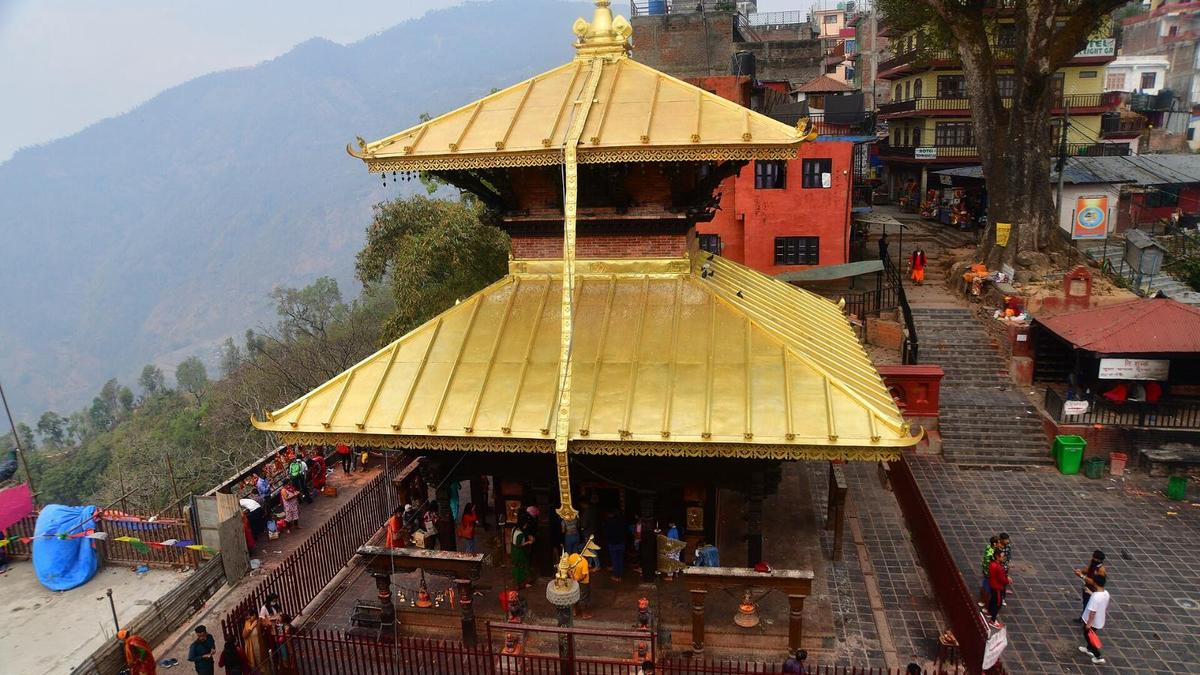
Soon after 8 am at Kurintar, beside the Trishuli, the first cabins of the day lift families and their puja offerings out of the lower station. Goats bought for offerings ride separately, in cargo cabins. About 10 minutes later the cabins reach the top, a short walk from the gold-plated roof of Manakamana Temple and the darshan queue.
By Uncover Nepal Guide · Checked by our Kathmandu travel team · Updated 12 Nov 2026
Manakamana Temple, a key stop in our Nepal pilgrimage guide, is the hilltop shrine of the wish-granting goddess Manakamana Devi in Gorkha district, at about 1,300 m. Most pilgrims ride the cable car from Kurintar, about 104 km from Kathmandu, which runs 8 am to 5 pm. Saturdays and Tuesdays bring the longest queues.
In this guide
- Key facts
- Where is Manakamana, and how high is the temple?
- The Manakamana cable car: fares, hours and closures
- Darshan at Manakamana Devi Temple: queues and busy days
- How to plan your darshan, step by step
- Manakamana Temple history and legend
- The 2015 earthquake and the rebuild
- How do you get to Manakamana from Kathmandu or Pokhara?
- For Indian pilgrims: ID, rupees and what to carry
- Things to see near Manakamana
- Fitting Manakamana into a longer trip
- Frequently asked questions
- Plan your visit with us
Key facts
- Location
- Shahid Lakhan Rural Municipality, Gorkha district (Nepal Tourism Board; The Rising Nepal, 13 November 2026)
- Height of the temple
- About 1,300 m (about 4,300 ft) (Manakamana Darshan Pvt Ltd; Ichchhakamana Rural Municipality brochure, 13 November 2026)
- Deity
- Manakamana Devi, an incarnation of Bhagawati, enshrined as a stone shila (Nepal Tourism Board; Manakamana Darshan Pvt Ltd, 13 November 2026)
- Cable car lower station
- Cheres, Kurintar, Ichchhakamana Rural Municipality, Chitwan district (The Rising Nepal; Manakamana Darshan Pvt Ltd, 13 November 2026)
- Cable car opened
- 24 November 1998, Nepal's first commercial cable car (Manakamana Darshan Pvt Ltd; The Himalayan Times, 13 November 2026)
- Line length and ride
- About 2.8 km; about 10 minutes (Government of Nepal film destination portal; Nepal Tourism Board, 13 November 2026)
- Cable car hours
- 8 am to 5 pm every day, apart from closure days (Manakamana Darshan Pvt Ltd, 13 November 2026)
- Adult cable car fare, one way or return
- Indian INR 400 or 670; Nepali NPR 450 or 770; SAARC USD 6 or 10; other foreign USD 11 or 20 (operator's published fares, not ours) (Manakamana Darshan Pvt Ltd, 13 November 2026)
- From Kathmandu
- About 104 km to Kurintar on the Prithvi Highway, about three hours by car (Government of Nepal film destination portal, 13 November 2026)
- Busiest days
- Saturdays and Tuesdays (Nepal Tourism Board, 13 November 2026)
- Rebuilt after 2015 earthquake
- Reopened to the public in late November 2018 (The Kathmandu Post, 13 November 2026)
Where is Manakamana, and how high is the temple?
Manakamana Temple stands on a ridge in Gorkha district, in central Nepal, at about 1,300 m (about 4,300 ft). The cable car that most pilgrims use starts below it at Kurintar, on the main highway in neighbouring Chitwan district, so the ride begins in Chitwan and ends in Gorkha.
The temple sits in Shahid Lakhan Rural Municipality, an area that was known as Manakamana VDC before Nepal's 2017 local-government restructuring.
Published heights differ by a few metres: the cable car company says the temple rests on a 1,300 m hill, a 2024 Kantipur feature put the top of the cable car at 1,302 m, and the brochure of Ichchhakamana Rural Municipality, at the foot of the ropeway, gives 1,303 m. "About 1,300 m" is the honest summary.
The Nepal Tourism Board says Manaslu and the Annapurna peaks are visible from the temple complex, and the cable car company adds Himalchuli. Below, the ridge overlooks the Trishuli and Marsyangdi rivers. Nobody can promise a clear view: cloud can hide the peaks on any day.
The Manakamana cable car: fares, hours and closures
The cable car is how most families reach the temple today. It opened on 24 November 1998 and was Nepal's first commercial cable car service. It is run by Manakamana Darshan Pvt Ltd, part of the Chitawon Co-E Group, and the system was installed by the Austrian firm Doppelmayr.
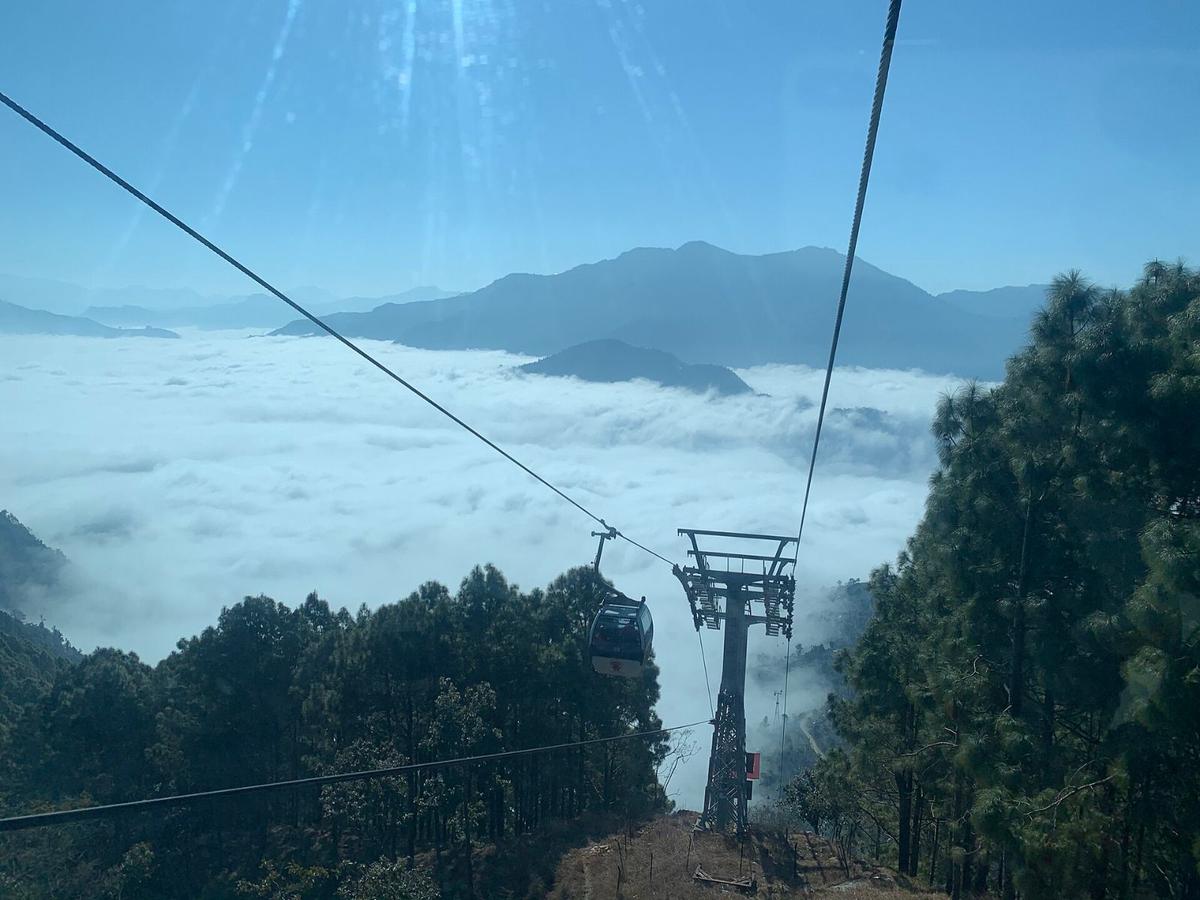
The line is about 2.8 km long and the ride takes about 10 minutes. A 2024 Kantipur feature reported 34 passenger cabins, each seating six, on 20 towers. In September 2024 the system was upgraded with Doppelmayr's D-Connect digital control, with the main haul rope, communication cables and gondola grips replaced.
In fiscal year 2022/23 the cable car carried 1,021,239 passengers in 11 months, Republica reported, and 26.41 per cent of them were Indian.
Cable car fares for 2026
These are the operator's published fares, checked 13 November 2026, not ours. The company says rates can change without notice, so confirm at the counter.
Manakamana cable car fares, one way and return (operator's published fares, checked 13 November 2026)
| Visitor group | One way | Return |
|---|---|---|
| Indian adult | INR 400 | INR 670 |
| Indian child (by height, ask at the counter) | INR 240 | INR 400 |
| Indian visitor with disability (verification card) | INR 200 | INR 340 |
| Nepali adult | NPR 450 | NPR 770 |
| Nepali child (by height, ask at the counter) | NPR 270 | NPR 460 |
| Nepali senior citizen (proof needed) | NPR 315 | NPR 540 |
| Nepali student (institutional ID) | NPR 335 | NPR 575 |
| Nepali visitor with disability (verification card) | NPR 225 | NPR 385 |
| SAARC adult | USD 6 | USD 10 |
| SAARC child (by height, ask at the counter) | USD 4 | USD 7 |
| SAARC visitor with disability (verification card) | USD 3 | USD 5 |
| Other foreign adult | USD 11 | USD 20 |
| Other foreign child (by height, ask at the counter) | USD 8 | USD 15 |
| Goat (cargo cabin) | NPR 275 | Not listed |
Rules from the same page:
- Indian visitors have their own fare column in Indian rupees, separate from the SAARC rate.
- Tickets are non-refundable and valid for seven days from purchase.
- Each passenger carries 15 kg of baggage free; extra weight is charged at NPR 20 per kg.
- Senior citizen and student fares need proof or ID at the counter.
- Children's fares go by height. The operator's page gives two different child height bands and two different senior ages, so we have not printed a cut-off; ask at the counter.
Older fares quoted on many websites are out of date.
Opening hours and closures
The cable car runs from 8 am to 5 pm. In the operator's own words:
"We are open every day until 5 pm through out the year."
Manakamana Darshan Pvt Ltd, "We are open every day", checked 13 November 2026
The planned exceptions are periodic maintenance shutdowns, three days in Dashain and two days in Tihar, announced in advance in the media and on the company's Facebook page. Closures without notice can happen for political or natural reasons. We found no published lunch break or seasonal hours. Recent examples:
- Mid-July to 17 September 2024: closed for the D-Connect upgrade.
- 10 to 17 September 2025: shut during the Gen Z movement, resuming on 17 September.
- 1 to 3 October 2025: closed, resuming on 4 October.
- March 2026: closed for two days during the House of Representatives election.
- 26 August 2026: suspended from 11:30 am as a precaution against flooding on the Bhote Koshi and Trishuli.
- 27 September 2026: an internal road at the cable car entrance subsided after rain and river erosion. The Himalayan Times and Annapurna Post reported the service closed that day; Ratopati reported that afternoon that the cable car and darshan were running, but that a landslide on the access road kept vehicles out of the usual parking area, with temporary parking beside the highway and a footpath from there.
- 6 October 2026: closed for one day for scheduled maintenance ahead of the festival season, resuming the next day (OnlineKhabar and Nagarik).
Riding with goats and luggage
Goats do not ride with passengers. They travel in separate cargo cabins on their own ticket, NPR 275 one way, with no return fare listed. Your own bags and puja items ride with you within the 15 kg free allowance.
Darshan at Manakamana Devi Temple: queues and busy days
Darshan at Manakamana Devi Temple means queuing, and on busy days it means queuing for hours. Saturdays and Tuesdays are the heaviest days, according to the Nepal Tourism Board, and Saturdays and public holidays also bring the most cable car passengers. A weekday other than Tuesday, on an early cabin, gives you a better chance of a shorter wait.
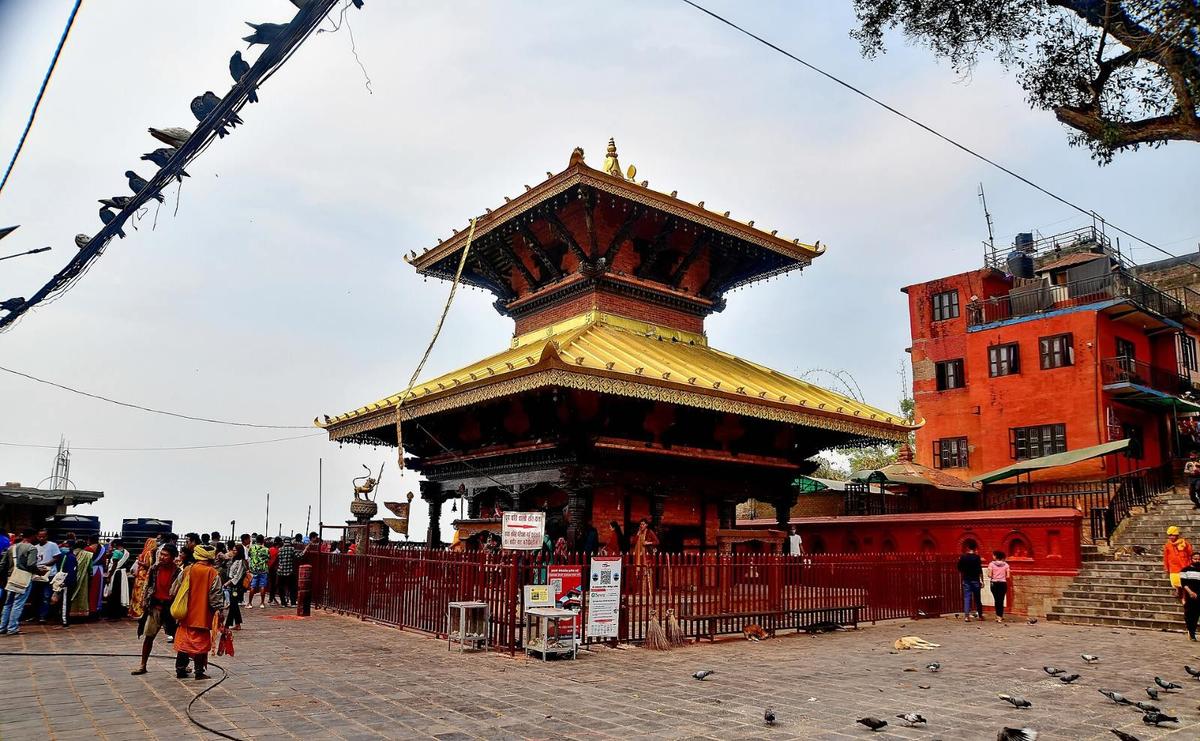
The Nepal Tourism Board puts it plainly:
"Especially Saturdays and Tuesdays see maximum rush when it takes hours just to get a glimpse of the goddess in the temple."
Nepal Tourism Board, Manakamana Temple, Gorkha, checked 13 November 2026
On one Saturday in November 2021, Nepal News reported 6,700 cable car riders and more than 9,000 temple visitors. In August 2026 the Manakamana Area Development Committee and Shahid Lakhan Rural Municipality opened a health assistance desk at the temple, offering primary care including ECG, for devotees waiting in long queues, some of them fasting. If you travel with elderly parents, that is worth knowing, and a quieter weekday is worth more.
We found no published opening hours for the temple itself, so plan darshan inside the cable car's 8 am to 5 pm window, and ask locally if you come up earlier by road.
Inside the shrine, the goddess is not a carved statue. The Nepal Tourism Board says Manakamana Devi is enshrined as a shila, a large boulder, with four other boulders for Bhairab, Ganesh, Kumari and Betaal. A special puja and fair is held at the temple on Guthi Panchami; Shahid Lakhan Rural Municipality declared a local holiday for it in 2025, so expect crowds on that day too.
How to plan your darshan, step by step
- Pick the day. Avoid Saturdays, Tuesdays and public holidays if you can, and check that your date does not fall on a Dashain or Tihar closure day.
- Check the cable car status the day before. Look for notices about maintenance, weather or road problems near Cheres, especially after heavy rain.
- Leave Kathmandu early. Allow about three hours for the 104 km drive to Kurintar, more in heavy traffic or when landslides hold up the highway.
- Carry the right ID. Indian visitors need an accepted identity document for Nepal (see below), and anyone claiming a senior citizen, student or disability fare needs proof.
- Buy return tickets at Kurintar. Use the Indian, Nepali, SAARC or foreign fare that applies to you. Buy a separate ticket for a goat, if your family is bringing one.
- Ride up and join the queue. The top station is a short walk from the temple. If elders find long standing hard, let them rest first, and remember the health assistance desk at the temple.
- Make your offering and take darshan. Give yourself time afterwards to walk around the courtyard and look out over the rivers.
- Ride down before 5 pm. The cable car stops at 5 pm, so do not leave the return to the last minute.
Manakamana Temple history and legend
Manakamana Temple history is mostly told through legend, and the legend comes in many versions. The Nepal Tourism Board explains the name simply: Manakamana means "having one’s wishes fulfilled". The cable car company describes the goddess as Manakamana Devi, an incarnation of Bhagawati who grants the wishes of pilgrims.
The legend of the queen and Lakhan Thapa
What follows is legend, told here as the temple's own story rather than recorded history. In the 17th century, the story goes, the queen of King Ram Shah of Gorkha was secretly a goddess. Only her devotee, Lakhan Thapa Magar, knew. When the king learned the truth, he died. The queen committed sati on his funeral pyre, but before she did she promised Lakhan Thapa that she would return.
Later, a farmer's plough struck a stone, and milk and blood flowed from it. Lakhan Thapa built a temple on the spot. Other versions give a specific founding year; we have left that out because we could not trace it to a reliable source.
The Magar priests
The legend lives on in who serves the goddess. By tradition, the priests at Manakamana are Magar, from the line of Lakhan Thapa. The cable car company says the priestly line is now in its 21st generation. The chief priest, as reported by The Kathmandu Post in 2018 and by OnlineKhabar in 2026, is Insan Thapa Magar.
Offerings and animal sacrifice
Most families bring their own puja offerings. Animal sacrifice is also part of the tradition here. A 1999 New York Times article, which the cable car company reprints on its site, described pilgrims bringing goats and chickens to the temple for sacrifice, and the cable car still sells a goat ticket today. We did not find a current official rule on sacrifice at Manakamana, in either direction, from the Nepal Tourism Board, the municipality or the press. If this matters to you, ask locally or ask us before you go.
The 2015 earthquake and the rebuild
The Manakamana Temple you see now is largely a rebuild. The earthquake of 25 April 2015 tilted the temple 9 to 12 inches (roughly 23 to 30 cm) towards the north-east and cracked its roofs, The Kathmandu Post reported. It was rebuilt from a new foundation under the supervision of Nepal's Department of Archaeology, and reopened to the public in late November 2018.
The new building is a pagoda-style temple in a large courtyard, with a gold-plated roof. About 18 kg of gold went into the roof. The coordinator of the renovation committee put it this way:
"We used 18 kilograms of the precious metal to gold-plate the temple’s roof."
Narendrababu Shrestha, Renovation Committee Coordinator, quoted in The Kathmandu Post, 15 September 2018
The reconstruction cost was reported at NPR 130 to 140 million, of which NPR 40 million came from the government.
How do you get to Manakamana from Kathmandu or Pokhara?
From Kathmandu, drive about 104 km west to the cable car station at Kurintar, which takes about three hours by car or jeep, then ride up. From Pokhara, follow the same main highway east towards Kathmandu. You can also go up by road from the Mugling side or walk up from Aanbukhaireni in about three hours.
From Kathmandu
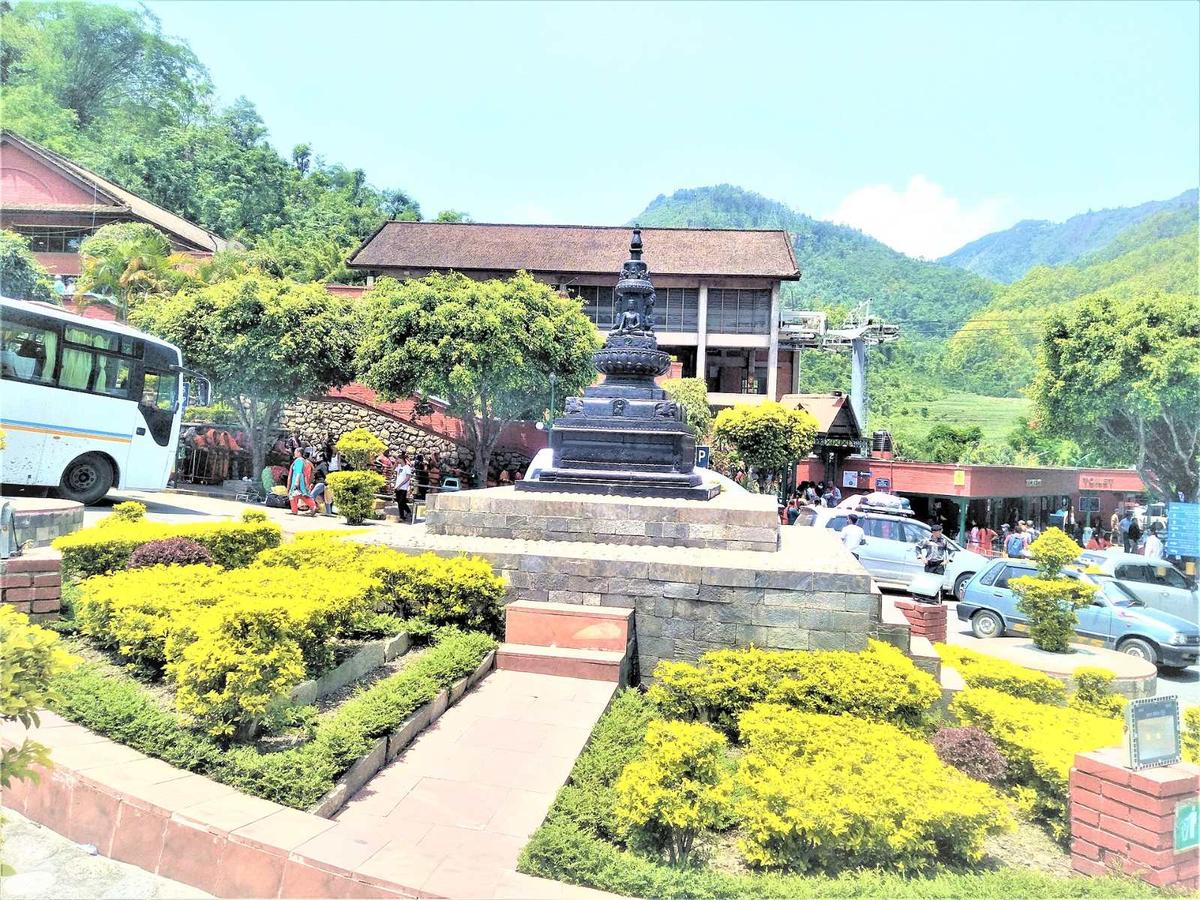
Kurintar is on the Prithvi Highway, the main road between Kathmandu and Pokhara, and the cable car station sits right on it. By car or jeep the 104 km takes about three hours. Mugling is about 110 km from Kathmandu, so Kurintar comes a little before it.
The highway near Kurintar is prone to landslides. Between 8 and 12 November 2026, repeated dry landslides at Ghoptebhir, in the same rural municipality as the lower station, blocked or slowed the Prithvi Highway, and on 12 November OnlineKhabar reported that traffic there was running one way only. Check the road the evening before you go. Our Kathmandu to Pokhara guide covers buses and the road in more detail.
From Pokhara
Manakamana is on the same highway: drive east towards Kathmandu, pass Mugling and stop at Kurintar. We found no reliable published distance from Pokhara, so we will not guess one. The full Kathmandu to Pokhara drive takes six to nine hours, so adding darshan makes a long day longer.
By road to the top
A road also climbs to the temple. From Mugling it is about 13.5 km, about an hour by jeep. Pilgrims who skipped the cable car used to cross the Trishuli on the suspension bridge from Cheres to Silingtar and take buses or jeeps up. Floods damaged that bridge badly in late September 2026, The Rising Nepal and OnlineKhabar reported. We had not seen a report that repairs were complete by 13 November 2026, so check before you plan on the road.
On foot from Aanbukhaireni
The walking route is the old way up. The Nepal Tourism Board describes the temple as "a pleasant three-hour trek uphill" from points on the highway, and the old route from Aanbukhaireni bazaar takes about three hours. It suits fit walkers, not elders or anyone fasting. You can also walk up and ride the cable car down.
Three ways up to Manakamana Temple (sources: Nepal Tourism Board, Government of Nepal film destination portal, The Himalayan Times, checked 13 November 2026)
| Way up | Starts from | Time | Good for | Watch for |
|---|---|---|---|---|
| Cable car | Cheres, Kurintar, on the highway | About 10 minutes | Families, elders, most pilgrims | Runs 8 am to 5 pm; closed on Dashain and Tihar days and for maintenance |
| Road | Mugling side, or via Silingtar | About an hour by jeep from Mugling | Groups going by jeep or bus | Silingtar bridge damaged by floods in late September 2026 |
| On foot | Aanbukhaireni bazaar | About three hours uphill | Fit walkers | A long uphill walk; not for elders or anyone fasting |
For Indian pilgrims: ID, rupees and what to carry
Indian nationals do not need a visa for Nepal, but you do need an accepted identity document, and Indian Rs 200 and Rs 500 notes have their own rules. Getting to Nepal is your own arrangement: we are a Kathmandu company and we start looking after you once you are in Nepal. The official details are on the Nepal Tourism Board tourist visa page.
ID for Indian visitors
NTB lists these valid documents for Indian nationals:
- a valid Indian passport
- a voter ID card issued by the Election Commission of India
- for people above 65, a PAN card, driving licence or ration card with a photo
- for children under 18, an identity card from their school principal
NTB states that an Aadhaar (UID) card is not accepted as a travel document. If you fly between India and Nepal, the Indian Embassy in Kathmandu accepts only a valid Indian passport or an Election Commission voter ID with a photo, as reported by Business Today in June 2026. The same report described tighter checks at land border crossings, where officials were told to refuse entry to anyone carrying only an Aadhaar card, so families arriving by road are safest with a passport or voter ID too.
Indian rupees
As reported on 24 July 2026, Nepal Rastra Bank allows Nepali and Indian citizens to bring, carry and exchange Indian Rs 200 and Rs 500 notes issued after 9 November 2016, up to INR 25,000 per person. Foreign currency above USD 5,000, or its equivalent, must be declared at customs on arrival. The cable car's Indian fares are quoted in Indian rupees, which helps, but carry some Nepali rupees as well for small purchases on the hill.
What to carry for the day
- your ID and, if relevant, proof for a senior, student or disability fare
- cash in small notes, in Nepali and Indian rupees
- your puja offerings, if your family brings its own
- drinking water and a light snack for anyone not fasting
- any regular medicines, especially for elders who will stand in the queue
- a hat or umbrella for sun or rain, and a light layer for a cool early morning
Things to see near Manakamana
The Nepal Tourism Board says the Bakreshwar Shiva Temple and Siddha Gufa, a cave, are about an hour's walk from the temple. The cable car company also lists Bakreshwor Mahadev, Lakhan Thapa Cave, Gorakhnath Cave and Betini village among the sights nearby, and hiking, rafting, cycling and picnics among the things to do.
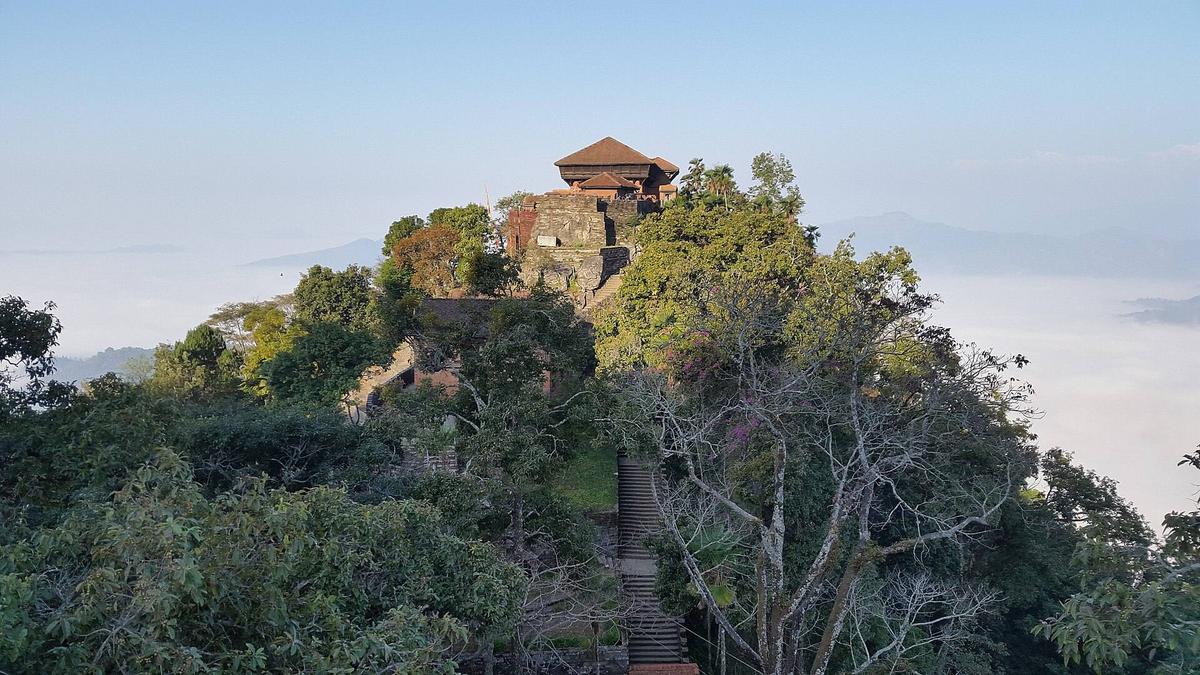
Gorkha Durbar. The hilltop palace above Gorkha town is about 36 km from Manakamana. King Ram Shah of the Manakamana legend was king of Gorkha, so the two visits sit well together on the same day if you start early, or across two days if you stay a night in the area.
The Trishuli at Kurintar. The lower station stands beside the Trishuli, and rafting is among the activities the cable car company lists nearby; ask us about the current season.
The Chitwan side. The ropeway starts in Chitwan district, and the usual road from Kathmandu to Chitwan National Park follows the same highway past Kurintar before turning south at Mugling, so you can break that drive here; our Kathmandu to Chitwan guide covers that road.
Fitting Manakamana into a longer trip
For Indian families on a Nepal temple circuit, the Manakamana mandir pairs well with the big shrines in the capital. Our guide to Pashupatinath Temple covers Kathmandu's great Shiva shrine, and Dakshinkali Temple is another goddess temple where Tuesdays and Saturdays are the busiest days, so plan those two visits for different days of the week. Muktinath, in Mustang, is a bigger journey that needs more time and some planning for altitude; our Mustang travel guide explains the permits and the road.
Manakamana rarely needs a trip of its own, so there is no Manakamana trip page on our site. Ask us to add Manakamana to a Kathmandu to Pokhara drive, or to a Chitwan transfer, and we will build the day around the cable car hours and the quieter days of the week. You can see the kind of trips we run on our cultural heritage tours page.
Frequently asked questions
What is the Manakamana cable car ticket price and timing?
The cable car runs 8 am to 5 pm. On the operator's fares (not ours), checked 13 November 2026, an Indian adult pays INR 400 one way or 670 return; a Nepali adult NPR 450 or 770; a SAARC adult USD 6 or 10; and other foreign adults USD 11 or 20. It closes for maintenance, three days in Dashain and two in Tihar.
What is the story of Manakamana Temple?
By legend, the 17th-century queen of King Ram Shah of Gorkha was a goddess, a secret known only to her devotee Lakhan Thapa Magar. After the king died, she committed sati, promising to return. Later a farmer's plough struck a stone that flowed with milk and blood, and Lakhan Thapa built a temple there. His descendants still serve as priests.
Which are the main Hindu pilgrimage sites in Nepal?
The Nepal Tourism Board's list includes Pashupatinath in Kathmandu, Muktinath in Mustang, Janaki Mandir in Janakpur, Manakamana in Gorkha, Gosainkunda in Rasuwa, Dakshinkali and Budhanilkantha near Kathmandu, Swargadwari in Pyuthan, Halesi Mahadev in Khotang and Barahakshetra in Sunsari. Our Nepal pilgrimage guide explains how to combine them.
Is there a Muktinath yatra package from India?
Not from us. We are an inbound company based in Kathmandu, so we do not sell packages that start in India, and your travel to Nepal is your own arrangement. Once you are here, we plan Muktinath trips from Kathmandu or Pokhara. The temple is at about 3,800 m (about 12,500 ft), according to NTB. Our Muktinath Temple guide covers routes and timing.
What is the Gosaikunda pilgrimage at Janai Purnima?
Gosaikunda (also written Gosainkunda) is a sacred lake at 4,380 m (about 14,370 ft) in Rasuwa district, inside Langtang National Park. On the Janai Purnima full moon, in July or August (28 August in 2026), pilgrims bathe in the lake, which Hindu legend links to Shiva cooling his throat after drinking poison. It is a high-altitude trek, not a day trip.
Plan your visit with us
Manakamana is an easy temple to reach and a hard one to time well. Go on a quiet weekday, start early, check for closures and carry the right ID, and it is a calm stop on the road between Kathmandu and Pokhara.
If you are building a wider temple circuit, our Nepal pilgrimage guide sets Manakamana alongside Nepal's other Hindu and Buddhist sites. When you know your dates, tell us who is travelling, including elders and children, and we will suggest the quietest day and fit Manakamana into your drive. Ask us on WhatsApp or through the enquiry form.