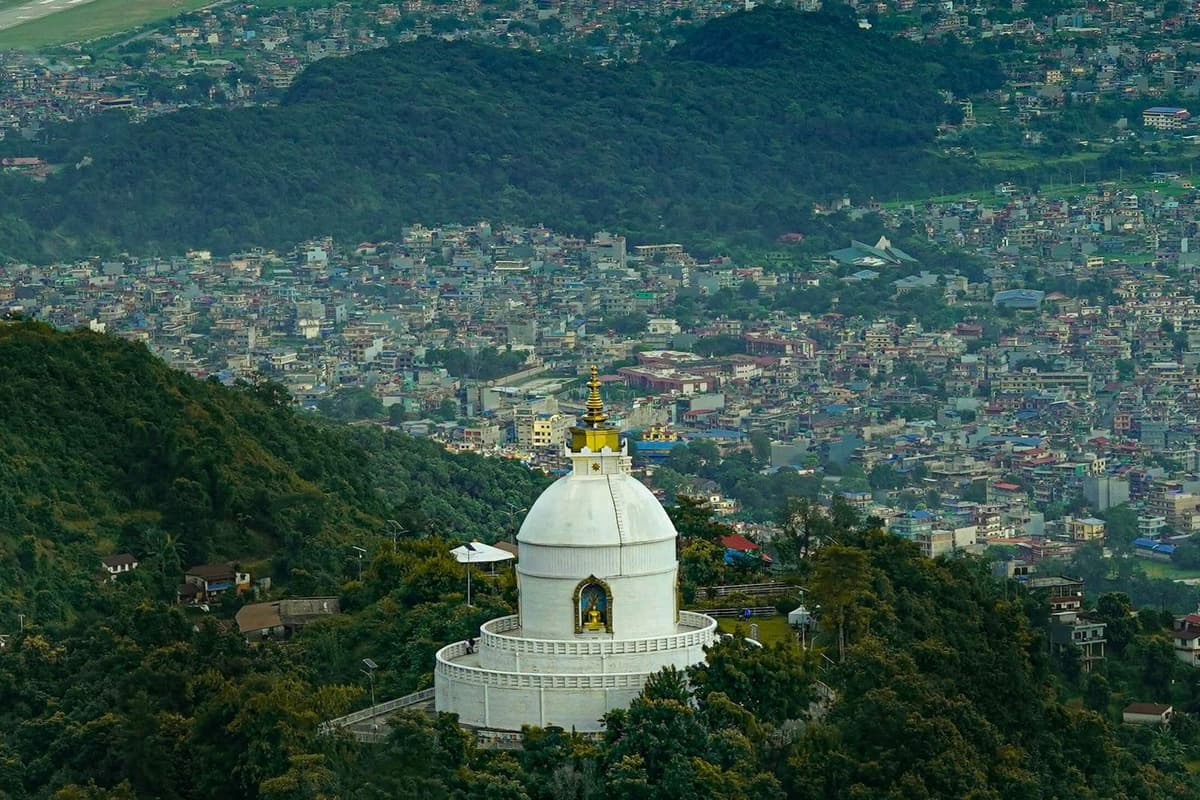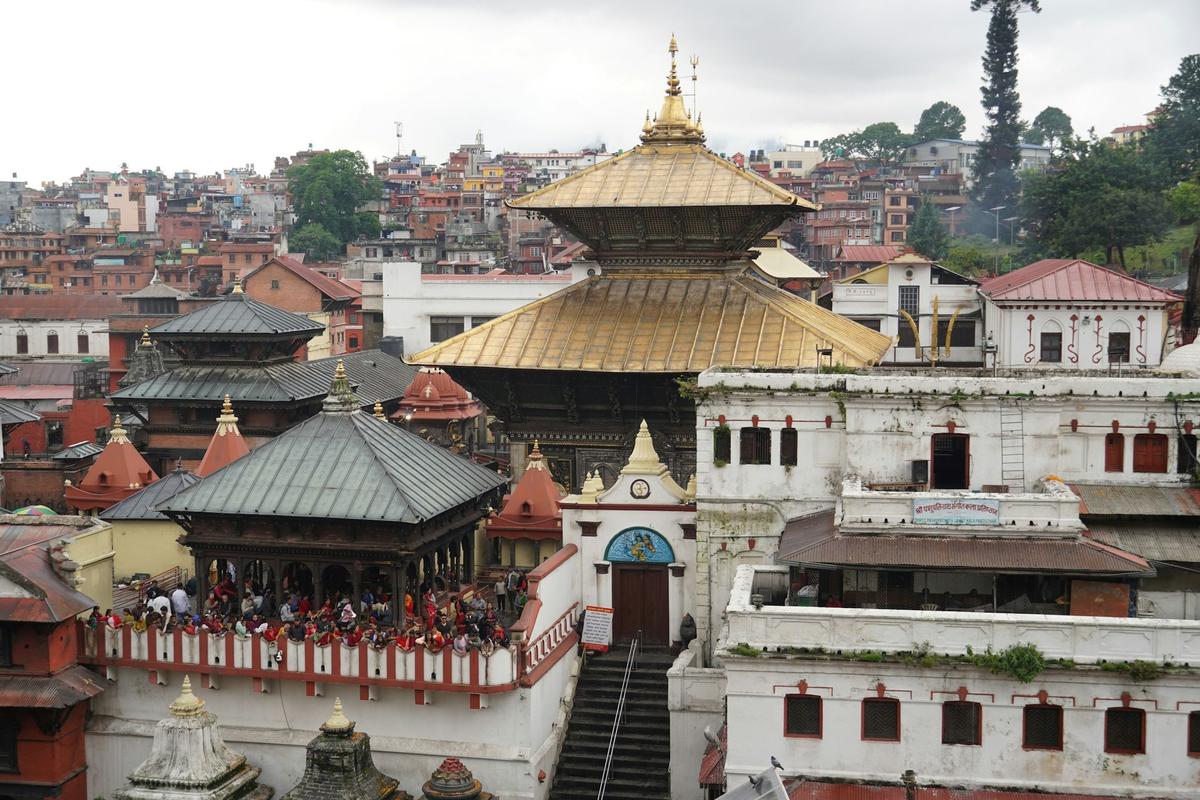
Bells ring across the Bagmati as the light goes, and incense smoke drifts past the gold roofs of Pashupatinath. Flower sellers line the lane to the gate with marigolds, bel leaves and little plates of red powder. Pilgrims from India and Nepal queue side by side, shoes left at the stalls, hands full of offerings.
By Uncover Nepal Team · Checked by our Kathmandu travel team · Last checked 9 November 2026
The best-known Kathmandu mandir is Pashupatinath, the Shiva temple the Nepal Tourism Board calls "the most revered Hindu temple in Nepal", and Indian visitors enter it free. Add Budhanilkantha, Dakshinkali, Changu Narayan and the Durbar Square temples and you have the heart of Hindu Kathmandu. For palaces, stupas and the rest of the city, see our guide to places to visit in Kathmandu.
Key facts
- Visa for Indian citizens
- Not needed to enter Nepal (Nepal Tourism Board (NTB), tourist-visa page (checked 9 Nov 2026))
- ID for Indian adults
- Valid Indian passport or Election Commission of India voter card. Aadhaar is not accepted as a travel document (NTB, tourist-visa page (checked 9 Nov 2026))
- Pashupatinath entry
- Free for Indian and Nepali nationals. NPR 1,000 for other foreign visitors, including other SAARC nationals and Chinese (NTB, heritage-site entry fees (checked 9 Nov 2026))
- What Indians pay elsewhere
- The SAARC rate, for example NPR 50 at Swayambhu and NPR 500 at Kathmandu or Patan Durbar Square (NTB, heritage-site entry fees (checked 9 Nov 2026))
- Pashupatinath main temple
- Hindus only. Non-Hindus watch from the terraces across the Bagmati (Pashupati Area Development Trust; NTB (checked 9 Nov 2026))
- Dakshinkali sacrifice days
- Tuesdays and Saturdays, when crowds are largest (NTB, Dakshinkali page (checked 9 Nov 2026))
- Budhanilkantha's big day
- Haribodhini Ekadashi, Fri 20 Nov 2026 (NTB; Hamro Patro (checked 9 Nov 2026))
In this guide
- Kathmandu mandir guide: which temples should you visit?
- What do Indian visitors need to know before visiting?
- What is Pashupatinath like for a Hindu visitor?
- Which Shiva temples in Kathmandu are worth seeing besides Pashupatinath?
- Where is the sleeping Vishnu at Budhanilkantha?
- What happens at Dakshinkali, and which days are quieter?
- Why is Changu Narayan worth the drive?
- Which temples stand in Kathmandu Durbar Square?
- What are the main temples in Patan?
- Which temples do Hindus and Buddhists share?
- How should you dress and behave at a Hindu temple in Kathmandu?
- When is the best time to visit Kathmandu's temples?
- How can you group the temples into days?
- Frequently asked questions
- Plan your visit
Kathmandu mandir guide: which temples should you visit?
With one day, go to Pashupatinath and stay for the evening aarti. With two or three, add Budhanilkantha in the north, Dakshinkali in the south, Changu Narayan in the east and the Durbar Square temples of Kathmandu and Patan. The table shows each temple's deity, location, fee and who may go inside.
"Mandir" means temple in both Hindi and Nepali, so asking a taxi driver for "Pashupati mandir" works. The temples of Kathmandu Valley are places of worship first and sights second, and the rules on who may enter the inner shrine exist for the families who come to pray.
| Temple | Deity | Where | Fee for Indian visitors | Fee for other foreign visitors | Who may enter the inner shrine | Best time |
|---|---|---|---|---|---|---|
| Pashupatinath | Shiva (Pashupati) | On the Bagmati River, Kathmandu | Free | NPR 1,000 (also non-Indian SAARC and Chinese) | Hindus only; others watch from the terraces across the river | Dusk for the aarti; Maha Shivaratri, Sat 6 Mar 2027 |
| Guhyeshwari | The goddess, one of the Shakti Peeths | About 1 km east of Pashupatinath on the Bagmati | None published; donations welcome | None published | Non-Hindus are not allowed in | With your Pashupatinath visit |
| Budhanilkantha | Vishnu, the sleeping image | About 9 to 11 km north of the city | None published | None published | Only Hindus go down to the image | Haribodhini Ekadashi, Fri 20 Nov 2026 |
| Dakshinkali | Kali | About 22 km away, at the valley's southern edge | None published | None published | Ask at the temple | Tue and Sat are sacrifice days; other days are quieter |
| Changu Narayan | Vishnu (Narayan) | Changu hill, Bhaktapur district, about 12 km east | Figures differ (NPR 100 or 300); check at the gate | Figures differ (NPR 300 or 400); check at the gate | Ask at the temple | A clear day, paired with the Nagarkot walk |
| Doleshwor Mahadev | Shiva | Sipadol, Bhaktapur district, about 20 km from Kathmandu | None published | None published | Ask at the temple | Shrawan, Maha Shivaratri and Teej fairs |
| Kumbheshwar | Shiva | About 200 m north of Patan Durbar Square | None published | None published | Ask at the temple | Janai Purnima, expected Tue 17 Aug 2027 |
| Taleju, Jagannath, Kal Bhairav, Kumari Ghar | Taleju, Jagannath, Kal Bhairav and the Kumari | Kathmandu Durbar Square | NPR 500 (square ticket) | NPR 1,000 (square ticket) | Taleju opens only on Maha Navami; never photograph the Kumari | Any day; Maha Navami during Dashain for Taleju |
| Krishna Mandir | Krishna | Patan Durbar Square | NPR 500 (square ticket) | NPR 1,000 (square ticket; Chinese NPR 500) | Ask locally | Krishna Janmashtami, expected Wed 25 Aug 2027 |
| Golden Temple (Kwa Bahal) | Buddhist monastery | A short walk north of Patan Durbar Square | Check at the door | A small separate fee; check at the door | Shoes off; no leather items inside | Any day |
| Swayambhunath | Buddhist stupa, visited by Hindus too | On a hillock 3 km west of the city | NPR 50 | NPR 200 | No restriction published | Clear October and November mornings |
| Seto Machhindranath | Karunamaya | Jana Bahal, Keltol, between Asan and Indra Chowk | None published | None published | Ask at the temple | Chariot festival in Chaitra |
| Bajrayogini | Vajrayogini | Sankhu, about 20 km north-east | None published | None published | Ask at the temple | Bajrayogini Jatra each April |
Children under 10 enter Swayambhu and Kathmandu Durbar Square free. "None published" means we found no official fee; donations and offerings are your choice. Fees were checked on the Nepal Tourism Board's heritage-site entry fee page on 9 November 2026.
What do Indian visitors need to know before visiting?
You do not need a visa to enter Nepal as an Indian citizen. Carry a valid Indian passport or your Election Commission of India voter card, because Aadhaar is not accepted as a travel document. At most heritage sites you pay the SAARC rate, and at Pashupatinath Indian nationals enter free.
"Travelers of Indian nationality do not need visa to enter Nepal."
Nepal Tourism Board, tourist-visa page, checked 9 November 2026
Which ID is accepted
The Nepal Tourism Board lists these for Indian nationals:
- A valid Indian passport.
- An election (voter) card issued by the Election Commission of India.
- A PAN card, driving licence or ration card with a photo and proof of age, but only for people above 65.
- For children below 18, an identity card from the school principal.
Aadhaar (UID) is not accepted. Keep the same document with you in Kathmandu: the SAARC rate, and free entry at Pashupatinath, depend on your nationality.
Indian rupees
Under the Nepal Rastra Bank guideline reissued in July 2026, as reported by ShareSansar on 24 July 2026, Nepali and Indian citizens may bring in, take out or exchange Indian ₹200 and ₹500 notes issued after 9 November 2016, up to INR 25,000 per person. Temple fees are charged in Nepali rupees, so change some money before you go to the gates.
Entry documents and your journey to Kathmandu are your own arrangements; we do not arrange them.
What is Pashupatinath like for a Hindu visitor?
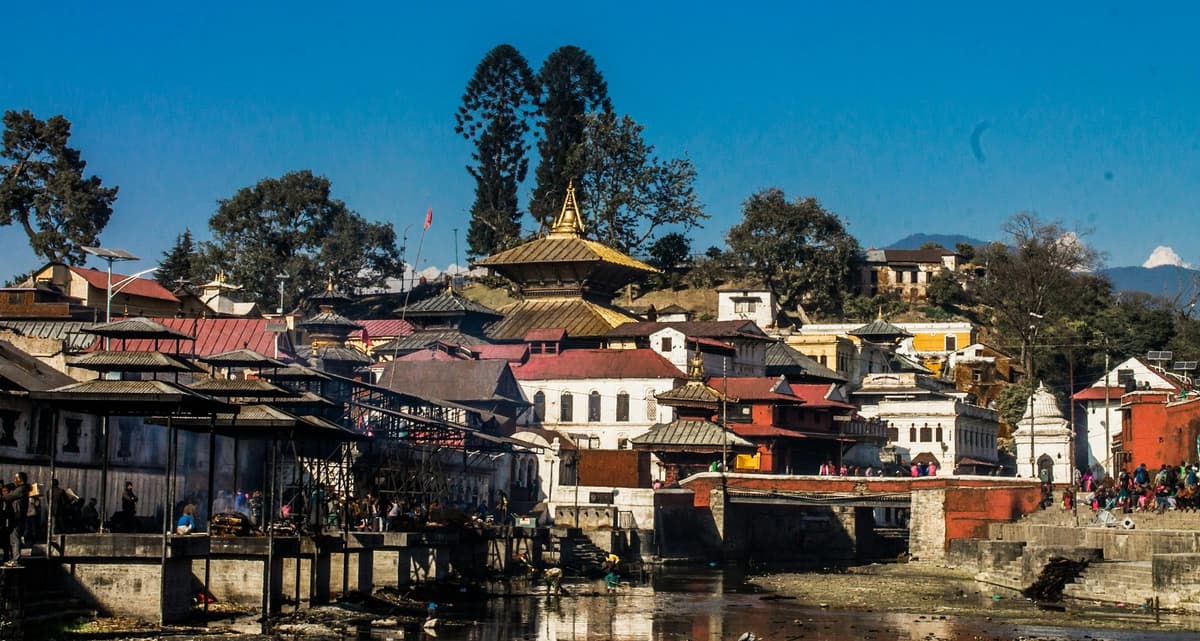
Pashupatinath is Shiva's temple on the Bagmati, and for Hindu visitors it is a full darshan: you go into the main courtyard, make your offering and join the crowd at the shrine. Non-Hindus cannot go inside; they watch from the terraces across the river. The area opens at 4 am.
"Non-Hindu visitors are not permitted inside the main sanctum."
Pashupati Area Development Trust website (pashupati.org.np), checked 9 November 2026
Beyond the main temple there are smaller shrines, the riverside ghats where cremations take place and the terraces on the east bank. Pashupati is one of the valley's seven UNESCO monument zones. Our Pashupatinath Temple guide covers gates, puja and festival crowds in depth.
The ghats are where Kathmandu families bring their dead. Watch quietly, keep a distance and do not photograph grieving families.
The evening aarti on the Bagmati
The Bagmati aarti starts around dusk every evening. The start time moves with the season, and the Trust's own website gives two different timings, so check on the day. Arrive early for a place on the steps.
Guhyeshwari, a short walk along the river
Guhyeshwari is about 1 km east of Pashupatinath on the Bagmati. The Nepal Tourism Board names it one of the Shakti Peeths, and non-Hindus are not allowed in. It was renovated by Pratap Malla in the 17th century, as reported.
Photos, shoes and leather
Photography and video are not allowed inside the main temple. In September 2023 the Trust warned of fines of NPR 500 to 2,000, and a Trust official said cameras or phones could be seized, as PTI reported. Leave shoes and leather items outside the inner temple, as is the custom.
Which Shiva temples in Kathmandu are worth seeing besides Pashupatinath?
After Pashupatinath, the two Shiva temples most worth your time are Doleshwor Mahadev in Bhaktapur district, which the temple and the Nepal Tourism Board link to Kedarnath, and Kumbheshwar, a five-tiered temple in Patan. Neither has a published entry ticket, and each has its own festival day, given below and in the festival table.
Doleshwor Mahadev and the Kedarnath link
Doleshwor Mahadev is a Shiva temple in Sipadol, Bhaktapur district, about 20 km from the capital according to the Nepal Tourism Board. Locals also call it Bimaleshwor or Sipare Mahadev.
For Indian pilgrims its draw is the link with Kedarnath. On 22 August 2009, according to the temple, the head priest of Kedarnath, Jagat Guru Bheemashankarling Shivacharya, unveiled a plaque declaring Doleshwor the head of Kedarnath; the Nepal Tourism Board also records the 2009 declaration. The temple holds special fairs in Shrawan, on Maha Shivaratri and at Teej. It pairs well with Bhaktapur, where the municipality has charged SAARC and Chinese visitors NPR 500 and other foreign visitors NPR 2,000 since 17 July 2025.
Kumbheshwar in Patan
Kumbheshwar stands about 200 m north of Patan Durbar Square. It was built around 1392 under Jayasthiti Malla, as reported. Its pond is said to be fed from Gosaikunda, and people bathe there at Janai Purnima, expected on Tuesday 17 August 2027.
Where is the sleeping Vishnu at Budhanilkantha?
Budhanilkantha is about 9 to 11 km north of Kathmandu. Its image of Vishnu lying asleep in a pond is about 5 m long, carved from a single stone and probably dates from the 7th century, in the Licchavi period. Only Hindus go down to the image.
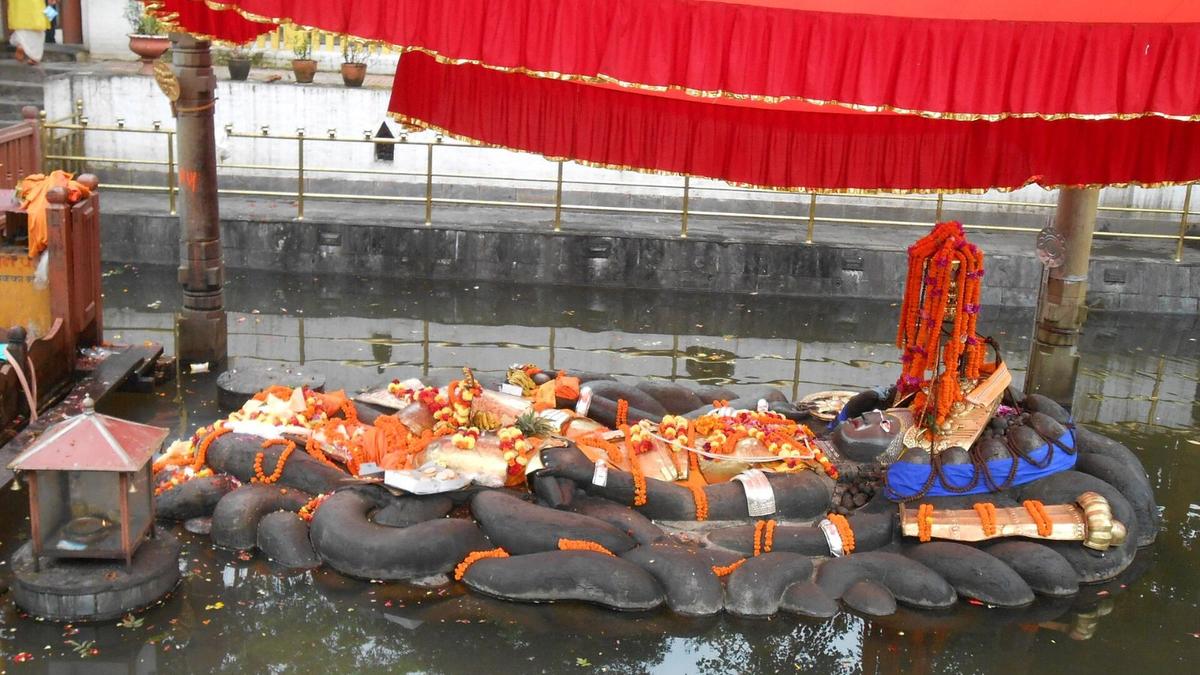
The biggest day of the year here is Haribodhini Ekadashi, when Vishnu is said to wake, and in 2026 it falls on Friday 20 November. Expect crowds that day. There is no published entry ticket. Our Budhanilkantha Temple guide has the full detail on the image and the festival.
What happens at Dakshinkali, and which days are quieter?
Dakshinkali is a temple of Kali about 22 km from Kathmandu, at the southern edge of the valley. Animal sacrifices are offered here on Tuesdays and Saturdays, and those are the days when crowds are largest. If you would rather not see a sacrifice, go on another day.
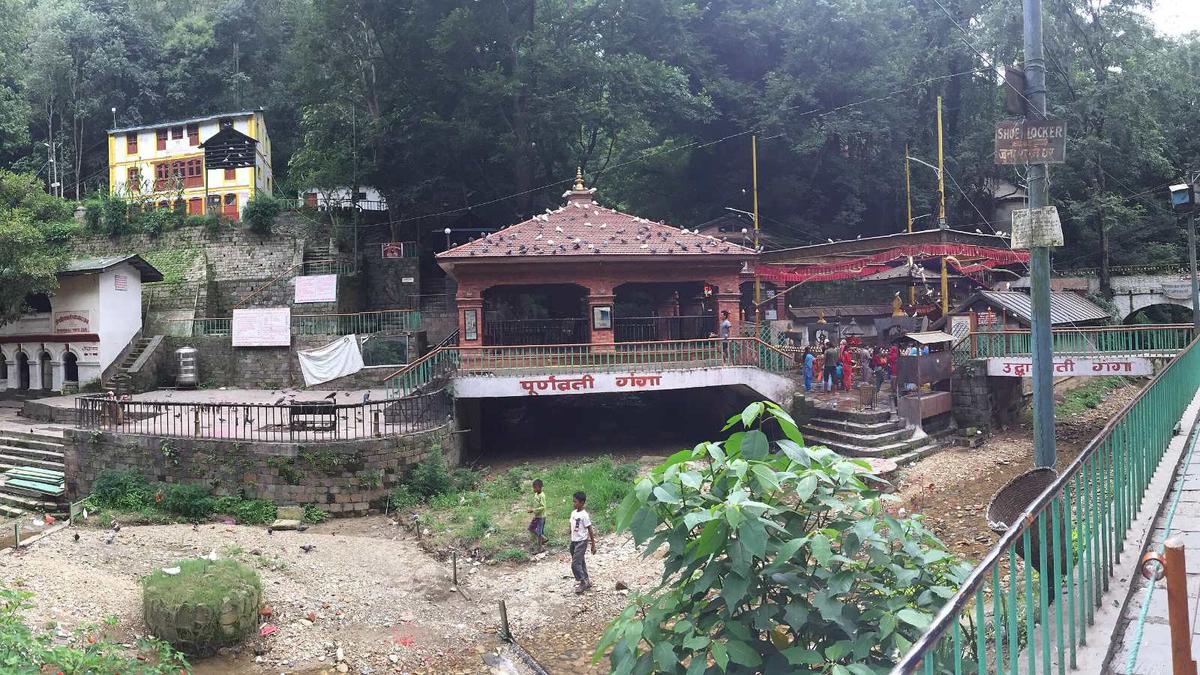
For the families who bring offerings, this is worship, and visitors should treat it that way. On the busy days the steps down to the shrine get very crowded. If you are not taking part, stay back, keep your camera down and let families go first.
There is no published entry ticket. Whether non-Hindus may enter the inner courtyard is something to ask at the temple. Our Dakshinkali Temple guide explains how to plan a visit on a quieter day.
Why is Changu Narayan worth the drive?
Changu Narayan is a temple of Vishnu, worshipped here as Narayan, on Changu (Dolagiri) hill in Changunarayan Municipality, Bhaktapur district, about 12 km east of Kathmandu. It is one of the seven monument zones of the Kathmandu Valley World Heritage property, and its carved doors reward a slow look.
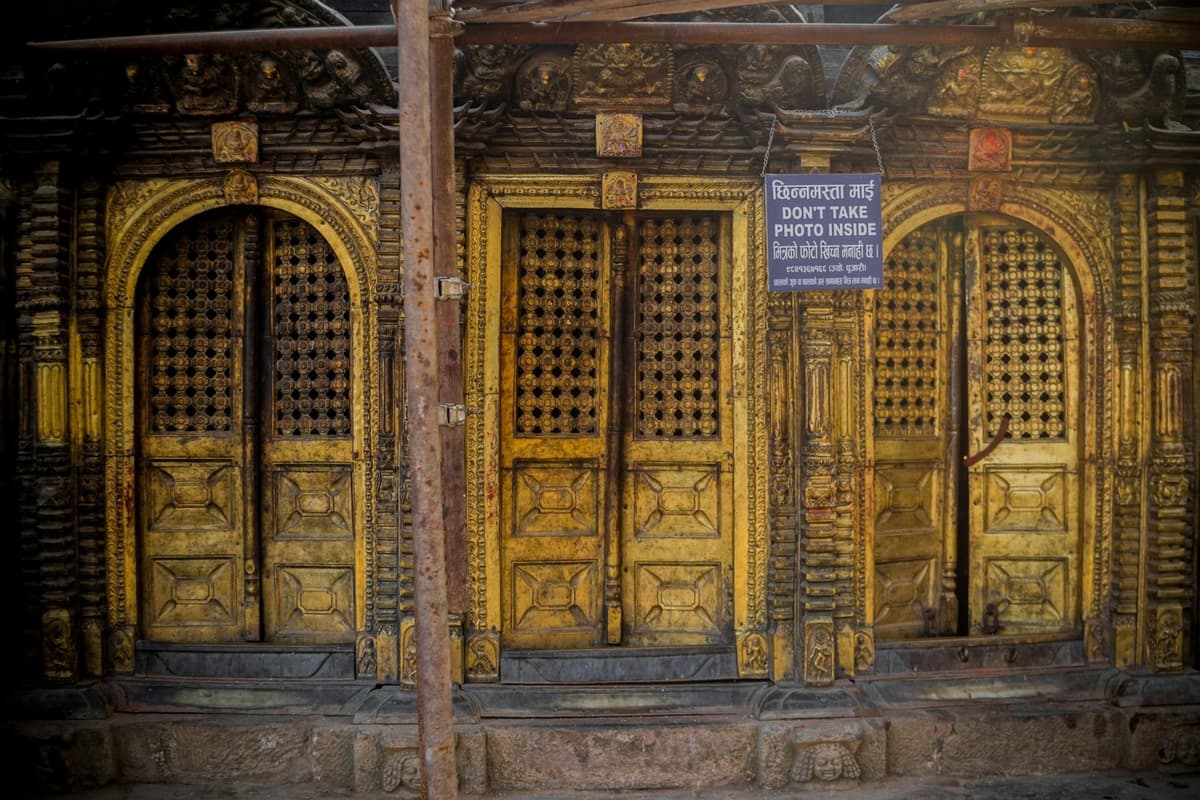
The temple keeps a stone pillar inscription of the Licchavi king Manadeva, which historians date to 464 AD; it is among the oldest inscriptions in Nepal. For a devotee, it means worship on this hill goes back at least to Manadeva's time.
Changu Narayan has its own ticket for foreign and SAARC visitors, collected by the municipality. Published figures differ (NPR 300 or 400 for foreign visitors, NPR 100 or 300 for SAARC visitors including Indians), so check at the gate.
Which temples stand in Kathmandu Durbar Square?
Kathmandu Durbar Square holds four temples worth knowing before you go: Taleju, the Jagannath temple, Kal Bhairav and the Kumari Ghar. One square ticket covers them: NPR 500 for SAARC visitors, including Indians, and NPR 1,000 for other foreign visitors. Some of what you see was rebuilt after the 2015 earthquake.
By May 2025, 134 of the 174 heritage structures damaged in the valley's three World Heritage cities had been rebuilt, according to Department of Archaeology figures reported by The Rising Nepal.
Taleju
Taleju was the royal goddess of the Malla kings, and her temple was built in 1564 under Mahendra Malla, as reported. It opens to worshippers only on Maha Navami during Dashain. The rest of the year you see it from outside.
Jagannath temple
The Jagannath temple was built by Mahendra Malla, according to the palace museum, and Lonely Planet says it "may actually date back to 1563". It is known for the erotic carvings on its roof struts; suggested reasons include lightning protection, sex education and Tantric ideas.
"No one knows why the erotic art are there in the struts of the temples."
Shivaji Das, quoted in The Kathmandu Post, 11 January 2020
Kal Bhairav
The Kal Bhairav image was installed by Pratap Malla, according to the palace museum. People still stop to pray and leave offerings in front of it, so give them room before taking a photo.
Kumari Ghar
The Kumari Ghar, home of the living goddess Kumari, was built in 1757 by Jaya Prakash Malla. She appears at the window a few times a day, but there is no fixed timetable. Never photograph her. You may photograph the courtyard when she is not at the window.
What are the main temples in Patan?
The two Patan temples to plan around are Krishna Mandir in Patan Durbar Square and the Golden Temple a short walk north. Kumbheshwar, the Shiva temple covered above, is about 200 m north of the square. The Patan ticket, which includes Patan Museum, is NPR 500 for SAARC visitors and NPR 1,000 for other foreign visitors (Chinese visitors pay NPR 500), but check at the gate.
Krishna Mandir
Krishna Mandir is the stone shikhara temple of Krishna in Patan Durbar Square, dated 1637 (some sources give 1667). It is covered by the square ticket. Krishna Janmashtami is its big night, expected on Wednesday 25 August 2027. We have not confirmed whether non-Hindus may go to the upper floors, so ask locally.
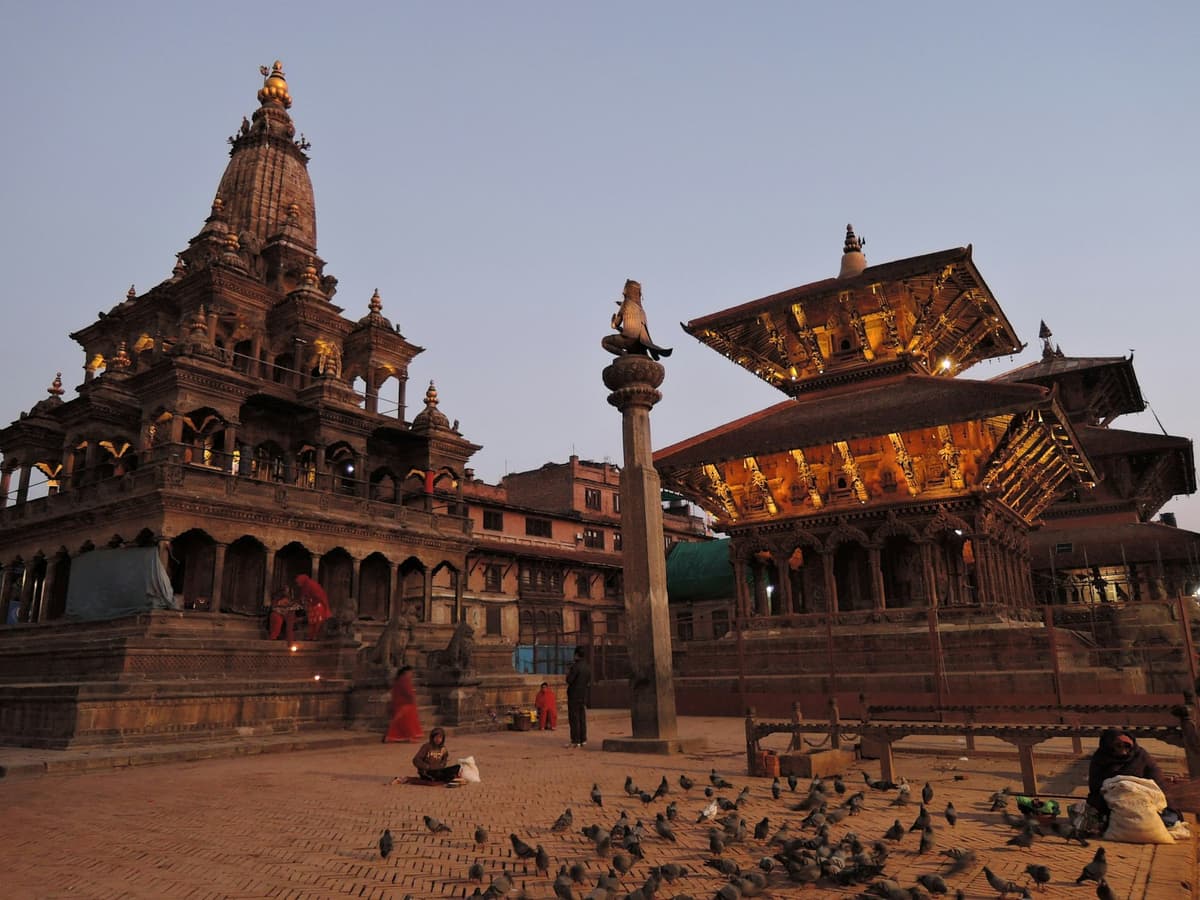
The Golden Temple
The Golden Temple is a Buddhist monastery, Hiranya Varna Mahavihar, known locally as Kwa Bahal. Take your shoes off at the entrance, and leave leather items such as belts and bags outside. It charges a small separate fee for foreign visitors that the Patan ticket does not cover; check at the door.
Which temples do Hindus and Buddhists share?
Several Kathmandu shrines are worshipped by Hindus and Buddhists alike. Swayambhunath is a Buddhist stupa where Hindus also pray, and Karunamaya at Seto Machhindranath and Vajrayogini at Sankhu are sacred to both faiths. UNESCO names this mix of the two faiths as one of the reasons the whole valley was made a World Heritage property in 1979.
"The property is tangibly associated with the unique coexistence and amalgamation of Hinduism and Buddhism."
UNESCO World Heritage Centre, Kathmandu Valley, criterion (vi), checked 9 November 2026
Swayambhunath
Swayambhunath stands on a hillock 3 km west of Kathmandu, reached by steep stone steps. Buddhists and Hindus both come to pray, and visitors have called it the Monkey Temple since the 1970s. SAARC visitors, including Indians, pay NPR 50 and other foreign visitors NPR 200. Our Swayambhunath Monkey Temple guide covers the steps, the shrines and the view.
Seto Machhindranath
Seto Machhindranath is in Jana Bahal at Keltol, between Asan and Indra Chowk in the old city. The deity is Karunamaya, an aspect of Avalokiteshvara, worshipped by Hindus and Buddhists. The chariot festival is held in Chaitra; in 2026 it began on 26 March.
Bajrayogini
Bajrayogini is in Sankhu, about 20 km north-east of Kathmandu. The goddess Vajrayogini is sacred to Hindus and Buddhists and is also linked with Ugra Tara. The Bajrayogini Jatra is held each April.
How should you dress and behave at a Hindu temple in Kathmandu?
Dress as you would for a temple at home, leave shoes and leather outside the inner temple, ask before photographing people and follow the signs on who may enter. Asking first is always fine; walking in where you should not is what causes offence, so when in doubt, wait and watch what local families do.
- Shoes and leather. Shoes stay outside the inner temple. Leave leather belts, wallets and bags outside as well where you can.
- Clothes. Covered shoulders and knees, for men and women.
- Photos. None inside Pashupatinath's main temple. Never photograph the Kumari. At cremations and sacrifices, keep your camera down.
- Direction. Walk clockwise around shrines and stupas, as local people do.
- Offerings. Flowers, incense and coins are welcome. Take prasad with your right hand.
When is the best time to visit Kathmandu's temples?
October and November are the best months for most visitors, with dry days, mild afternoons and clear skies. The monsoon, normally from 13 June to 2 October, brings heavy rain, but the temples stay open and festivals carry on. Plan around a festival if darshan on a special day matters to you.
The Nepal Tourism Board puts it simply: "the clearest skies are found after the monsoon in October and November". In 2026 the monsoon fully withdrew on 14 October.
Weather month by month
| Month | Average high | Average low | Rain |
|---|---|---|---|
| October | 27.2 °C | 13.9 °C | 43.3 mm |
| November | 23.6 °C | 8.4 °C | 6.4 mm |
| December | 20.2 °C | 4.2 °C | 7.8 mm |
| January | 19.2 °C | 2.8 °C | 15.2 mm |
| March | 26.0 °C | 8.8 °C | 38.0 mm |
| April | 28.6 °C | 12.3 °C | 62.9 mm |
| July | 28.7 °C | 20.3 °C | 384.1 mm |
Tribhuvan Airport station, 1991 to 2020 normals (WMO and the Department of Hydrology and Meteorology). Winter mornings are cold, so carry a warm layer for early visits.
Temple festival dates
| Festival | Where | Date |
|---|---|---|
| Haribodhini Ekadashi | Budhanilkantha | Fri 20 Nov 2026 |
| Maha Shivaratri | Pashupatinath, Doleshwor | Sat 6 Mar 2027 |
| Seto Machhindranath chariot festival | Old Kathmandu, from Jana Bahal | Chaitra (began 26 Mar in 2026) |
| Bajrayogini Jatra | Sankhu | Each April |
| Janai Purnima | Kumbheshwar, Patan | Expected Tue 17 Aug 2027 |
| Krishna Janmashtami | Krishna Mandir, Patan | Expected Wed 25 Aug 2027 |
| Teej | Pashupatinath, Doleshwor | Expected Fri 3 Sep 2027 |
| Maha Navami (Taleju opens) | Kathmandu Durbar Square | During Dashain; 2027 date not yet published |
"Expected" means the official 2084 BS holiday list was not out when we checked. Festival days are crowded, so go early.
How can you group the temples into days?
Group the temples by direction and you spend far less time in traffic. Pashupatinath is in the east, Budhanilkantha in the north and Dakshinkali in the south. Each line below is one outing. The trips beyond Bhaktapur take longest, because Changu Narayan, Doleshwor and Bajrayogini sit on separate roads.
- East. Pashupatinath and Guhyeshwari, ending with the aarti.
- Old Kathmandu. Durbar Square, Seto Machhindranath near Asan, then Swayambhunath.
- Patan. Krishna Mandir, the Golden Temple and Kumbheshwar, on foot.
- North. Budhanilkantha, ideally early.
- South. Dakshinkali: Tuesday or Saturday for puja, another day to avoid sacrifices.
- Beyond Bhaktapur. Changu Narayan with the Nagarkot walk, Doleshwor with Bhaktapur, or Bajrayogini in Sankhu.
Frequently asked questions
How many steps does Swayambhunath have, and what about the monkeys?
Swayambhunath is reached by steep stone steps up its hillock. The count is often said to be 365, but published counts differ, so take it as a climb rather than a number. The monkeys gave the place its visitor name, the Monkey Temple. Keep food and plastic bags out of sight, do not feed them, and hold on to sunglasses and phones near the top.
How do I combine Changu Narayan with a Nagarkot hike?
Walk downhill. Drive to Nagarkot, about 32 km and usually 1.5 to 2 hours by road, then walk down to Changu Narayan, which takes about 3 hours via Telkot. The other way, uphill from Changu Narayan to Nagarkot, takes about 4 to 5 hours. From Changu it is about 12 km back to Kathmandu. Carry cash for the Changu ticket and check the fee at the gate.
When is the best time to visit Kathmandu?
October and November are the best months: the Nepal Tourism Board says the clearest skies come after the monsoon then, and November averages only 6.4 mm of rain. December to February is dry but cold at dawn. The monsoon normally runs from 13 June to 2 October, with heavy rain in July and August, though temples stay busy all year.
Can non-Hindus enter Pashupatinath Temple?
No. The Pashupati Area Development Trust says non-Hindu visitors are not permitted inside the main sanctum. Non-Hindus can walk the wider area, see the smaller shrines and watch the evening aarti from the terraces across the Bagmati. Guhyeshwari, nearby on the river, is also closed to non-Hindus. Hindu visitors from India enter as any Hindu would.
Is there a Jagannath temple in Kathmandu?
Yes. The Jagannath temple stands in Kathmandu Durbar Square, built by Mahendra Malla according to the palace museum, and possibly dating to 1563, according to Lonely Planet. It is known for the erotic carvings on its roof struts. The Durbar Square ticket covers it, along with Taleju, Kal Bhairav and the Kumari Ghar.
Can I use my Aadhaar card to enter Nepal?
No. The Nepal Tourism Board says Aadhaar (UID) is not accepted as a travel document. Indian adults can use a valid Indian passport or an Election Commission of India voter card. A PAN card, driving licence or photo ration card, with proof of age, is accepted only for people above 65. This is information only; entry documents are your own arrangement.
Plan your visit
Traffic, festival crowds and the shifting times at Pashupatinath are easier with someone local planning the order of the day. Browse our cultural heritage tours for the options. The Kathmandu UNESCO World Heritage Sites day tour takes in several of the seven monument zones in one day, and the three Durbar Squares tour covers the Durbar Squares of Kathmandu, Patan and Bhaktapur.
Tell us which temples matter to you and your dates, on WhatsApp or through the enquiry form, and we will suggest an honest plan. For the rest of the city, see our guide to places to visit in Kathmandu.
Your Nepal visa and international flights are your own arrangements; official visa information is on the Nepal Tourism Board tourist-visa page.