
by gomayu
Search Tours or Places

Budhanilkantha Temple Kathmandu: The Sleeping Vishnu

19 min read Posted 10 Nov 2026Updated 06 Nov 2026
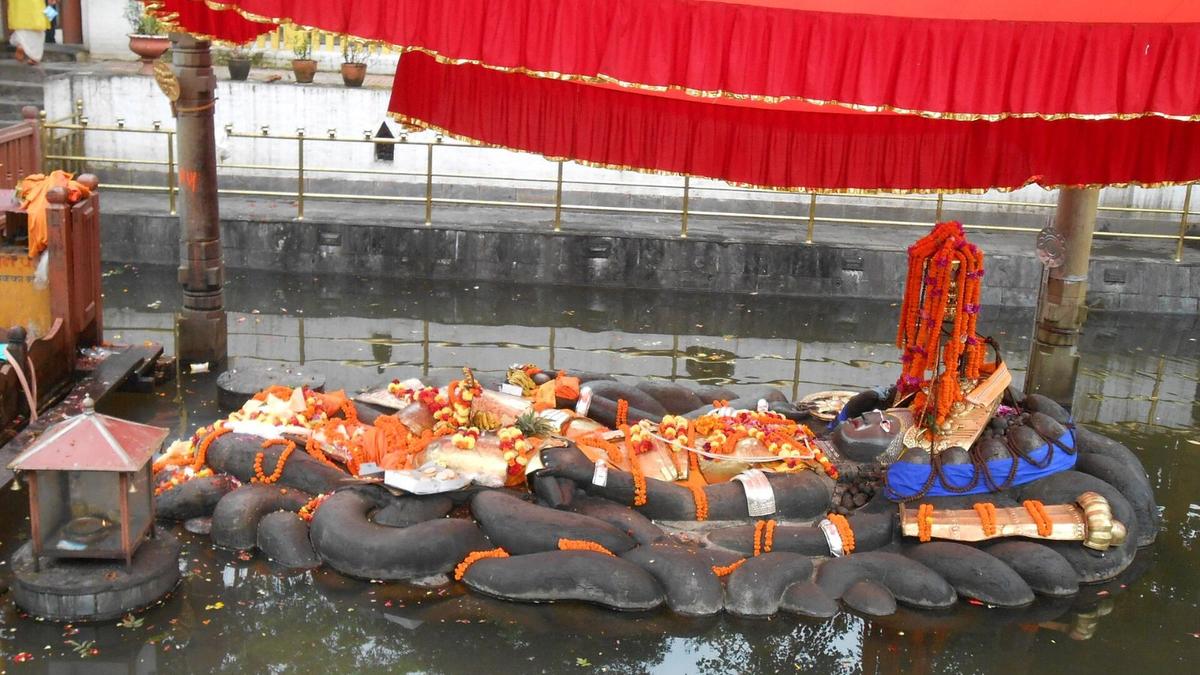
The great stone statue of the sleeping Vishnu lying in its pond at Budhanilkantha, Kathmandu

By Uncover Nepal Team · Checked by our Kathmandu travel team · Last checked 7 Nov 2026

On 25 July 2026, the day of Harishayani Ekadashi, the doors at Budhanilkantha opened at 3 am because devotees were already arriving. They had come to see Vishnu asleep: a great stone figure lying on the coils of a serpent, in the middle of a pond. The national news agency's report that day noted that visitors from Nepal and from abroad crowd in to see it.

Budhanilkantha temple, Kathmandu, is a walled pond shrine at the foot of the Shivapuri hills, on the valley's northern edge. Its sleeping Vishnu, about five metres long, was carved from a single block of stone. Anyone can look at it from the railing; only Hindus go down to the image with offerings.

Like our guide to places to visit in Kathmandu, this page sticks to what helps on the day: what you are looking at, which stories are legend, who can go where, when the crowds come, how to get there and how to add a walk in the national park above.

In this guide

  • Key facts
  • Budhanilkantha Temple Kathmandu: what you are looking at
  • How old is the sleeping Vishnu?
  • The name and the legends
  • Why kings stay away: the royal tradition
  • Can foreigners enter Budhanilkantha temple?
  • Is there an entry fee, and when is it open?
  • When to go: festivals, seasons and crowds
  • How to get to Budhanilkantha from central Kathmandu
  • Adding a Shivapuri hike
  • Who looks after the temple today
  • How to plan your visit, step by step
  • Frequently asked questions
  • Plan your visit with us

Key facts

What it is
A stone image of Vishnu reclining on a bed of snakes in the middle of a pond (Nepal Tourism Board, checked 7 Nov 2026)
Length
About five metres (Nepal Tourism Board, checked 7 Nov 2026)
Carved from
A single block of stone; published sources differ on the type of stone (Nepal Tourism Board and Lonely Planet, checked 7 Nov 2026)
Period
Licchavi period, probably 7th century (Nepal Tourism Board and Lonely Planet, checked 7 Nov 2026)
Where
Foot of the Shivapuri hills, Budhanilkantha Municipality, Kathmandu District, Bagmati Province (Nepal Tourism Board and Budhanilkantha Municipality, checked 7 Nov 2026)
Distance
About 9 to 11 km north of central Kathmandu, depending on the page (Nepal Tourism Board temple and park pages, checked 7 Nov 2026)
Entry ticket
None published by the temple or the municipality; not on the Nepal Tourism Board's heritage-site fee list (Our check of official pages, the Nepal Tourism Board and Lonely Planet, 7 Nov 2026)
Opening hours
Dawn to dusk (reported, not official) (Lonely Planet, checked 7 Nov 2026)
Who goes down to the image
Hindus only; other visitors view it through the barrier (Lonely Planet, checked 7 Nov 2026)
Next big fair
Haribodhini Ekadashi, Friday 20 November 2026 (Hamro Patro, checked 7 Nov 2026)
Park fee above the temple
NPR 1,000 foreign, NPR 600 SAARC, NPR 100 Nepali, per day, per person, per entry; children under 10 free (Shivapuri Nagarjun National Park office and Nepal Tourism Board, checked 7 Nov 2026)

Budhanilkantha Temple Kathmandu: what you are looking at

You come in from the street through a gate and find a recessed tank of water inside a walled enclosure. In the middle lies Vishnu, about five metres long and carved from a single block of stone. The Nepal Tourism Board's description chooses its words with care:

"This site, situated at the foot of the Shivpuri hills in the northern-most part of the Kathmandu Valley, has probably the largest stone statue of Lord Vishnu in Nepal reclining on a bed of snakes in the middle of a pond."

Nepal Tourism Board

Note the word "probably". The statue is often described as the largest stone statue of Vishnu in Nepal, and a 2015 Himalayan Times report said it is considered the largest stone carving in the country. We have not found a measured comparison, so we keep the board's hedge.

The statue up close

Vishnu rests on the coils of Ananta, also called Shesha, the serpent god. Lonely Planet counts 11 heads on the serpent. The figure has four arms holding Vishnu's emblems; Lonely Planet lists the discus, conch, mace and lotus, while other sources name a gem in place of the lotus.
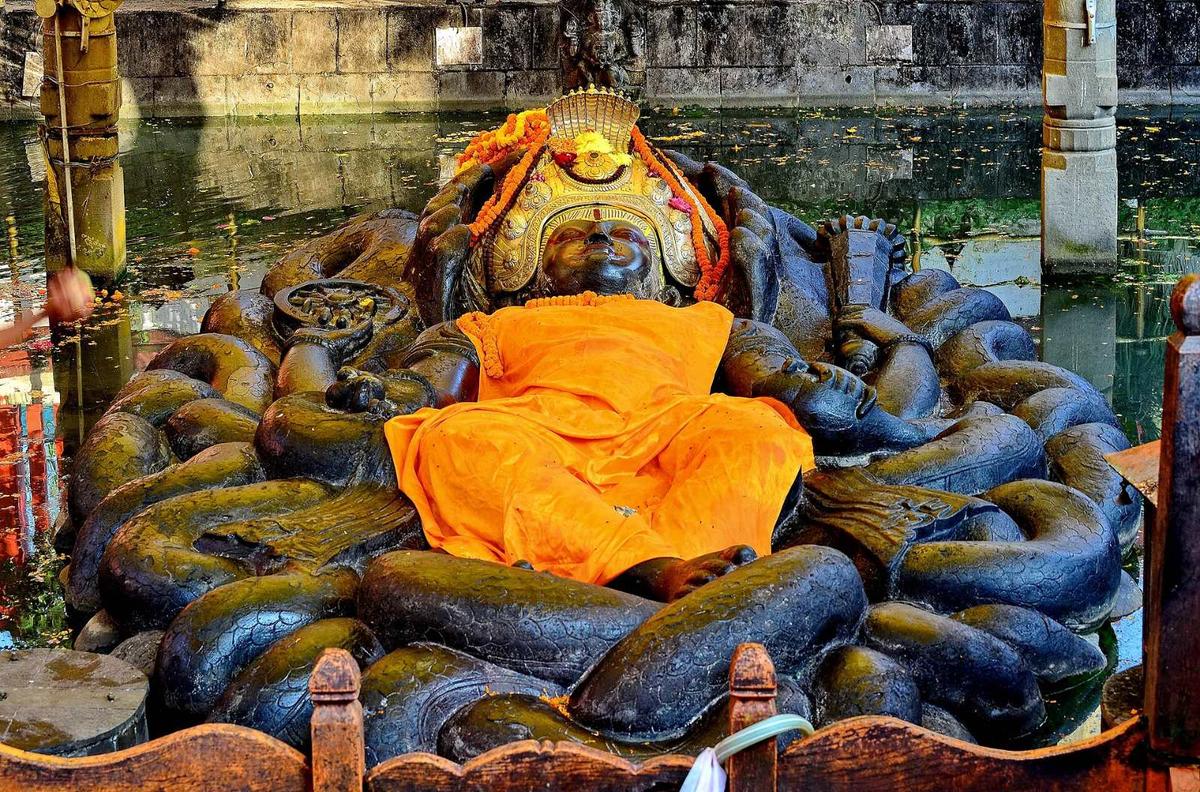
Close view of the face of the sleeping Vishnu resting on the coiled serpent bed at Budhanilkantha
Vishnu's face above the coils of the serpent bed.

Almost every source gives the length as about five metres; one scholar's photo caption gives a larger figure. Published sources differ on the type of stone, so we simply call it stone, but all agree it is one piece.

The water matters as much as the figure. Sacred Sites, a long-running reference on pilgrimage places, says the tank represents the cosmic sea and is about 13 metres long.

Narayan is another name for Vishnu, so you will also hear the image called Jal Narayan, Narayan on the water; Sacred Sites calls it Jalakshayan Narayan. If you ask for the Jal Narayan temple in Kathmandu, make sure you are heading here and not to the smaller copy at Balaju, which shows the same scene. These are descriptive names, not an official title.

How old is the sleeping Vishnu?

The sleeping Vishnu was carved in the Licchavi period, the age of the Licchavi kings in the Kathmandu Valley, probably in the 7th century. Tradition links it to Vishnugupta, a 7th-century ruler of the Licchavi era. We have found no record that fixes the exact year of the carving.

The sources line up like this:

  • Nepal Tourism Board: "dates back to the Lichchhavi period", no century given.
  • Lonely Planet (French edition): the 7th or 8th century.
  • asianart.com: an article by Amy Heller, with a photo by the art historian Mary Slusser, captions the statue "641 AD".
  • Sacred Sites: the reign of Vishnugupta, a 7th-century monarch.
  • Atlas Obscura: the 6th century, also under Vishnugupta.

A Licchavi-era stone inscription was also recorded near the gate of the walled tank, and the SIDDHAM database of Asian inscriptions lists it. The record names no king, and it is not proof of who carved the statue or when.

Practical takeaway: "Licchavi period, probably 7th century" is as precise as the evidence allows, whatever exact age you hear at the gate.

The name and the legends

Budhanilkantha means "Old Blue Throat": budha is old, nil is blue and kantha is throat. It is a name of Shiva, not of Vishnu, and that puzzle sits at the heart of the stories told here.

The poison and the lake. The story goes that Shiva drank a poison that threatened the world, and it burned his throat blue. Legend says he went into the Himalayas to cool it and struck the mountainside with his trident, creating the sacred lake of Gosaikunda. Devotees believe the spring that feeds the pond here is connected to Gosaikunda.

Hari and Hara on one stone. Many devotees hold that Hari and Hara, Vishnu and Shiva, are both present in the one great stone, and some describe a mirror-like image of Shiva in the water beside the statue. That belief is one way people explain a Shiva name on a Vishnu shrine.

The farmer's plough. The Nepal Tourism Board retells the folklore of the statue's discovery: a farmer was ploughing his field when his plough struck a boulder, and blood began to ooze from the cut in the stone.

The old Brahmin. Another version, retold in The Himalayan Times, says an old Brahmin ascetic named Nilkantha had the image installed.

Hauled by the faithful. Lonely Planet says instead that devotees hauled the statue here, which does not sit with the boulder story. You may also hear that the statue floats; that is a popular legend, not a fact.

The image is revered by Buddhists as well as Hindus, according to The Himalayan Times.

Practical takeaway: enjoy these as stories; none of them is history, and versions differ from teller to teller.

Why kings stay away: the royal tradition

According to tradition, King Pratap Malla dreamed that if he or his descendants visited Budhanilkantha, they would die, and so no ruling king may visit the temple. That is the version told most often. In another, an unnamed Malla king has the dream after channelling the pond's water to his palace pool; in a third, a King Surya Ketu is cursed for doubting the image.

Kings who could not come here had copies made:

"And so later kings commanded two similar but smaller images placed in pools in the gardens of Balaju and the royal palace at Hanuman Dhoka."

The Himalayan Times, 29 January 2005

Accounts differ on which king ordered which copy. The Balaju copy lies in the water gardens at Balaju, in north-west Kathmandu, and the writer Desmond Doig felt it lacked the original's serenity and proportions.

Can foreigners enter Budhanilkantha temple?

Yes. Foreigners can visit Budhanilkantha and see the sleeping Vishnu clearly. Only Hindus may go down to the statue to make offerings; other visitors view it through the barrier around the sacred pond, according to Lonely Planet. We found no written visitor rules published by the temple, so follow what temple staff and signs tell you on the day.
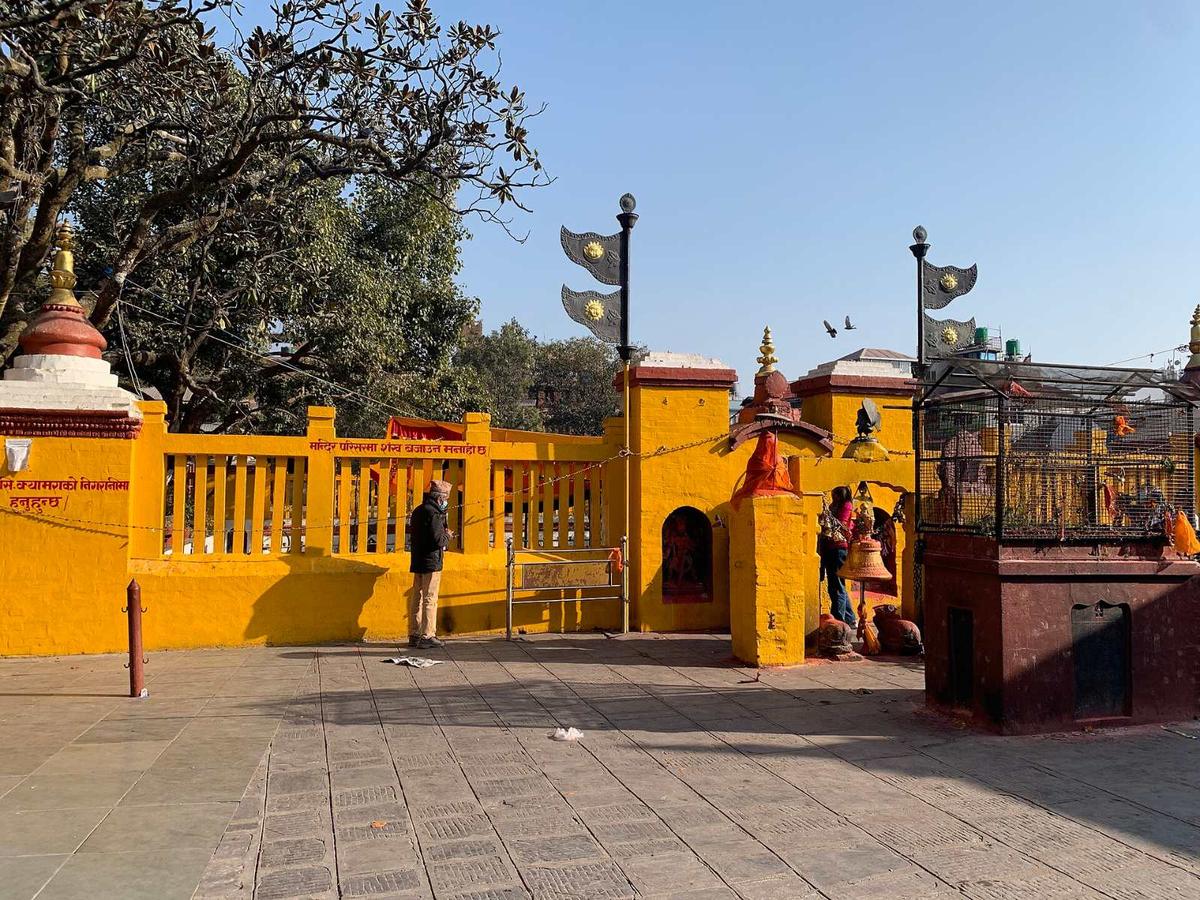
Yellow railings and gateway of the outer enclosure around the sacred pond at Budhanilkantha temple
The yellow railed outer enclosure and gateway around the pond.
At the temple Hindu devotees Other visitors Based on
Enter the compound and view the statue Yes Yes, through the barrier around the pond Lonely Planet; Onlinekhabar, 25 Jul 2026
Go down to the statue with offerings Yes No Lonely Planet
Photograph worshippers or priests Ask first Ask first Our team's advice
Photograph inside the enclosure Only with permission Only with permission Our team's advice
Buy meat, alcohol or tobacco close by Sales banned within 300 metres of major shrines Same Municipal notice reported by Republica, 22 May 2026

Sacred Sites adds that touching Vishnu's feet is forbidden for foreign visitors. We have found no official dress code, but we advise modest clothing, as at any working shrine. If temple staff or a sign asks you to put the camera away, put it away, and on busy mornings take your look and step back so the next person can see. We have not checked how strictly the municipality's sales ban is enforced.

Practical takeaway: you lose very little by staying at the railing, because the statue lies open to view in its pond.

Is there an entry fee, and when is it open?

We have found no entry ticket for Budhanilkantha published by the temple or the municipality, and it is not on the Nepal Tourism Board's heritage-site fee list (checked 7 Nov 2026). Lonely Planet lists no fee and gives the hours as dawn to dusk. Neither is an official notice, so ask us or check at the gate before you go.

Festival days run to a different clock. On Harishayani Ekadashi in July 2026 the doors opened at 3 am, but that was one festival morning, not a daily timetable.

Practical takeaway: arrive in daylight, and remember the national park above has its own fee and guide rule.

When to go: festivals, seasons and crowds

The two biggest days at Budhanilkantha are the Ekadashi fairs, when Vishnu is said to fall asleep and, four months later, to wake. Ekadashi is the eleventh day of the lunar fortnight, kept as a day of devotion to Vishnu, and a mela is a religious fair. The Nepal Tourism Board says a big mela is held on both days, "marking the four-month period when the Lord retires to sleep".

Harishayani Ekadashi is the day Vishnu goes to sleep; Haribodhini Ekadashi is the day he wakes, ending four months of devotion. In 2026 Haribodhini falls on Friday 20 November, Mangsir 4, 2083 in the Nepali calendar; check the date nearer the time. The same day is kept as Tulsi Vivah, the ritual marriage of the tulsi (holy basil) plant to Vishnu. In 2015, organisers expected tens of thousands of devotees. Haribodhini is not a national public holiday.

Occasion 2026 date What happens Source and date
Harishayani Ekadashi Saturday 25 July 2026 (past) Vishnu is said to fall asleep; big fair; doors opened at 3 am Onlinekhabar and eKantipur, 25 Jul 2026
Tihar public holiday 8 to 12 November 2026 National holiday week; plan for festival traffic Ministry of Home Affairs list, via Pradhan & Associates, checked 7 Nov 2026
Haribodhini Ekadashi Friday 20 November 2026 Vishnu is said to wake; Tulsi Vivah; big fair Hamro Patro, checked 7 Nov 2026
Fair after Haribodhini Runs to the Kartik full moon; 2026 end date not yet confirmed The fair continues for several days The Himalayan Times, 2015; Onlinekhabar, 2024

Outside the fairs, the Nepal Tourism Board says the clearest skies come after the monsoon, in October and November. The monsoon normally runs from about 13 June to 2 October, although it withdrew later than that every year from 2020 to 2025. Winter mornings are cold: at the Kathmandu airport weather station, January averages a low of 2.8 °C and a high of 19.2 °C (1991 to 2020 normals). Budhanilkantha sits higher, on the valley's northern edge, though we have found no published altitude for the temple itself.

Practical takeaway: we have found no count of daily visitors, so we cannot promise a quiet hour, but an ordinary day in October or November, early, is the calm choice.

How to get to Budhanilkantha from central Kathmandu

Budhanilkantha is about 9 to 11 km north of central Kathmandu, depending on the source: the Nepal Tourism Board's temple page says 9 km and its Shivapuri park page says 11 km. Microbuses and buses run from the centre, and a taxi takes about 30 to 40 minutes, longer in traffic.
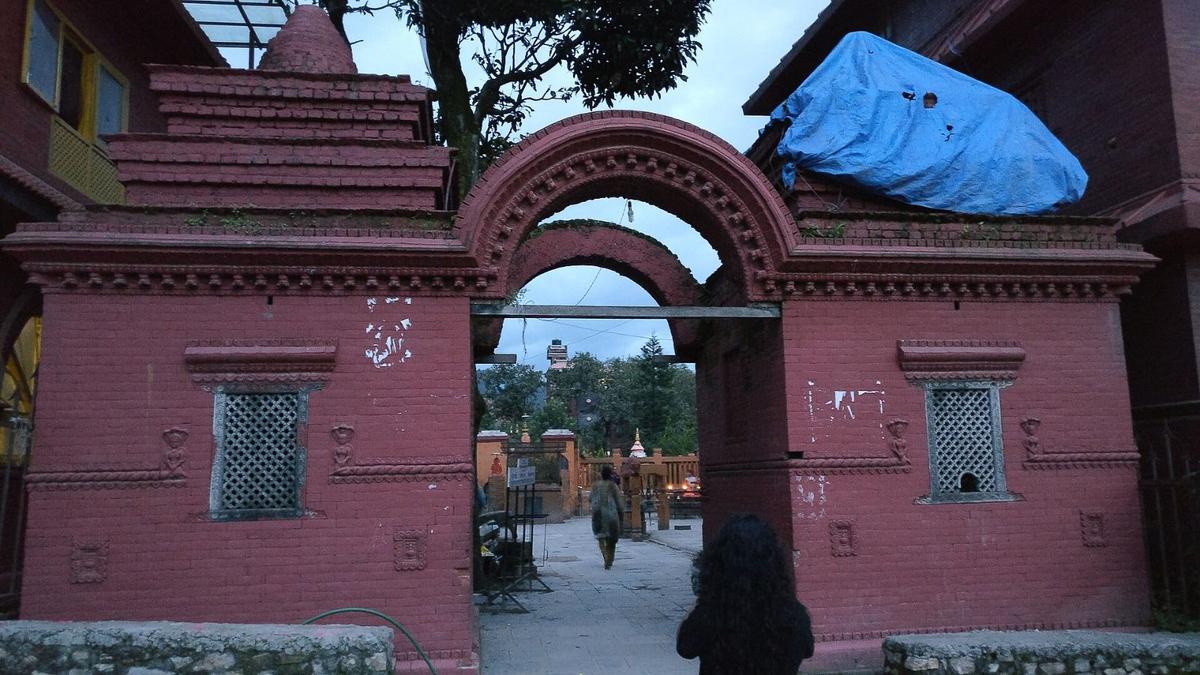
Red brick entrance gate of Budhanilkantha temple seen from the street
The red brick entrance gate of Budhanilkantha temple, seen from the street.
Option Where from Time Good to know
Microbus Kathmandu city centre About an hour by public vehicle Regular services, according to the Nepal Tourism Board
Public bus Ratna Park or the NAC Building About an hour We found no current route numbers or fares, so ask at the stop
Taxi or private car Anywhere in the city About 30 to 40 minutes, longer at rush hour The easiest choice if you plan to start a hike

In a map app, search for "Budhanilkantha Temple Kathmandu" rather than just "Budhanilkantha". The name also belongs to the municipality around the temple, so a pin on the town may not put you at the gate.

In 2026 the Tihar public holiday runs from 8 to 12 November, so allow extra time for festival traffic that week.

Dakshinkali, the Kali temple at the southern end of the valley, has its own page in our Dakshinkali temple guide. For more half-day and day outings, see our Kathmandu day trips guide.

Adding a Shivapuri hike

The temple sits right below Shivapuri Nagarjun National Park. The park gate is a short uphill walk above the temple; The Annapurna Express put it at about half an hour on foot. Every visitor pays the park's entry fee, and foreign and SAARC visitors must walk with a guide.
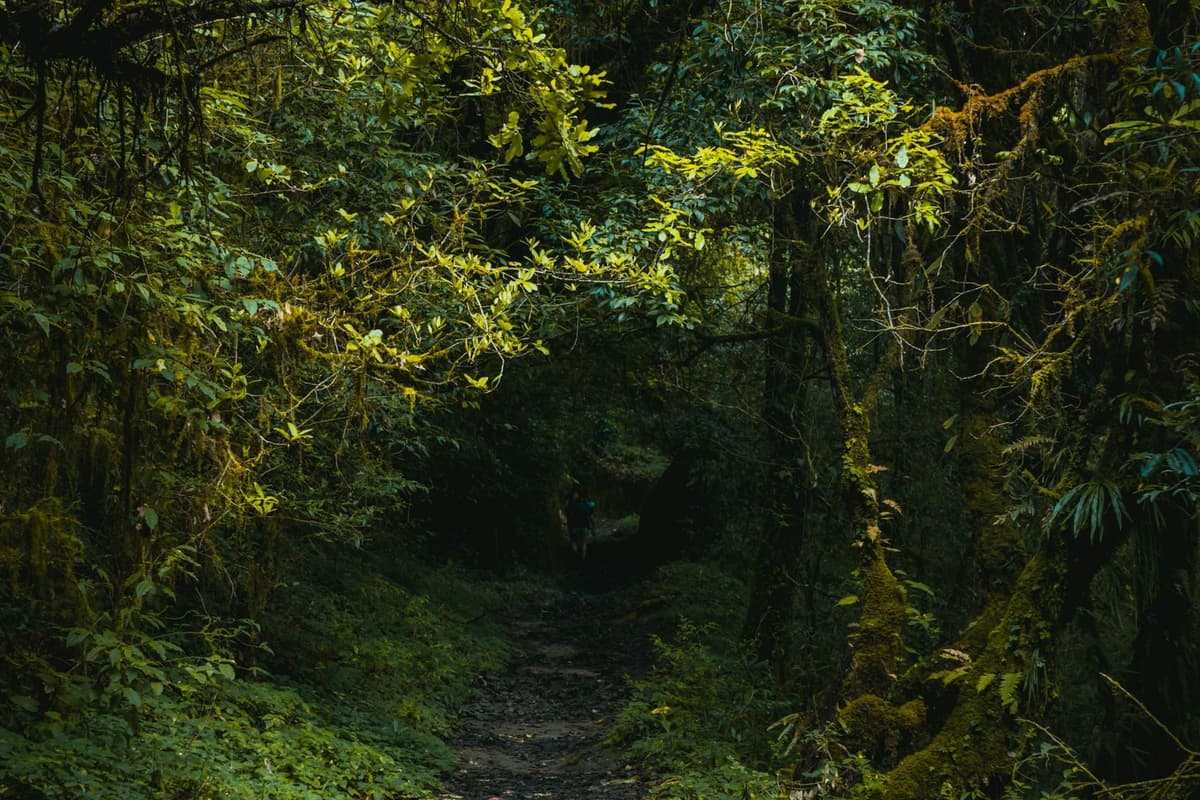
Forest trail in Shivapuri Nagarjun National Park above Budhanilkantha
A forest trail in Shivapuri Nagarjun National Park.

The park covers 159 sq km, was gazetted as Nepal's ninth national park in 2002, and is one of the main sources of drinking water for the Kathmandu Valley.

Entry fee. The park office lists NPR 1,000 for foreign visitors, NPR 600 for visitors from SAARC countries and NPR 100 for Nepali citizens; the Nepal Tourism Board adds that children below 10 enter free. The park words the charge as per day, per person, per entry, so if you plan two days inside the park, ask us and we will check with the park office how it applies.

The guide rule. For SAARC and other foreign visitors, the park office's fee page says a "nature guide" must accompany you, and marks it compulsory. In plain words, you need a park-certified guide inside the park. On our hikes, a licensed guide walks with you.

Where the trails go:

  • Bishnudwar. The national parks department names Baghdwar and Bishnudwar as the places where the sacred Bagmati and Bishnumati rivers begin. The Annapurna Express gives Bishnudwar's height as 1,950 m (about 6,400 ft), and about 2 to 3 hours from the gate to a viewpoint, then an hour and a half more to Bishnudwar, depending on pace.
  • Nagi Gompa. A gompa is a Buddhist monastery, and Nagi Gompa is a nunnery and monastery on Shivapuri Hill, around 2 to 3 hours' hike from the park gate according to Republica.
  • Shivapuri Peak. At about 2,730 m (about 8,960 ft), it is the second-highest mountain around the Kathmandu Valley, according to BirdLife International; other sources give 2,732 m.

Our guide to day hikes on the Kathmandu valley rim compares Shivapuri with the other walks.

Mountain views depend on the sky, and October and November give the best odds. Nobody can promise a view of the snow peaks, and we won't.

Practical takeaway: for foreign visitors, the temple plus the forest needs a guide, the park fee and a full morning at least.

Who looks after the temple today

The temple is run by the Budhanilkantha Narayansthan Dashnami Math. A math is a Hindu monastic institution, and Dashnami is the name of a tradition of Hindu ascetics. The Math's mahant, or head, Nigamanand Swami, was named in news reports from the temple in July 2026.

The temple shares its name with the town and with Budhanilkantha Municipality, in Kathmandu District, Bagmati Province. The municipality is seeking UNESCO World Heritage status for the temple; that is a goal, not a listing.

The 2015 earthquake destroyed several smaller structures in the compound; a 2018 report listed the rest house, a Shiva temple, a Saraswati temple and a wall. We have not found a later report on whether all of them have been rebuilt.

If Budhanilkantha is part of a wider religious journey, our Nepal pilgrimage guide shows how it fits with the country's other Hindu and Buddhist sites.

How to plan your visit, step by step

  1. Pick your day. For quiet, avoid the two Ekadashi fairs; for the fair, Haribodhini falls on Friday 20 November 2026, but check the date nearer the time.
  2. Choose temple only, or temple plus hike (guide and park fee needed).
  3. Dress for a temple and for the weather. Wear modest clothing, and in winter take a warm layer, because January mornings in the valley are near freezing.
  4. Set your map pin on the temple, not just the town.
  5. Get there. About an hour by microbus or bus, or 30 to 40 minutes by taxi.
  6. Ask at the gate if anything has changed. We have found no published ticket or hours.
  7. Follow temple staff at the railing. Only Hindus go down to the image; everyone else views it through the barrier.
  8. Photograph with care. Ask before photographing people, and not inside the enclosure without permission.
  9. Walk on, if you planned to, with your guide to the park gate.
  10. Be back before dusk, when the reported hours end.

Frequently asked questions

Can foreigners enter Budhanilkantha, and what is the sleeping Vishnu?

Yes, foreigners can visit and see the statue clearly from the railing, but only Hindus may go down to it to make offerings, according to Lonely Planet. The sleeping Vishnu is a stone image of the god reclining on a bed of snakes in a pond, about five metres long and carved from a single block of stone. Follow what temple staff tell you on the day.

Is there an entrance fee to visit Budhanilkantha Temple?

We have found no entry fee published by the temple, the municipality or the Nepal Tourism Board, and Lonely Planet lists none (checked 7 Nov 2026). Rules can change, so ask us or check at the gate before you go. If you walk on into Shivapuri Nagarjun National Park, the park charges its own fee.

What are the visiting hours for Budhanilkantha Temple?

Lonely Planet gives the hours as dawn to dusk; we found no official timetable from the temple. On festival mornings the doors can open far earlier: on Harishayani Ekadashi in July 2026 they opened at 3 am. Check close to your day.

How do I get to Budhanilkantha from Kathmandu city centre?

Microbuses and public buses run from the centre, with buses leaving from Ratna Park or the NAC Building, and the ride takes about an hour. A taxi takes about 30 to 40 minutes, longer in traffic. The temple is about 9 to 11 km north of the centre, depending on which Nepal Tourism Board page you read.

Why do Nepal's kings not visit Budhanilkantha?

According to tradition, King Pratap Malla dreamed that if he or his descendants visited Budhanilkantha they would die, so no ruling king may visit. Versions of the story differ. Later kings had smaller copies placed in pools at Balaju and at the old royal palace at Hanuman Dhoka instead.

When is the Budhanilkantha festival, and what is Haribodhini Ekadashi?

The big fairs fall on Harishayani and Haribodhini Ekadashi, the days Vishnu is said to fall asleep and to wake. Haribodhini ends four months of devotion and is also kept as Tulsi Vivah, the ritual marriage of the tulsi plant to Vishnu. In 2026 it falls on Friday 20 November; check the date nearer the time.

Plan your visit with us

Budhanilkantha is one stop in a much bigger city, and our guide to places to visit in Kathmandu puts it next to the rest of the valley.

If you would rather not sort out the park side yourself, we run two walks that take in the temple. The half-day temple and forest walk to Bishnudwar suits a free morning, and the two-day version with a night in Dadagaon gives you more time in the forest. On both, a licensed guide walks with you.

Tell us your dates and what you would like to see. Message us on WhatsApp or send an enquiry, and we will tell you honestly which option fits your day.
Tags
BudhanilkanthaSleeping VishnuKathmandu templesHindu pilgrimageShivapuri Nagarjun National ParkHaribodhini Ekadashi
Share
U
Uncover Nepal Team
Writer at Uncover Nepal
More in Temples & cultureSee all Temples & culture

Budhanilkantha Temple Kathmandu: The Sleeping Vishnu

19 min read Posted 10 Nov 2026Updated 06 Nov 2026
The great stone statue of the sleeping Vishnu lying in its pond at Budhanilkantha, Kathmandu

By Uncover Nepal Team · Checked by our Kathmandu travel team · Last checked 7 Nov 2026

On 25 July 2026, the day of Harishayani Ekadashi, the doors at Budhanilkantha opened at 3 am because devotees were already arriving. They had come to see Vishnu asleep: a great stone figure lying on the coils of a serpent, in the middle of a pond. The national news agency's report that day noted that visitors from Nepal and from abroad crowd in to see it.

Budhanilkantha temple, Kathmandu, is a walled pond shrine at the foot of the Shivapuri hills, on the valley's northern edge. Its sleeping Vishnu, about five metres long, was carved from a single block of stone. Anyone can look at it from the railing; only Hindus go down to the image with offerings.

Like our guide to places to visit in Kathmandu, this page sticks to what helps on the day: what you are looking at, which stories are legend, who can go where, when the crowds come, how to get there and how to add a walk in the national park above.

In this guide

  • Key facts
  • Budhanilkantha Temple Kathmandu: what you are looking at
  • How old is the sleeping Vishnu?
  • The name and the legends
  • Why kings stay away: the royal tradition
  • Can foreigners enter Budhanilkantha temple?
  • Is there an entry fee, and when is it open?
  • When to go: festivals, seasons and crowds
  • How to get to Budhanilkantha from central Kathmandu
  • Adding a Shivapuri hike
  • Who looks after the temple today
  • How to plan your visit, step by step
  • Frequently asked questions
  • Plan your visit with us

Key facts

What it is
A stone image of Vishnu reclining on a bed of snakes in the middle of a pond (Nepal Tourism Board, checked 7 Nov 2026)
Length
About five metres (Nepal Tourism Board, checked 7 Nov 2026)
Carved from
A single block of stone; published sources differ on the type of stone (Nepal Tourism Board and Lonely Planet, checked 7 Nov 2026)
Period
Licchavi period, probably 7th century (Nepal Tourism Board and Lonely Planet, checked 7 Nov 2026)
Where
Foot of the Shivapuri hills, Budhanilkantha Municipality, Kathmandu District, Bagmati Province (Nepal Tourism Board and Budhanilkantha Municipality, checked 7 Nov 2026)
Distance
About 9 to 11 km north of central Kathmandu, depending on the page (Nepal Tourism Board temple and park pages, checked 7 Nov 2026)
Entry ticket
None published by the temple or the municipality; not on the Nepal Tourism Board's heritage-site fee list (Our check of official pages, the Nepal Tourism Board and Lonely Planet, 7 Nov 2026)
Opening hours
Dawn to dusk (reported, not official) (Lonely Planet, checked 7 Nov 2026)
Who goes down to the image
Hindus only; other visitors view it through the barrier (Lonely Planet, checked 7 Nov 2026)
Next big fair
Haribodhini Ekadashi, Friday 20 November 2026 (Hamro Patro, checked 7 Nov 2026)
Park fee above the temple
NPR 1,000 foreign, NPR 600 SAARC, NPR 100 Nepali, per day, per person, per entry; children under 10 free (Shivapuri Nagarjun National Park office and Nepal Tourism Board, checked 7 Nov 2026)

Budhanilkantha Temple Kathmandu: what you are looking at

You come in from the street through a gate and find a recessed tank of water inside a walled enclosure. In the middle lies Vishnu, about five metres long and carved from a single block of stone. The Nepal Tourism Board's description chooses its words with care:

"This site, situated at the foot of the Shivpuri hills in the northern-most part of the Kathmandu Valley, has probably the largest stone statue of Lord Vishnu in Nepal reclining on a bed of snakes in the middle of a pond."

Nepal Tourism Board

Note the word "probably". The statue is often described as the largest stone statue of Vishnu in Nepal, and a 2015 Himalayan Times report said it is considered the largest stone carving in the country. We have not found a measured comparison, so we keep the board's hedge.

The statue up close

Vishnu rests on the coils of Ananta, also called Shesha, the serpent god. Lonely Planet counts 11 heads on the serpent. The figure has four arms holding Vishnu's emblems; Lonely Planet lists the discus, conch, mace and lotus, while other sources name a gem in place of the lotus.

Close view of the face of the sleeping Vishnu resting on the coiled serpent bed at Budhanilkantha
Vishnu's face above the coils of the serpent bed.

Almost every source gives the length as about five metres; one scholar's photo caption gives a larger figure. Published sources differ on the type of stone, so we simply call it stone, but all agree it is one piece.

The water matters as much as the figure. Sacred Sites, a long-running reference on pilgrimage places, says the tank represents the cosmic sea and is about 13 metres long.

Narayan is another name for Vishnu, so you will also hear the image called Jal Narayan, Narayan on the water; Sacred Sites calls it Jalakshayan Narayan. If you ask for the Jal Narayan temple in Kathmandu, make sure you are heading here and not to the smaller copy at Balaju, which shows the same scene. These are descriptive names, not an official title.

How old is the sleeping Vishnu?

The sleeping Vishnu was carved in the Licchavi period, the age of the Licchavi kings in the Kathmandu Valley, probably in the 7th century. Tradition links it to Vishnugupta, a 7th-century ruler of the Licchavi era. We have found no record that fixes the exact year of the carving.

The sources line up like this:

  • Nepal Tourism Board: "dates back to the Lichchhavi period", no century given.
  • Lonely Planet (French edition): the 7th or 8th century.
  • asianart.com: an article by Amy Heller, with a photo by the art historian Mary Slusser, captions the statue "641 AD".
  • Sacred Sites: the reign of Vishnugupta, a 7th-century monarch.
  • Atlas Obscura: the 6th century, also under Vishnugupta.

A Licchavi-era stone inscription was also recorded near the gate of the walled tank, and the SIDDHAM database of Asian inscriptions lists it. The record names no king, and it is not proof of who carved the statue or when.

Practical takeaway: "Licchavi period, probably 7th century" is as precise as the evidence allows, whatever exact age you hear at the gate.

The name and the legends

Budhanilkantha means "Old Blue Throat": budha is old, nil is blue and kantha is throat. It is a name of Shiva, not of Vishnu, and that puzzle sits at the heart of the stories told here.

The poison and the lake. The story goes that Shiva drank a poison that threatened the world, and it burned his throat blue. Legend says he went into the Himalayas to cool it and struck the mountainside with his trident, creating the sacred lake of Gosaikunda. Devotees believe the spring that feeds the pond here is connected to Gosaikunda.

Hari and Hara on one stone. Many devotees hold that Hari and Hara, Vishnu and Shiva, are both present in the one great stone, and some describe a mirror-like image of Shiva in the water beside the statue. That belief is one way people explain a Shiva name on a Vishnu shrine.

The farmer's plough. The Nepal Tourism Board retells the folklore of the statue's discovery: a farmer was ploughing his field when his plough struck a boulder, and blood began to ooze from the cut in the stone.

The old Brahmin. Another version, retold in The Himalayan Times, says an old Brahmin ascetic named Nilkantha had the image installed.

Hauled by the faithful. Lonely Planet says instead that devotees hauled the statue here, which does not sit with the boulder story. You may also hear that the statue floats; that is a popular legend, not a fact.

The image is revered by Buddhists as well as Hindus, according to The Himalayan Times.

Practical takeaway: enjoy these as stories; none of them is history, and versions differ from teller to teller.

Why kings stay away: the royal tradition

According to tradition, King Pratap Malla dreamed that if he or his descendants visited Budhanilkantha, they would die, and so no ruling king may visit the temple. That is the version told most often. In another, an unnamed Malla king has the dream after channelling the pond's water to his palace pool; in a third, a King Surya Ketu is cursed for doubting the image.

Kings who could not come here had copies made:

"And so later kings commanded two similar but smaller images placed in pools in the gardens of Balaju and the royal palace at Hanuman Dhoka."

The Himalayan Times, 29 January 2005

Accounts differ on which king ordered which copy. The Balaju copy lies in the water gardens at Balaju, in north-west Kathmandu, and the writer Desmond Doig felt it lacked the original's serenity and proportions.

Can foreigners enter Budhanilkantha temple?

Yes. Foreigners can visit Budhanilkantha and see the sleeping Vishnu clearly. Only Hindus may go down to the statue to make offerings; other visitors view it through the barrier around the sacred pond, according to Lonely Planet. We found no written visitor rules published by the temple, so follow what temple staff and signs tell you on the day.

Yellow railings and gateway of the outer enclosure around the sacred pond at Budhanilkantha temple
The yellow railed outer enclosure and gateway around the pond.
At the temple Hindu devotees Other visitors Based on
Enter the compound and view the statue Yes Yes, through the barrier around the pond Lonely Planet; Onlinekhabar, 25 Jul 2026
Go down to the statue with offerings Yes No Lonely Planet
Photograph worshippers or priests Ask first Ask first Our team's advice
Photograph inside the enclosure Only with permission Only with permission Our team's advice
Buy meat, alcohol or tobacco close by Sales banned within 300 metres of major shrines Same Municipal notice reported by Republica, 22 May 2026

Sacred Sites adds that touching Vishnu's feet is forbidden for foreign visitors. We have found no official dress code, but we advise modest clothing, as at any working shrine. If temple staff or a sign asks you to put the camera away, put it away, and on busy mornings take your look and step back so the next person can see. We have not checked how strictly the municipality's sales ban is enforced.

Practical takeaway: you lose very little by staying at the railing, because the statue lies open to view in its pond.

Is there an entry fee, and when is it open?

We have found no entry ticket for Budhanilkantha published by the temple or the municipality, and it is not on the Nepal Tourism Board's heritage-site fee list (checked 7 Nov 2026). Lonely Planet lists no fee and gives the hours as dawn to dusk. Neither is an official notice, so ask us or check at the gate before you go.

Festival days run to a different clock. On Harishayani Ekadashi in July 2026 the doors opened at 3 am, but that was one festival morning, not a daily timetable.

Practical takeaway: arrive in daylight, and remember the national park above has its own fee and guide rule.

When to go: festivals, seasons and crowds

The two biggest days at Budhanilkantha are the Ekadashi fairs, when Vishnu is said to fall asleep and, four months later, to wake. Ekadashi is the eleventh day of the lunar fortnight, kept as a day of devotion to Vishnu, and a mela is a religious fair. The Nepal Tourism Board says a big mela is held on both days, "marking the four-month period when the Lord retires to sleep".

Harishayani Ekadashi is the day Vishnu goes to sleep; Haribodhini Ekadashi is the day he wakes, ending four months of devotion. In 2026 Haribodhini falls on Friday 20 November, Mangsir 4, 2083 in the Nepali calendar; check the date nearer the time. The same day is kept as Tulsi Vivah, the ritual marriage of the tulsi (holy basil) plant to Vishnu. In 2015, organisers expected tens of thousands of devotees. Haribodhini is not a national public holiday.

Occasion 2026 date What happens Source and date
Harishayani Ekadashi Saturday 25 July 2026 (past) Vishnu is said to fall asleep; big fair; doors opened at 3 am Onlinekhabar and eKantipur, 25 Jul 2026
Tihar public holiday 8 to 12 November 2026 National holiday week; plan for festival traffic Ministry of Home Affairs list, via Pradhan & Associates, checked 7 Nov 2026
Haribodhini Ekadashi Friday 20 November 2026 Vishnu is said to wake; Tulsi Vivah; big fair Hamro Patro, checked 7 Nov 2026
Fair after Haribodhini Runs to the Kartik full moon; 2026 end date not yet confirmed The fair continues for several days The Himalayan Times, 2015; Onlinekhabar, 2024

Outside the fairs, the Nepal Tourism Board says the clearest skies come after the monsoon, in October and November. The monsoon normally runs from about 13 June to 2 October, although it withdrew later than that every year from 2020 to 2025. Winter mornings are cold: at the Kathmandu airport weather station, January averages a low of 2.8 °C and a high of 19.2 °C (1991 to 2020 normals). Budhanilkantha sits higher, on the valley's northern edge, though we have found no published altitude for the temple itself.

Practical takeaway: we have found no count of daily visitors, so we cannot promise a quiet hour, but an ordinary day in October or November, early, is the calm choice.

How to get to Budhanilkantha from central Kathmandu

Budhanilkantha is about 9 to 11 km north of central Kathmandu, depending on the source: the Nepal Tourism Board's temple page says 9 km and its Shivapuri park page says 11 km. Microbuses and buses run from the centre, and a taxi takes about 30 to 40 minutes, longer in traffic.

Red brick entrance gate of Budhanilkantha temple seen from the street
The red brick entrance gate of Budhanilkantha temple, seen from the street.
Option Where from Time Good to know
Microbus Kathmandu city centre About an hour by public vehicle Regular services, according to the Nepal Tourism Board
Public bus Ratna Park or the NAC Building About an hour We found no current route numbers or fares, so ask at the stop
Taxi or private car Anywhere in the city About 30 to 40 minutes, longer at rush hour The easiest choice if you plan to start a hike

In a map app, search for "Budhanilkantha Temple Kathmandu" rather than just "Budhanilkantha". The name also belongs to the municipality around the temple, so a pin on the town may not put you at the gate.

In 2026 the Tihar public holiday runs from 8 to 12 November, so allow extra time for festival traffic that week.

Dakshinkali, the Kali temple at the southern end of the valley, has its own page in our Dakshinkali temple guide. For more half-day and day outings, see our Kathmandu day trips guide.

Adding a Shivapuri hike

The temple sits right below Shivapuri Nagarjun National Park. The park gate is a short uphill walk above the temple; The Annapurna Express put it at about half an hour on foot. Every visitor pays the park's entry fee, and foreign and SAARC visitors must walk with a guide.

Forest trail in Shivapuri Nagarjun National Park above Budhanilkantha
A forest trail in Shivapuri Nagarjun National Park.

The park covers 159 sq km, was gazetted as Nepal's ninth national park in 2002, and is one of the main sources of drinking water for the Kathmandu Valley.

Entry fee. The park office lists NPR 1,000 for foreign visitors, NPR 600 for visitors from SAARC countries and NPR 100 for Nepali citizens; the Nepal Tourism Board adds that children below 10 enter free. The park words the charge as per day, per person, per entry, so if you plan two days inside the park, ask us and we will check with the park office how it applies.

The guide rule. For SAARC and other foreign visitors, the park office's fee page says a "nature guide" must accompany you, and marks it compulsory. In plain words, you need a park-certified guide inside the park. On our hikes, a licensed guide walks with you.

Where the trails go:

  • Bishnudwar. The national parks department names Baghdwar and Bishnudwar as the places where the sacred Bagmati and Bishnumati rivers begin. The Annapurna Express gives Bishnudwar's height as 1,950 m (about 6,400 ft), and about 2 to 3 hours from the gate to a viewpoint, then an hour and a half more to Bishnudwar, depending on pace.
  • Nagi Gompa. A gompa is a Buddhist monastery, and Nagi Gompa is a nunnery and monastery on Shivapuri Hill, around 2 to 3 hours' hike from the park gate according to Republica.
  • Shivapuri Peak. At about 2,730 m (about 8,960 ft), it is the second-highest mountain around the Kathmandu Valley, according to BirdLife International; other sources give 2,732 m.

Our guide to day hikes on the Kathmandu valley rim compares Shivapuri with the other walks.

Mountain views depend on the sky, and October and November give the best odds. Nobody can promise a view of the snow peaks, and we won't.

Practical takeaway: for foreign visitors, the temple plus the forest needs a guide, the park fee and a full morning at least.

Who looks after the temple today

The temple is run by the Budhanilkantha Narayansthan Dashnami Math. A math is a Hindu monastic institution, and Dashnami is the name of a tradition of Hindu ascetics. The Math's mahant, or head, Nigamanand Swami, was named in news reports from the temple in July 2026.

The temple shares its name with the town and with Budhanilkantha Municipality, in Kathmandu District, Bagmati Province. The municipality is seeking UNESCO World Heritage status for the temple; that is a goal, not a listing.

The 2015 earthquake destroyed several smaller structures in the compound; a 2018 report listed the rest house, a Shiva temple, a Saraswati temple and a wall. We have not found a later report on whether all of them have been rebuilt.

If Budhanilkantha is part of a wider religious journey, our Nepal pilgrimage guide shows how it fits with the country's other Hindu and Buddhist sites.

How to plan your visit, step by step

  1. Pick your day. For quiet, avoid the two Ekadashi fairs; for the fair, Haribodhini falls on Friday 20 November 2026, but check the date nearer the time.
  2. Choose temple only, or temple plus hike (guide and park fee needed).
  3. Dress for a temple and for the weather. Wear modest clothing, and in winter take a warm layer, because January mornings in the valley are near freezing.
  4. Set your map pin on the temple, not just the town.
  5. Get there. About an hour by microbus or bus, or 30 to 40 minutes by taxi.
  6. Ask at the gate if anything has changed. We have found no published ticket or hours.
  7. Follow temple staff at the railing. Only Hindus go down to the image; everyone else views it through the barrier.
  8. Photograph with care. Ask before photographing people, and not inside the enclosure without permission.
  9. Walk on, if you planned to, with your guide to the park gate.
  10. Be back before dusk, when the reported hours end.

Frequently asked questions

Can foreigners enter Budhanilkantha, and what is the sleeping Vishnu?

Yes, foreigners can visit and see the statue clearly from the railing, but only Hindus may go down to it to make offerings, according to Lonely Planet. The sleeping Vishnu is a stone image of the god reclining on a bed of snakes in a pond, about five metres long and carved from a single block of stone. Follow what temple staff tell you on the day.

Is there an entrance fee to visit Budhanilkantha Temple?

We have found no entry fee published by the temple, the municipality or the Nepal Tourism Board, and Lonely Planet lists none (checked 7 Nov 2026). Rules can change, so ask us or check at the gate before you go. If you walk on into Shivapuri Nagarjun National Park, the park charges its own fee.

What are the visiting hours for Budhanilkantha Temple?

Lonely Planet gives the hours as dawn to dusk; we found no official timetable from the temple. On festival mornings the doors can open far earlier: on Harishayani Ekadashi in July 2026 they opened at 3 am. Check close to your day.

How do I get to Budhanilkantha from Kathmandu city centre?

Microbuses and public buses run from the centre, with buses leaving from Ratna Park or the NAC Building, and the ride takes about an hour. A taxi takes about 30 to 40 minutes, longer in traffic. The temple is about 9 to 11 km north of the centre, depending on which Nepal Tourism Board page you read.

Why do Nepal's kings not visit Budhanilkantha?

According to tradition, King Pratap Malla dreamed that if he or his descendants visited Budhanilkantha they would die, so no ruling king may visit. Versions of the story differ. Later kings had smaller copies placed in pools at Balaju and at the old royal palace at Hanuman Dhoka instead.

When is the Budhanilkantha festival, and what is Haribodhini Ekadashi?

The big fairs fall on Harishayani and Haribodhini Ekadashi, the days Vishnu is said to fall asleep and to wake. Haribodhini ends four months of devotion and is also kept as Tulsi Vivah, the ritual marriage of the tulsi plant to Vishnu. In 2026 it falls on Friday 20 November; check the date nearer the time.

Plan your visit with us

Budhanilkantha is one stop in a much bigger city, and our guide to places to visit in Kathmandu puts it next to the rest of the valley.

If you would rather not sort out the park side yourself, we run two walks that take in the temple. The half-day temple and forest walk to Bishnudwar suits a free morning, and the two-day version with a night in Dadagaon gives you more time in the forest. On both, a licensed guide walks with you.

Tell us your dates and what you would like to see. Message us on WhatsApp or send an enquiry, and we will tell you honestly which option fits your day.
Tags
BudhanilkanthaSleeping VishnuKathmandu templesHindu pilgrimageShivapuri Nagarjun National ParkHaribodhini Ekadashi
Share
U
Uncover Nepal Team
Writer at Uncover Nepal
More in Temples & cultureSee all Temples & culture