
by gomayu
Search Tours or Places

World Peace Pagoda Pokhara: How to Get There

18 min read Posted 08 Nov 2026Updated 05 Nov 2026
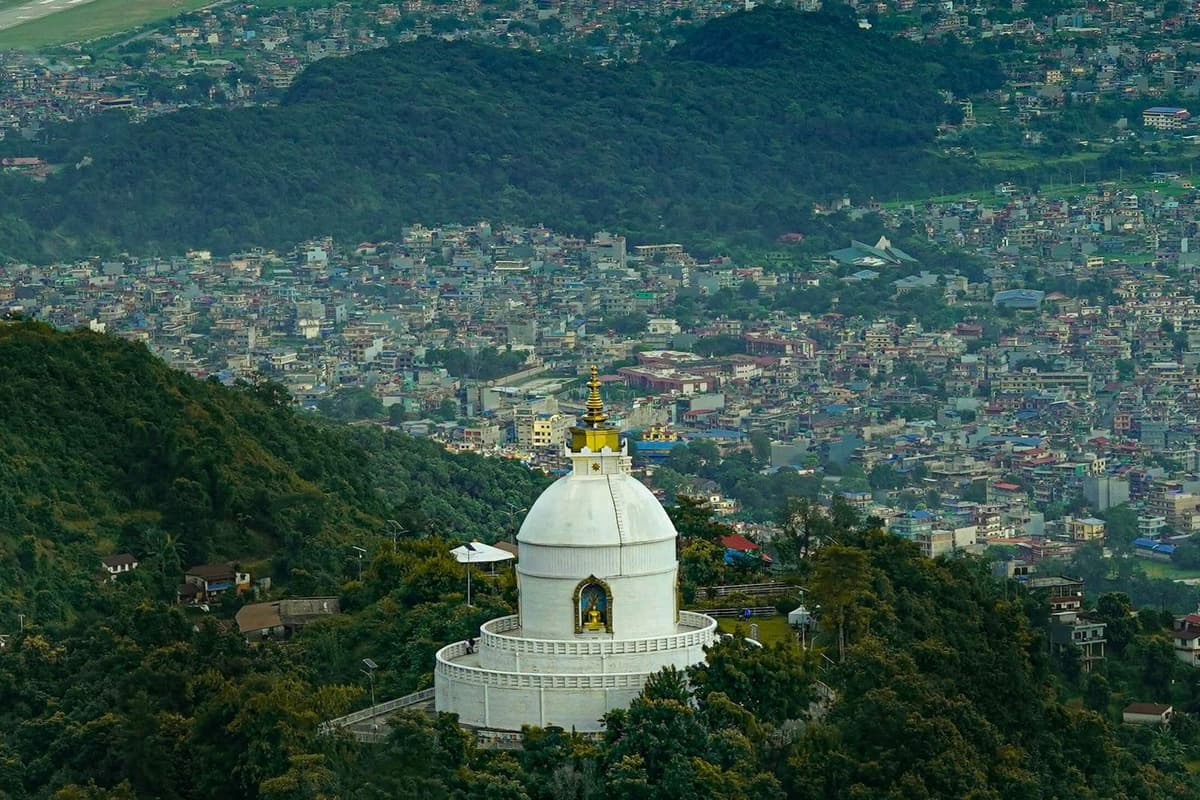
White World Peace Pagoda on its forested hill above Pokhara city and Phewa Lake

Look south from Lakeside and a white dome sits on the forested ridge above Phewa Lake. A boatman rows you across, life jackets on, towards the landing below the hill. From there, stone and wooden steps climb through the forest to the stupa.

By Uncover Nepal Team · Checked by our Kathmandu travel team · Last checked 2 November 2026

The World Peace Pagoda, Pokhara's Shanti Stupa, is a white Buddhist stupa on Anadu Hill above Phewa Lake's south shore. Cross by boat and climb about 45 minutes to an hour, or take a taxi, about 30 minutes, plus a 10-minute walk. Entry is free. Our guide to things to do in Pokhara counts it among the city's classic sights.

Key facts

Other names
Shanti Stupa; Peace Pagoda (Nepal Tourism Board; OnlineKhabar, 2023 (2 Nov 2026))
Where
Anadu Hill, above the Raniban forest on the south side of Phewa Lake, about 7 to 8 km from the city centre (The Himalayan Times, 2016; OnlineKhabar, 2016 and 2023; Montagna.tv, 2014 (2 Nov 2026))
Built by
Nipponzan Myohoji, a Japanese Buddhist order (Pokhara Metropolitan City; Nepali Times, 2003 (2 Nov 2026))
History
Foundation laid 1973; stupa inaugurated 1999 (Nepali Times, 2003; The Himalayan Times, 2016 and 2017 (2 Nov 2026))
Height
About 35 m (115 ft) (Nepali Times, 2003; The Himalayan Times, 2017 (2 Nov 2026))
Buddha images
Four, facing the four directions, from Japan, Sri Lanka, Thailand and Nepal (Nepal Tourism Board; Nepali Times, 2003 (2 Nov 2026))
Entry fee
Free (Pokhara Metropolitan City (2 Nov 2026))
Opening hours
6 am to 6 pm (Pokhara Metropolitan City (2 Nov 2026))
By boat and trail
A short row, then about 45 minutes to an hour uphill (The Longest Way Home, 2026; GoNomad, 2022 (2 Nov 2026))
By road
About 30 minutes by taxi from Lakeside, then about a 10-minute walk (Nepal Traveller, 2020; The Longest Way Home, 2026 (2 Nov 2026))
Boat rules
Life jackets for everyone; all water activities stop at 6 pm (DAO Kaski directive, 25 June 2026, via The Kathmandu Post and Republica (2 Nov 2026))
Clearest skies
October and November, after the monsoon (Nepal Tourism Board (2 Nov 2026))

In this guide

  • What is the World Peace Pagoda in Pokhara?
  • What will you see at the Pokhara Shanti Stupa?
  • World Peace Pagoda Pokhara: how do you get there?
  • What are the Phewa boat rules for the crossing?
  • Is there an entry fee, and when is it open?
  • How should you behave at the stupa?
  • Is the forest trail to the Peace Pagoda safe?
  • When is the best time to visit for the views?
  • What is near the World Peace Pagoda?
  • Frequently asked questions
  • Plan your visit

What is the World Peace Pagoda in Pokhara?

The World Peace Pagoda in Pokhara is a Buddhist stupa on a hill overlooking Phewa Lake, raised by the Japanese order Nipponzan Myohoji to promote world peace. Pokhara Metropolitan City calls it one of 80 peace pagodas the order has built around the world. Its foundation was laid in 1973, and it was inaugurated in 1999.

The hill is Anadu Hill, also written Anadu Danda or Andu Danda, and the forest on the slope below it, running down to the lake, is Raniban. You will also see the stupa called the Peace Pagoda or the Shanti Stupa.

Who built it: Nipponzan Myohoji

Nipponzan Myohoji was founded in Japan in 1917 by the monk Nichidatsu Fujii, who lived from 1885 to 1985. The order has built peace pagodas in many countries, and Pokhara's is one of them. Nepal Traveller says the Nipponzan Myohoji monk Morioka Sonin took the initiative for the construction in Pokhara. The same order built the World Peace Pagoda in Lumbini, the Buddha's birthplace, which makes a good second visit if your trip runs south.

A stupa that was built twice

The pagoda's story is longer than it looks. The land was given by Min Bahadur Gurung, a former minister, and the foundation was laid in 1973, Nepali Times reported. Under the Panchayat government, the half-built stupa was razed, and Gurung was charged with clearing forest and building without permission.

Permission to build again came in the early 1990s: Nepali Times names the Koirala government in 1993. The finished stupa was inaugurated in 1999.

In 2003 Nepali Times reported that its upkeep came mainly from Nipponzan Myohoji and a local committee, and in 2016 The Himalayan Times reported that Japanese monks had been managing the stupa. An annual puja (a ritual of worship and offerings) is held there in autumn; the paper covered the 17th on 5 November 2016.

The hill has had its troubles too. On 24 August 2014 a landslide swept away the stupa's front yard, and by 2016 the stupa's committee was thanking donors who had helped pay for landslide control.

What will you see at the Pokhara Shanti Stupa?

At the top you find a white, dome-shaped stupa about 35 m (115 ft) tall, with four Buddha images facing the four directions and wide views across the lake and Pokhara to the Annapurna range. It has two levels you can walk round, and there is a meditation hall at the site.

"The World Peace Pagoda can be seen on top of a hill on the southern fringe of Phewa Lake. It has four images of the Buddha facing the four directions. The dome-shaped pagoda is an impressive sight, and its hilltop location commands a great view."

Nepal Tourism Board, World Peace Pagoda page (read 2 November 2026)

The four Buddhas and where they came from

The four statues came from four countries, and each faces its own direction, according to Nepali Times:
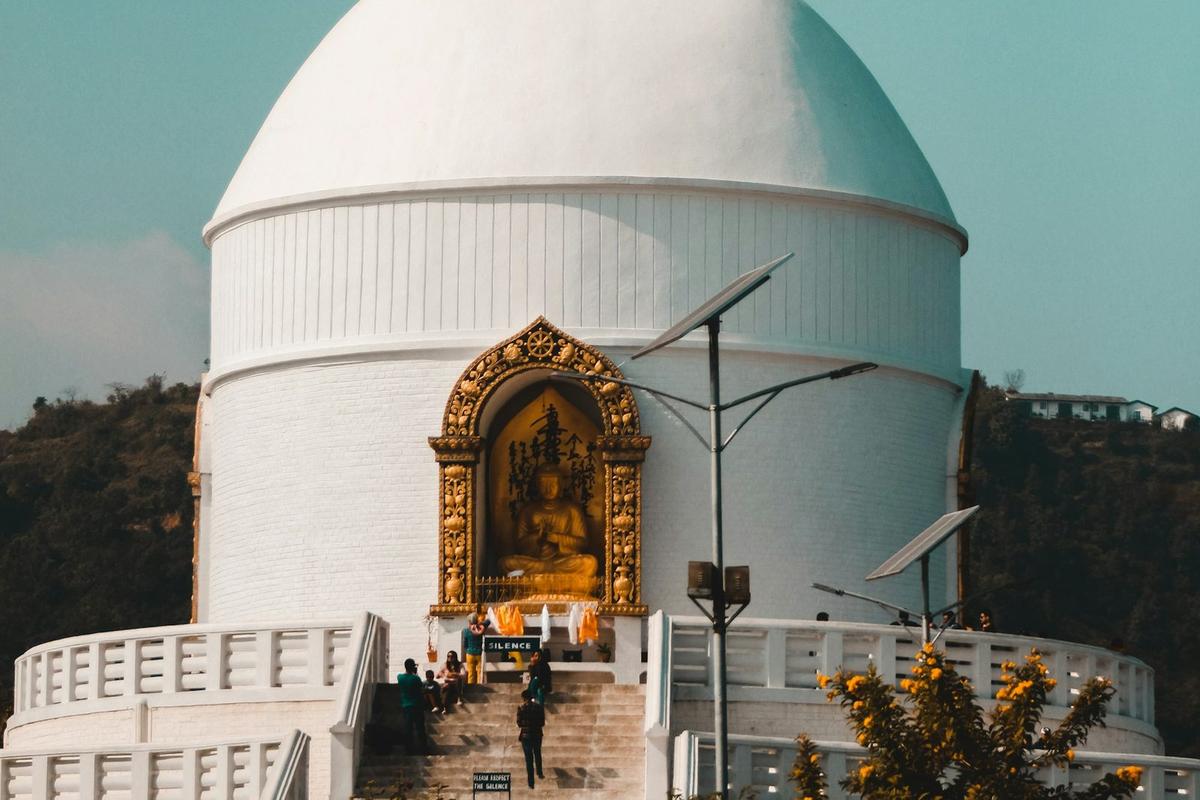
Golden Buddha statue in its niche on the World Peace Pagoda, Pokhara, with visitors on the steps below
One of the four Buddhas, which came from Japan, Sri Lanka, Thailand and Nepal.
  • South: a standing bronze Buddha from Nepal.
  • West: a Buddha from Sri Lanka.
  • North: a Buddha from Thailand.
  • East: a Buddha from Japan.

Walk round once and you meet all four. Nepali Times counted 37 steps up to the second tier, where the Buddhas sit.

Pujas, butter lamps and the meditation hall

Pujas are held at full moon, when pilgrims light butter lamps at the stupa. Nepali Times wrote in 2003 that everyone was welcome to use the meditation hall. If you arrive during a puja, stand back, keep quiet and let worshippers go first.

The view

On a clear day the terrace looks over Phewa Lake and the city to the Annapurna range, and Machhapuchhre, the "Fishtail" peak, is part of that view. Cloud often hides the mountains, especially in the monsoon, so treat the view as a bonus rather than a promise.

There are a few small cafes near the top if you want tea before the walk down.

World Peace Pagoda Pokhara: how do you get there?

There are three ways up: by boat across Phewa Lake and then a forest climb of about 45 minutes to an hour; by taxi on a paved road for about 30 minutes, then about a 10-minute walk; or by minibus to Chhorepatan and up the paved trail on foot. Lonely Planet also counts three paths up.

Route How it works Time Good for Watch out for
Boat and forest climb Row across Phewa from Lakeside, then climb stone and wooden steps through the forest A short row, then about 45 minutes to an hour uphill The classic way; a lake crossing and a forest walk in one Muddy, slippery steps after rain; boats stop at 6 pm
Road and short walk Taxi from Lakeside on a paved road that climbs from the Chhorepatan side About 30 minutes, then about a 10-minute walk Anyone who wants less climbing The last stretch is still on foot
Chhorepatan footpath Minibus from Lakeside past Pardi Bazaar to Chhorepatan, then the paved trail up the hill We found no reliable walking time, so we give none Walkers who like to go up one way and down another Unlit at dusk; go in daylight

Route 1: by boat and forest trail

Travel guides call this the most popular way up. Step by step:
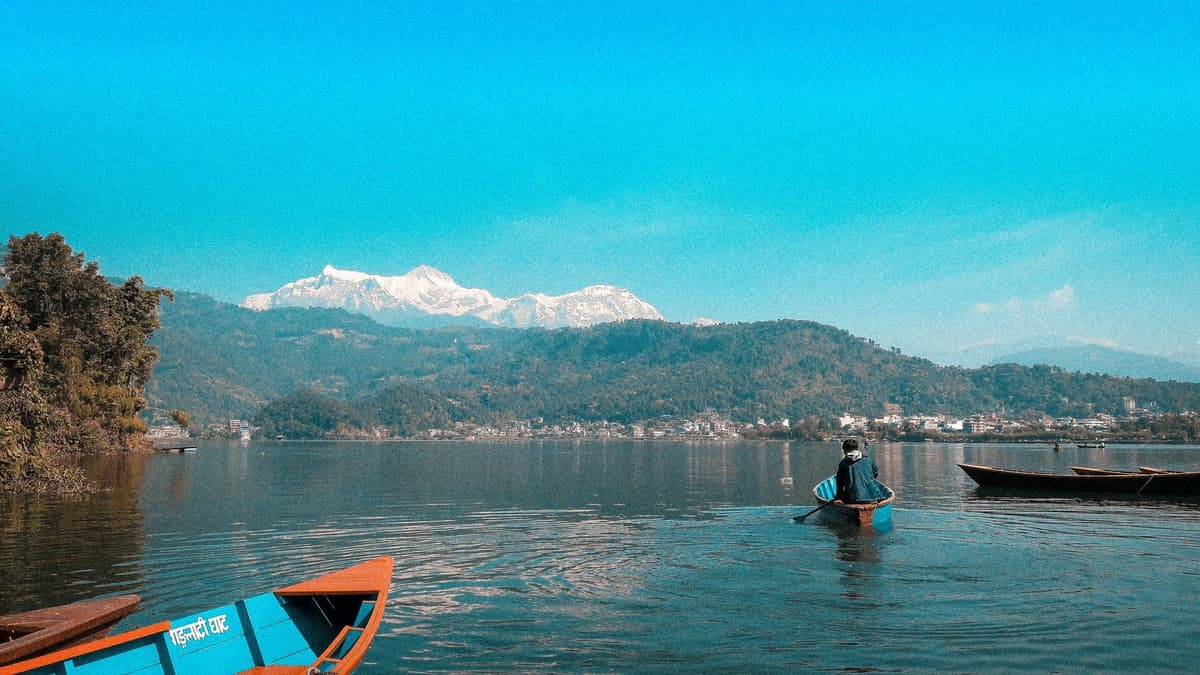
Wooden rowing boats on Phewa Lake with the Annapurna range behind
The classic way up starts with a row across Phewa.
  1. Go to a boat counter in Lakeside and hire a rowing boat to the landing below the Peace Pagoda trail.
  2. Agree the price, the return time and where you will be picked up before you leave the shore.
  3. Put on your life jacket and keep it on until you step out.
  4. From the landing, follow the forest trail of stone and wooden steps uphill. Most people take about 45 minutes to an hour.
  5. Take water, and wear shoes with grip: the steps get muddy and slippery.

You can break the crossing at Tal Barahi, the island temple, which reopened for worship on 11 October 2026; boats leave for it from Barahi Ghat, about five minutes' row away. Our guide to Phewa Lake covers the temple and the lake in more depth.

Route 2: by road and a short walk

A taxi from Lakeside takes about 30 minutes on a paved road, and from the end of the road it is about a 10-minute walk up to the stupa. The road climbs from the Chhorepatan side, south of the lake. This is the easiest way in for older travellers, young children or anyone short of time.

Route 3: the Chhorepatan footpath

Take a minibus from Lakeside to Chhorepatan, past Pardi Bazaar near the Damside end of the lake, then follow the paved trail up the hill to the pagoda. We found no walking time we trust for this route, so allow a generous margin and start well before mid-afternoon.

Coming down a different way

You do not have to return the way you came. You can walk back down to the boat landing, or take the road or footpath down to Chhorepatan and catch a minibus back to Lakeside. If you came by boat and plan to go down by road, tell your boatman before you set off so he is not left waiting.

Is there a cable car to the Peace Pagoda?

No. The Annapurna Cable Car runs from the Phewa shore up to Sarangkot, not to the Peace Pagoda. A cable car line from Lakeside to the pagoda was proposed in 2015, but we found no report that it was ever built. For the Sarangkot ride and sunrise, see our guide to Sarangkot in Pokhara.

What are the Phewa boat rules for the crossing?

Since a District Administration Office (DAO) Kaski directive of 25 June 2026, everyone on Phewa Lake must wear a life jacket, and all water activities stop at 6 pm. In bad weather, boating, kayaking and surfing are not allowed after 2 pm, so plan the crossing for the morning or early afternoon.

"All water tourism activities must stop after 6 pm every day."

The Kathmandu Post, 2 August 2026

The other rules that matter for this trip:

  • Children: those aged 16 and under may not boat or paddleboard without an adult.
  • Insurance: insurance for tourists on the water is mandatory.
  • Operators: they must register and give a safety briefing, so listen to it.
  • Fares: we do not print boat fares, because there is no official published list. Check the board at the counter and agree the price before you get in.

The practical point: if you walk up in the afternoon, the boat back is the part with a deadline. Be at the landing in good time, or plan to come down by road instead.

Is there an entry fee, and when is it open?

Entry to the World Peace Pagoda is free, and Pokhara Metropolitan City lists its hours as 6 am to 6 pm. You can leave a donation towards the upkeep if you wish. We found no report of a new fee in 2025 or 2026, but rules change, so check locally on the day.

How should you behave at the stupa?

The World Peace Pagoda is a working Buddhist shrine, not only a viewpoint. Dress modestly, take your shoes off before you climb to the stupa, walk round it clockwise and keep your voice down: visitors have reported signs at the site asking for silence.
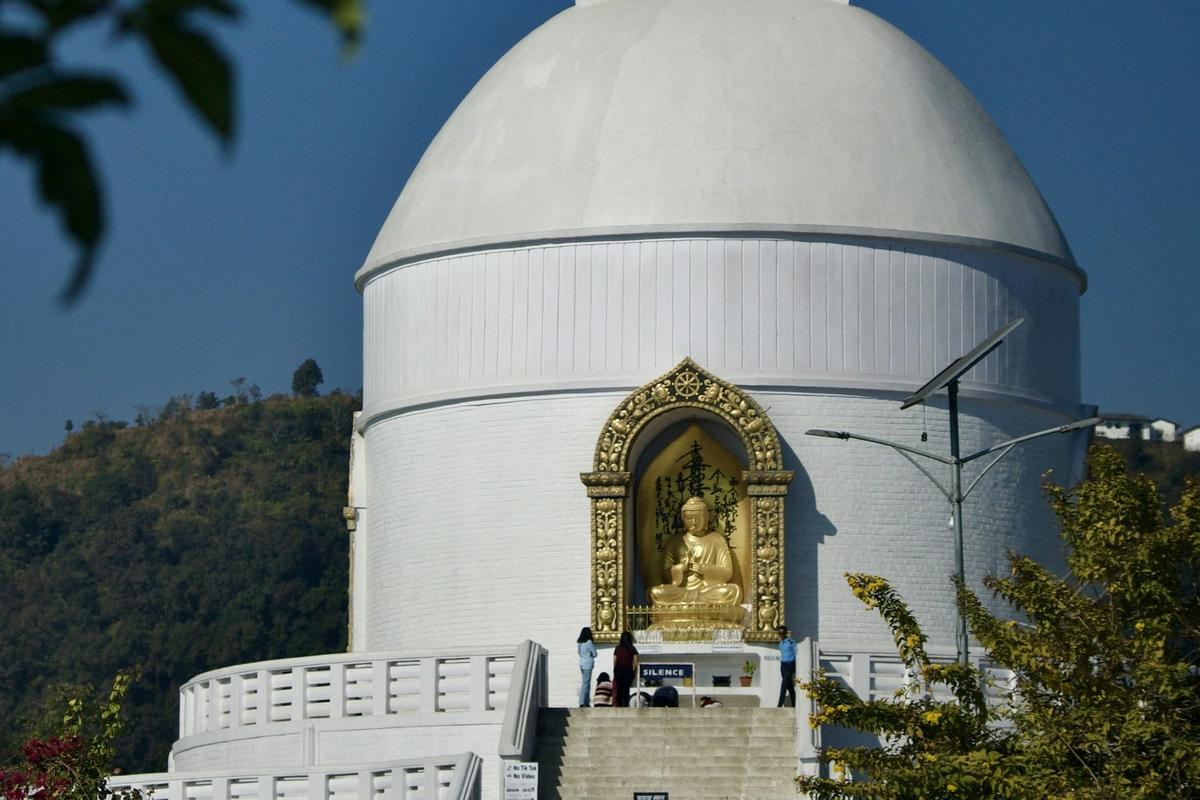
Visitors climbing the steps to a Buddha niche on the World Peace Pagoda in Pokhara
Shoes off, walk clockwise and keep your voice down.

Step by step:

  1. Dress. Cover your shoulders and knees. A light scarf or shirt in your daypack is enough.
  2. Shoes. Take them off where the signs ask, before you climb to the stupa. Socks help on hot or wet stone.
  3. Direction. Walk round the stupa clockwise, keeping it on your right.
  4. Noise. Keep quiet. People come here to pray and meditate.
  5. Photos. Taking photos is fine. Ask before filming video, as some visitors report it is not allowed.
  6. Drones. Leave the drone in your bag. We found no posted rule, but flying one over a shrine full of quiet visitors is not respectful.
  7. Pujas. On full-moon days, give worshippers space and do not step over offerings or butter lamps.
  8. Donations. There is no fee, but a donation towards upkeep is welcome.

Is the forest trail to the Peace Pagoda safe?

We found no recent reports of muggings on the trail, but it has a past: in 2005 The Himalayan Times reported a run of muggings of tourists on the way to the stupa, some by men carrying khukuris (curved Nepali knives). Go in daylight, go with someone, and do not walk it alone at dusk.

Since then the picture has improved. In 2016 a local club told the national news agency that there had been no robbery or theft in the area for three years, with local youth helping with security. A guidebook updated in January 2026 says there have been no recent reports of muggings, but that the trails and roads have no lighting and can be loose underfoot.

"Sadly, there have been muggings on the trails in the past. Check the latest situation before you head off."

Lonely Planet, World Peace Pagoda page (read 2 November 2026)

How to walk the trail safely

  1. Go in daylight, and be off the trail well before dark.
  2. Go with someone, especially if you are travelling solo.
  3. Carry little cash and leave valuables at your hotel.
  4. Keep your phone charged.
  5. Wear shoes with grip: the steps get muddy and slippery.
  6. Carry water for the climb.
  7. Ask locally about the trail's condition after heavy rain.

When is the best time to visit for the views?

The clearest skies normally come after the monsoon, in October and November. Nepali Times thought early morning the best time of day. We like the late-afternoon light on the lake, but leave time to be down, or back at your taxi, before the 6 pm close and before the boats stop.
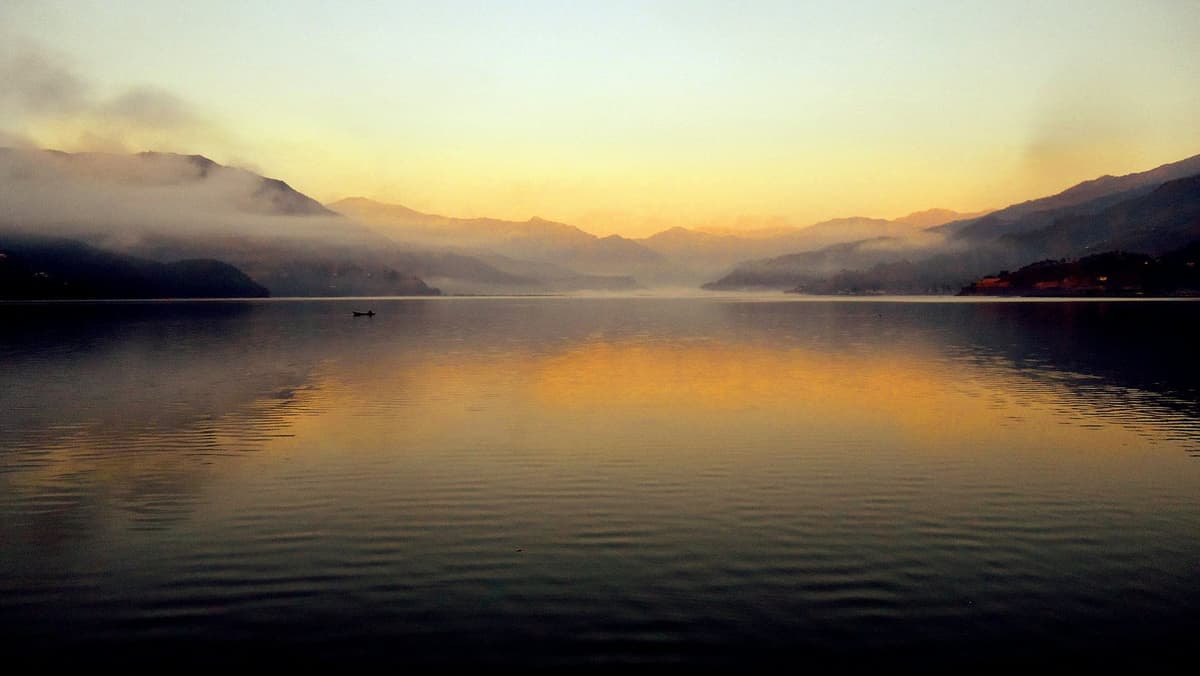
Golden light over Phewa Lake in Pokhara
Phewa Lake in golden light. Boats stop at 6 pm, so plan the crossing for daylight.

"But the best time to visit is early morning as dawn colours the world and there is a slight nip in the air."

Nepali Times, 16 May 2003

One honest note: the listed hours start at 6 am, and the trails and roads up are unlit, so we do not suggest climbing in the dark to catch sunrise at the stupa. For sunrise over the mountains, Sarangkot is the usual choice.

Pokhara weather month by month

These are the Pokhara Airport weather station's 1991 to 2020 averages. The pagoda hill is higher and a little cooler than the valley.

Month Average high / low Rain At the pagoda
October 27.9 °C / 17.2 °C 159.2 mm After the monsoon; clear skies most likely in October and November
November 24.4 °C / 12.3 °C 17.2 mm Clear skies most likely; cooler mornings
December 21.0 °C / 8.3 °C 11.5 mm The driest month; cool mornings
June 30.8 °C / 21.2 °C 648.2 mm The monsoon usually arrives around mid-June
July 30.4 °C / 22.4 °C 941.0 mm The wettest month; muddy steps, views rare

In the monsoon, from about mid-June to early October, cloud often hides the mountains, the forest steps are muddy and slippery, and boating stops after 2 pm in bad weather. The pagoda is still worth the trip for the stupa itself; just take the road route if the steps look bad.

What is near the World Peace Pagoda?

The road and footpath down the far side of the hill lead to Chhorepatan, where Davis Falls, Gupteshwor Cave and the Tashiling Tibetan settlement are close together. Pumdikot, with its large Shiva statue, sits on the same southern ridge and looks over the lake and the pagoda.

Davis Falls and Gupteshwor Cave

Davis Falls, also called Devi's Fall and locally Patale Chhango, is about 2 km south-west of Pokhara's old airport on the Siddhartha Highway. Gupteshwor Mahadev Cave, a Hindu cave shrine, is across the road from the falls. Both are easy to add on the way back from the pagoda by road.

Tashiling Tibetan settlement

Tashiling, at Chhorepatan, is about 350 m from Davis Falls and Gupteshwor Cave. It was set up in 1965 on land from the Nepal government, procured by the International Red Cross, and its handicraft centre, set up in 1980, sells hand-woven carpets and other Tibetan handicrafts.

Pumdikot

Pumdikot is on the same southern ridge as the pagoda, with a Shiva statue looking over the lake and back towards the stupa. We found no walking time between the two that we trust, so we give none.

A half day on the south side

  1. Cross Phewa by boat in the morning and climb to the pagoda.
  2. Walk round the stupa, then take tea at one of the small cafes near the top.
  3. Go down the road side to Chhorepatan, having told your boatman not to wait.
  4. Visit Davis Falls and Gupteshwor Cave, then Tashiling.
  5. Take a minibus or taxi back to Lakeside.

Frequently asked questions

How do I reach the World Peace Pagoda in Pokhara?

Take a rowing boat from Lakeside across Phewa Lake, then climb a forest trail of stone and wooden steps for about 45 minutes to an hour. Or take a taxi for about 30 minutes on a paved road and walk about 10 minutes up. A third way is a minibus to Chhorepatan and the paved trail up the hill. Wear a life jacket on the lake; boats stop at 6 pm.

How many days should I spend in Pokhara?

Two full days cover Pokhara's classic sights at an easy pace, the Peace Pagoda included. Add a third day for Begnas Lake, paragliding or a short hike, and add trek days plus a spare day if you are trekking. Getting there takes about 30 minutes by air from Kathmandu, or most of a day by road, often six to nine hours. Our Kathmandu to Pokhara guide compares the options.

Is it OK to visit Pokhara in the monsoon?

Yes, if you plan around the rain. The monsoon normally runs from about 13 June to 2 October. Pokhara is one of Nepal's wettest areas: the airport station averages 3,868.3 mm of rain a year, with 941.0 mm in July, and rain on about 22 to 26 days a month from June to August. Expect cloud over the mountains, muddy steps to the pagoda and no boating after 2 pm in bad weather.

What is the Tibetan refugee settlement near Pokhara?

There are four Tibetan settlements in and around Pokhara: Tashiling, Tashi Palkhel, Paljorling and Jampaling. Tashiling, at Chhorepatan near Davis Falls, was set up in 1965 and has a handicraft centre selling hand-woven carpets. Tashi Palkhel is at Hyangja (Hemja), north-west of the city. Paljorling is in the city itself, and Jampaling is about 25 km out on the road to Kathmandu.

What are the best things to do in Pokhara?

The favourites are boating on Phewa Lake, sunrise at Sarangkot, the World Peace Pagoda, Davis Falls and Gupteshwor Cave, the Mountain Museum, paragliding and day hikes. Most sit a short drive from Lakeside, so two or three days covers the classics. Our full guide to things to do in Pokhara has each one, with times, tickets and tips.

Plan your visit

The pagoda fits easily into a Pokhara stay of two days or more. Three of our trips include it:

On each of these trips a licensed guide is with you in Pokhara, and we arrange the vehicle and your hotels. For the rest of the city, see our guide to things to do in Pokhara. Ask us on WhatsApp or through the enquiry form, and we will tell you honestly how the pagoda fits around your other days.

Your Nepal visa and international flights are your own arrangements; official visa information is on the Nepal Tourism Board tourist-visa page.
Tags
World Peace PagodaPokhara Shanti StupaPhewa LakePokhara sightseeingBuddhist sites in NepalPokhara viewpoints
Share
U
Uncover Nepal Team
Writer at Uncover Nepal
More in Temples & cultureSee all Temples & culture

World Peace Pagoda Pokhara: How to Get There

18 min read Posted 08 Nov 2026Updated 05 Nov 2026
White World Peace Pagoda on its forested hill above Pokhara city and Phewa Lake

Look south from Lakeside and a white dome sits on the forested ridge above Phewa Lake. A boatman rows you across, life jackets on, towards the landing below the hill. From there, stone and wooden steps climb through the forest to the stupa.

By Uncover Nepal Team · Checked by our Kathmandu travel team · Last checked 2 November 2026

The World Peace Pagoda, Pokhara's Shanti Stupa, is a white Buddhist stupa on Anadu Hill above Phewa Lake's south shore. Cross by boat and climb about 45 minutes to an hour, or take a taxi, about 30 minutes, plus a 10-minute walk. Entry is free. Our guide to things to do in Pokhara counts it among the city's classic sights.

Key facts

Other names
Shanti Stupa; Peace Pagoda (Nepal Tourism Board; OnlineKhabar, 2023 (2 Nov 2026))
Where
Anadu Hill, above the Raniban forest on the south side of Phewa Lake, about 7 to 8 km from the city centre (The Himalayan Times, 2016; OnlineKhabar, 2016 and 2023; Montagna.tv, 2014 (2 Nov 2026))
Built by
Nipponzan Myohoji, a Japanese Buddhist order (Pokhara Metropolitan City; Nepali Times, 2003 (2 Nov 2026))
History
Foundation laid 1973; stupa inaugurated 1999 (Nepali Times, 2003; The Himalayan Times, 2016 and 2017 (2 Nov 2026))
Height
About 35 m (115 ft) (Nepali Times, 2003; The Himalayan Times, 2017 (2 Nov 2026))
Buddha images
Four, facing the four directions, from Japan, Sri Lanka, Thailand and Nepal (Nepal Tourism Board; Nepali Times, 2003 (2 Nov 2026))
Entry fee
Free (Pokhara Metropolitan City (2 Nov 2026))
Opening hours
6 am to 6 pm (Pokhara Metropolitan City (2 Nov 2026))
By boat and trail
A short row, then about 45 minutes to an hour uphill (The Longest Way Home, 2026; GoNomad, 2022 (2 Nov 2026))
By road
About 30 minutes by taxi from Lakeside, then about a 10-minute walk (Nepal Traveller, 2020; The Longest Way Home, 2026 (2 Nov 2026))
Boat rules
Life jackets for everyone; all water activities stop at 6 pm (DAO Kaski directive, 25 June 2026, via The Kathmandu Post and Republica (2 Nov 2026))
Clearest skies
October and November, after the monsoon (Nepal Tourism Board (2 Nov 2026))

In this guide

  • What is the World Peace Pagoda in Pokhara?
  • What will you see at the Pokhara Shanti Stupa?
  • World Peace Pagoda Pokhara: how do you get there?
  • What are the Phewa boat rules for the crossing?
  • Is there an entry fee, and when is it open?
  • How should you behave at the stupa?
  • Is the forest trail to the Peace Pagoda safe?
  • When is the best time to visit for the views?
  • What is near the World Peace Pagoda?
  • Frequently asked questions
  • Plan your visit

What is the World Peace Pagoda in Pokhara?

The World Peace Pagoda in Pokhara is a Buddhist stupa on a hill overlooking Phewa Lake, raised by the Japanese order Nipponzan Myohoji to promote world peace. Pokhara Metropolitan City calls it one of 80 peace pagodas the order has built around the world. Its foundation was laid in 1973, and it was inaugurated in 1999.

The hill is Anadu Hill, also written Anadu Danda or Andu Danda, and the forest on the slope below it, running down to the lake, is Raniban. You will also see the stupa called the Peace Pagoda or the Shanti Stupa.

Who built it: Nipponzan Myohoji

Nipponzan Myohoji was founded in Japan in 1917 by the monk Nichidatsu Fujii, who lived from 1885 to 1985. The order has built peace pagodas in many countries, and Pokhara's is one of them. Nepal Traveller says the Nipponzan Myohoji monk Morioka Sonin took the initiative for the construction in Pokhara. The same order built the World Peace Pagoda in Lumbini, the Buddha's birthplace, which makes a good second visit if your trip runs south.

A stupa that was built twice

The pagoda's story is longer than it looks. The land was given by Min Bahadur Gurung, a former minister, and the foundation was laid in 1973, Nepali Times reported. Under the Panchayat government, the half-built stupa was razed, and Gurung was charged with clearing forest and building without permission.

Permission to build again came in the early 1990s: Nepali Times names the Koirala government in 1993. The finished stupa was inaugurated in 1999.

In 2003 Nepali Times reported that its upkeep came mainly from Nipponzan Myohoji and a local committee, and in 2016 The Himalayan Times reported that Japanese monks had been managing the stupa. An annual puja (a ritual of worship and offerings) is held there in autumn; the paper covered the 17th on 5 November 2016.

The hill has had its troubles too. On 24 August 2014 a landslide swept away the stupa's front yard, and by 2016 the stupa's committee was thanking donors who had helped pay for landslide control.

What will you see at the Pokhara Shanti Stupa?

At the top you find a white, dome-shaped stupa about 35 m (115 ft) tall, with four Buddha images facing the four directions and wide views across the lake and Pokhara to the Annapurna range. It has two levels you can walk round, and there is a meditation hall at the site.

"The World Peace Pagoda can be seen on top of a hill on the southern fringe of Phewa Lake. It has four images of the Buddha facing the four directions. The dome-shaped pagoda is an impressive sight, and its hilltop location commands a great view."

Nepal Tourism Board, World Peace Pagoda page (read 2 November 2026)

The four Buddhas and where they came from

The four statues came from four countries, and each faces its own direction, according to Nepali Times:

Golden Buddha statue in its niche on the World Peace Pagoda, Pokhara, with visitors on the steps below
One of the four Buddhas, which came from Japan, Sri Lanka, Thailand and Nepal.
  • South: a standing bronze Buddha from Nepal.
  • West: a Buddha from Sri Lanka.
  • North: a Buddha from Thailand.
  • East: a Buddha from Japan.

Walk round once and you meet all four. Nepali Times counted 37 steps up to the second tier, where the Buddhas sit.

Pujas, butter lamps and the meditation hall

Pujas are held at full moon, when pilgrims light butter lamps at the stupa. Nepali Times wrote in 2003 that everyone was welcome to use the meditation hall. If you arrive during a puja, stand back, keep quiet and let worshippers go first.

The view

On a clear day the terrace looks over Phewa Lake and the city to the Annapurna range, and Machhapuchhre, the "Fishtail" peak, is part of that view. Cloud often hides the mountains, especially in the monsoon, so treat the view as a bonus rather than a promise.

There are a few small cafes near the top if you want tea before the walk down.

World Peace Pagoda Pokhara: how do you get there?

There are three ways up: by boat across Phewa Lake and then a forest climb of about 45 minutes to an hour; by taxi on a paved road for about 30 minutes, then about a 10-minute walk; or by minibus to Chhorepatan and up the paved trail on foot. Lonely Planet also counts three paths up.

Route How it works Time Good for Watch out for
Boat and forest climb Row across Phewa from Lakeside, then climb stone and wooden steps through the forest A short row, then about 45 minutes to an hour uphill The classic way; a lake crossing and a forest walk in one Muddy, slippery steps after rain; boats stop at 6 pm
Road and short walk Taxi from Lakeside on a paved road that climbs from the Chhorepatan side About 30 minutes, then about a 10-minute walk Anyone who wants less climbing The last stretch is still on foot
Chhorepatan footpath Minibus from Lakeside past Pardi Bazaar to Chhorepatan, then the paved trail up the hill We found no reliable walking time, so we give none Walkers who like to go up one way and down another Unlit at dusk; go in daylight

Route 1: by boat and forest trail

Travel guides call this the most popular way up. Step by step:

Wooden rowing boats on Phewa Lake with the Annapurna range behind
The classic way up starts with a row across Phewa.
  1. Go to a boat counter in Lakeside and hire a rowing boat to the landing below the Peace Pagoda trail.
  2. Agree the price, the return time and where you will be picked up before you leave the shore.
  3. Put on your life jacket and keep it on until you step out.
  4. From the landing, follow the forest trail of stone and wooden steps uphill. Most people take about 45 minutes to an hour.
  5. Take water, and wear shoes with grip: the steps get muddy and slippery.

You can break the crossing at Tal Barahi, the island temple, which reopened for worship on 11 October 2026; boats leave for it from Barahi Ghat, about five minutes' row away. Our guide to Phewa Lake covers the temple and the lake in more depth.

Route 2: by road and a short walk

A taxi from Lakeside takes about 30 minutes on a paved road, and from the end of the road it is about a 10-minute walk up to the stupa. The road climbs from the Chhorepatan side, south of the lake. This is the easiest way in for older travellers, young children or anyone short of time.

Route 3: the Chhorepatan footpath

Take a minibus from Lakeside to Chhorepatan, past Pardi Bazaar near the Damside end of the lake, then follow the paved trail up the hill to the pagoda. We found no walking time we trust for this route, so allow a generous margin and start well before mid-afternoon.

Coming down a different way

You do not have to return the way you came. You can walk back down to the boat landing, or take the road or footpath down to Chhorepatan and catch a minibus back to Lakeside. If you came by boat and plan to go down by road, tell your boatman before you set off so he is not left waiting.

Is there a cable car to the Peace Pagoda?

No. The Annapurna Cable Car runs from the Phewa shore up to Sarangkot, not to the Peace Pagoda. A cable car line from Lakeside to the pagoda was proposed in 2015, but we found no report that it was ever built. For the Sarangkot ride and sunrise, see our guide to Sarangkot in Pokhara.

What are the Phewa boat rules for the crossing?

Since a District Administration Office (DAO) Kaski directive of 25 June 2026, everyone on Phewa Lake must wear a life jacket, and all water activities stop at 6 pm. In bad weather, boating, kayaking and surfing are not allowed after 2 pm, so plan the crossing for the morning or early afternoon.

"All water tourism activities must stop after 6 pm every day."

The Kathmandu Post, 2 August 2026

The other rules that matter for this trip:

  • Children: those aged 16 and under may not boat or paddleboard without an adult.
  • Insurance: insurance for tourists on the water is mandatory.
  • Operators: they must register and give a safety briefing, so listen to it.
  • Fares: we do not print boat fares, because there is no official published list. Check the board at the counter and agree the price before you get in.

The practical point: if you walk up in the afternoon, the boat back is the part with a deadline. Be at the landing in good time, or plan to come down by road instead.

Is there an entry fee, and when is it open?

Entry to the World Peace Pagoda is free, and Pokhara Metropolitan City lists its hours as 6 am to 6 pm. You can leave a donation towards the upkeep if you wish. We found no report of a new fee in 2025 or 2026, but rules change, so check locally on the day.

How should you behave at the stupa?

The World Peace Pagoda is a working Buddhist shrine, not only a viewpoint. Dress modestly, take your shoes off before you climb to the stupa, walk round it clockwise and keep your voice down: visitors have reported signs at the site asking for silence.

Visitors climbing the steps to a Buddha niche on the World Peace Pagoda in Pokhara
Shoes off, walk clockwise and keep your voice down.

Step by step:

  1. Dress. Cover your shoulders and knees. A light scarf or shirt in your daypack is enough.
  2. Shoes. Take them off where the signs ask, before you climb to the stupa. Socks help on hot or wet stone.
  3. Direction. Walk round the stupa clockwise, keeping it on your right.
  4. Noise. Keep quiet. People come here to pray and meditate.
  5. Photos. Taking photos is fine. Ask before filming video, as some visitors report it is not allowed.
  6. Drones. Leave the drone in your bag. We found no posted rule, but flying one over a shrine full of quiet visitors is not respectful.
  7. Pujas. On full-moon days, give worshippers space and do not step over offerings or butter lamps.
  8. Donations. There is no fee, but a donation towards upkeep is welcome.

Is the forest trail to the Peace Pagoda safe?

We found no recent reports of muggings on the trail, but it has a past: in 2005 The Himalayan Times reported a run of muggings of tourists on the way to the stupa, some by men carrying khukuris (curved Nepali knives). Go in daylight, go with someone, and do not walk it alone at dusk.

Since then the picture has improved. In 2016 a local club told the national news agency that there had been no robbery or theft in the area for three years, with local youth helping with security. A guidebook updated in January 2026 says there have been no recent reports of muggings, but that the trails and roads have no lighting and can be loose underfoot.

"Sadly, there have been muggings on the trails in the past. Check the latest situation before you head off."

Lonely Planet, World Peace Pagoda page (read 2 November 2026)

How to walk the trail safely

  1. Go in daylight, and be off the trail well before dark.
  2. Go with someone, especially if you are travelling solo.
  3. Carry little cash and leave valuables at your hotel.
  4. Keep your phone charged.
  5. Wear shoes with grip: the steps get muddy and slippery.
  6. Carry water for the climb.
  7. Ask locally about the trail's condition after heavy rain.

When is the best time to visit for the views?

The clearest skies normally come after the monsoon, in October and November. Nepali Times thought early morning the best time of day. We like the late-afternoon light on the lake, but leave time to be down, or back at your taxi, before the 6 pm close and before the boats stop.

Golden light over Phewa Lake in Pokhara
Phewa Lake in golden light. Boats stop at 6 pm, so plan the crossing for daylight.

"But the best time to visit is early morning as dawn colours the world and there is a slight nip in the air."

Nepali Times, 16 May 2003

One honest note: the listed hours start at 6 am, and the trails and roads up are unlit, so we do not suggest climbing in the dark to catch sunrise at the stupa. For sunrise over the mountains, Sarangkot is the usual choice.

Pokhara weather month by month

These are the Pokhara Airport weather station's 1991 to 2020 averages. The pagoda hill is higher and a little cooler than the valley.

Month Average high / low Rain At the pagoda
October 27.9 °C / 17.2 °C 159.2 mm After the monsoon; clear skies most likely in October and November
November 24.4 °C / 12.3 °C 17.2 mm Clear skies most likely; cooler mornings
December 21.0 °C / 8.3 °C 11.5 mm The driest month; cool mornings
June 30.8 °C / 21.2 °C 648.2 mm The monsoon usually arrives around mid-June
July 30.4 °C / 22.4 °C 941.0 mm The wettest month; muddy steps, views rare

In the monsoon, from about mid-June to early October, cloud often hides the mountains, the forest steps are muddy and slippery, and boating stops after 2 pm in bad weather. The pagoda is still worth the trip for the stupa itself; just take the road route if the steps look bad.

What is near the World Peace Pagoda?

The road and footpath down the far side of the hill lead to Chhorepatan, where Davis Falls, Gupteshwor Cave and the Tashiling Tibetan settlement are close together. Pumdikot, with its large Shiva statue, sits on the same southern ridge and looks over the lake and the pagoda.

Davis Falls and Gupteshwor Cave

Davis Falls, also called Devi's Fall and locally Patale Chhango, is about 2 km south-west of Pokhara's old airport on the Siddhartha Highway. Gupteshwor Mahadev Cave, a Hindu cave shrine, is across the road from the falls. Both are easy to add on the way back from the pagoda by road.

Tashiling Tibetan settlement

Tashiling, at Chhorepatan, is about 350 m from Davis Falls and Gupteshwor Cave. It was set up in 1965 on land from the Nepal government, procured by the International Red Cross, and its handicraft centre, set up in 1980, sells hand-woven carpets and other Tibetan handicrafts.

Pumdikot

Pumdikot is on the same southern ridge as the pagoda, with a Shiva statue looking over the lake and back towards the stupa. We found no walking time between the two that we trust, so we give none.

A half day on the south side

  1. Cross Phewa by boat in the morning and climb to the pagoda.
  2. Walk round the stupa, then take tea at one of the small cafes near the top.
  3. Go down the road side to Chhorepatan, having told your boatman not to wait.
  4. Visit Davis Falls and Gupteshwor Cave, then Tashiling.
  5. Take a minibus or taxi back to Lakeside.

Frequently asked questions

How do I reach the World Peace Pagoda in Pokhara?

Take a rowing boat from Lakeside across Phewa Lake, then climb a forest trail of stone and wooden steps for about 45 minutes to an hour. Or take a taxi for about 30 minutes on a paved road and walk about 10 minutes up. A third way is a minibus to Chhorepatan and the paved trail up the hill. Wear a life jacket on the lake; boats stop at 6 pm.

How many days should I spend in Pokhara?

Two full days cover Pokhara's classic sights at an easy pace, the Peace Pagoda included. Add a third day for Begnas Lake, paragliding or a short hike, and add trek days plus a spare day if you are trekking. Getting there takes about 30 minutes by air from Kathmandu, or most of a day by road, often six to nine hours. Our Kathmandu to Pokhara guide compares the options.

Is it OK to visit Pokhara in the monsoon?

Yes, if you plan around the rain. The monsoon normally runs from about 13 June to 2 October. Pokhara is one of Nepal's wettest areas: the airport station averages 3,868.3 mm of rain a year, with 941.0 mm in July, and rain on about 22 to 26 days a month from June to August. Expect cloud over the mountains, muddy steps to the pagoda and no boating after 2 pm in bad weather.

What is the Tibetan refugee settlement near Pokhara?

There are four Tibetan settlements in and around Pokhara: Tashiling, Tashi Palkhel, Paljorling and Jampaling. Tashiling, at Chhorepatan near Davis Falls, was set up in 1965 and has a handicraft centre selling hand-woven carpets. Tashi Palkhel is at Hyangja (Hemja), north-west of the city. Paljorling is in the city itself, and Jampaling is about 25 km out on the road to Kathmandu.

What are the best things to do in Pokhara?

The favourites are boating on Phewa Lake, sunrise at Sarangkot, the World Peace Pagoda, Davis Falls and Gupteshwor Cave, the Mountain Museum, paragliding and day hikes. Most sit a short drive from Lakeside, so two or three days covers the classics. Our full guide to things to do in Pokhara has each one, with times, tickets and tips.

Plan your visit

The pagoda fits easily into a Pokhara stay of two days or more. Three of our trips include it:

On each of these trips a licensed guide is with you in Pokhara, and we arrange the vehicle and your hotels. For the rest of the city, see our guide to things to do in Pokhara. Ask us on WhatsApp or through the enquiry form, and we will tell you honestly how the pagoda fits around your other days.

Your Nepal visa and international flights are your own arrangements; official visa information is on the Nepal Tourism Board tourist-visa page.
Tags
World Peace PagodaPokhara Shanti StupaPhewa LakePokhara sightseeingBuddhist sites in NepalPokhara viewpoints
Share
U
Uncover Nepal Team
Writer at Uncover Nepal
More in Temples & cultureSee all Temples & culture