


Explore by activity
Not listed yet

We run Motorbiking & Overland trips — we just haven’t put the itinerary on the site yet. Tell us your dates and we’ll send a costed day-by-day plan.

Explore by experience
Explore by region
by gomayu
Search Tours or Places

Phewa Lake, Pokhara: Boating, Walks and Views

22 min read Posted 27 Oct 2026Updated 28 Oct 2026
Phewa Lake, Pokhara: Boating, Walks and Views

By Uncover Nepal Team · Checked by our Kathmandu travel team · Last checked 27 October 2026

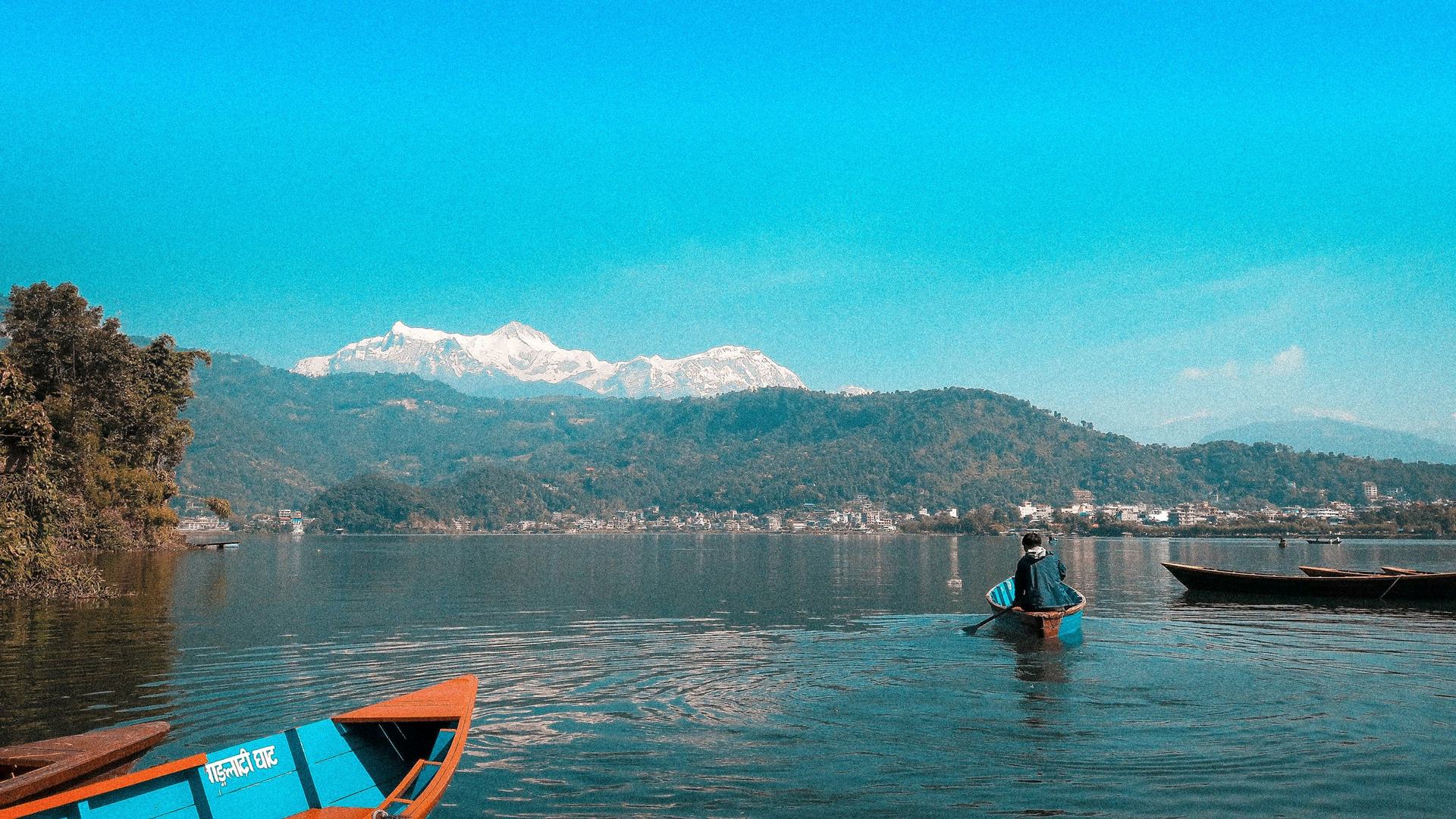
Early in the morning, before the wind gets up, the wooden boats at Barahi Ghat lie in a row and the water is flat. A few minutes' row out, the pagoda roof of Tal Barahi Temple rises from its island, open for worship again since 11 October 2026. On a clear day Machhapuchhre stands white above the hills to the north.

Phewa Lake is the lake at the heart of Pokhara, about 200 km west of Kathmandu. You can take a boat or paddleboard out, cross to the island temple of Tal Barahi, and walk up to the World Peace Pagoda. The shore is free; on the water, life jackets are compulsory and boating stops at 6 pm.

Our guide to things to do in Pokhara covers the whole city. This one is the lake on its own: how boating works under the new safety rules, what changed at Tal Barahi, the walks around the shore, when the views are clearest, and why nobody can give you one honest figure for the lake's size.

In this guide

  • Key facts
  • Where is Phewa Lake, and what is it like?
  • How big is Phewa Lake, and how deep?
  • Boating on Phewa Lake: how it works
  • Phewa Lake safety rules in 2026
  • Tal Barahi Temple, open again after the rebuild
  • Walks around Phewa Lake
  • When is the best time to visit Phewa Lake?
  • Why Phewa Lake is protected, and what threatens it
  • Getting to Phewa Lake
  • Frequently asked questions

Key facts

Where
Pokhara, about 200 km west of Kathmandu; the city sits at about 820 m (Wikipedia (Pokhara); Uncover Nepal standard figure, 27 Oct 2026)
Size
No single figure: officially 5.726 km² (gazetted March 2022); 6.343 km² in a 2025 survey to the monsoon high-water line (The Kathmandu Post, 1 June 2025, 27 Oct 2026)
Depth
Deepest point 21.4 m, mean 8.5 m (survey of May 2018) (Watson and others, Remote Sensing, 2019, 27 Oct 2026)
Size rank
Pokhara Metropolitan City calls it Nepal's second largest lake; some references say third (Pokhara Metropolitan City; Wikipedia, 27 Oct 2026)
Ramsar site
Part of the Lake Cluster of Pokhara Valley, Ramsar Site no. 2257, designated 2 February 2016 (Ramsar Sites Information Service, 27 Oct 2026)
Tal Barahi Temple
Island temple, reached by boat; reopened 11 October 2026 after a rebuild begun 26 October 2023 (Nepal Tourism Board; Meronews; HimalPress, 27 Oct 2026)
Water rules
Life jackets compulsory for everyone; all water activities stop at 6 pm (District Administration Office Kaski, 25 June 2026) (The Kathmandu Post; Republica, 27 Oct 2026)
Entry
No fee to walk the shore; boat fares are set at the boat counters (Pokhara Metropolitan City; our own checks, 27 Oct 2026)
Weather
Pokhara Airport, 1991 to 2020: driest month December (11.5 mm), wettest July (941.0 mm) (DHM and WMO normals, 27 Oct 2026)
Getting there
From Kathmandu, six to nine hours by road or about 30 minutes by air (Uncover Nepal standard figures, 27 Oct 2026)

Where is Phewa Lake, and what is it like?

Phewa Lake lies along the edge of Pokhara, the lakeside city about 200 km west of Kathmandu, which sits at about 820 m. The tourist district called Lakeside, or Baidam, runs along the shore, with hotels, cafés and boat stands a short walk from the water.

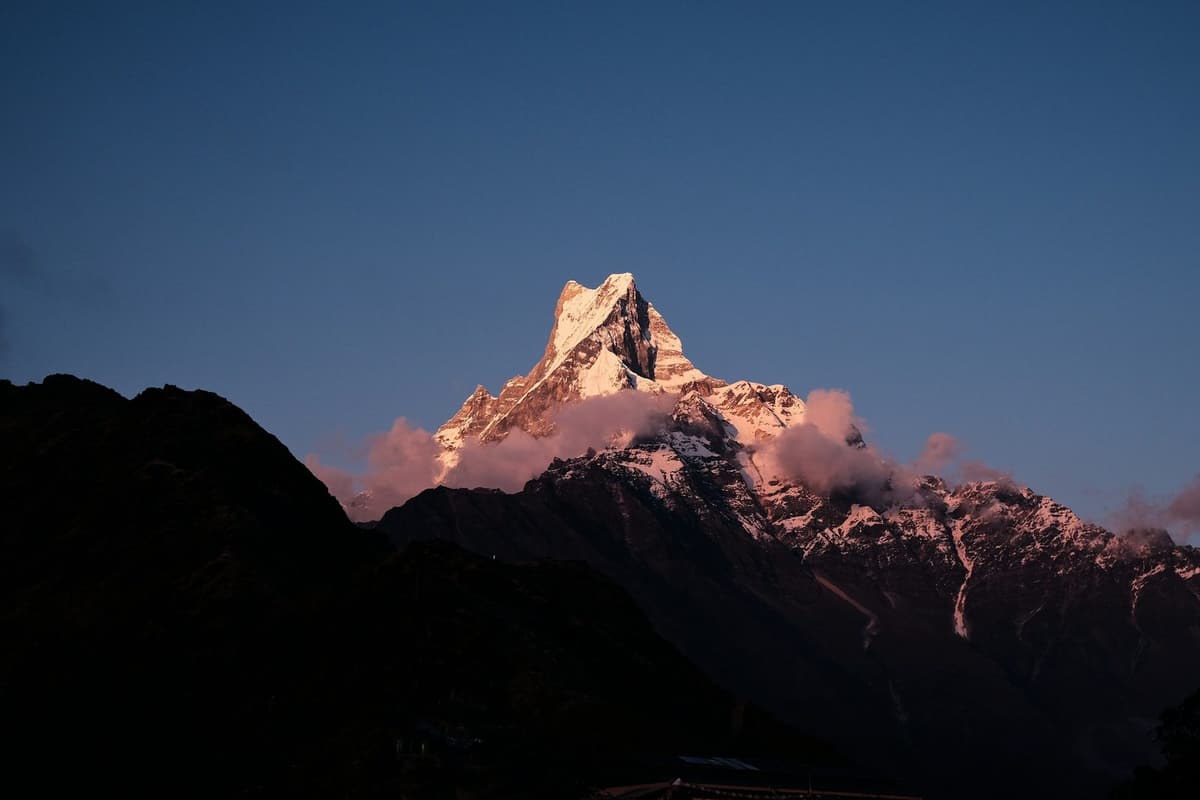
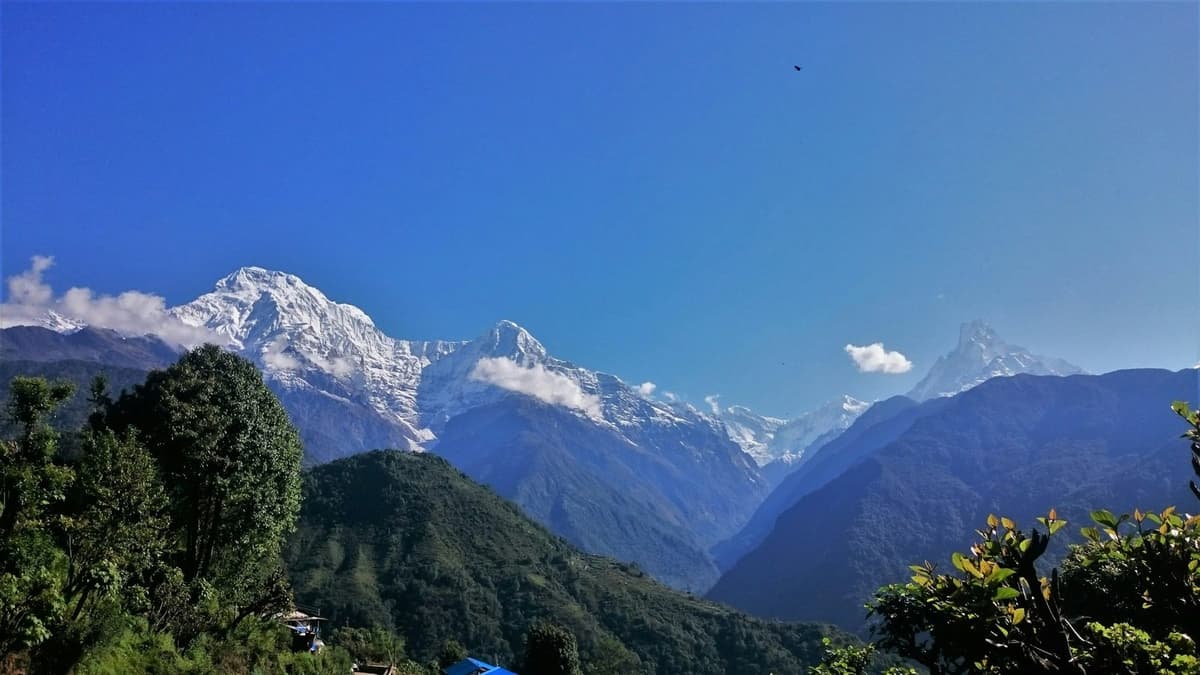
Look north on a clear morning and Machhapuchhre, the "Fishtail", stands above the hills. It is 6,993 m (22,943 ft) high, about 25 km north of Pokhara, and closed to climbing. To the south, forest called Raniban comes down to the water, and the World Peace Pagoda sits on the hilltop above it.

The city's tourism office gives the short version of how the lake began:

"Phewa Lake was formed after a landslide blocked the Seti River."

Pokhara Metropolitan City, tourism website

People have shaped it since. A dam slightly enlarged the lake; it failed in the mid-1970s and was rebuilt, and the outflow is used at the Fewa Hydropower Station. You will see the name spelt both ways, Phewa and Fewa.

For where Phewa fits among the country's other sights, see our guide to Nepal tourist places.

Practical takeaway: stay in Lakeside and you can walk to the water in minutes. Everything in this guide starts from the shore.

How big is Phewa Lake, and how deep?

There is no single honest answer. Phewa Lake's official area is 5.726 km², published in the Nepal Gazette in March 2022. A 2025 survey to the highest monsoon water line measured 6.343 km², and a satellite study measured about 4 km² in April 2018. The figure depends on where the shoreline is drawn and in which season.
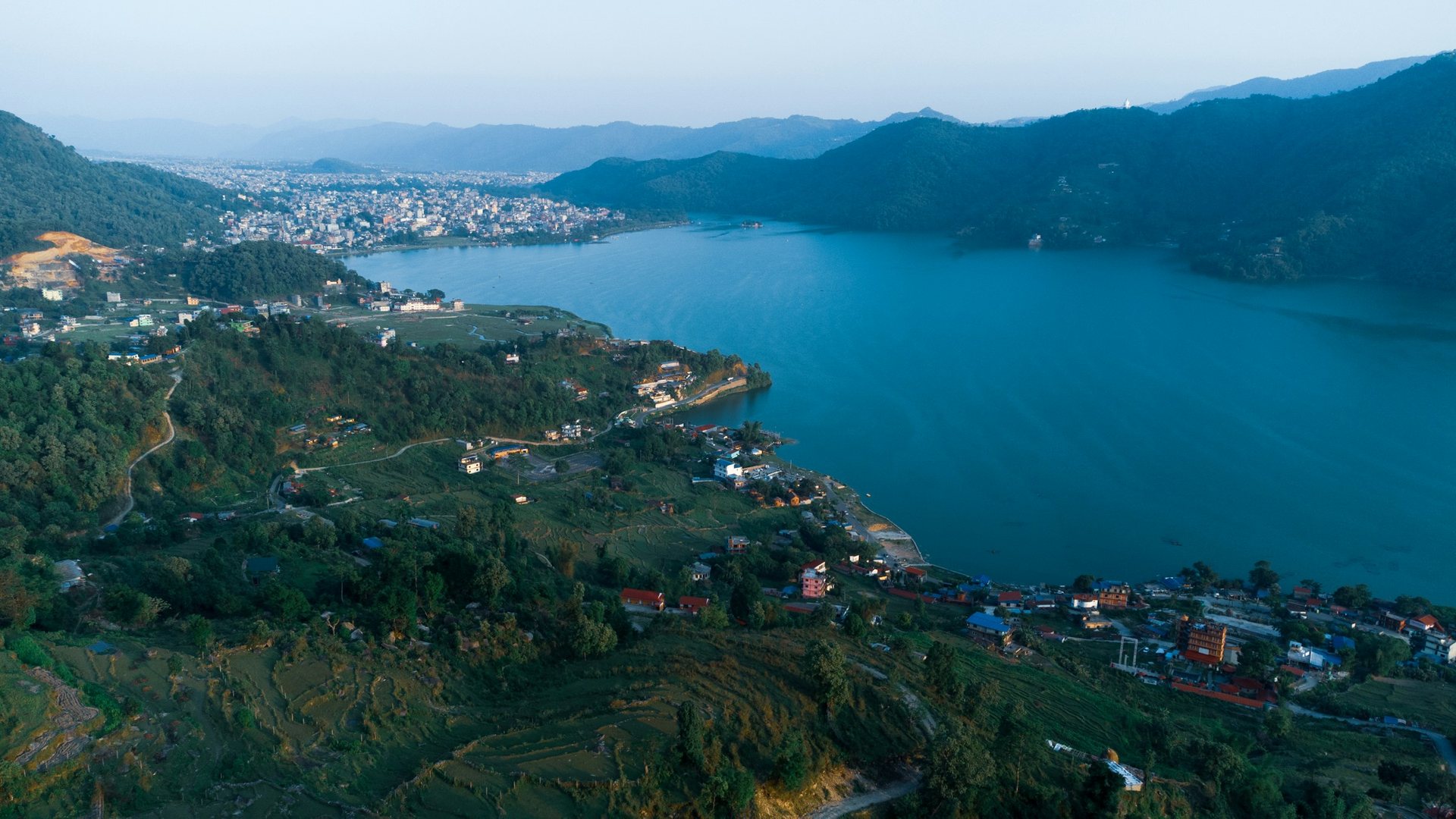
Phewa Lake and Pokhara from the air
Phewa Lake from the air, with Pokhara along its eastern shore.
Figure Area When How it was measured Source
Official (gazetted) 5.726 km² Measured in 2021; published in the Nepal Gazette, March 2022 Punya Paudel Commission The Kathmandu Post, 1 June 2025
2025 survey 6.343 km² 2025 Highest observed monsoon water level as the boundary; differential GPS and drone surveys The Kathmandu Post, 1 June 2025
Lake plus buffer zone 7.616 km² Technical sub-committee report, January 2024 Includes the 65 m conservation strip around the lake The Kathmandu Post, 1 June 2025
Satellite study 4.02 km² (± 0.07) April 2018 Satellite imagery Watson and others, Remote Sensing, 2019

The 2025 survey came out 0.617 km² larger than the gazetted figure, and the 2019 study found the lake grows by about 0.18 km² in the monsoon.

Older figures are further apart still. A 1957 to 1958 survey gave 10.36 km², but the 2019 study found no support for a figure of about 10 km² in the 1950s. By its measurements the lake grew until about 1961 and has shrunk since, losing about 1.2 km² when the dam failed in the mid-1970s.

Whether Phewa is Nepal's second or third largest lake is disputed too. Pokhara Metropolitan City calls it "the second largest lake in Nepal", English Wikipedia says third, and we do not take a side.

How deep is Phewa Lake?

A depth survey in May 2018 found the deepest point, 21.4 m, near the southern shore. The mean depth was 8.5 m, and the shallowest water, about 3 m, was in the channel near the dam. Older estimates put the deepest point at about 24 m.

The same study projected that, as silt keeps washing in, Phewa will lose 80% of its storage capacity within 110 to 347 years.

Practical takeaway: if someone quotes you one figure for Phewa's size, ask when it was measured and where they drew the shore.

Boating on Phewa Lake: how it works

Boating on Phewa Lake runs from eight boat stations along the shore, and many boats leave from Barahi Ghat in Lakeside. You pick a boat at a counter, agree the price and the return time, put on the life jacket, and go out with a boatman. Go in the morning, before the afternoon wind.
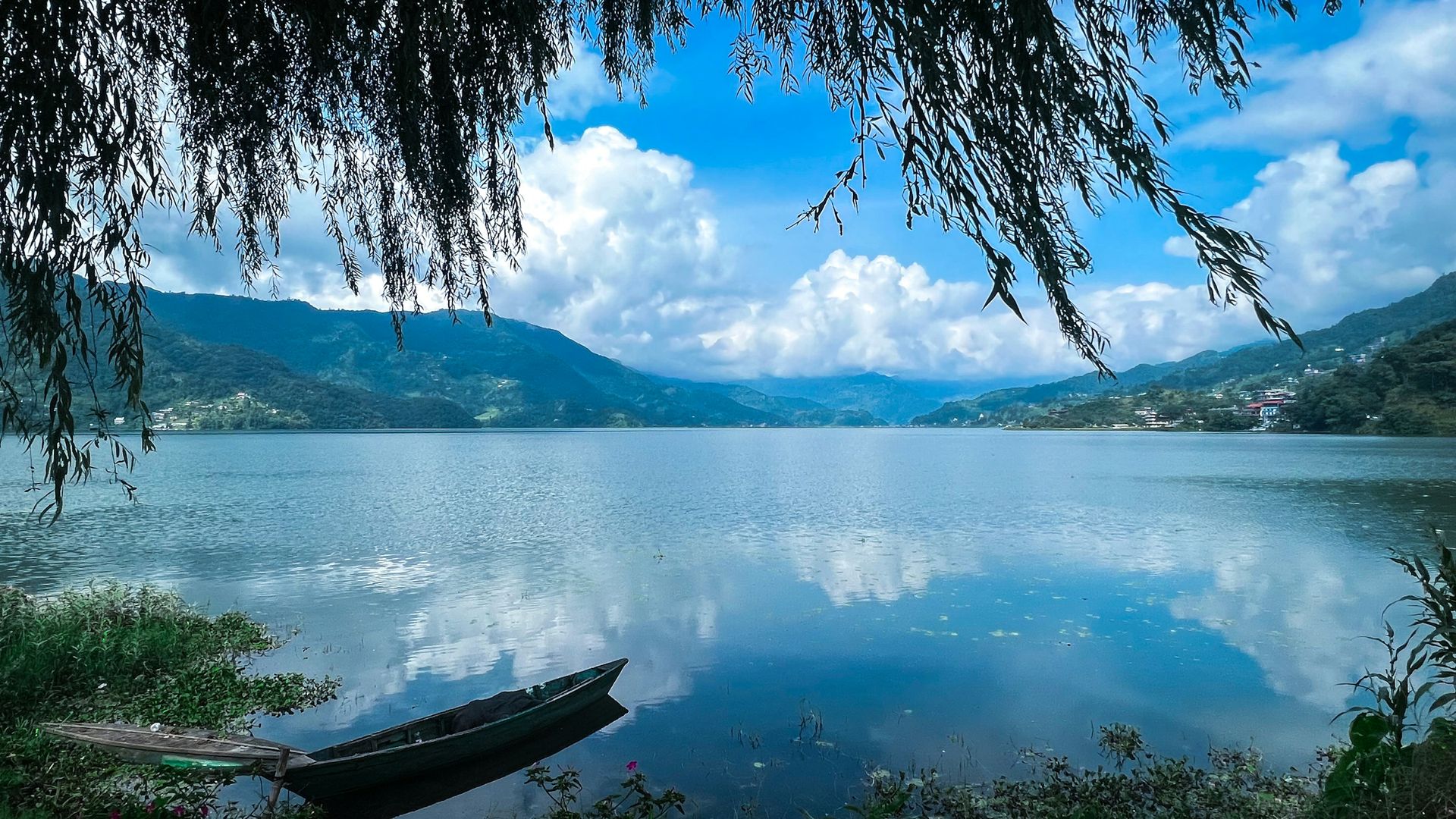
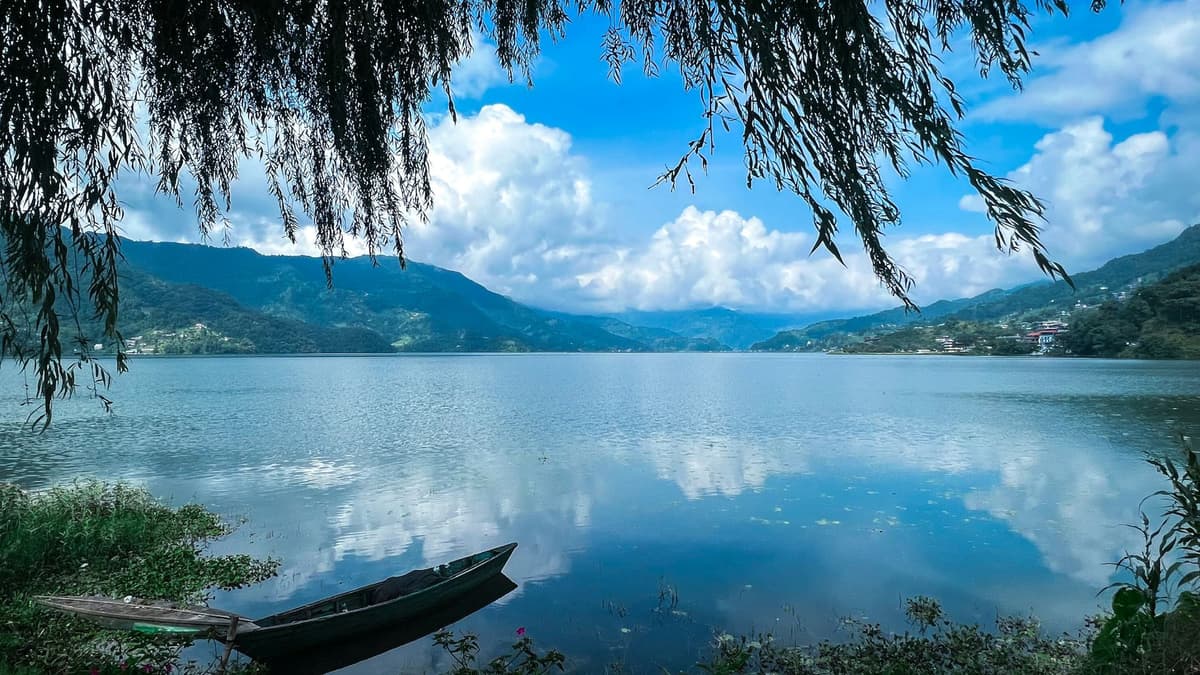
A wooden boat reflected in the calm water of Phewa Lake
Wooden boats on Phewa Lake. Life jackets are compulsory.

In August 2026 the chairman of the Phewa Boat Entrepreneurs' Committee told The Kathmandu Post that 767 wooden boats and 72 large motor-assisted boats work under the official committee; a June 2026 report counted 847 boats and nearly 350 boatmen. So more than 800 boats work the lake, and motor-assisted boats are among them, whatever some websites say.

A 2023 report named the eight stations:

  • Barahi Ghat, where many boats leave from
  • Swimming Ghat
  • Gauri Ghat
  • Ammat Ghat
  • Fishtail Ghat
  • Phewa Ghat
  • Bangladi Ghat
  • Pari Ghat

What does it cost? We could not find an official published fare list, and the prices quoted online disagree widely, so we do not print one. Fares are set at the boat counters and change. Check the board, and agree the price and the return time before you leave the shore.

How to hire a boat, step by step

  1. Go early. Strong winds often pick up after midday and raise waves on the lake, Republica reported in June 2026.
  2. Use a recognised boat station. Since June 2026 the boat organisation has insured boatmen and passengers on its registered boats with Shikhar Insurance, for one year.
  3. Agree the details at the counter: the price, where you are going (just Tal Barahi, or across to the Peace Pagoda trail) and when you will be back.
  4. Put on the life jacket and fasten it. It is compulsory for every user.
  5. Sit low and in the middle, and stay seated for photos.
  6. Be back on shore well before 6 pm, and earlier if cloud or wind builds.

Paddleboards and kayaks

Paddleboarding has surged on Phewa in the past two years. In August 2026 The Kathmandu Post reported that "hundreds of stand-up paddleboards are now available for rent through 42 operators", and that only five of those operators had permits from the local government. The boat committee's chairman put the risk plainly:

"Stand-up paddleboards are unstable by nature. Even a small wave can overturn them."

Balaram Giri, chairman, Phewa Boat Entrepreneurs' Committee, The Kathmandu Post, 2 August 2026

Ask the operator whether they are registered before you pay, and keep the life jacket on the whole time. Under the 2026 rules, children aged 16 and under may not take out a paddleboard or boat without adult supervision. Kayaks are for hire too, and the same rules apply.

Practical takeaway: a boat with a boatman is the easy, steady way to see the lake. Save the paddleboard for a calm morning, from a registered operator.

Phewa Lake safety rules in 2026

Since a District Administration Office (DAO) Kaski directive of 25 June 2026, everyone on Phewa Lake must wear a life jacket and all water activities stop at 6 pm. In bad weather, nobody should go out after 2 pm, and children aged 16 and under may not boat or paddleboard without an adult.

The directive, as reported by The Kathmandu Post, also requires operators to register and renew their permits, provide life jackets, keep safety insurance, follow set hours and watch the weather. You get a safety briefing before you go out, operators must not serve anyone under the influence of alcohol or drugs, and they must keep their customers in sight. Republica reported that insurance is "mandatory for tourists participating in water activities".

"Boating, kayaking and surfing without life jackets are completely prohibited. Even during the tourist season, safety remains the top priority."

Chitrangat Baral, Assistant Chief District Officer, Kaski, Republica, 30 June 2026

Who is watching the water. The Armed Police Force's 24th (Kalika) Battalion staffs the Phewa Watch and Rescue Tower at Barahi Ghat round the clock, with 20 personnel in two shifts and at least three deep-water divers on standby. In the 2025 to 2026 fiscal year, which ended in mid-July 2026, there were 28 major water-related incidents on the lake: "Rescue teams saved 85 people, but eight people died."

Can you swim in Phewa Lake?

We found no formal ban on swimming in Phewa Lake, but we advise against it. Several of the people who drowned in the lake in 2026 were swimming. In July 2026 a visitor drowned near Tal Barahi Temple; Kantipur, citing police, reported that he had gone swimming after leaving the boat at the temple with friends. Other 2026 deaths included a paddleboarder out after 6 pm and a man who was fishing. Enjoy the lake from a boat, and do not drink the water.

Staying safe on the water, step by step

  1. Wear the life jacket, fastened, the whole time, even for the five-minute hop to Tal Barahi.
  2. Go out in the morning, and head back if wind or cloud builds.
  3. Do not swim, not even from the temple island.
  4. Skip the beer until you are back on land. Operators may not serve anyone who has been drinking.
  5. Be ashore before 6 pm.
  6. If something goes wrong, shout and wave to the nearest boat. The rescue tower at Barahi Ghat is staffed day and night.

Practical takeaway: the rules are simple, and the boatmen know them. Life jacket on, out in the morning, back before dark.

Tal Barahi Temple, open again after the rebuild

Tal Barahi Temple is a two-storey pagoda on a small island in Phewa Lake, reached by a boat ride of about five minutes from Barahi Ghat. It reopened for worship on 11 October 2026, Ghatasthapana, the first day of Dashain, after a rebuild that began on 26 October 2023.

The Nepal Tourism Board describes the goddess:

"The two-storied pagoda is dedicated to the boar manifestation of Ajima representing the female force."

Nepal Tourism Board, Taal Barahi page

The story behind the shrine. Local tradition credits King Kulmandan Shah of Kaski with founding it as a thatched hut on a mound in the lake. It is believed to be several centuries old, but sources give different founding dates, so we give none. The temple most visitors photographed until 2023 was much younger: it was built in 2017 BS, around 1960, under King Mahendra.

Why it was rebuilt. The 2015 earthquake tilted the temple about three inches to the south. Reconstruction began on 26 October 2023, when Mayor Dhanaraj Acharya laid the foundation stone, with the Department of Archaeology and the Talbarahi Temple Guthi Management Committee in charge. While the work went on, a silver idol of the goddess was placed nearby so that people could still worship. Ratopati reported in October 2026 that the temple had been rebuilt in its old pagoda form, with skilled craftsmen brought in from Bhaktapur and Lalitpur.

Meronews reported the reopening on the day. If you read a guide written between 2024 and mid-2026 that says the temple is closed or under scaffolding, it is out of date.

Festival days. The Nepal Tourism Board says devotees throng the temple during fairs in the Nepali months of Baisakh and Kartik. An annual fair is held on Kojagrat Purnima, and Nepali New Year brings big crowds: in 2009 an official of the temple's conservation committee put that day's visitors at more than 10,000.

On the island, take your shoes off at the shrine and leave leather items in the boat. Ask before photographing people at worship, agree with your boatman when you will be back, and do not swim from the island.

Practical takeaway: go early, while the water is calm, and keep the life jacket on for the short crossing.

Walks around Phewa Lake

The main walks around Phewa Lake are the boat-and-trail route up to the World Peace Pagoda, the shore path north from Lakeside towards Pame, the forest of Raniban on the south shore, and Sarangkot on the ridge above. We found no reliable distance or time for a full loop of the lake, so we give routes, not totals.
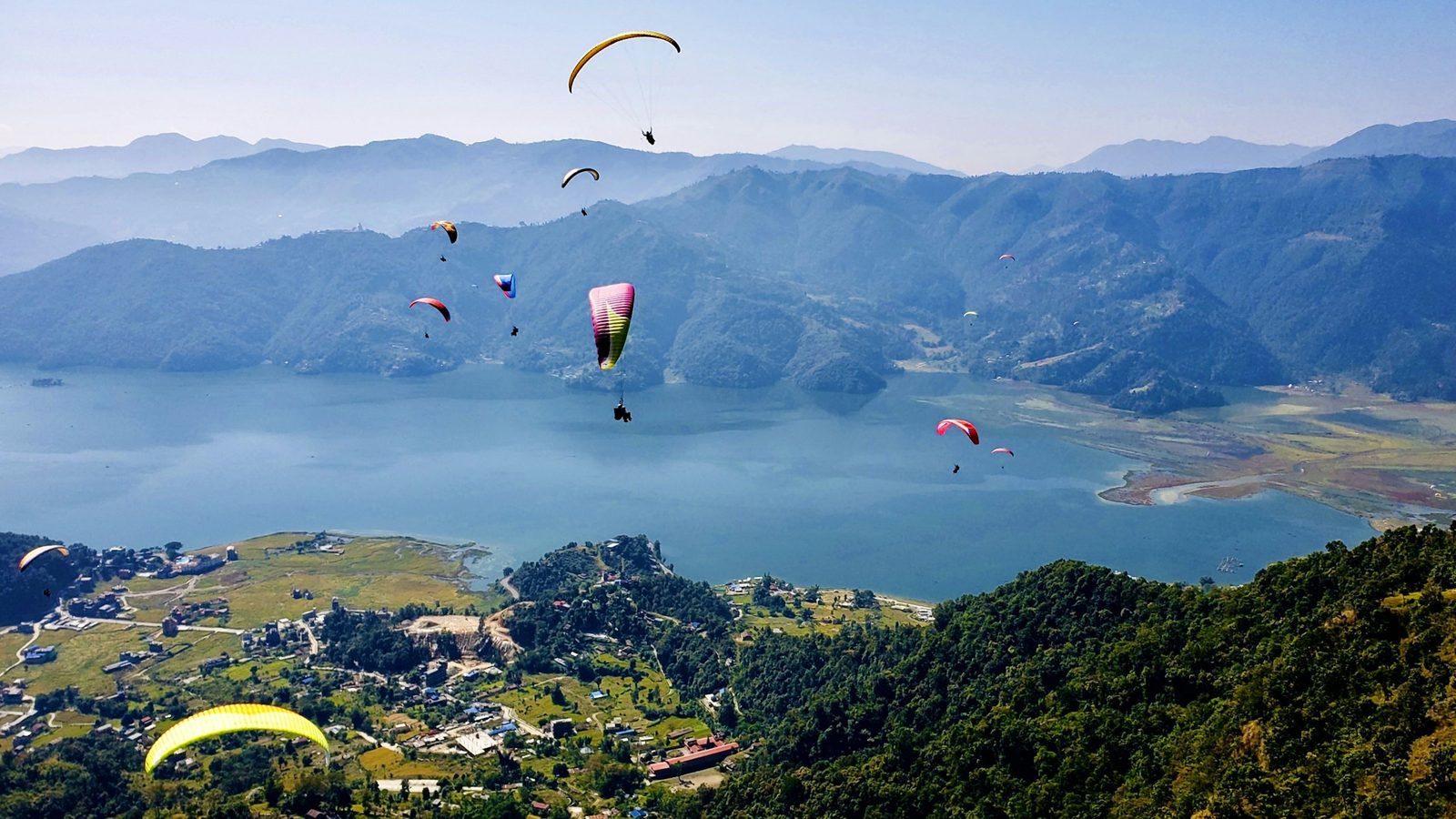
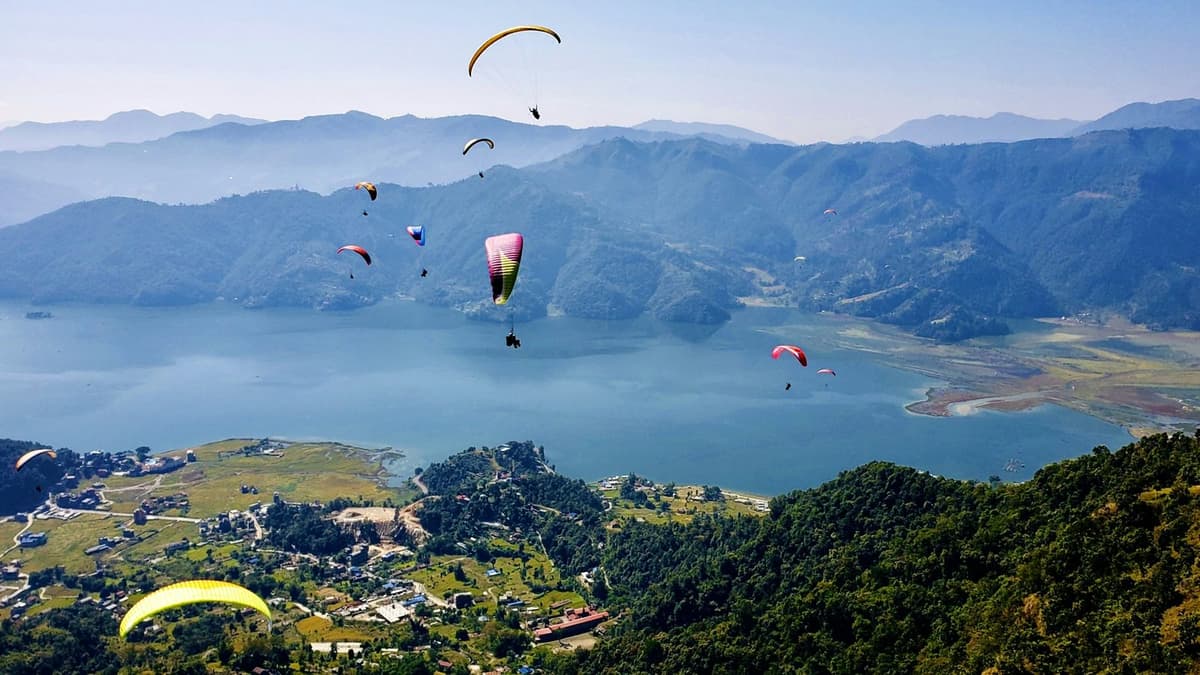
Paragliders above Phewa Lake in Pokhara
Paragliders from Sarangkot drift down over the lake.

To the World Peace Pagoda by boat and on foot

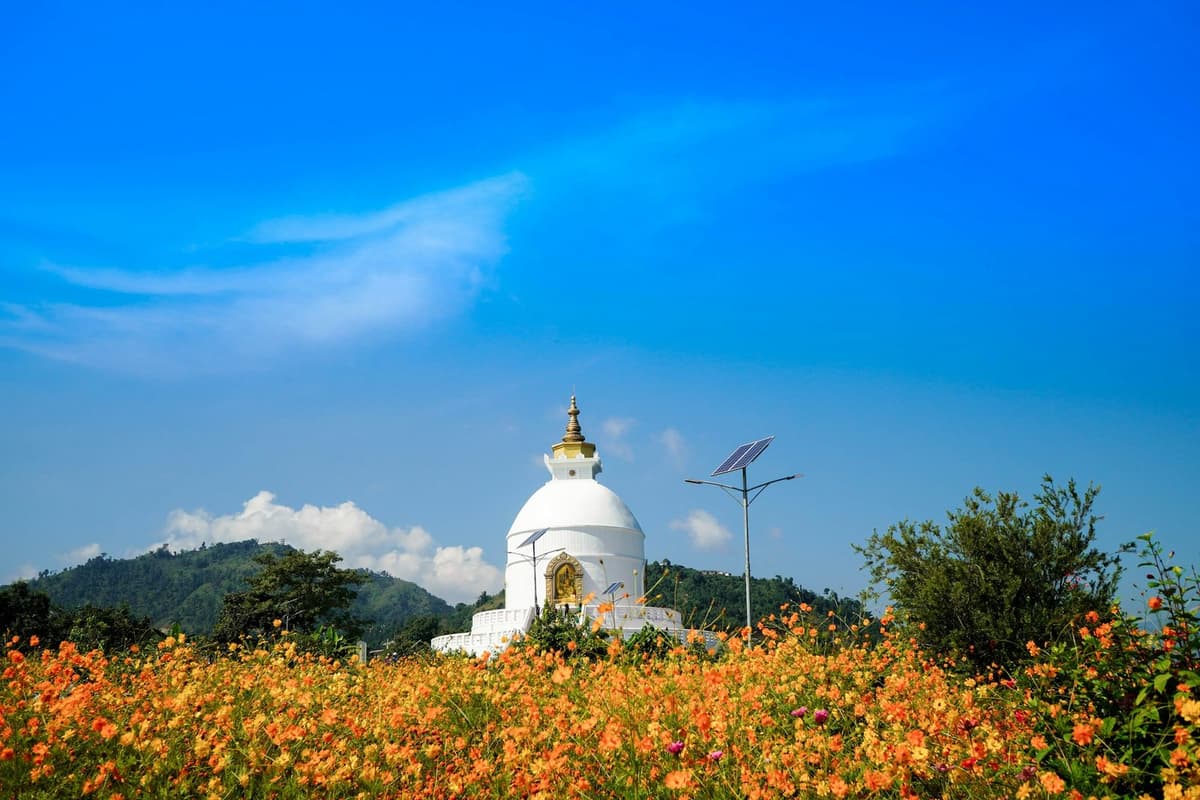
The World Peace Pagoda, also called the Shanti Stupa, stands on a hill above the southern shore of Phewa Lake. It was built by the Buddhist order Nipponzan Myohoji with local supporters, inaugurated in 1999, and was the first of the order's peace stupas in Nepal.

There are two ways up:

  • By boat and trail. Take a small boat from the Lakeside shore across the lake. From the landing, the path climbs through thick forest, with uphill stairs. Travel guides put the walk at about an hour; one adds "depending on your speed and the heat".
  • By road. It is about 30 minutes' drive on a paved road from Lakeside, then a 10-minute walk.

Entry is free.

Practical takeaway: boat over in the cool of the morning and walk up. If your legs have had enough, come down by road, and tell your boatman so he is not left waiting.

Lakeside and the north shore towards Pame

From Lakeside, a path follows the shore north towards Pame. This used to be a water route: boats carried goods up to Pame until the road reached it in 1994, and the lake once stretched as far as Chankhapur.

Sarangkot, the ridge above the lake

Sarangkot rises to 1,595 m (5,233 ft) above the lake. It is about 11.3 km by road from Lakeside, at most about 30 minutes by car, and the Nepal Tourism Board says tourists drive up "to see the sunrise from the top of the hill's view tower". The board also names "Paragliding from Sarangkot to lakeside" as one of Sarangkot's major attractions.

If the view from the ridge makes you want to walk closer to the mountains, our Ghandruk village guide covers a village walk you can start from Pokhara.

When is the best time to visit Phewa Lake?

The best time to visit Phewa Lake for clear views is October and November, after the monsoon, when the Nepal Tourism Board says the clearest skies are found. December to February is dry and cool. In July, the wettest month, rain falls on most days at the Pokhara Airport station.

The figures below are the 1991 to 2020 normals for the Pokhara Airport weather station, at 827 m. The lake shore is at roughly the same height, so they hold for the lake; Sarangkot and the Peace Pagoda hill are higher, and cooler.

Month Average high (°C) Average low (°C) Rain (mm) Rain days
January 19.9 7.1 21.6 2.4
February 22.7 9.7 35.1 3.8
March 27.1 13.1 63.7 6.4
April 30.0 16.1 141.7 10.5
May 30.4 18.7 354.7 18.3
June 30.8 21.2 648.2 22.2
July 30.4 22.4 941.0 25.6
August 30.5 22.3 839.4 24.3
September 29.9 21.1 635.0 19.4
October 27.9 17.2 159.2 8.0
November 24.4 12.3 17.2 1.3
December 21.0 8.3 11.5 1.0
Year 27.1 15.8 3,868.3 143.2

Source: Pokhara Airport station (827 m), DHM and WMO 1991 to 2020 normals; rain days are days with at least 1 mm.

November averages just 1.3 rain days. December to February is the driest stretch, with January lows averaging 7.1 °C, so bring a warm layer for an early boat. By April and May highs reach about 30 °C and rain builds towards the monsoon, which DHM normally dates from 13 June to 2 October; in 2026 it arrived on 19 June and fully withdrew on 14 October.

The time of day matters as much as the month. Wind often picks up after midday, so mornings are calmer on the water.

If the pre-monsoon heat gets to you, our guide to hill stations in Nepal has cooler places to spend a night or two.

Why Phewa Lake is protected, and what threatens it

Phewa Lake is part of the Lake Cluster of Pokhara Valley, listed as a Ramsar wetland of international importance on 2 February 2016. In June 2023 the Supreme Court declared a 65 m strip around its highest water line a green conservation area. The long-running threats are silt, sewage, encroachment and water hyacinth.

The Ramsar listing

The Lake Cluster of Pokhara Valley is Ramsar Site no. 2257, designated on 2 February 2016, covering 26,106 ha. It joins nine lakes, including Phewa, Begnas and Rupa, into one site. The Ramsar summary puts a value on Phewa alone:

"an economic valuation has shown that Phewa Lake provides goods and services worth more than USD 279,000 per year"

Ramsar Sites Information Service, Lake Cluster of Pokhara Valley

The courts and the 65 m strip

In February 2022 the federal government declared Phewa a protected watershed area, after Supreme Court directives of 2 April 2012 and 29 April 2018. On 19 June 2023 the Supreme Court ordered the removal of unauthorised structures within 65 m of the highest water level and declared that 65 m strip a green conservation area. In May 2025 the first boundary marker was set at Barahi Ghat, out of 1,055 planned. We have not seen a report that the clearance is complete.

Silt, sewage and hyacinth

Silt is the slow threat. The 2019 study worked with a low and a high scenario of 78,700 and 225,000 m³ of sediment entering the lake each year, which is why it expects the lake to keep losing storage. Water hyacinth, a floating invasive weed, is the one you can see. The reports we found are from different years, so read each with its date:

  • 2004: Nepali Times reported that hyacinth had first appeared in the Pokhara lakes only 15 years earlier, and that Fisheries Research Centre biologists estimated it covered up to a quarter of Phewa. Soldiers cleared weed that July.
  • 2015: a Himalayan Times photo report said rowing had become difficult because of the weed.
  • 2018: Nepali Times described the lake as having "become a dumping ground for urban garbage and sewage".
  • 2021: Nepali Times reported that higher water let hyacinth at the mouth of the lake spread further and clog fish cages.
  • 2024: The Annapurna Express reported in June 2024 that the city employed a traditional fisher group to remove hyacinth, but that the effort was not sustainable because the weed has to be cleared again and again.

We found no survey of hyacinth cover or water quality from 2024 to 2026, so we cannot tell you how the lake measures today.

What you can do: carry your rubbish back to Lakeside, refuse plastic you do not need on the boat, and stay on paths along the shore.

Getting to Phewa Lake

Phewa Lake is in Pokhara, about 200 km west of Kathmandu: six to nine hours by road, or about 30 minutes by air. Pokhara International Airport opened on 1 January 2023. From a Lakeside hotel you walk to the shore, and walking the shore is free.

We book domestic flights and arrange private transport, so if you want the flight in one direction and the road in the other, we can plan it that way.

Read next: Sarangkot guide.

Frequently asked questions

Is Tal Barahi Temple open now?

Yes. Tal Barahi Temple reopened for worship on 11 October 2026, Ghatasthapana, after a rebuild that began on 26 October 2023. The only way there is by boat from Barahi Ghat, a crossing of about five minutes, and you must wear a life jacket on the water. Take your shoes off at the shrine and leave leather items in the boat.

How much does a boat ride on Phewa Lake cost?

We could not find an official published fare list, and the prices quoted online disagree, so we do not print one. Fares are set at the boat counters and change. Check the board, agree the price, where you are going and when you will be back before you leave the shore, and hire from a recognised station; many boats leave from Barahi Ghat.

Can you take a boat to the World Peace Pagoda?

Yes. Small boats cross from the Lakeside shore to a forest trail with uphill stairs on the south side of the lake. Travel guides put the walk up at about an hour, depending on your pace and the heat. You can also drive about 30 minutes from Lakeside and walk 10 minutes. Entry is free, and all water activities stop at 6 pm, so plan your return.

Can you swim in Phewa Lake?

We advise against it. We found no formal ban, but several of the people who drowned in Phewa in 2026 were swimming, and a visitor drowned near Tal Barahi Temple in July. In the year to mid-July 2026 there were 28 major water-related incidents on the lake, and eight people died. Enjoy the lake from a boat, with a life jacket on.

Is Phewa the second or third largest lake in Nepal?

Sources disagree. Pokhara Metropolitan City calls it the second largest, and so does the title of a 2019 peer-reviewed study. English Wikipedia says third, citing a 2007 paper whose link no longer works. Its size varies too: officially 5.726 km² (Nepal Gazette, March 2022), while a 2025 survey measured 6.343 km² to the monsoon high-water line.

What time does boating stop on Phewa Lake?

All water activities stop at 6 pm, under a District Administration Office Kaski directive of 25 June 2026. In bad weather, visitors are told not to go out after 2 pm, because strong winds often pick up after midday. Life jackets are compulsory for everyone, and children aged 16 and under may not boat or paddleboard without an adult.

Plan your Pokhara days with us

We are a Kathmandu team, and we arrange hotels, licensed guides, private transport and domestic flights. For trips that take in Pokhara, browse our tours, and for the rest of the city, see our guide to things to do in Pokhara.

Send us your dates on WhatsApp or through our enquiry form, and we will tell you honestly whether a morning on the lake fits around your flight.

Your Nepal visa and international flights are your own arrangements. Official visa information is on the Nepal Tourism Board tourist-visa page.
Tags
Phewa LakePokharaTal Barahi TempleWorld Peace PagodaBoating in NepalRamsar wetlands
Share
U
Uncover Nepal Team
Writer at Uncover Nepal
More in PlacesSee all Places

Phewa Lake, Pokhara: Boating, Walks and Views

22 min read Posted 27 Oct 2026Updated 28 Oct 2026
Phewa Lake, Pokhara: Boating, Walks and Views

By Uncover Nepal Team · Checked by our Kathmandu travel team · Last checked 27 October 2026

Early in the morning, before the wind gets up, the wooden boats at Barahi Ghat lie in a row and the water is flat. A few minutes' row out, the pagoda roof of Tal Barahi Temple rises from its island, open for worship again since 11 October 2026. On a clear day Machhapuchhre stands white above the hills to the north.

Phewa Lake is the lake at the heart of Pokhara, about 200 km west of Kathmandu. You can take a boat or paddleboard out, cross to the island temple of Tal Barahi, and walk up to the World Peace Pagoda. The shore is free; on the water, life jackets are compulsory and boating stops at 6 pm.

Our guide to things to do in Pokhara covers the whole city. This one is the lake on its own: how boating works under the new safety rules, what changed at Tal Barahi, the walks around the shore, when the views are clearest, and why nobody can give you one honest figure for the lake's size.

In this guide

  • Key facts
  • Where is Phewa Lake, and what is it like?
  • How big is Phewa Lake, and how deep?
  • Boating on Phewa Lake: how it works
  • Phewa Lake safety rules in 2026
  • Tal Barahi Temple, open again after the rebuild
  • Walks around Phewa Lake
  • When is the best time to visit Phewa Lake?
  • Why Phewa Lake is protected, and what threatens it
  • Getting to Phewa Lake
  • Frequently asked questions

Key facts

Where
Pokhara, about 200 km west of Kathmandu; the city sits at about 820 m (Wikipedia (Pokhara); Uncover Nepal standard figure, 27 Oct 2026)
Size
No single figure: officially 5.726 km² (gazetted March 2022); 6.343 km² in a 2025 survey to the monsoon high-water line (The Kathmandu Post, 1 June 2025, 27 Oct 2026)
Depth
Deepest point 21.4 m, mean 8.5 m (survey of May 2018) (Watson and others, Remote Sensing, 2019, 27 Oct 2026)
Size rank
Pokhara Metropolitan City calls it Nepal's second largest lake; some references say third (Pokhara Metropolitan City; Wikipedia, 27 Oct 2026)
Ramsar site
Part of the Lake Cluster of Pokhara Valley, Ramsar Site no. 2257, designated 2 February 2016 (Ramsar Sites Information Service, 27 Oct 2026)
Tal Barahi Temple
Island temple, reached by boat; reopened 11 October 2026 after a rebuild begun 26 October 2023 (Nepal Tourism Board; Meronews; HimalPress, 27 Oct 2026)
Water rules
Life jackets compulsory for everyone; all water activities stop at 6 pm (District Administration Office Kaski, 25 June 2026) (The Kathmandu Post; Republica, 27 Oct 2026)
Entry
No fee to walk the shore; boat fares are set at the boat counters (Pokhara Metropolitan City; our own checks, 27 Oct 2026)
Weather
Pokhara Airport, 1991 to 2020: driest month December (11.5 mm), wettest July (941.0 mm) (DHM and WMO normals, 27 Oct 2026)
Getting there
From Kathmandu, six to nine hours by road or about 30 minutes by air (Uncover Nepal standard figures, 27 Oct 2026)

Where is Phewa Lake, and what is it like?

Phewa Lake lies along the edge of Pokhara, the lakeside city about 200 km west of Kathmandu, which sits at about 820 m. The tourist district called Lakeside, or Baidam, runs along the shore, with hotels, cafés and boat stands a short walk from the water.

Look north on a clear morning and Machhapuchhre, the "Fishtail", stands above the hills. It is 6,993 m (22,943 ft) high, about 25 km north of Pokhara, and closed to climbing. To the south, forest called Raniban comes down to the water, and the World Peace Pagoda sits on the hilltop above it.

The city's tourism office gives the short version of how the lake began:

"Phewa Lake was formed after a landslide blocked the Seti River."

Pokhara Metropolitan City, tourism website

People have shaped it since. A dam slightly enlarged the lake; it failed in the mid-1970s and was rebuilt, and the outflow is used at the Fewa Hydropower Station. You will see the name spelt both ways, Phewa and Fewa.

For where Phewa fits among the country's other sights, see our guide to Nepal tourist places.

Practical takeaway: stay in Lakeside and you can walk to the water in minutes. Everything in this guide starts from the shore.

How big is Phewa Lake, and how deep?

There is no single honest answer. Phewa Lake's official area is 5.726 km², published in the Nepal Gazette in March 2022. A 2025 survey to the highest monsoon water line measured 6.343 km², and a satellite study measured about 4 km² in April 2018. The figure depends on where the shoreline is drawn and in which season.

Phewa Lake and Pokhara from the air
Phewa Lake from the air, with Pokhara along its eastern shore.
Figure Area When How it was measured Source
Official (gazetted) 5.726 km² Measured in 2021; published in the Nepal Gazette, March 2022 Punya Paudel Commission The Kathmandu Post, 1 June 2025
2025 survey 6.343 km² 2025 Highest observed monsoon water level as the boundary; differential GPS and drone surveys The Kathmandu Post, 1 June 2025
Lake plus buffer zone 7.616 km² Technical sub-committee report, January 2024 Includes the 65 m conservation strip around the lake The Kathmandu Post, 1 June 2025
Satellite study 4.02 km² (± 0.07) April 2018 Satellite imagery Watson and others, Remote Sensing, 2019

The 2025 survey came out 0.617 km² larger than the gazetted figure, and the 2019 study found the lake grows by about 0.18 km² in the monsoon.

Older figures are further apart still. A 1957 to 1958 survey gave 10.36 km², but the 2019 study found no support for a figure of about 10 km² in the 1950s. By its measurements the lake grew until about 1961 and has shrunk since, losing about 1.2 km² when the dam failed in the mid-1970s.

Whether Phewa is Nepal's second or third largest lake is disputed too. Pokhara Metropolitan City calls it "the second largest lake in Nepal", English Wikipedia says third, and we do not take a side.

How deep is Phewa Lake?

A depth survey in May 2018 found the deepest point, 21.4 m, near the southern shore. The mean depth was 8.5 m, and the shallowest water, about 3 m, was in the channel near the dam. Older estimates put the deepest point at about 24 m.

The same study projected that, as silt keeps washing in, Phewa will lose 80% of its storage capacity within 110 to 347 years.

Practical takeaway: if someone quotes you one figure for Phewa's size, ask when it was measured and where they drew the shore.

Boating on Phewa Lake: how it works

Boating on Phewa Lake runs from eight boat stations along the shore, and many boats leave from Barahi Ghat in Lakeside. You pick a boat at a counter, agree the price and the return time, put on the life jacket, and go out with a boatman. Go in the morning, before the afternoon wind.

A wooden boat reflected in the calm water of Phewa Lake
Wooden boats on Phewa Lake. Life jackets are compulsory.

In August 2026 the chairman of the Phewa Boat Entrepreneurs' Committee told The Kathmandu Post that 767 wooden boats and 72 large motor-assisted boats work under the official committee; a June 2026 report counted 847 boats and nearly 350 boatmen. So more than 800 boats work the lake, and motor-assisted boats are among them, whatever some websites say.

A 2023 report named the eight stations:

  • Barahi Ghat, where many boats leave from
  • Swimming Ghat
  • Gauri Ghat
  • Ammat Ghat
  • Fishtail Ghat
  • Phewa Ghat
  • Bangladi Ghat
  • Pari Ghat

What does it cost? We could not find an official published fare list, and the prices quoted online disagree widely, so we do not print one. Fares are set at the boat counters and change. Check the board, and agree the price and the return time before you leave the shore.

How to hire a boat, step by step

  1. Go early. Strong winds often pick up after midday and raise waves on the lake, Republica reported in June 2026.
  2. Use a recognised boat station. Since June 2026 the boat organisation has insured boatmen and passengers on its registered boats with Shikhar Insurance, for one year.
  3. Agree the details at the counter: the price, where you are going (just Tal Barahi, or across to the Peace Pagoda trail) and when you will be back.
  4. Put on the life jacket and fasten it. It is compulsory for every user.
  5. Sit low and in the middle, and stay seated for photos.
  6. Be back on shore well before 6 pm, and earlier if cloud or wind builds.

Paddleboards and kayaks

Paddleboarding has surged on Phewa in the past two years. In August 2026 The Kathmandu Post reported that "hundreds of stand-up paddleboards are now available for rent through 42 operators", and that only five of those operators had permits from the local government. The boat committee's chairman put the risk plainly:

"Stand-up paddleboards are unstable by nature. Even a small wave can overturn them."

Balaram Giri, chairman, Phewa Boat Entrepreneurs' Committee, The Kathmandu Post, 2 August 2026

Ask the operator whether they are registered before you pay, and keep the life jacket on the whole time. Under the 2026 rules, children aged 16 and under may not take out a paddleboard or boat without adult supervision. Kayaks are for hire too, and the same rules apply.

Practical takeaway: a boat with a boatman is the easy, steady way to see the lake. Save the paddleboard for a calm morning, from a registered operator.

Phewa Lake safety rules in 2026

Since a District Administration Office (DAO) Kaski directive of 25 June 2026, everyone on Phewa Lake must wear a life jacket and all water activities stop at 6 pm. In bad weather, nobody should go out after 2 pm, and children aged 16 and under may not boat or paddleboard without an adult.

The directive, as reported by The Kathmandu Post, also requires operators to register and renew their permits, provide life jackets, keep safety insurance, follow set hours and watch the weather. You get a safety briefing before you go out, operators must not serve anyone under the influence of alcohol or drugs, and they must keep their customers in sight. Republica reported that insurance is "mandatory for tourists participating in water activities".

"Boating, kayaking and surfing without life jackets are completely prohibited. Even during the tourist season, safety remains the top priority."

Chitrangat Baral, Assistant Chief District Officer, Kaski, Republica, 30 June 2026

Who is watching the water. The Armed Police Force's 24th (Kalika) Battalion staffs the Phewa Watch and Rescue Tower at Barahi Ghat round the clock, with 20 personnel in two shifts and at least three deep-water divers on standby. In the 2025 to 2026 fiscal year, which ended in mid-July 2026, there were 28 major water-related incidents on the lake: "Rescue teams saved 85 people, but eight people died."

Can you swim in Phewa Lake?

We found no formal ban on swimming in Phewa Lake, but we advise against it. Several of the people who drowned in the lake in 2026 were swimming. In July 2026 a visitor drowned near Tal Barahi Temple; Kantipur, citing police, reported that he had gone swimming after leaving the boat at the temple with friends. Other 2026 deaths included a paddleboarder out after 6 pm and a man who was fishing. Enjoy the lake from a boat, and do not drink the water.

Staying safe on the water, step by step

  1. Wear the life jacket, fastened, the whole time, even for the five-minute hop to Tal Barahi.
  2. Go out in the morning, and head back if wind or cloud builds.
  3. Do not swim, not even from the temple island.
  4. Skip the beer until you are back on land. Operators may not serve anyone who has been drinking.
  5. Be ashore before 6 pm.
  6. If something goes wrong, shout and wave to the nearest boat. The rescue tower at Barahi Ghat is staffed day and night.

Practical takeaway: the rules are simple, and the boatmen know them. Life jacket on, out in the morning, back before dark.

Tal Barahi Temple, open again after the rebuild

Tal Barahi Temple is a two-storey pagoda on a small island in Phewa Lake, reached by a boat ride of about five minutes from Barahi Ghat. It reopened for worship on 11 October 2026, Ghatasthapana, the first day of Dashain, after a rebuild that began on 26 October 2023.

The Nepal Tourism Board describes the goddess:

"The two-storied pagoda is dedicated to the boar manifestation of Ajima representing the female force."

Nepal Tourism Board, Taal Barahi page

The story behind the shrine. Local tradition credits King Kulmandan Shah of Kaski with founding it as a thatched hut on a mound in the lake. It is believed to be several centuries old, but sources give different founding dates, so we give none. The temple most visitors photographed until 2023 was much younger: it was built in 2017 BS, around 1960, under King Mahendra.

Why it was rebuilt. The 2015 earthquake tilted the temple about three inches to the south. Reconstruction began on 26 October 2023, when Mayor Dhanaraj Acharya laid the foundation stone, with the Department of Archaeology and the Talbarahi Temple Guthi Management Committee in charge. While the work went on, a silver idol of the goddess was placed nearby so that people could still worship. Ratopati reported in October 2026 that the temple had been rebuilt in its old pagoda form, with skilled craftsmen brought in from Bhaktapur and Lalitpur.

Meronews reported the reopening on the day. If you read a guide written between 2024 and mid-2026 that says the temple is closed or under scaffolding, it is out of date.

Festival days. The Nepal Tourism Board says devotees throng the temple during fairs in the Nepali months of Baisakh and Kartik. An annual fair is held on Kojagrat Purnima, and Nepali New Year brings big crowds: in 2009 an official of the temple's conservation committee put that day's visitors at more than 10,000.

On the island, take your shoes off at the shrine and leave leather items in the boat. Ask before photographing people at worship, agree with your boatman when you will be back, and do not swim from the island.

Practical takeaway: go early, while the water is calm, and keep the life jacket on for the short crossing.

Walks around Phewa Lake

The main walks around Phewa Lake are the boat-and-trail route up to the World Peace Pagoda, the shore path north from Lakeside towards Pame, the forest of Raniban on the south shore, and Sarangkot on the ridge above. We found no reliable distance or time for a full loop of the lake, so we give routes, not totals.

Paragliders above Phewa Lake in Pokhara
Paragliders from Sarangkot drift down over the lake.

To the World Peace Pagoda by boat and on foot

The World Peace Pagoda, also called the Shanti Stupa, stands on a hill above the southern shore of Phewa Lake. It was built by the Buddhist order Nipponzan Myohoji with local supporters, inaugurated in 1999, and was the first of the order's peace stupas in Nepal.

There are two ways up:

  • By boat and trail. Take a small boat from the Lakeside shore across the lake. From the landing, the path climbs through thick forest, with uphill stairs. Travel guides put the walk at about an hour; one adds "depending on your speed and the heat".
  • By road. It is about 30 minutes' drive on a paved road from Lakeside, then a 10-minute walk.

Entry is free.

Practical takeaway: boat over in the cool of the morning and walk up. If your legs have had enough, come down by road, and tell your boatman so he is not left waiting.

Lakeside and the north shore towards Pame

From Lakeside, a path follows the shore north towards Pame. This used to be a water route: boats carried goods up to Pame until the road reached it in 1994, and the lake once stretched as far as Chankhapur.

Sarangkot, the ridge above the lake

Sarangkot rises to 1,595 m (5,233 ft) above the lake. It is about 11.3 km by road from Lakeside, at most about 30 minutes by car, and the Nepal Tourism Board says tourists drive up "to see the sunrise from the top of the hill's view tower". The board also names "Paragliding from Sarangkot to lakeside" as one of Sarangkot's major attractions.

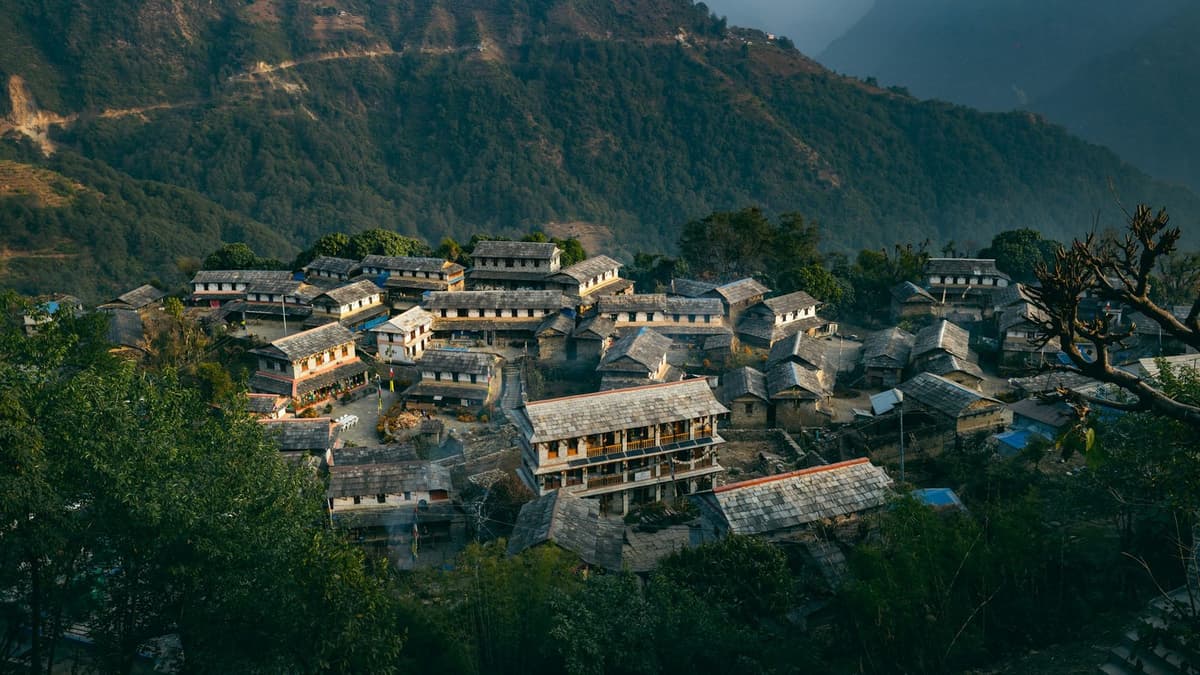
If the view from the ridge makes you want to walk closer to the mountains, our Ghandruk village guide covers a village walk you can start from Pokhara.

When is the best time to visit Phewa Lake?

The best time to visit Phewa Lake for clear views is October and November, after the monsoon, when the Nepal Tourism Board says the clearest skies are found. December to February is dry and cool. In July, the wettest month, rain falls on most days at the Pokhara Airport station.

The figures below are the 1991 to 2020 normals for the Pokhara Airport weather station, at 827 m. The lake shore is at roughly the same height, so they hold for the lake; Sarangkot and the Peace Pagoda hill are higher, and cooler.

Month Average high (°C) Average low (°C) Rain (mm) Rain days
January 19.9 7.1 21.6 2.4
February 22.7 9.7 35.1 3.8
March 27.1 13.1 63.7 6.4
April 30.0 16.1 141.7 10.5
May 30.4 18.7 354.7 18.3
June 30.8 21.2 648.2 22.2
July 30.4 22.4 941.0 25.6
August 30.5 22.3 839.4 24.3
September 29.9 21.1 635.0 19.4
October 27.9 17.2 159.2 8.0
November 24.4 12.3 17.2 1.3
December 21.0 8.3 11.5 1.0
Year 27.1 15.8 3,868.3 143.2

Source: Pokhara Airport station (827 m), DHM and WMO 1991 to 2020 normals; rain days are days with at least 1 mm.

November averages just 1.3 rain days. December to February is the driest stretch, with January lows averaging 7.1 °C, so bring a warm layer for an early boat. By April and May highs reach about 30 °C and rain builds towards the monsoon, which DHM normally dates from 13 June to 2 October; in 2026 it arrived on 19 June and fully withdrew on 14 October.

The time of day matters as much as the month. Wind often picks up after midday, so mornings are calmer on the water.

If the pre-monsoon heat gets to you, our guide to hill stations in Nepal has cooler places to spend a night or two.

Why Phewa Lake is protected, and what threatens it

Phewa Lake is part of the Lake Cluster of Pokhara Valley, listed as a Ramsar wetland of international importance on 2 February 2016. In June 2023 the Supreme Court declared a 65 m strip around its highest water line a green conservation area. The long-running threats are silt, sewage, encroachment and water hyacinth.

The Ramsar listing

The Lake Cluster of Pokhara Valley is Ramsar Site no. 2257, designated on 2 February 2016, covering 26,106 ha. It joins nine lakes, including Phewa, Begnas and Rupa, into one site. The Ramsar summary puts a value on Phewa alone:

"an economic valuation has shown that Phewa Lake provides goods and services worth more than USD 279,000 per year"

Ramsar Sites Information Service, Lake Cluster of Pokhara Valley

The courts and the 65 m strip

In February 2022 the federal government declared Phewa a protected watershed area, after Supreme Court directives of 2 April 2012 and 29 April 2018. On 19 June 2023 the Supreme Court ordered the removal of unauthorised structures within 65 m of the highest water level and declared that 65 m strip a green conservation area. In May 2025 the first boundary marker was set at Barahi Ghat, out of 1,055 planned. We have not seen a report that the clearance is complete.

Silt, sewage and hyacinth

Silt is the slow threat. The 2019 study worked with a low and a high scenario of 78,700 and 225,000 m³ of sediment entering the lake each year, which is why it expects the lake to keep losing storage. Water hyacinth, a floating invasive weed, is the one you can see. The reports we found are from different years, so read each with its date:

  • 2004: Nepali Times reported that hyacinth had first appeared in the Pokhara lakes only 15 years earlier, and that Fisheries Research Centre biologists estimated it covered up to a quarter of Phewa. Soldiers cleared weed that July.
  • 2015: a Himalayan Times photo report said rowing had become difficult because of the weed.
  • 2018: Nepali Times described the lake as having "become a dumping ground for urban garbage and sewage".
  • 2021: Nepali Times reported that higher water let hyacinth at the mouth of the lake spread further and clog fish cages.
  • 2024: The Annapurna Express reported in June 2024 that the city employed a traditional fisher group to remove hyacinth, but that the effort was not sustainable because the weed has to be cleared again and again.

We found no survey of hyacinth cover or water quality from 2024 to 2026, so we cannot tell you how the lake measures today.

What you can do: carry your rubbish back to Lakeside, refuse plastic you do not need on the boat, and stay on paths along the shore.

Getting to Phewa Lake

Phewa Lake is in Pokhara, about 200 km west of Kathmandu: six to nine hours by road, or about 30 minutes by air. Pokhara International Airport opened on 1 January 2023. From a Lakeside hotel you walk to the shore, and walking the shore is free.

We book domestic flights and arrange private transport, so if you want the flight in one direction and the road in the other, we can plan it that way.

Read next: Sarangkot guide.

Frequently asked questions

Is Tal Barahi Temple open now?

Yes. Tal Barahi Temple reopened for worship on 11 October 2026, Ghatasthapana, after a rebuild that began on 26 October 2023. The only way there is by boat from Barahi Ghat, a crossing of about five minutes, and you must wear a life jacket on the water. Take your shoes off at the shrine and leave leather items in the boat.

How much does a boat ride on Phewa Lake cost?

We could not find an official published fare list, and the prices quoted online disagree, so we do not print one. Fares are set at the boat counters and change. Check the board, agree the price, where you are going and when you will be back before you leave the shore, and hire from a recognised station; many boats leave from Barahi Ghat.

Can you take a boat to the World Peace Pagoda?

Yes. Small boats cross from the Lakeside shore to a forest trail with uphill stairs on the south side of the lake. Travel guides put the walk up at about an hour, depending on your pace and the heat. You can also drive about 30 minutes from Lakeside and walk 10 minutes. Entry is free, and all water activities stop at 6 pm, so plan your return.

Can you swim in Phewa Lake?

We advise against it. We found no formal ban, but several of the people who drowned in Phewa in 2026 were swimming, and a visitor drowned near Tal Barahi Temple in July. In the year to mid-July 2026 there were 28 major water-related incidents on the lake, and eight people died. Enjoy the lake from a boat, with a life jacket on.

Is Phewa the second or third largest lake in Nepal?

Sources disagree. Pokhara Metropolitan City calls it the second largest, and so does the title of a 2019 peer-reviewed study. English Wikipedia says third, citing a 2007 paper whose link no longer works. Its size varies too: officially 5.726 km² (Nepal Gazette, March 2022), while a 2025 survey measured 6.343 km² to the monsoon high-water line.

What time does boating stop on Phewa Lake?

All water activities stop at 6 pm, under a District Administration Office Kaski directive of 25 June 2026. In bad weather, visitors are told not to go out after 2 pm, because strong winds often pick up after midday. Life jackets are compulsory for everyone, and children aged 16 and under may not boat or paddleboard without an adult.

Plan your Pokhara days with us

We are a Kathmandu team, and we arrange hotels, licensed guides, private transport and domestic flights. For trips that take in Pokhara, browse our tours, and for the rest of the city, see our guide to things to do in Pokhara.

Send us your dates on WhatsApp or through our enquiry form, and we will tell you honestly whether a morning on the lake fits around your flight.

Your Nepal visa and international flights are your own arrangements. Official visa information is on the Nepal Tourism Board tourist-visa page.
Tags
Phewa LakePokharaTal Barahi TempleWorld Peace PagodaBoating in NepalRamsar wetlands
Share
U
Uncover Nepal Team
Writer at Uncover Nepal
More in PlacesSee all Places