By Uncover Nepal Guide · Checked by our Kathmandu travel team · Last checked 12 November 2026
Sit on the edge of Taumadhi Square in the late afternoon and watch what people do when they first see Nyatapola. They stop at the foot of the stairway, look up past the stone wrestlers and elephants, and keep looking up. Around them, motorbikes pick their way across the square and someone leaves flowers at a shrine on the way home.
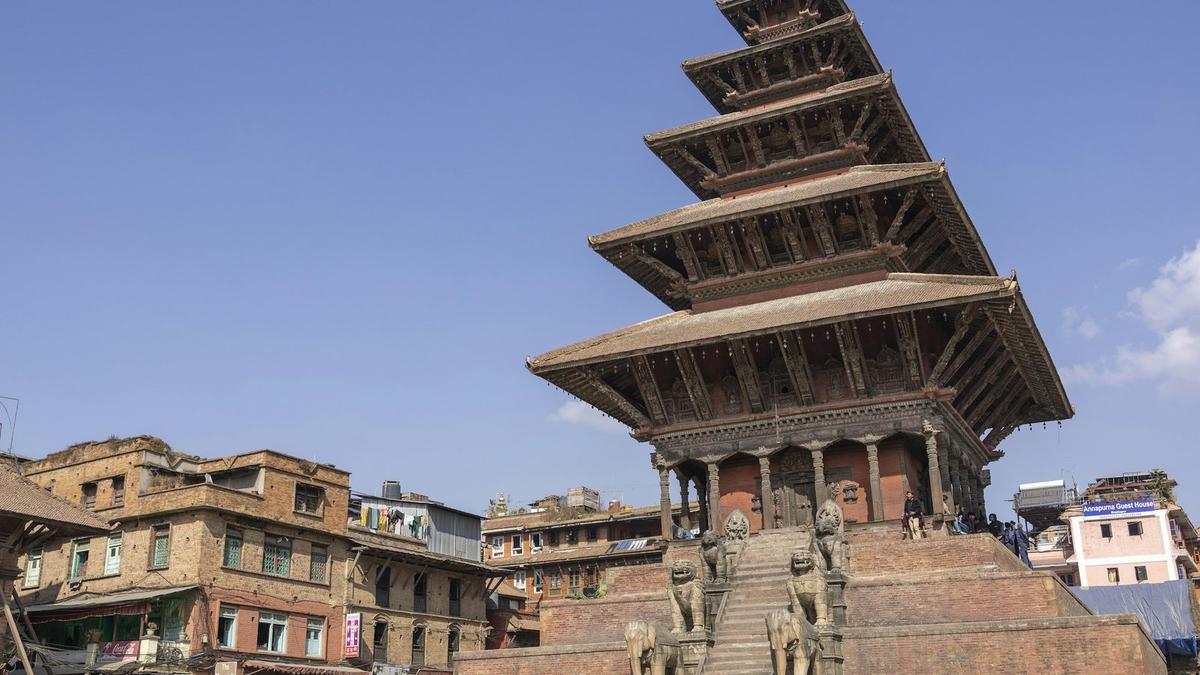
The Bhaktapur Nyatapola temple is a five-roofed temple to the goddess Siddhi Lakshmi on the northern side of Taumadhi Square, a short walk from Durbar Square. King Bhupatindra Malla began it in 1701 and completed it in 1702. The Nepal Tourism Board calls it the tallest pagoda-style temple in Nepal, and your Bhaktapur ticket covers it.
Nyatapola is one of the highlights in our guide to places to visit in Kathmandu. This article goes deeper than our Bhaktapur city guide: the goddess, the guardians, the earthquakes, the festival and how to visit well.
In this guide
- What is the Bhaktapur Nyatapola temple?
- Who built Nyatapola, and for whom?
- What do the stairway guardians mean?
- What should you look for on the temple?
- How did Nyatapola survive the 1934 and 2015 earthquakes?
- Can you go inside or climb the steps?
- What else is in Taumadhi Square?
- When is Bisket Jatra at Nyatapola?
- How do you visit, and what is the entry fee?
- What is near Nyatapola?
- Frequently asked questions
- Plan your visit with us
Key facts
- What it is
- Five-roofed temple on the northern side of Taumadhi Square; the tallest pagoda-style temple in Nepal (Nepal Tourism Board; The Kathmandu Post (15 Jan 2020); ISPRS Annals (2017); checked 12 Nov 2026)
- Built
- Begun in 1701, completed in 1702, under King Bhupatindra Malla (Nepal Tourism Board; ISPRS Annals (2017); The Kathmandu Post (15 Jan 2020); checked 12 Nov 2026)
- Dedicated to
- Siddhi Lakshmi, ancestral deity of the Malla kings (Nepal Tourism Board; The Kathmandu Post (15 Jan 2020); checked 12 Nov 2026)
- Height
- About 33 m; you will also see 30 m (Nepal Tourism Board; ISPRS Annals laser-scan survey (2017); checked 12 Nov 2026)
- Earthquakes
- Stood through 15 January 1934 and 25 April 2015; upper roofs damaged and repaired (CIRES (Roger Bilham); USGS; ISPRS Annals (2017); The Kathmandu Post (2020); checked 12 Nov 2026)
- Latest repairs
- December 2019 to July 2020 (OnlineKhabar (12 Dec 2019; 3 May 2021); checked 12 Nov 2026)
- Entry
- Bhaktapur ticket: NPR 2,000 foreign, NPR 500 SAARC (and China), since 17 July 2025; no separate Nyatapola ticket (Bhaktapur Municipality, via The Rising Nepal (24 Jul 2025); checked 12 Nov 2026)
- Location
- Bhaktapur, 12 km east of Kathmandu on the Arniko Highway (Nepal Tourism Board; checked 12 Nov 2026)
What is the Bhaktapur Nyatapola temple?
Nyatapola is a five-roofed, pagoda-style temple on a high stepped plinth on the northern side of Taumadhi Square in Bhaktapur. The Nepal Tourism Board and The Kathmandu Post both describe it as the tallest pagoda-style temple in Nepal. It is dedicated to the goddess Siddhi Lakshmi and is still a working temple.
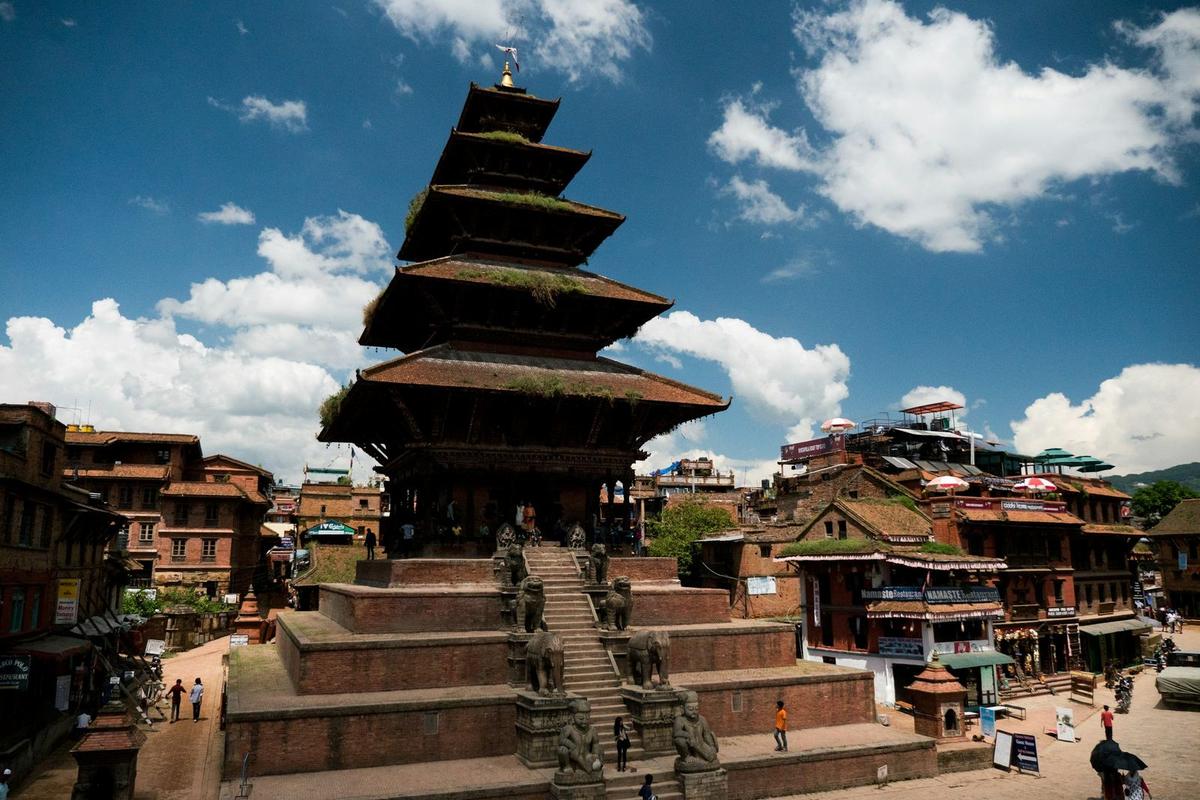
The name tells you what to look at. In Nepal Bhasa, the Newar language of Bhaktapur's old town, "nyata" means five storeys and "pola" means roof.
It is about 33 m tall, according to the Nepal Tourism Board and a 2017 laser-scan survey of the temple published in the ISPRS Annals. You will also see 30 m quoted. The same survey found that the five-stepped plinth alone is about 9 m high, which is a large part of why the temple rises so far above the houses around it.
Bhaktapur Durbar Square, a short walk away, is one of the seven monument zones of the Kathmandu Valley World Heritage Site, inscribed in 1979. We could not confirm whether that zone takes in Taumadhi.
Who built Nyatapola, and for whom?
King Bhupatindra Malla built Nyatapola. Work began in 1701 and the temple was completed in 1702. It is dedicated to Siddhi Lakshmi, a Tantric goddess whom The Kathmandu Post describes as the ancestral deity (kul-deuta) of the Malla kings. Her image is kept hidden, and only the temple's priests go inside.
You will hear Bhupatindra Malla's name often in Bhaktapur: his statue sits on a stone column in Durbar Square. The Nepal Tourism Board describes the goddess of Nyatapola as "a strong goddess who protects people from evil." Not everyone names her the same way, as the writer Desmond Doig noted:
"To most she is Siddhi Lakshmi, to others Bhairabi, the consort of Bhairab, Lord of Terror."
Desmond Doig, Nepali Times, 12 January 2001
Local legend also ties the temple to Bhairav, whose own temple stands beside it. In one version Doig retold, the god's anger brought disasters on the town, and a temple to a goddess was built to calm him. It is a story, not history, but it helps explain why the two temples share the square.
What do the stairway guardians mean?
The stairway climbs past five pairs of stone guardians, one pair on each level of the plinth. From the bottom they are two wrestlers, two elephants, two lions, two griffins (sardula) and two goddesses: the lion goddess Singhini and the tiger goddess Baghini. Each pair is said to be ten times stronger than the pair below it.
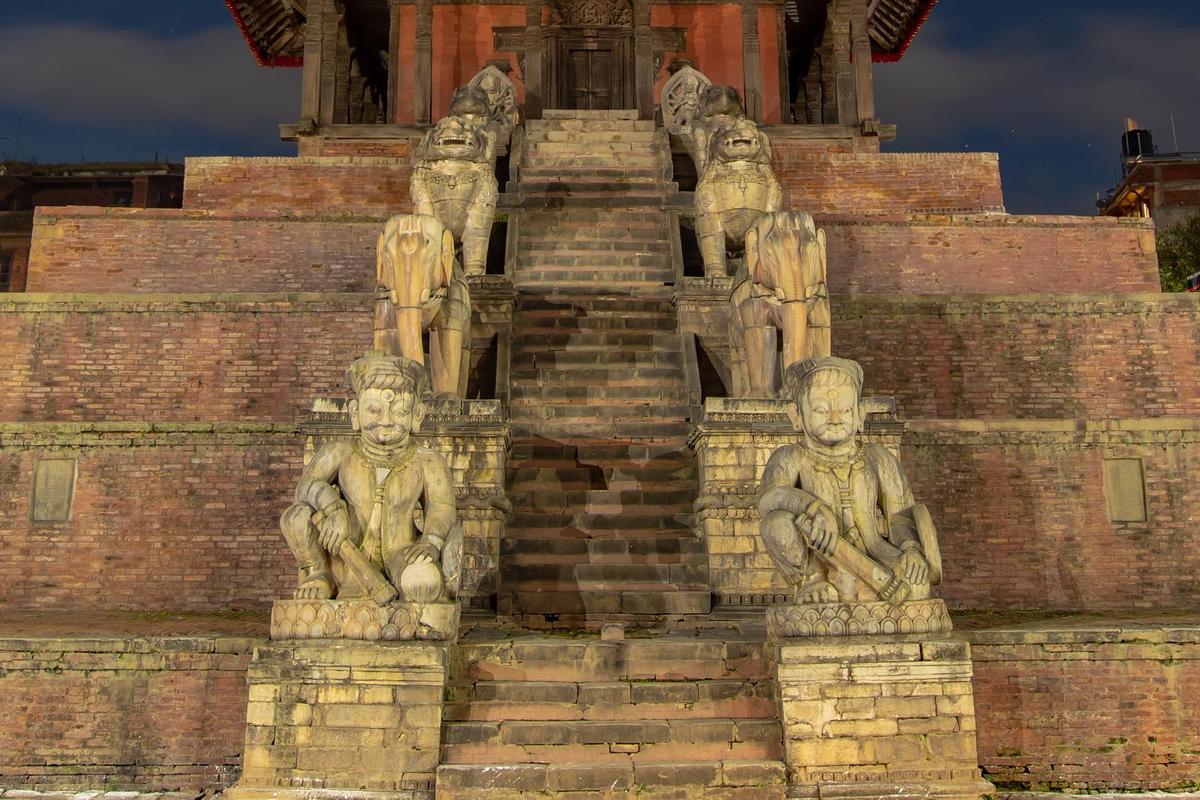
In the Nepal Tourism Board's words, "Each statue is said to be ten times stronger than the one below it." Read that way, the stairway is a ladder of power climbing towards the goddess at the top.
| Level, from the bottom | Guardians | As the belief goes |
|---|---|---|
| 1 | Two wrestlers | The first line of protection. Local stories name them, but the names are told in different ways, so we leave them out. |
| 2 | Two elephants | Ten times stronger than the wrestlers |
| 3 | Two lions | Ten times stronger than the elephants |
| 4 | Two griffins (sardula) | Ten times stronger than the lions |
| 5 | Singhini and Baghini (Simhini and Vyaghrini in Sanskrit) | Ten times stronger than the griffins, and closest to the goddess |
What should you look for on the temple?
Look closely at the carved roof struts, the shrine door and the roofs themselves. The temple is built of brick walls in mud mortar tied to timber beams, with a stone block under each wooden post, according to the 2017 ISPRS survey. Carved wooden struts hold up the five roofs above the five-stepped plinth.
According to the writer Desmond Doig, the temple has 108 carved roof struts, each showing a form of the goddess. Other writers give other counts, so treat the number as Doig's, not a measured figure.
- The roof struts. Stand at the edge of the square for the whole shape, then move closer and zoom in on the carving.
- The shrine door. It is usually closed. That is normal for a temple whose image is kept hidden.
- All five roofs. Walk over towards the Bhairavnath Temple and look back. It is a good place to count them.
How did Nyatapola survive the 1934 and 2015 earthquakes?
Nyatapola stayed standing through the great earthquakes of 15 January 1934 and 25 April 2015. It was not untouched: its upper roofs were damaged each time and repaired afterwards. The latest repairs ran from December 2019 to July 2020, led by a local users' committee.
The 1934 earthquake did heavy damage in Bhaktapur. The Nepali Times later counted Nyatapola among the few Bhaktapur monuments that survived it, while the 2017 ISPRS survey records that its upper tier collapsed and was rebuilt later. Both can be true: the temple stood, but its top was hurt.
In the magnitude 7.8 Gorkha earthquake of 2015 the temple stood again, but sources disagree on how badly it was damaged. The ISPRS team described "some minor damage to the upper tiers of the temple". The Kathmandu Post reported something more serious:
"the top floor had tilted significantly to the east, while the floor below had also slightly tipped in the same direction."
The Kathmandu Post, 15 January 2020
Why did it survive? The researchers who scanned it wrote that "it is not clear... why this temple was resistant to collapse." The Kathmandu Post reported that the users' committee president, Keshav Tamakhu, credits a 2009 restoration with saving it from worse.
There had been earlier work too: Bhaktapur Municipality carried out a major renovation in 1996, mainly to the roof, according to the ISPRS survey. The repairs after 2015 were a local effort, and the municipality said 4,165 people volunteered labour on the temple.
Can you go inside or climb the steps?
You cannot go inside: the goddess's image is kept hidden and only the temple's priests enter the shrine. You can usually climb the stairway. The travel guide The Longest Way Home (updated January 2026) says visitors can climb to the top platform, with no fee beyond the Bhaktapur ticket. Follow any signs or instructions at the temple.
The climb is short, but the steps are steep and high and the stone is worn. Going up past each pair of guardians is the best way to see them, and the top platform looks out over the square.
- Take your time; coming down can feel harder than going up.
- Give way to anyone coming to worship, and step aside during rituals and festivals.
- Keep hold of small children on the steps.
- Do not climb on the guardian statues or lean on them for photos.
- Follow what local people do about shoes, and remove them where asked.
- Ask before you photograph people, especially anyone praying.
What else is in Taumadhi Square?
Beside Nyatapola stands the three-roofed Bhairavnath Temple, dedicated to Bhairav. In front of Nyatapola, behind a row of houses, is the Til Madhav Narayan temple to Vishnu, and around the square are rest houses (sattal), water spouts and the small Betal shrine. Motorbikes pass through, so watch your step.
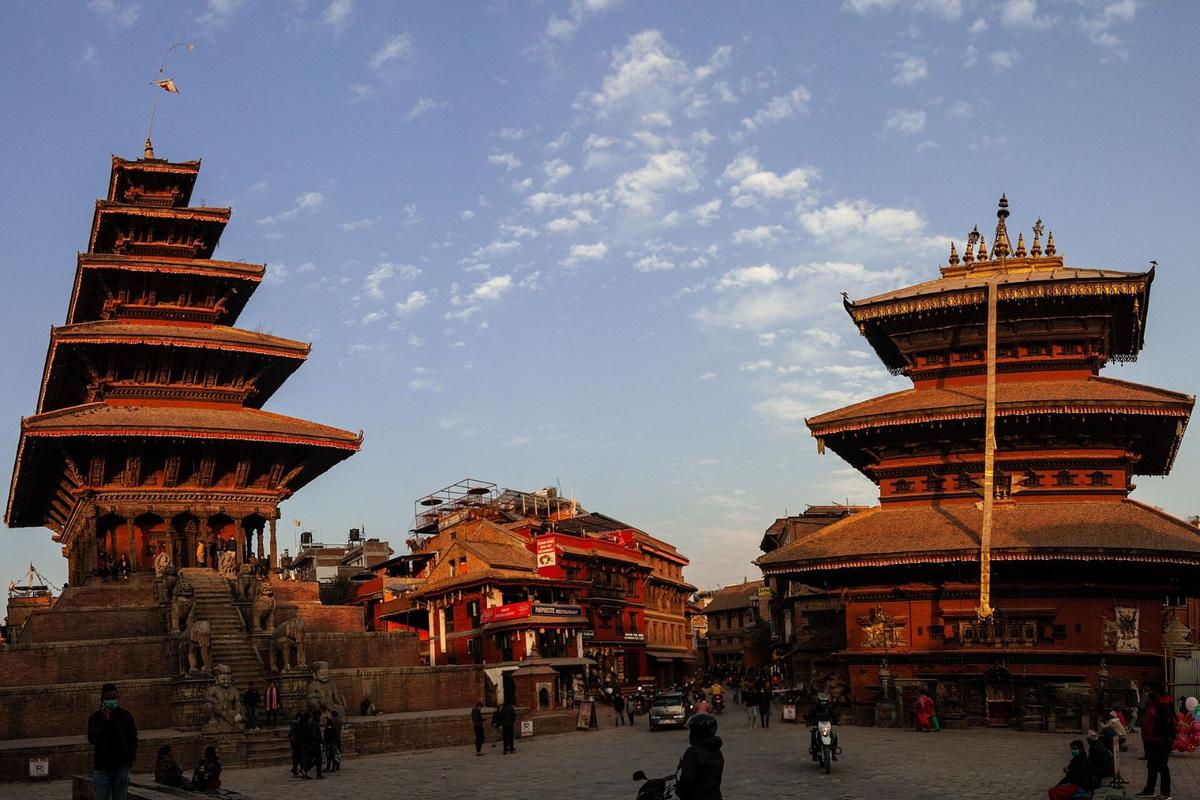
Bhairavnath Temple
The Nepal Tourism Board says only Bhairav's head is kept in this temple's inner sanctum. It took its three-roofed form under the same king, Bhupatindra Malla, in the early 1700s. The Himalayan Times listed it among the monuments whose post-2015 repairs were completed by 2020. Bhairav's chariot is at the heart of Bisket Jatra, and the festival starts in front of Nyatapola, so the two temples are bound together.
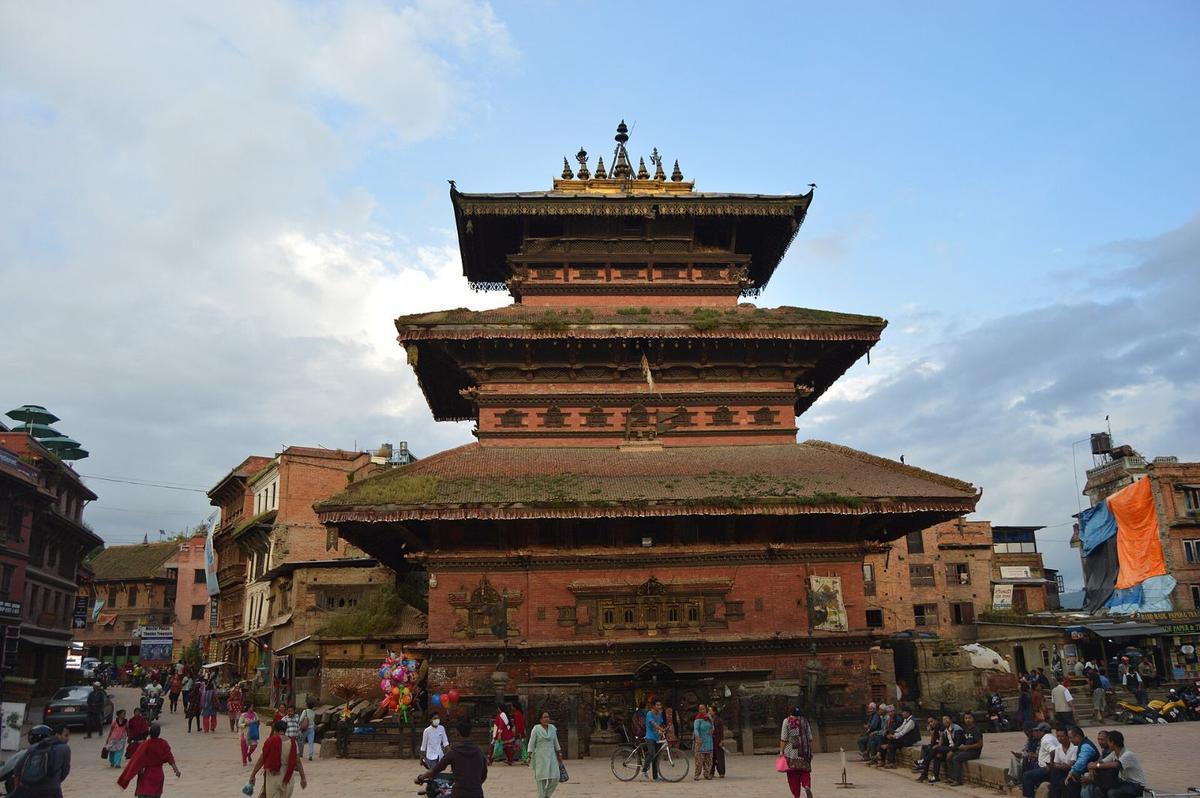
Til Madhav Narayan
The Til Madhav Narayan temple (also called Til Mahadev Narayan) is easy to miss. It stands in front of Nyatapola but behind a row of houses, reached through a narrow doorway. Narayan is a form of Vishnu. Step in quietly: it is a place of worship.
When is Bisket Jatra at Nyatapola?
Bisket Jatra, also spelled Biska Jatra, is usually in April, around Nepali New Year. It lasts nine days and eight nights and starts in Taumadhi Square in front of Nyatapola, from where the chariots of Bhairav and Bhadrakali are pulled. Check the dates before you plan, because they follow the Nepali calendar.
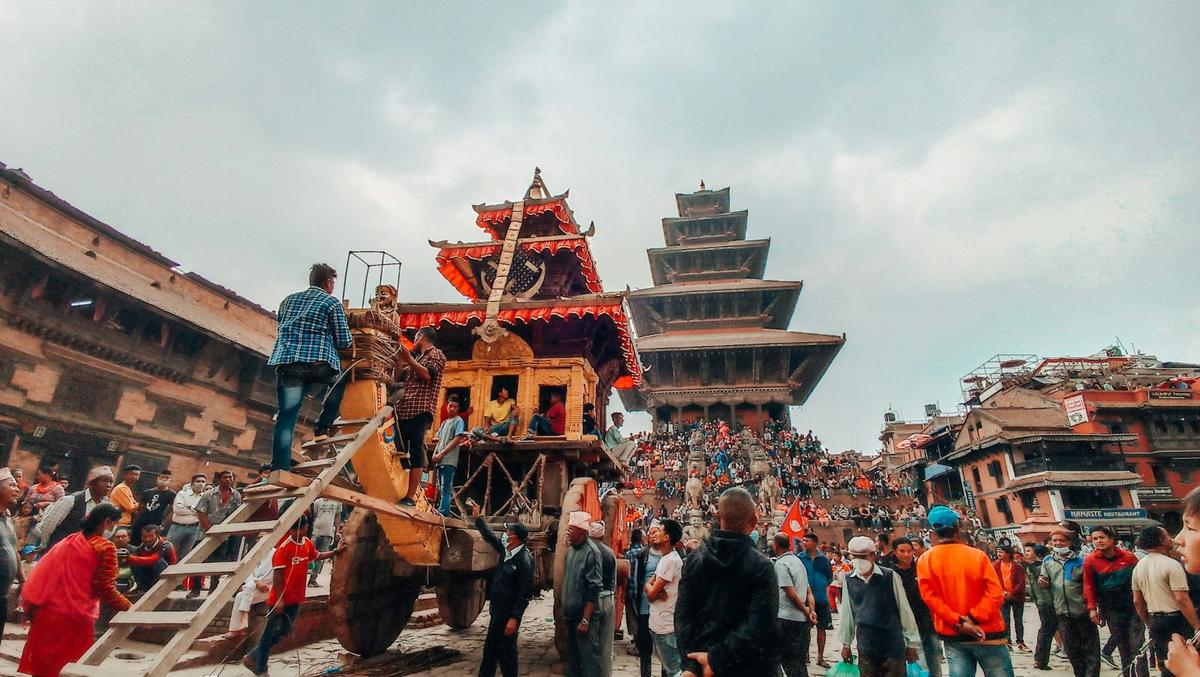
The festival begins four days before Nepali New Year (Baisakh 1), which falls in mid-April. The tall wooden pole, the yosin, also called the lingo, is raised on the last day of the old year and brought down on New Year's Day, as The Kathmandu Post (2017) and OnlineKhabar (2026) describe it. OnlineKhabar also describes a second ceremonial pole at Kumale Tole in Talako that is lowered on the festival's final day. The chariot is assembled in Taumadhi before the festival. In 2026 OnlineKhabar reported it beginning on 10 April. We do not have confirmed dates for 2027, so check with us before you build a trip around it.
It is loud, crowded and physical. If you go:
- Stand well back from the chariot and its ropes. A chariot pulled by a crowd can move suddenly.
- Keep to the edges and away from anyone pulling or pushing.
- The Nyatapola steps fill with people watching. If you want a place there, go early and stay put.
- Agree a meeting point, and keep valuables zipped away.
How do you visit, and what is the entry fee?
Nyatapola is inside Bhaktapur's heritage area, so the Bhaktapur entry ticket covers it: NPR 2,000 for foreign visitors and NPR 500 for SAARC nationals (and visitors from China, as reported by The Rising Nepal), since 17 July 2025. There is no separate Nyatapola ticket.
Buy the ticket at a counter where you enter the heritage area and keep it with you, as staff may ask to see it. We do not give a validity period, so ask at the counter if you plan to stay longer. Carry Nepali rupees in cash.
Bhaktapur lies 12 km east of Kathmandu on the Arniko Highway, according to the Nepal Tourism Board, at 1,401 m. Drive times depend on traffic, so ask us for a realistic estimate. Our guide to day trips from Kathmandu shows how Bhaktapur fits with other outings.
Early morning and late afternoon give softer light and fewer people. At Nyatapola itself, a short stop is enough to climb the steps and see the guardians, longer if you sit in the square and watch. For Bhaktapur as a whole, our suggestion is a morning at least, or a full day if you add Changu Narayan. For a sunrise first, see our Nagarkot guide.
What is near Nyatapola?
Bhaktapur Durbar Square is a short walk away. Pottery Square, in the Talako area, is where potters of the Prajapati community work at the wheel and dry pots in the open. And juju dhau, Bhaktapur's sweet, rich buffalo-milk yoghurt set in a small clay pot, is sold around the squares.
Bhaktapur Durbar Square
The old royal palace square is the natural start or end of a walk to Nyatapola. Our Bhaktapur Durbar Square guide goes through it monument by monument.
Pottery Square
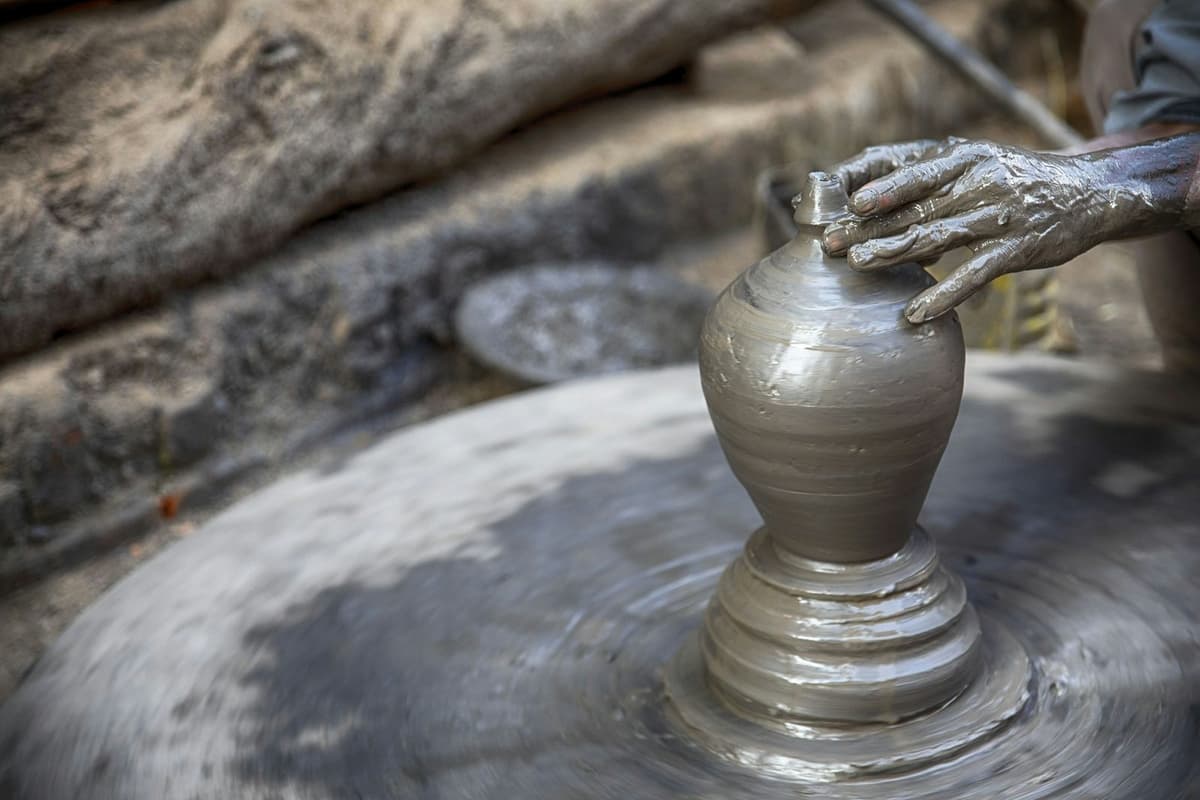
Pottery Square is a working space, and its trade is under pressure: The Kathmandu Post reported in 2022 that of about 150 Prajapati households, only about 40 people still made pots. Keep off the drying pots and ask before you photograph anyone. Potters sometimes offer short wheel sessions; ask the price first. For a longer go, our Nepali cooking class with pottery is a half day in Kathmandu that finishes at the wheel.
Juju dhau
Juju dhau means "king of curd" in Nepal Bhasa. The Kathmandu Post put it well: "Rich from buffalo milk and sweet from copious amounts of sugar, it is served in tiny clay pots." Save it for the end of your walk.
Frequently asked questions
How much is the Bhaktapur entry fee, and how long should I spend there?
The Bhaktapur entry fee is NPR 2,000 for foreign visitors and NPR 500 for SAARC nationals (and visitors from China, as reported by The Rising Nepal), since 17 July 2025. There is no separate ticket for Nyatapola. Give Bhaktapur a morning at least, or a full day with Changu Narayan.
How tall is Nyatapola Temple?
Nyatapola is about 33 m tall, according to the Nepal Tourism Board and a 2017 laser-scan survey published in the ISPRS Annals. You will also see 30 m quoted. The Nepal Tourism Board calls it the tallest pagoda-style temple in Nepal.
Can you climb the Nyatapola steps?
Usually, yes. The travel guide The Longest Way Home (updated January 2026) says visitors can climb past the guardians to the top platform, with no fee beyond the Bhaktapur ticket. Follow any signs or instructions at the temple. The steps are steep, so take care and give way to worshippers.
Can you go inside Nyatapola, and who is worshipped there?
No. The shrine is closed to visitors. Nyatapola is dedicated to Siddhi Lakshmi, a Tantric goddess and the ancestral deity of the Malla kings. Her image is kept hidden, and only the temple's priests go inside. Some local accounts know her as Bhairabi, the consort of Bhairav.
Who built Nyatapola, and when?
King Bhupatindra Malla built Nyatapola. Work began in 1701 and the temple was completed in 1702, according to the Nepal Tourism Board, The Kathmandu Post and the 2017 ISPRS survey. The same king gave the Bhairavnath Temple beside it its three-roofed form.
How did Nyatapola survive the earthquakes?
Nyatapola stayed standing in the earthquakes of 15 January 1934 and 25 April 2015, but its upper roofs were damaged each time and repaired; the latest repairs finished in July 2020. Researchers who surveyed it after 2015 wrote that it is not clear why it resisted collapse.
Plan your visit with us
For the bigger picture, go back to our guide to places to visit in Kathmandu, or read our Kathmandu Valley guide.
If you would like us to arrange it, the Nagarkot sunrise and Bhaktapur tour is a day trip that pairs a sunrise with Bhaktapur's squares, and the Patan, Bhaktapur and Boudhanath tour spends a night in Bhaktapur, so you can see Taumadhi early and late.
Message us on WhatsApp or send an enquiry and we will reply with honest options.