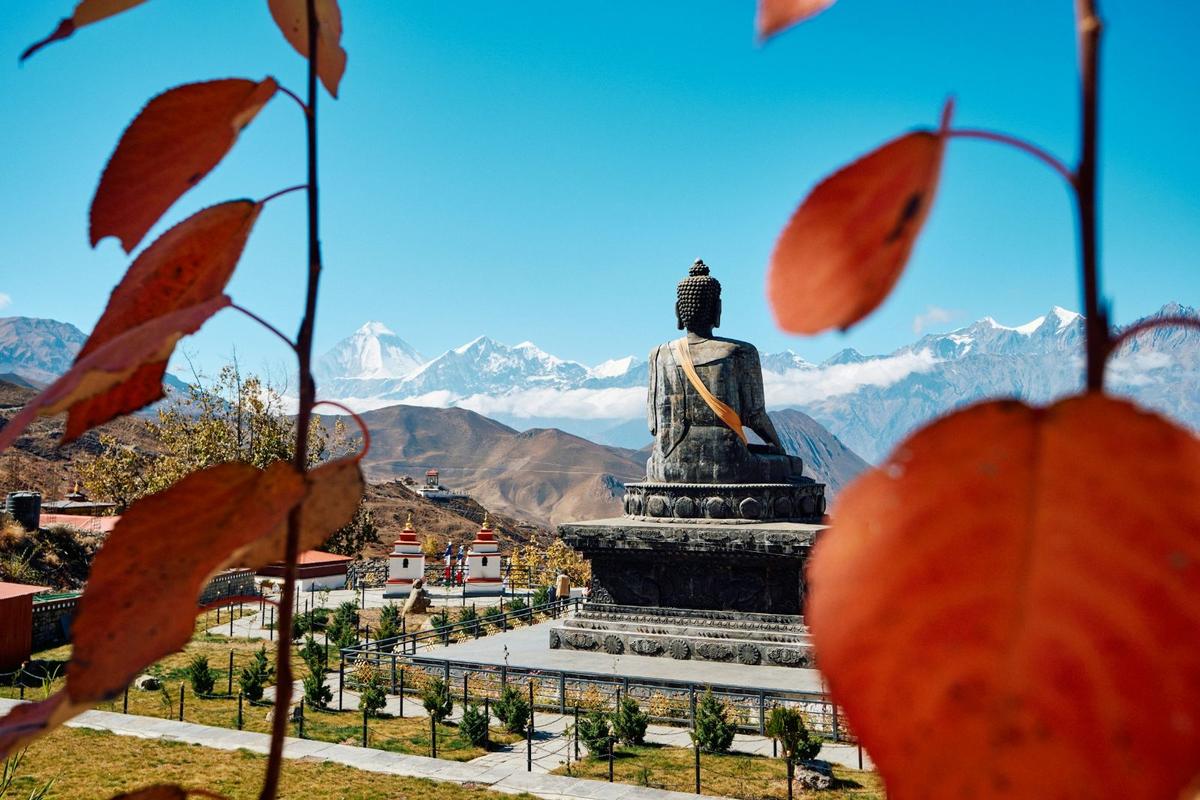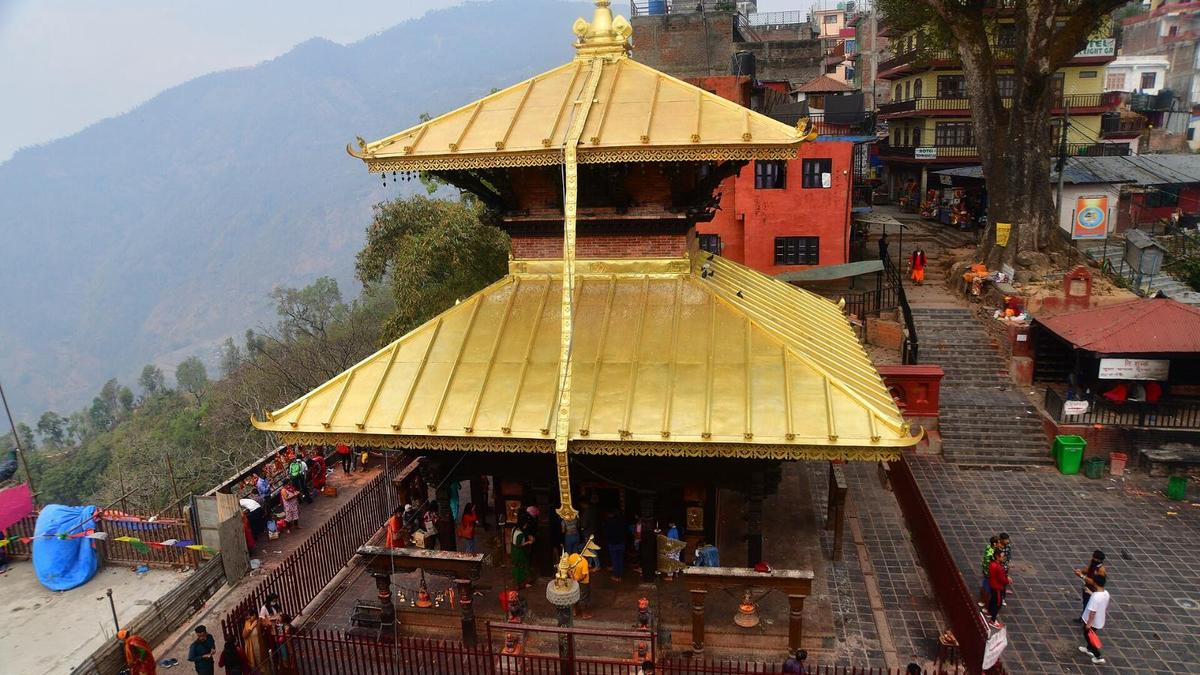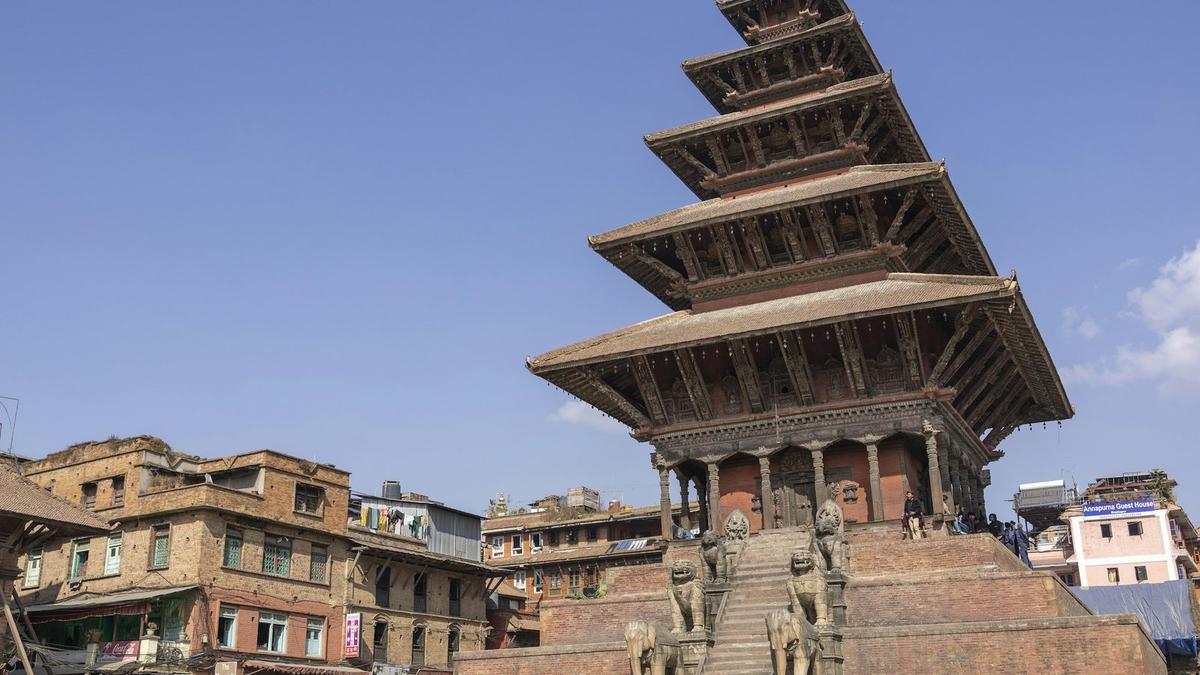
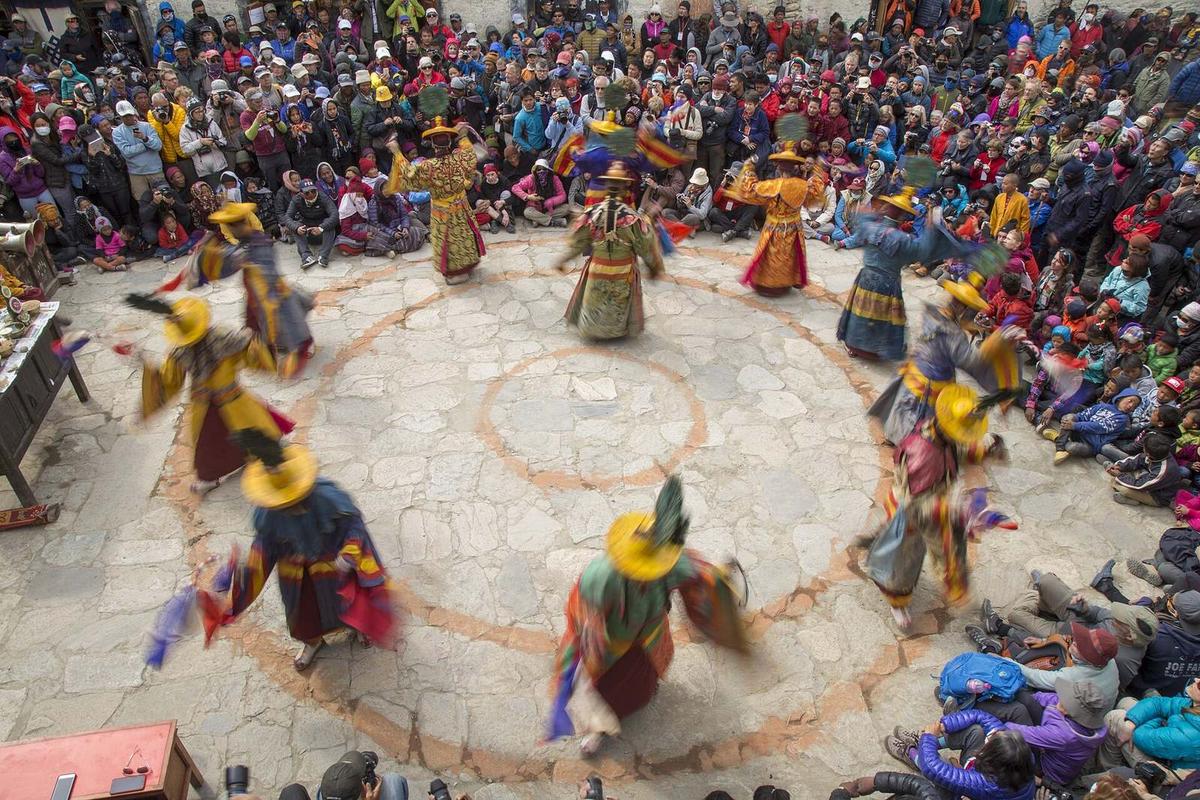
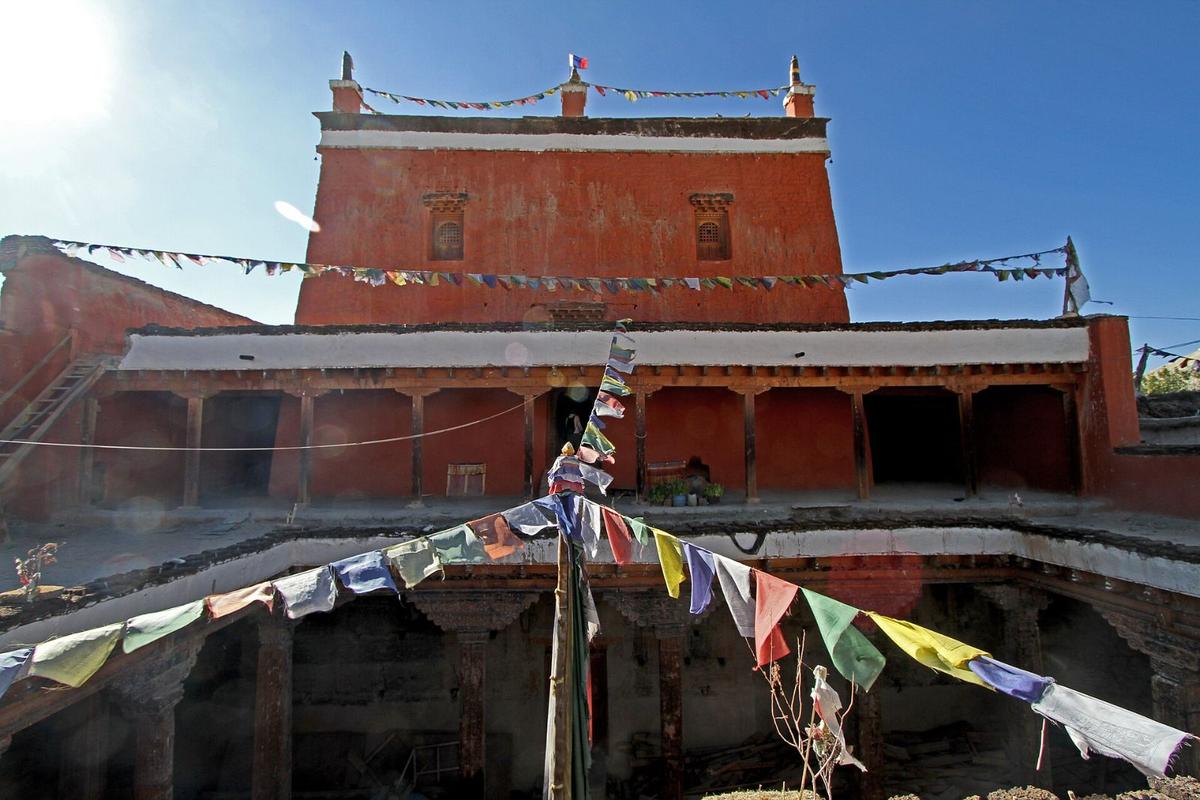
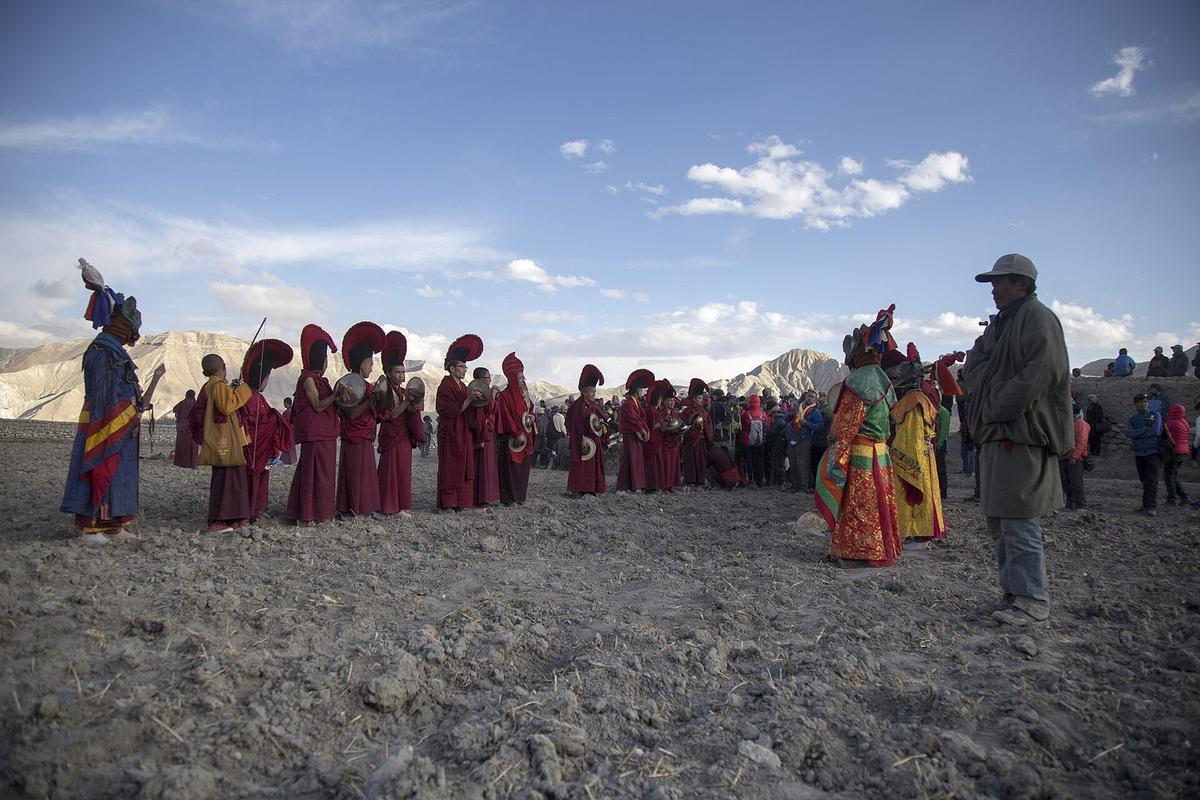
For three days each spring, masked dancers move through the courtyard in front of the old palace in Lo Manthang while lamas and monks perform the rites. During the festival a thangka of Guru Rinpoche nearly two storeys tall is carried out of the palace and shown to the public; it is taken out only for Tiji.
A Tiji festival trek takes you to Lo Manthang, the walled town of Upper Mustang at about 3,800 m (about 12,500 ft), for three days of rites and masked dances. Recent years fell in May; the 2027 dates are not announced yet. You need the Upper Mustang restricted-area permit; since March 2026 even a single traveller can get one, with a licensed guide. Our complete guide to Mustang covers the wider region.
In this guide
- What is the Tiji festival?
- Tiji festival dates: past years and 2027
- What happens on each of the three days
- How to reach Lo Manthang for Tiji
- Permits for the Tiji festival trek
- Tiji weather and altitude in May
- Etiquette and photography at Tiji
- Frequently asked questions
Key facts
- What it is
- A sacred Buddhist ritual, also called Tenchi (NTB, checked 17 Nov 2026)
- Where
- The palace courtyard in Lo Manthang, Upper Mustang (Gorkhapatra and The Rising Nepal, checked 17 Nov 2026)
- Altitude
- About 3,800 m (about 12,500 ft) (UNESCO Tentative List, checked 17 Nov 2026)
- How the date is set
- 26th to 29th of the third month of the Tibetan calendar (NTB, checked 17 Nov 2026)
- Length of the public festival
- Three days (Gorkhapatra, checked 17 Nov 2026)
- Tiji 2026
- 13 to 15 May 2026 (Gorkhapatra, checked 17 Nov 2026)
- Tiji 2027
- Not announced as of 17 Nov 2026 (NTB and Nepali press searched 17 Nov 2026)
- Upper Mustang permit
- USD 50 per person per day (NTB, checked 17 Nov 2026)
- ACAP entry (foreigners)
- NPR 3,000 per person per entry (NTB, checked 17 Nov 2026)
- Guide
- Since 22 March 2026 a single traveller can get the permit, with a licensed guide and through a registered agency (Kathmandu Post, checked 17 Nov 2026)
- May at Jomsom (nearest station)
- Average high 20.6 °C, low 7.8 °C (DHM normals 1991 to 2020, checked 17 Nov 2026)
What is the Tiji festival?
Tiji is a sacred Buddhist ritual held each year in Lo Manthang to drive out negative forces. The Nepal Tourism Board (NTB) calls it a ritual "celebrated in Lo Manthang, Upper Mustang", based on the meditation practice of Vajrakila, also called Dorje Phurba, a deity associated with removing negative forces.
It is the community's own festival, not a show for visitors. Residents of Lo Manthang and Lo-Ghekar Damodarkunda rural municipalities celebrate it, and a local ward member called it "the greatest and most popular festival of Lowa community", according to The Rising Nepal.
Where Tiji comes from
NTB says "Tiji Festival began in the early 15th century, introduced by Khenchen Sonam Lhundrup, son of Mustang's second king". King Samdup Rabten revived it in the 17th century with the Sakya master Ngawang Kunga Sonam, and "In 1963, the tradition was restored again." Gorkhapatra reports that Tiji was halted from 1992 to 1994 for various reasons. You will see other ages quoted online; we follow NTB.
Chhoede monastery and the Sakya tradition
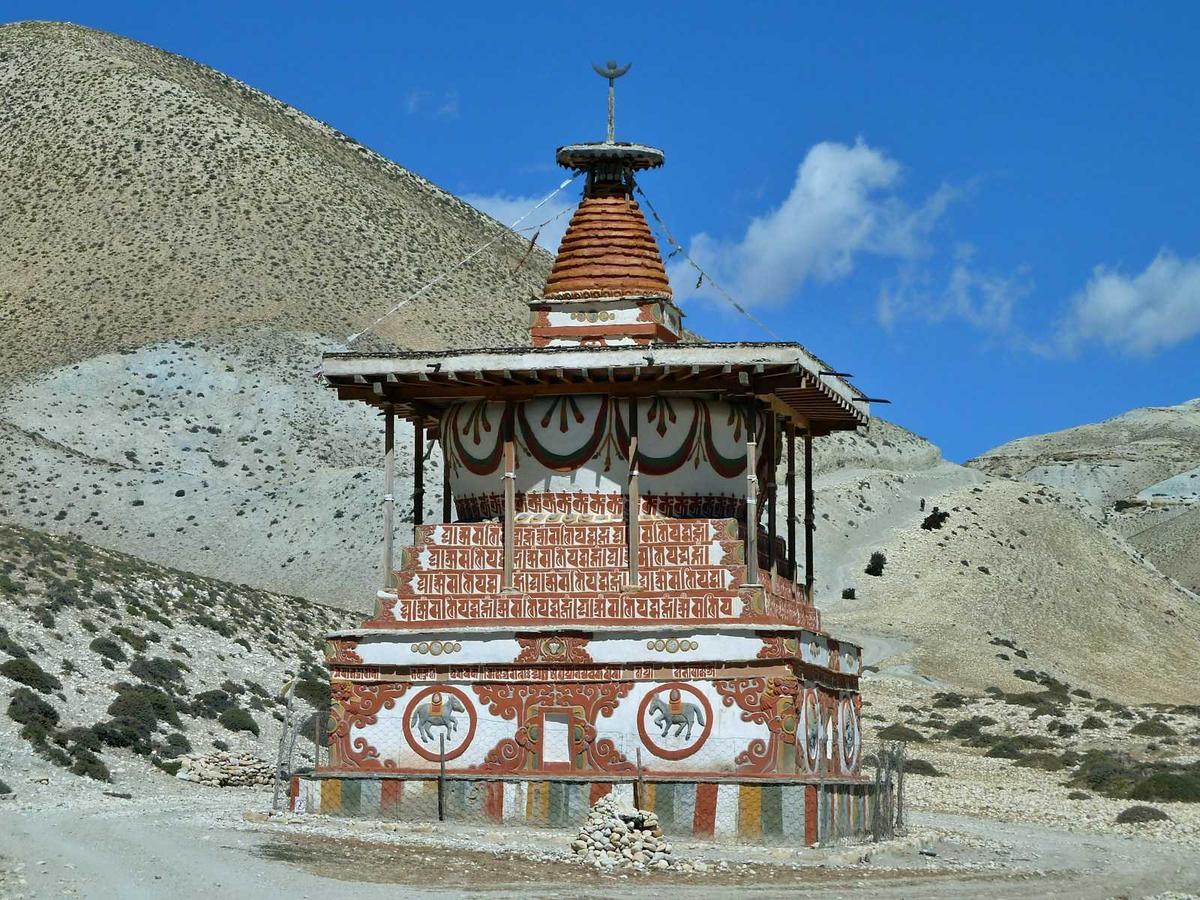
UNESCO puts Lo Manthang's religious life plainly: "The culture is to a large degree defined by the Sakyapa traditions of Tibetan Buddhism". Its description of the walled town lists "the monastery of Choede Lakhang from the 18th Century", known locally as Chhoede Gompa. NTB says the sacred dances are performed by monks who prepare through three months of retreat. For the town and its walls, read our guide to Lo Manthang.
The story told locally
Nepali newspapers link Tiji to the reincarnation of Lama Dorje Sunu (also spelt Dorji Sunu). As the chair of Lomanthang Rural Municipality told Gorkhapatra in 2026, it is celebrated in the belief that Dorje Sunu was reborn, removed the fear and violence caused by a demon, and restored peace and order. The prayers are also meant to keep away disasters, famine and disease.
The former royal family
Jigme Dorje Palbar Bista, the last king of Mustang, lost the royal title in 2008 when Nepal abolished its monarchy and died on 16 December 2016. Jigme Singhe Palbar Bista carries on the family's ritual role at festivals such as Tiji, and the family, whose role is now cultural rather than legal, took part in Tiji 2026.
Tiji festival dates: past years and 2027
Tiji follows the Tibetan calendar, so its Western date moves each year. NTB says: "Tiji is held annually from the 26th to 29th of the third month in the Tibetan calendar." As of 17 November 2026, no official or press source had announced the 2027 dates.
Nepali newspapers give the start in the Nepali lunar calendar as Jestha Krishna Dwadashi, the twelfth day of the waning moon in Jestha, followed by three days of festival. These are the years we could confirm from press reports:
| Year | Dates | Source |
|---|---|---|
| 2022 | Began Friday 27 May 2022 | Nepalnews, 28 May 2022 |
| 2023 | Tuesday 16 May to Thursday 18 May 2023 | The Rising Nepal, 18 May 2023 |
| 2026 | Wednesday 13 May (30 Baisakh 2083) to Friday 15 May 2026 | Gorkhapatra, 13 and 15 May 2026 |
| 2027 | Not announced as of 17 November 2026 | NTB and Nepali press searched |
We found no press or official report of the 2024 and 2025 dates, so we leave them out rather than copy other agencies' lists.
What about Tiji 2027?
Several tour operators list early June 2027, but none cites a source and we could not confirm it. Every reported year above fell in May. Until the date is announced, hold off on non-refundable flights to Nepal (your own arrangement) and keep spare days either side of your plans. If May does not suit you, Lo Manthang held its own three-day Yartung with horse races in mid-August 2026.
What happens on each of the three days
Gorkhapatra's 2026 reports describe the three days like this:
| Day | What happens | Source |
|---|---|---|
| Day 1 | Prayers to the earth deities | Gorkhapatra, May 2026 |
| Day 2 | Lamas and monks perform rites and masked dances to end the demon | Gorkhapatra, May 2026 |
| Day 3 | The demon is driven away; ritual cakes are thrown and puja materials carried out of the village | Gorkhapatra and NTB |
It all happens in the courtyard in front of the Lo Manthang palace. During the festival a huge thangka of Padmasambhava, known in Nepal as Guru Rinpoche, nearly two storeys tall, is brought out of the palace and shown to the public; it comes out only for Tiji. On the last day, in NTB's words, "religious cakes are thrown away to banish negativity, based on astrological guidance." If you can stay for only part of Tiji, the masked dances and the closing ritual fall on the second and third days.
How busy does it get?
Busy for a small town. In 2026 ACAP counted 307 foreign tourists arriving on the opening day, and its Lo Manthang chief said about 350 watched the festival. Organisers expected more than 2,000 Nepali and foreign visitors in all.
How to reach Lo Manthang for Tiji
Lo Manthang is reached by road. A road runs from Jomsom through Upper Mustang to Lo Manthang and on to the Korala border, so you can arrive by jeep, though snow can make it difficult. The Beni to Jomsom to Korala road is about 202 km, and the Korala pass is about 4,650 m (about 15,260 ft), according to Gorkhapatra.
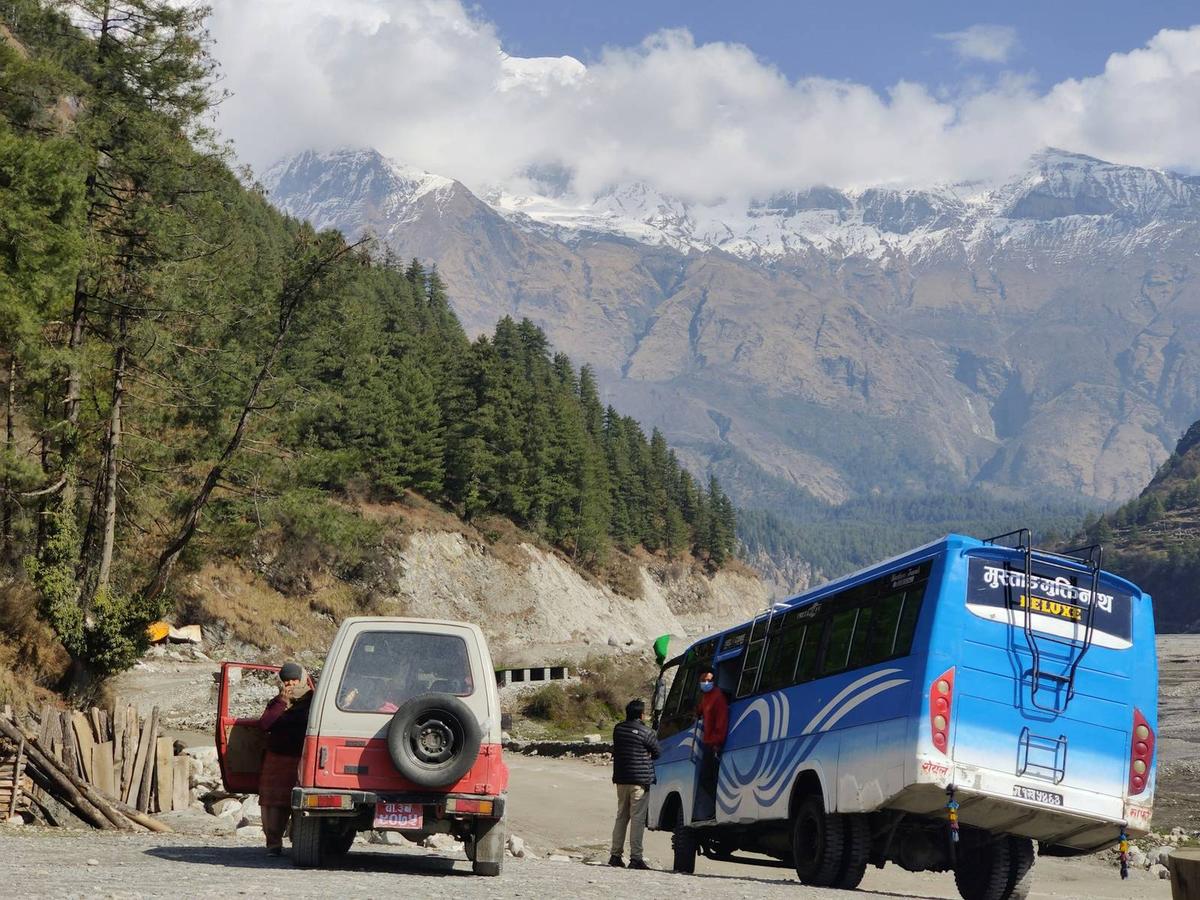
Most travellers reach Pokhara first, then follow the Kali Gandaki valley north to Jomsom; our guides to Pokhara to Mustang and Jomsom cover that leg. UNESCO notes that Lo Manthang "is located on the ancient trade route that runs along the Kali Gandaki River", and some visitors still walk sections of the valley rather than drive all the way. Our Upper Mustang guide covers the villages on the way.
Road and flight status, November 2026
The road had a hard autumn in 2026:
- Floods on about 24 to 27 September damaged the Beni to Jomsom to Korala road at 46 places, and more than 12 km collapsed.
- On 3 November traffic ran one way on damaged stretches, with repairs under way; full restoration is expected to take two to three years.
- Snow fell in Lo Manthang bazaar, at Chhoser and at Korala at the end of October, and ACAP asked tourists not to travel.
- The Korala to Chhusang section, about 88 km, was temporarily repaired and traffic was back to normal by 10 November.
Scheduled Pokhara to Jomsom flights were suspended in the second half of October 2026, while charters continue; we found no restart report as of 17 November. When flights run, most leave in the morning because of strong afternoon winds at Jomsom airport. Even with a flight, you continue from Jomsom to Lo Manthang by road.
Permits for the Tiji festival trek
Lo Manthang is inside the restricted area of Upper Mustang, so a Tiji festival trek needs two permits: the Upper Mustang restricted-area permit, at USD 50 per person per day, and the Annapurna Conservation Area (ACAP) entry permit. This section sets out the official rules for your information.
| Permit | Who | Official fee |
|---|---|---|
| Upper Mustang restricted-area permit | Foreign visitors, including Indian visitors | USD 50 per person per day |
| ACAP entry permit | Foreigners | NPR 3,000 per person per entry |
| ACAP entry permit | SAARC nationals | NPR 1,000 per person per entry |
| ACAP entry permit | Nepali citizens | NPR 100; under 10 free |
- The daily fee replaced an older flat fee after a Cabinet decision in November 2025; check the date on anything you read. NTB says the restricted-area permit is obtained from the Department of Immigration.
- An ACAP permit bought at a check post costs double, and paying online adds 2.9%.
- Since 22 March 2026 a single traveller can get the restricted-area permit, but must be accompanied by a licensed guide and book through a registered agency. The Department of Immigration says: "The facilitating agency will be fully responsible for emergency rescue and logistical arrangements."
So plan Tiji with a licensed guide and a registered agency from the start. A licensed guide walks with you on every trek we run. Fees can change, so check the fee for your dates. Your Nepal visa and international flights are your own arrangement.
Tiji weather and altitude in May
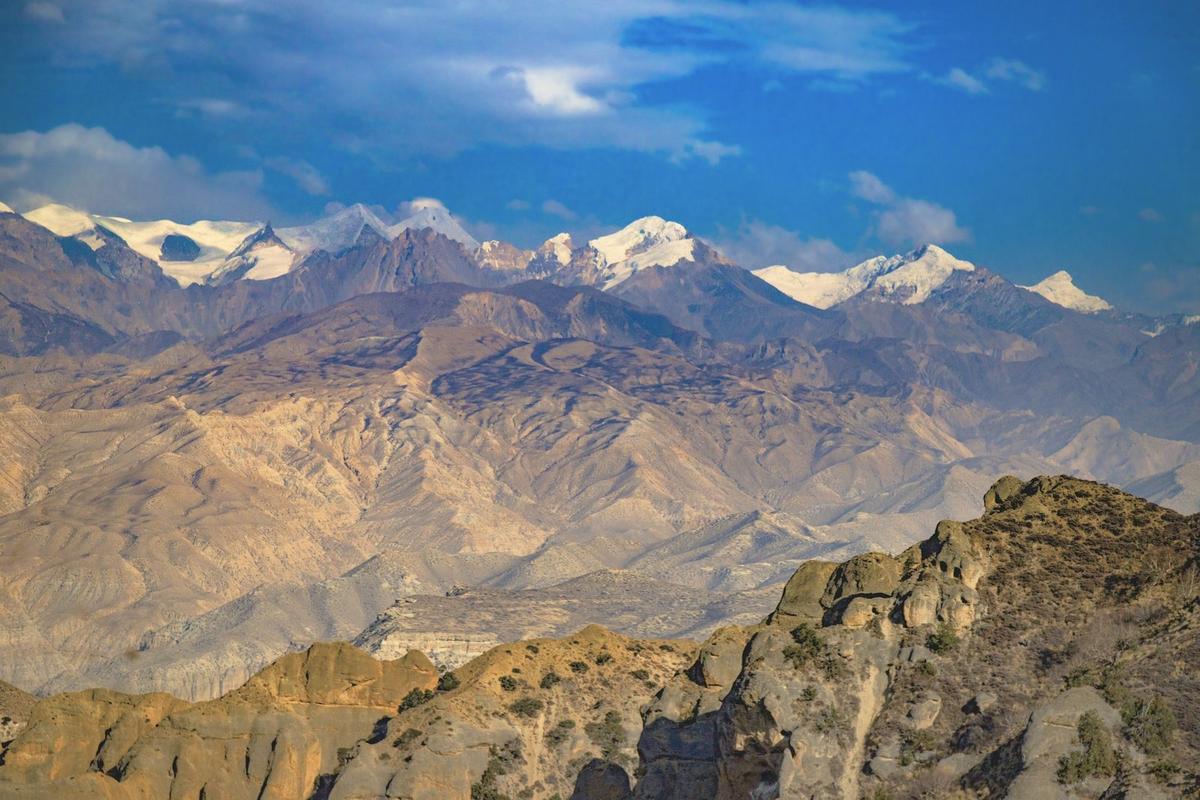
Expect mild days and cold nights. There is no official long-term weather normal for anywhere in Upper Mustang, so the closest guide is Jomsom station at 2,741 m (about 8,990 ft). Lo Manthang is about 1,000 m higher, so expect it to be colder.
| May at Jomsom station (2,741 m) | Average |
|---|---|
| Daytime high | 20.6 °C |
| Night-time low | 7.8 °C |
| Precipitation (rain and snow) | 18.6 mm |
NTB's rule of thumb is that temperatures drop about 6 °C for every 1,000 m of height, so Lo Manthang's nights feel colder than the Jomsom numbers suggest. Pack a warm jacket and hat, light layers, sunglasses, sun cream and a buff for wind and dust. By May the town is full of its own people again: most residents move to lower areas in November and December and come back in spring. For month-by-month planning, see our guides to the best time to visit Mustang and Nepal in May.
Altitude: plan for it
At about 3,800 m, Lo Manthang is high enough for altitude sickness. The CDC says travellers sleeping at 2,450 m or higher are at risk, and that above 3,000 m sleeping height should rise by no more than 500 m a night; the Wilderness Medical Society advises a rest day every 3 to 4 days above 3,000 m. Jomsom to Lo Manthang is a gain of about 1,000 m, twice that nightly guideline, so if your plan drives it in one day, take the first afternoon easy. Our advice:
- Go up slowly and walk slowly, even in town.
- Drink plenty of water and avoid alcohol for the first days at height.
- Know the symptoms: headache, nausea, dizziness, poor sleep, unusual tiredness. Tell your guide early.
- Never go higher with symptoms, and go down if they get worse.
- Ask your doctor before the trip whether preventive medicine such as acetazolamide suits you.
Garlic soup and other hot soups are a comforting local tradition, not a proven cure. Our guide to altitude sickness on Nepal treks has more.
Etiquette and photography at Tiji
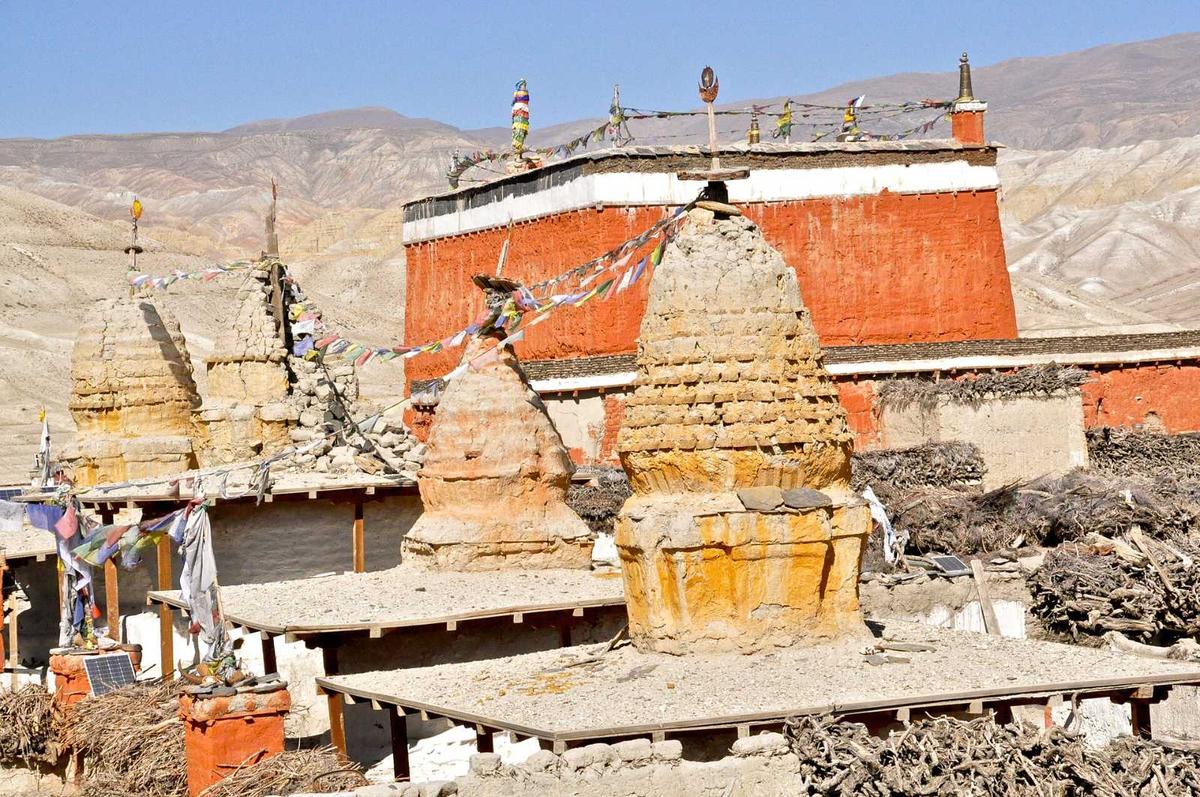
We found no official published rule on photography or drones at Tiji or Chhoede monastery, so what follows is our advice, not regulation. One firm point: tourists cannot enter the Lo Manthang palace, which the royal family uses for festivals.
- Stand or sit where local people show you, and keep the dance space clear.
- Turn off your flash and keep quiet during the rites.
- Ask before close-up photos of people, and accept a no.
- Leave drones packed unless your guide has confirmed permission locally.
- Do not touch masks, ritual objects or the thangka.
- Walk clockwise around chortens and prayer walls, as local people do.
- Dress modestly and warmly; you will be outside for hours.
"even today many of the ancient festival, rituals and ceremonies are being performed."
UNESCO World Heritage Centre, Tentative List entry for Lo Manthang (submitted 2008)
Frequently asked questions
When is the Tiji festival in 2027?
No official or press source had announced the 2027 dates as of 17 November 2026. NTB says Tiji is held from the 26th to 29th of the third Tibetan month, and recent years fell in May, for example 13 to 15 May 2026. Some operators list early June 2027 without a source, so wait for confirmation before booking flights.
What is the Tiji festival?
Tiji, also called Tenchi, is a sacred Buddhist ritual held each year in Lo Manthang, Upper Mustang, based on the practice of Vajrakila (Dorje Phurba), a deity associated with removing negative forces. Over three days, monks perform rites and masked dances in the palace courtyard. NTB dates it to the early 15th century.
Do I need a special permit for the Tiji festival?
Yes. Foreign visitors need the Upper Mustang restricted-area permit, USD 50 per person per day, plus the ACAP entry permit, NPR 3,000 for foreigners. Since 22 March 2026 even a single traveller can get the restricted-area permit, but must be accompanied by a licensed guide and book through a registered agency. Fees can change, so check them for your dates.
Can I go to Tiji alone?
As a single traveller, yes; unguided, no. Since 22 March 2026 one person can get the Upper Mustang restricted-area permit, but must be accompanied by a licensed guide and book through a registered agency. You do not need to join a group.
How do I get to Lo Manthang for Tiji?
Most people travel to Pokhara, then north along the Kali Gandaki valley to Jomsom and on by road to Lo Manthang. Scheduled Pokhara to Jomsom flights were suspended in the second half of October 2026, with charters continuing, so check the situation close to your dates.
Can you drive to Lo Manthang?
Yes. A road runs from Jomsom to Lo Manthang and the Korala border, so you can reach the town by jeep. Snow can make it difficult, as at the end of October 2026, and September 2026 floods damaged the road in many places, with repairs under way in November. Check the status before you go.
Plan your Tiji festival trek with us
Tiji rewards careful planning: confirm the date, sort permits and a licensed guide, book rooms early and allow time to adjust to the height. As the chair of Lomanthang Rural Municipality told Gorkhapatra in May 2026, "Tiji has helped preserve our culture and also promote tourism" (translated from Nepali).
Our Upper Mustang tour by road runs on dates we confirm with you. Tiji dates need confirming each year, so tell us you want to time your trip for the festival and we can plan around the 2027 date once it is announced. For the wider region, start with our complete guide to Mustang. To ask about dates, message us on WhatsApp or use the enquiry form on any trip page.