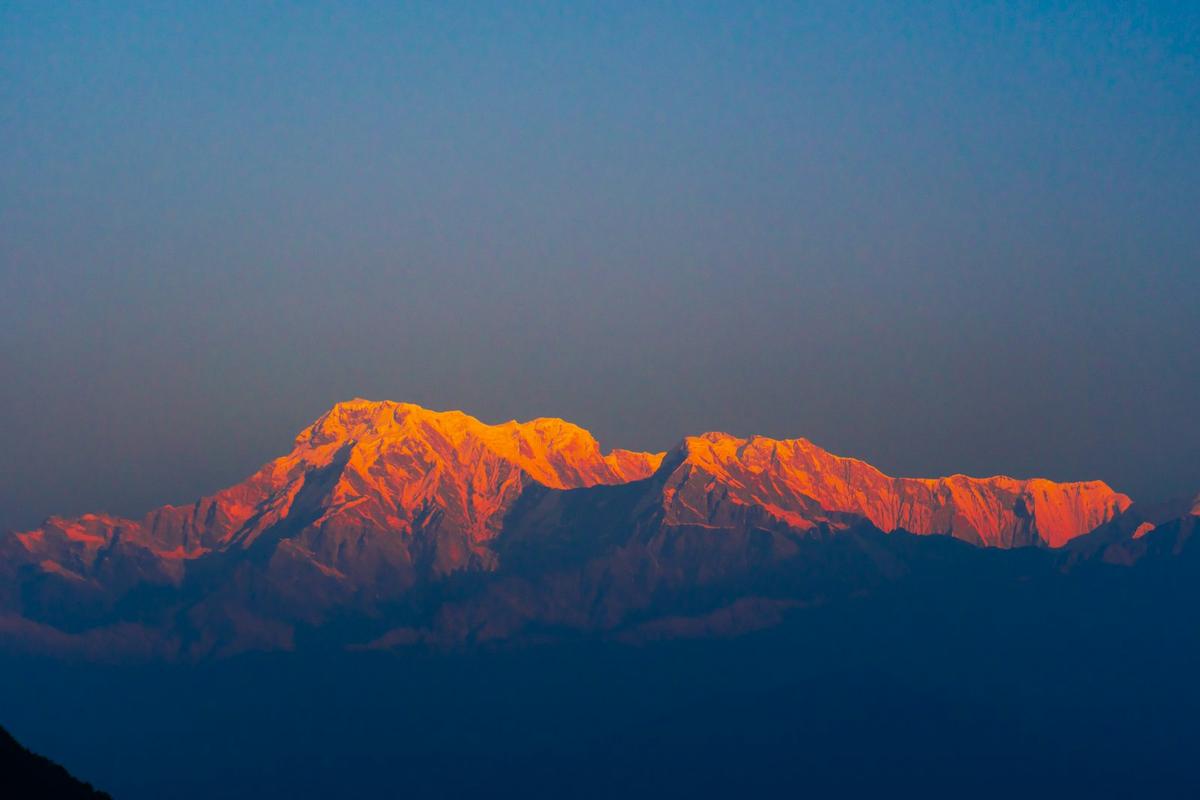
Long before dawn, car headlights wind up the hill on the western side of Pokhara, above Phewa Lake. On top, people in warm jackets climb the last steps to the view tower and turn to face the mountains. The first colour lands on the snow while the city below is still in shadow.
The Sarangkot sunrise comes between about 5:11 am in June and 7:02 am in mid January. As a rough planning estimate, leave Lakeside about 80 minutes before sunrise, climb the steps to the tower and watch Dhaulagiri, the Annapurna range and Machhapuchhre light up. It is one of the easiest early starts among the things to do in Pokhara.
This article is only about the sunrise. For paragliding and hikes, see our full guide to Sarangkot.
Updated 18 Nov 2026
In this guide
- What time is the Sarangkot sunrise each month?
- When to leave Lakeside, and how to get up
- Where to watch sunrise on the hill
- Which mountains catch the light first?
- Which month gives the clearest Sarangkot sunrise?
- How cold is it at dawn, and what should you wear?
- Should you stay overnight in Sarangkot for sunrise?
- Photography tips for a Sarangkot dawn
- Crowds and safety on the steps in the dark
- Frequently asked questions
- Plan your Sarangkot sunrise with us
Key facts
- Altitude
- 1,595 m (5,233 ft); some guides round it to 1,600 m (UncoverNepal house figure; Wikipedia, checked 19 Nov 2026)
- Road distance from Lakeside
- 11.3 km (7 miles) (Nepal Tourism Board (NTB), Sarangkot, checked 19 Nov 2026)
- Drive time
- 30 minutes at most, by NTB's figure (NTB, Sarangkot, checked 19 Nov 2026)
- Sunrise range
- About 5:11 am (early to mid June) to 7:02 am (mid January) (timeanddate.com, Pokhara, checked 19 Nov 2026)
- First light
- Civil twilight starts 23 to 26 minutes before sunrise all year (timeanddate.com, Pokhara, checked 19 Nov 2026)
- Viewpoint ticket
- NPR 50 on the city tourism site; a January 2026 visitor guide reported NPR 60 for the tower (Pokhara Metropolitan City tourism site, checked 19 Nov 2026; The Longest Way Home, Jan 2026)
- Permit
- None needed: Sarangkot is a ward of Pokhara city, not a park or conservation area (Wikipedia (ward status); our checks, 19 Nov 2026)
- Peaks NTB names
- Dhaulagiri, Machhapuchhre, Annapurna II, Lamjung Himal (NTB, Sarangkot, checked 19 Nov 2026)
- Fewest rain days
- December 1.0, November 1.3, January 2.4 (Pokhara Airport station) (WMO/DHM 1991 to 2020 normals, checked 19 Nov 2026)
- Altitude sickness
- Not a concern: well below about 2,450 m (8,000 ft) (US CDC, house altitude line, 19 Nov 2026)
What time is the Sarangkot sunrise each month?
Sunrise at Sarangkot follows Pokhara's published times. The earliest is about 5:11 am in early to mid June and the latest about 7:02 am in mid January. In November it moves from 6:30 am on the 15th to 6:42 am on the 30th, and first light comes 23 to 26 minutes before sunrise all year.
| Month | First light on the 15th | Sunrise on the 15th | Sunrise on the last day |
|---|---|---|---|
| January | 6:36 am | 7:02 am | 6:57 am |
| February | 6:23 am | 6:47 am | 6:35 am |
| March | 5:55 am | 6:19 am | 6:01 am |
| April | 5:20 am | 5:44 am | 5:30 am |
| May | 4:53 am | 5:19 am | 5:12 am |
| June | 4:45 am | 5:11 am | 5:15 am |
| July | 4:55 am | 5:21 am | 5:30 am |
| August | 5:13 am | 5:38 am | 5:46 am |
| September | 5:30 am | 5:53 am | 6:01 am |
| October | 5:45 am | 6:09 am | 6:19 am |
| November | 6:05 am | 6:30 am | 6:42 am |
| December | 6:27 am | 6:53 am | 7:00 am |
Source: timeanddate.com, Pokhara, December 2026 and January to November 2027 tables, Nepal Time, checked 19 November 2026. First light means civil twilight, when the sky is usually bright enough to see a path.
Published times assume a flat horizon. At Sarangkot the sun climbs over the eastern hills, so the disc appears a few minutes later, while the snow peaks catch the light first. Nepal has no daylight saving, so the times barely move from one year to the next: the 2026 and 2027 tables agree to within a minute.
When to leave Lakeside, and how to get up
As a rough planning estimate, leave Lakeside by car about 80 minutes before the listed sunrise. That allows for a drive NTB puts at 30 minutes at most, a short walk and steps from where cars stop, and arriving about 30 minutes early. In mid November that means leaving at about 5:10 am.
Treat this as planning advice, not a fixed timetable. Here is how we built it:
- The drive. The road is 11.3 km (7 miles), and NTB says it takes 30 minutes at most. An operator and a visitor guide allow 30 to 45 minutes depending on traffic and the road, so in the dark, give yourself a little more if you can.
- The walk. One visitor guide, The Longest Way Home (January 2026), says taxis stop 15 to 20 minutes' walk from the top. We allow up to 20 minutes.
- Arriving early. A Kathmandu trekking operator, Nepal Hiking Team, says many visitors aim to reach the viewpoint at least 30 minutes before sunrise. That puts you there before first light.
The same sum, sunrise minus about 80 minutes, gives about 5:40 am in mid January (sunrise 7:02 am) and about 3:50 am in mid June (sunrise 5:11 am). Work it out from the month table for your own date.
Cable car. The Annapurna Cable Car links Sedi Bagar on the Phewa shore with Sarangkot. We have not confirmed its current hours, so ask whether the first ride beats sunrise; if not, save it for sunset.
On foot. Operators put the walk up from the north end of Phewa Lake at about two to three hours, much of it steep steps through forest. In the dark, only with a licensed guide who knows the path; better to drive up and walk down in daylight.
Coming from Kathmandu? It is most of a day by road, often six to nine hours with traffic and roadworks, or about 30 minutes by air; flights are your own arrangement, and our Kathmandu to Pokhara guide covers both.
Where to watch sunrise on the hill
Many people watch from the view tower at the top of the hill, which is where NTB says tourists go for the sunrise. Quieter choices exist: around the car park below the tower, a temple platform below it, a lodge terrace if you sleep on the hill, or Kaskikot, further west beyond Sarangkot.
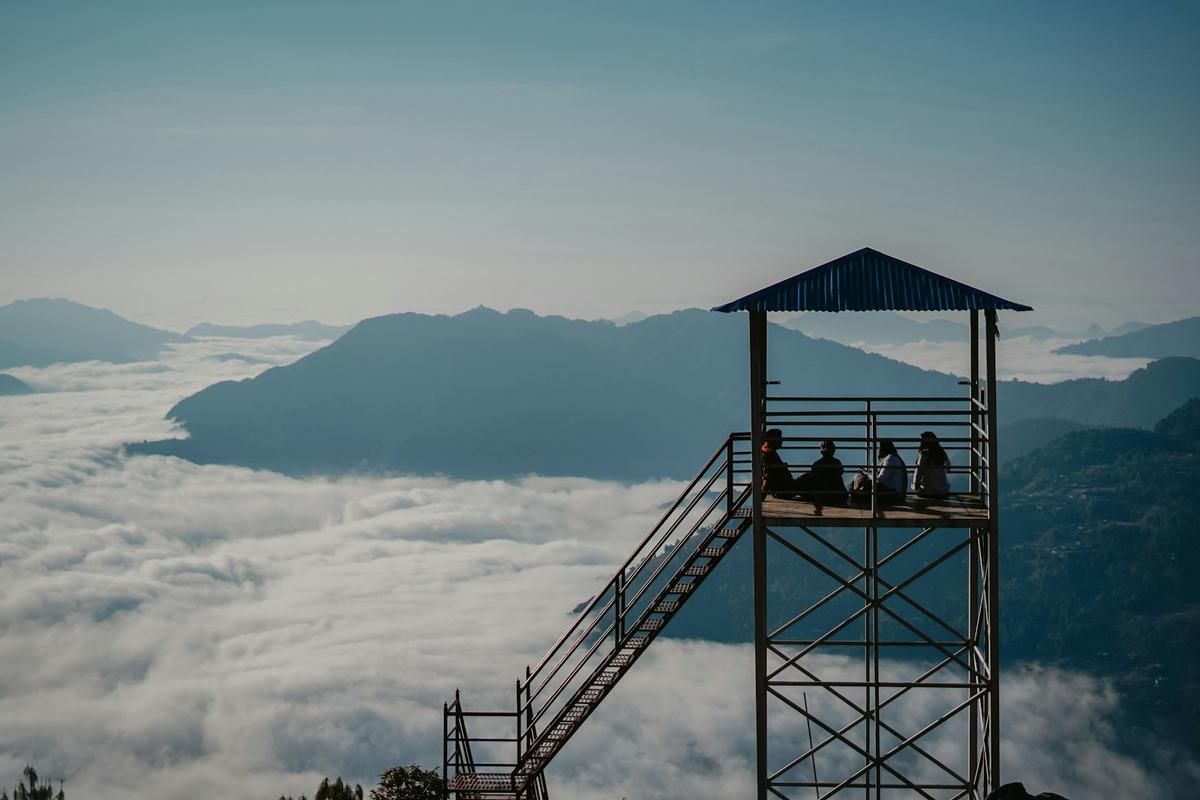
The tower. One travel website, JourneyEra, describes a small tower and an information board at the summit. We found no published height or step count, so we give neither.
Below the tower. Republica reported in 2019 that some visitors watch from the car park at the foot of the tower, and The Longest Way Home reports free views from the Ganesh Temple platform below it. Either may save you the last climb; ask your driver the evening before where cars stop now.
The ticket. The Pokhara Metropolitan City tourism site lists a Sarangkot ticket of NPR 50 (checked 19 November 2026); a January 2026 visitor guide reported NPR 60 for the tower. Carry small notes. No separate rate for foreigners is published, and no permit is needed for the hill.
Further along the ridge. Kaskikot has a 1.3 km accessible trail, opened in 2018, with views of the Annapurna range, Machhapuchhre and Dhaulagiri, NTB says. NTB also names Thulakot, Kahun Hill, Naudanda and Ramkot for sunrise views; our guide to Pokhara viewpoints compares them, and the World Peace Pagoda above Phewa Lake makes a good second viewpoint later in the day.
Which mountains catch the light first?
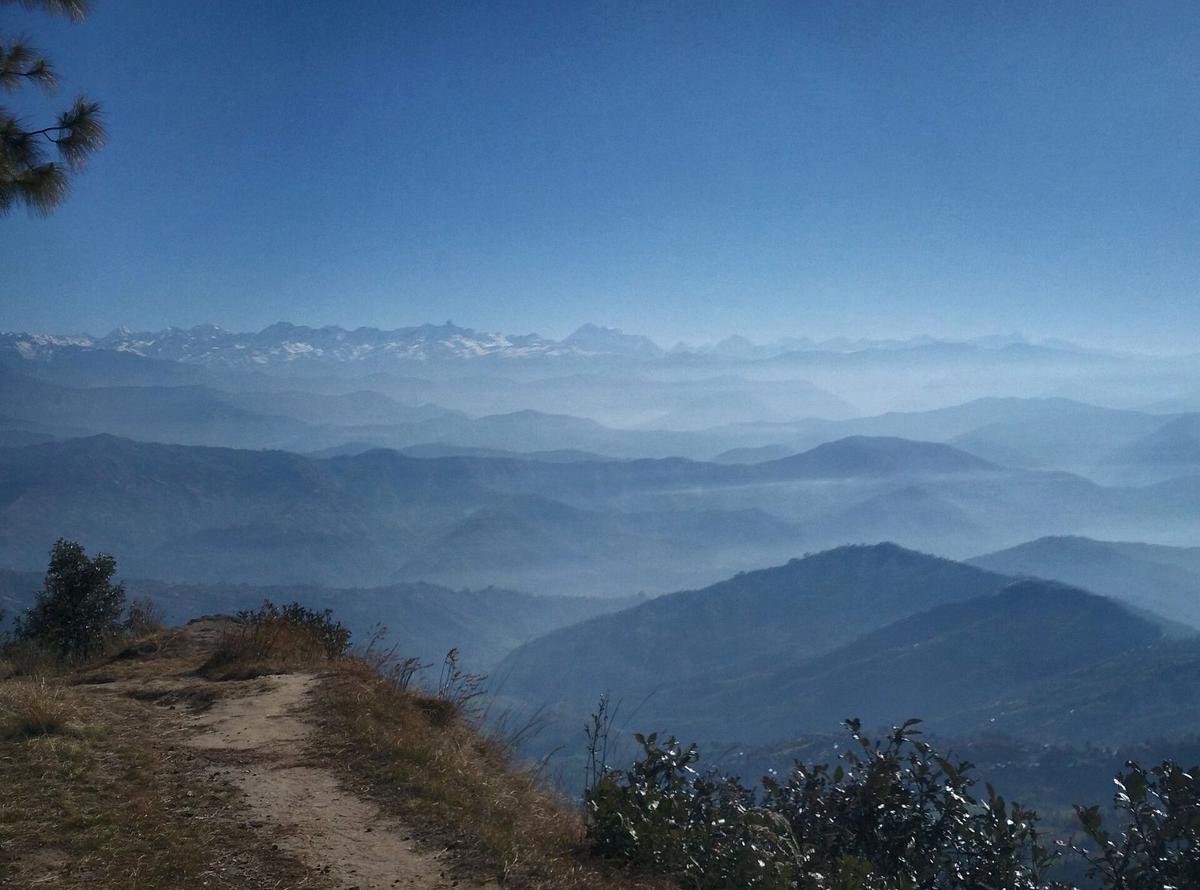
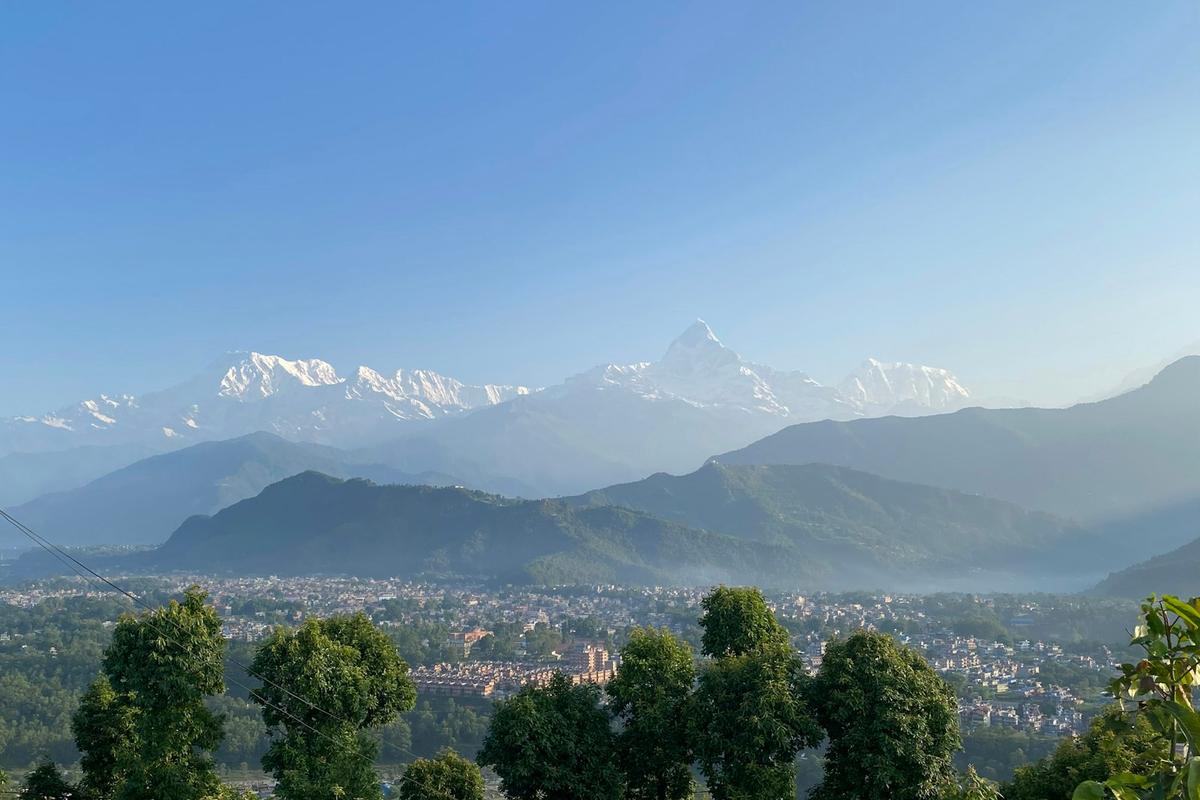
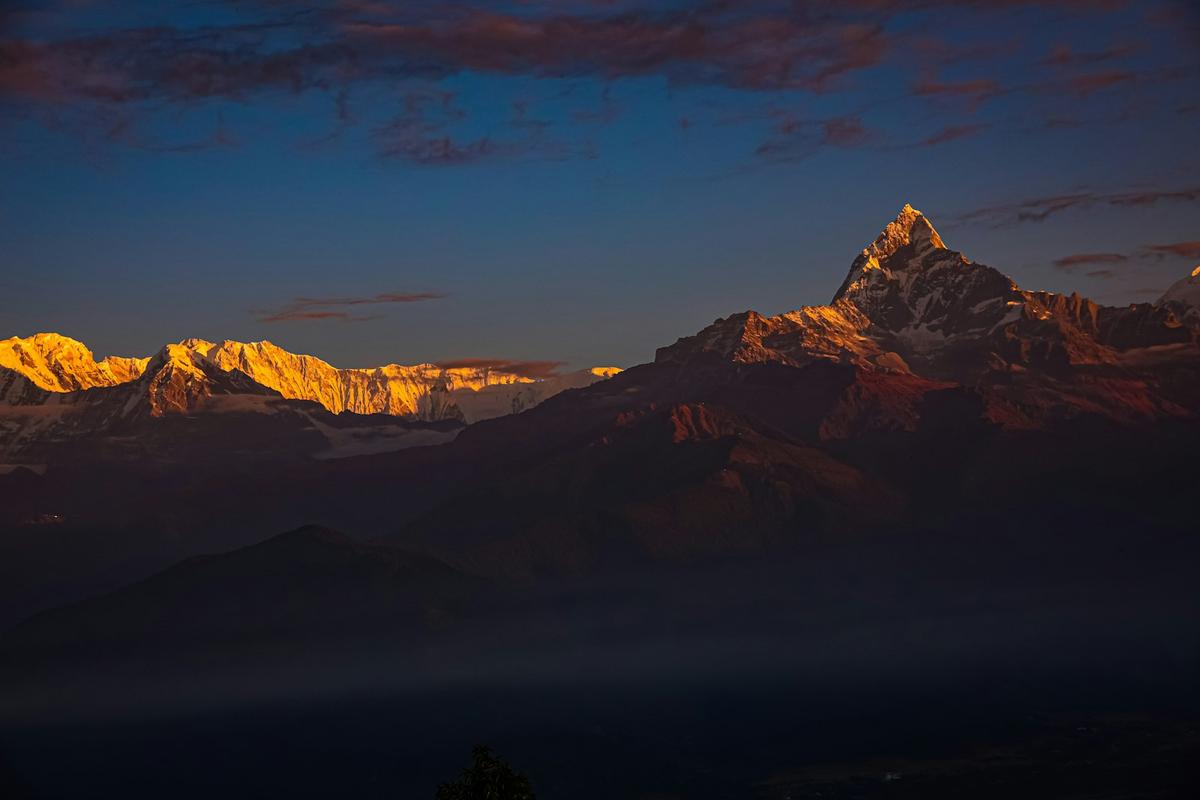
On a clear morning NTB names a skyline from Dhaulagiri (8,167 m) in the west to Machhapuchhre, Annapurna II (7,937 m) and Lamjung Himal (6,983 m) in the east. The high snow catches the sun before the valley does, so the summits turn pale gold while Pokhara and Phewa Lake are still dark.
| Peak | Height | What to know |
|---|---|---|
| Dhaulagiri I | 8,167 m | World's seventh highest, north-west of Pokhara |
| Annapurna I | 8,091 m | World's tenth highest, but hard to pick out |
| Annapurna II | 7,937 m | Named on NTB's Sarangkot page |
| Annapurna South | 7,219 m | NTB names it in the view from Pokhara |
| Machhapuchhre | 6,993 m (22,943 ft); NTB's Sarangkot page gives 6,997 m | About 25 km north of Pokhara, closed to climbing |
| Lamjung Himal | 6,983 m | The eastern end of NTB's list |
| Manaslu | 8,163 m | World's eighth highest; NTB says it is seen "further away" from Pokhara |
Source: NTB; Wikipedia (Peakbagger) for Machhapuchhre; checked 19 November 2026.
Machhapuchhre, the Fishtail, dominates the view because it is so close, NTB notes. The highest summit is the hardest to spot.
"Unlike other giants, the Annapurna I barely stands out, most of it hidden by other peaks in front of it."
Nepal Tourism Board, Annapurna page, checked 19 November 2026
Treat Manaslu as a bonus: NTB says Dhaulagiri and Manaslu can be seen further away from Pokhara.
Which month gives the clearest Sarangkot sunrise?
October and November give the most reliable mornings. NTB says the clearest skies come after the monsoon in those months, and Pokhara's valley station averages only 1.3 rain days in November and 1.0 in December. June to September is the hardest time, with the most rain days and the fewest sunshine hours of the year.
"Spring is the time for rhododendrons to bloom while the clearest skies are found after the monsoon in October and November."
Nepal Tourism Board, Climate page, checked 19 November 2026
| Month | Rain days (1.0 mm or more) | Sunshine hours |
|---|---|---|
| Jan | 2.4 | 204.6 |
| Feb | 3.8 | 208.1 |
| Mar | 6.4 | 229.4 |
| Apr | 10.5 | 219.0 |
| May | 18.3 | 167.4 |
| Jun | 22.2 | 111.0 |
| Jul | 25.6 | 105.4 |
| Aug | 24.3 | 96.1 |
| Sep | 19.4 | 132.0 |
| Oct | 8.0 | 189.1 |
| Nov | 1.3 | 222.0 |
| Dec | 1.0 | 220.1 |
Source: Pokhara Airport station, 827 m, WMO/DHM 1991 to 2020 normals via Wikipedia; sunshine FAO 1971 to 2000; checked 19 November 2026. Sarangkot is about 770 m higher and has no station. Nobody publishes a monthly chance of a clear sunrise, so we do not invent one.
Autumn. DHM's normal monsoon withdrawal date is 2 October, but DHM's own records show it ran later in every year from 2020 to 2024; in 2026 it had fully withdrawn by 14 October. Early October can still be cloudy.
Winter. Dry and often bright: NTB notes bright sun and brilliant views even in December and January. From November to February the valley station averages between 1.0 and 3.8 rain days a month, the driest run of the year, so winter is a good time to try.
Monsoon. July is the wettest month, with 941.0 mm of rain; plan a spare day. For the wider picture, see the best time to visit Nepal.
Spring haze
March has the most sunshine of the year, but sunshine is not a view. In April 2024 the Kathmandu Post reported Phewa Lake and Pokhara bazaar covered in haze, with visitors unable to see the mountains; people it spoke to blamed wildfires and pollution drifting in from India.
"The wildfire season in Nepal has just begun and is expected to peak in April and May."
Sangam Prasain, The Kathmandu Post, "Wildfires put 500m tonnes of carbon and tourism at risk", 17 March 2025
We found no haze figures for 2026. In spring, look north from Lakeside the evening before: if the hills behind the lake are blurred, the peaks may well be hidden at dawn too. Keep a second morning free.
How cold is it at dawn, and what should you wear?
Colder than Lakeside, and dawn is the coldest time. Pokhara Airport, about 770 m lower, averages a daily low of 7.1 °C in January and 12.3 °C in November (WMO/DHM 1991 to 2020). Lumle, a station at 1,738 m on a wetter ridge north-west of Pokhara, averages 4.7 °C in January; that is Lumle, not Sarangkot, which has no station.
You stand still for half an hour or more, so dress for waiting. For a winter sunrise, bring:
- A warm jacket, a hat and thin gloves
- A headtorch, so both hands are free on the steps
- Shoes with a good grip
- Water and small rupee notes
- A spare battery in an inside pocket, as batteries drain faster in the cold
Altitude is not a worry: Sarangkot is well below about 2,450 m (8,000 ft), where the US CDC says altitude illness becomes a risk.
Should you stay overnight in Sarangkot for sunrise?
Stay the night for two chances at the view and no pre-dawn drive. NTB lists tourist-standard hotels, lodges and teahouses on the hill, as well as luxury resorts, so you can watch sunset, sleep, and walk out for sunrise. With only one morning, the drive works fine, since the hill is less than an hour from Pokhara.
A teahouse is a simple family-run lodge. Staying gives you the evening light, with sunset about 5:16 pm in mid November, and a head start on the crowd at the tower. The trade-off is a colder night and fewer places to eat than Lakeside. If sleeping on a hill appeals, our guide to hill stations in Nepal has more ideas.
Photography tips for a Sarangkot dawn
The best light comes just before and just after the sun appears. The snow peaks light first, then the sun clears the eastern hills, then Pokhara and Phewa Lake come out of the shadow. Be set up by first light and stay a while after sunrise.
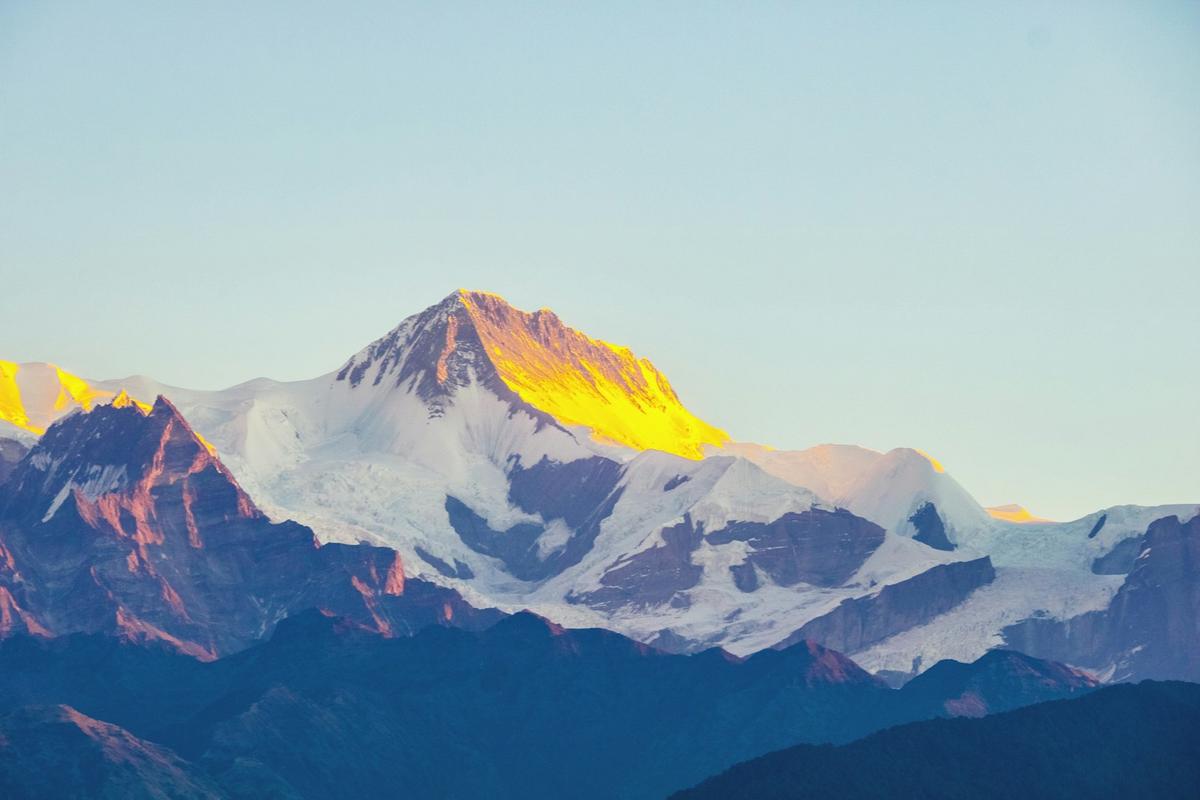
- Come for the blue. Nautical twilight begins about an hour before sunrise; the deep blue behind white peaks is worth the early start.
- Know the sun's direction. It rises east-south-east in December and January (about 114 to 116 degrees from north), due east around the equinoxes and east-north-east in June (63 degrees on 15 June). The mountains lie to the north, so the light rakes across them from the side.
- Expose for the snow. Turn the exposure down so bright peaks keep their detail.
- Keep it small. A full tripod blocks a crowded tower; brace on the rail instead.
- Do not wait for paragliders. Flight hours were set at 11:00 am to 4:30 pm in May 2025, Himal Press reported, so there are none in the dawn sky.
Crowds and safety on the steps in the dark
Expect company. Visitor guides describe the tower as busy every morning and evening, and Pokhara fills on holidays: tourism entrepreneurs told Republica that Lakeside hotel occupancy was around 90 percent over the English New Year 2026. The main risk is ordinary: uneven steps in the dark. A headtorch, grippy shoes and a slow pace deal with most of it.
What we tell our own guests:
- Use a headtorch, so one hand is free for the rail, and climb slowly.
- Keep children close, especially near the tower's edge.
- Agree a meeting point with your driver before you walk up.
- If steps are hard for someone, watch from below the tower.
- Save the numbers: the city's tourism site lists the Tourist Police in Pokhara on +977 61 524457, and emergency numbers 100 and 102.
Frequently asked questions
What time is sunrise at Sarangkot tomorrow?
Check timeanddate.com's Pokhara page the evening before. As a guide, sunrise is 6:30 am on 15 November and 6:53 am on 15 December, and first light begins 23 to 26 minutes earlier. The sun itself clears the eastern hills a few minutes after the listed time.
How far is Sarangkot from Lakeside?
Sarangkot is 11.3 km (7 miles) from Lakeside by road, and the Nepal Tourism Board puts the drive at 30 minutes at most. An operator and a visitor guide allow 30 to 45 minutes depending on traffic and the road. Before dawn, add time for the dark road and the walk up from where cars stop.
How much is the Sarangkot view tower ticket?
The Pokhara Metropolitan City tourism site lists a Sarangkot ticket of NPR 50 (checked 19 November 2026), while a January 2026 visitor guide reported NPR 60 for the tower. No separate rate for foreigners is published, so carry small rupee notes. Free views are reported from the Ganesh Temple platform below the tower.
How high is the Sarangkot view tower?
We have not found a published height for the tower, so we do not give one. The hill it stands on is 1,595 m (5,233 ft), about 770 m above Pokhara Airport. One travel website describes a small tower with an information board at the summit.
Can you take the cable car up to Sarangkot for sunrise?
Possibly, but check first. The Annapurna Cable Car links Sedi Bagar on the Phewa shore with Sarangkot, and we have not confirmed its current first ride. Ask the evening before whether it reaches the top before sunrise in your month. If it does not, take a car for sunrise and save the cable car for a sunset visit.
Can you walk up to Sarangkot?
Yes, in daylight. Operators put the walk from the north end of Phewa Lake at about two to three hours, much of it steep steps through forest. For sunrise, drive up and walk down after breakfast. If you do climb in the dark, go with a licensed guide who knows the path.
Plan your Sarangkot sunrise with us
A Sarangkot sunrise fits into almost any Pokhara stay. An hour on Phewa Lake rounds off the morning, and our guide to things to do in Pokhara covers the rest of your days. Based in Kathmandu instead? Nagarkot is a sunrise hill near the capital.
Each of these Pokhara tours includes a Sarangkot sunrise:
- Pokhara Tour by Flight and Road, with a pre-dawn drive up on day two
- Bandipur and Pokhara Lakeside Tour, with an early drive up for sunrise over the Annapurna range
- Pokhara, Sarangkot and Australian Camp Tour, which adds a second mountain dawn at Australian Camp
Want help timing your morning? Message us on WhatsApp or use the enquiry form on any trip page, and we will tell you what fits your dates.