











Explore by activity
Not listed yet

We run Motorbiking & Overland trips — we just haven’t put the itinerary on the site yet. Tell us your dates and we’ll send a costed day-by-day plan.

Explore by experience
Explore by region
by gomayu
Search Tours or Places

Chitwan Rhinos and Wildlife: What You Can See

16 min read Posted 08 Oct 2026Updated 15 Oct 2026
Chitwan Rhinos and Wildlife: What You Can See

By Uncover Nepal Team · Checked by our Kathmandu travel team · Last checked 8 October 2026

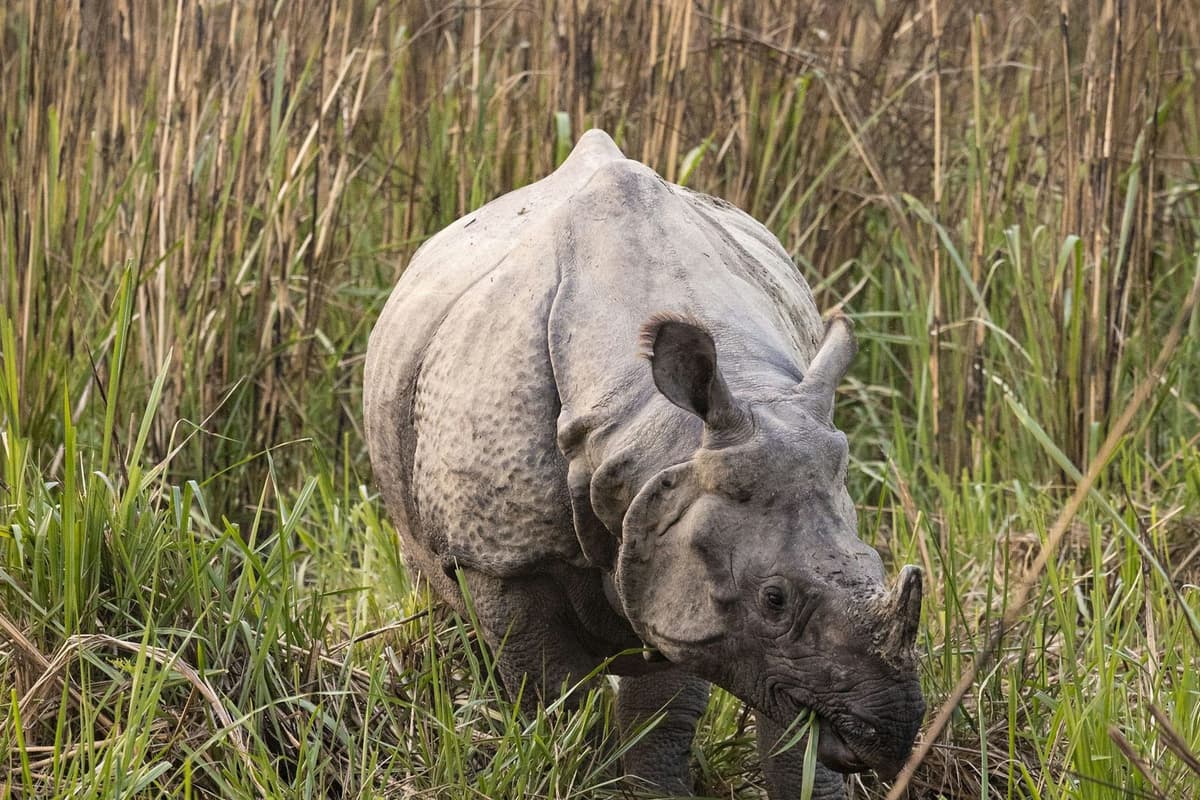
It usually starts with a sound before a sight: a heavy splash in the river, then the snap of reeds. You look across the Rapti in the early light and a grey shape the size of a small car lifts its head, water running off the folds of its armour-like skin. That is the moment most people come to Chitwan for.

The short answer. A Chitwan rhino is the animal you are most likely to see on a safari here. The latest national count, in 2021, found 694 greater one-horned rhinos in Chitwan National Park, its buffer zone and adjoining forests, out of 752 in Nepal. Tigers live here too, along with elephants, sloth bears, gaur, deer, crocodiles and more than 525 bird species, but most of those take more luck.

Below: what you can realistically see, the newest figures for the Chitwan National Park tiger and rhino populations, how each safari works, and when your odds are best. It is part of our Chitwan National Park visitor guide and a good first read on Nepal wildlife.

Key facts

Rhinos in Chitwan (park, buffer zone, adjoining forests)
694 (2021 count) (NTNC; Kathmandu Post 23 Sep 2026; checked 8 Oct 2026)
Rhinos in Nepal
752 (2021 count) (NTNC National Rhino Count 2021; checked 8 Oct 2026)
Next rhino count
Postponed; no newer count published (Himalayan Times 11 May 2026; Kantipur 17 Apr 2026; checked 8 Oct 2026)
Tigers in Chitwan and surrounding areas
145 (survey released July 2026) (Kathmandu Post 29 Jul 2026; IUCN; checked 8 Oct 2026)
Tigers in Nepal
429 (survey released 29 Jul 2026) (DNPWC via Kathmandu Post and IUCN; checked 8 Oct 2026)
Bird species
More than 525 (Nepal Tourism Board; checked 8 Oct 2026)
Mammal species
More than 50 (Nepal Tourism Board; checked 8 Oct 2026)
Park established
1973, Nepal's first national park (DNPWC; checked 8 Oct 2026)
UNESCO World Heritage Site
Since 1984 (UNESCO; checked 8 Oct 2026)
Park entry fee, foreigners
NPR 2,000 per person per day, about USD 13 (NTB; NRB rate 155.15 (8 Oct 2026))

How many rhinos are there in Chitwan?

The 2021 National Rhino Count found 694 greater one-horned rhinos in Chitwan National Park, its buffer zone and adjoining forests, and 752 across Nepal. No newer count has been published; the next one has been postponed.
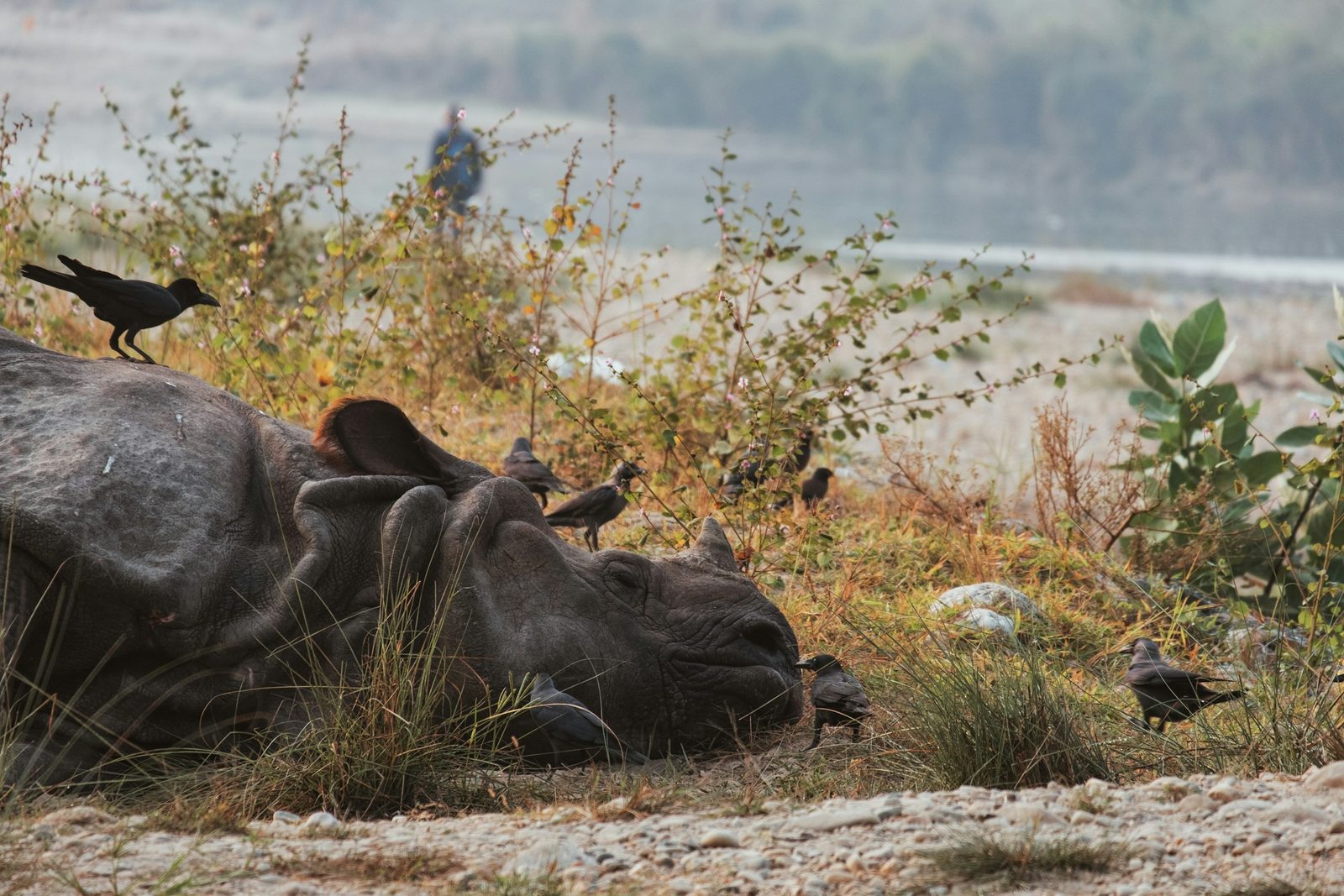
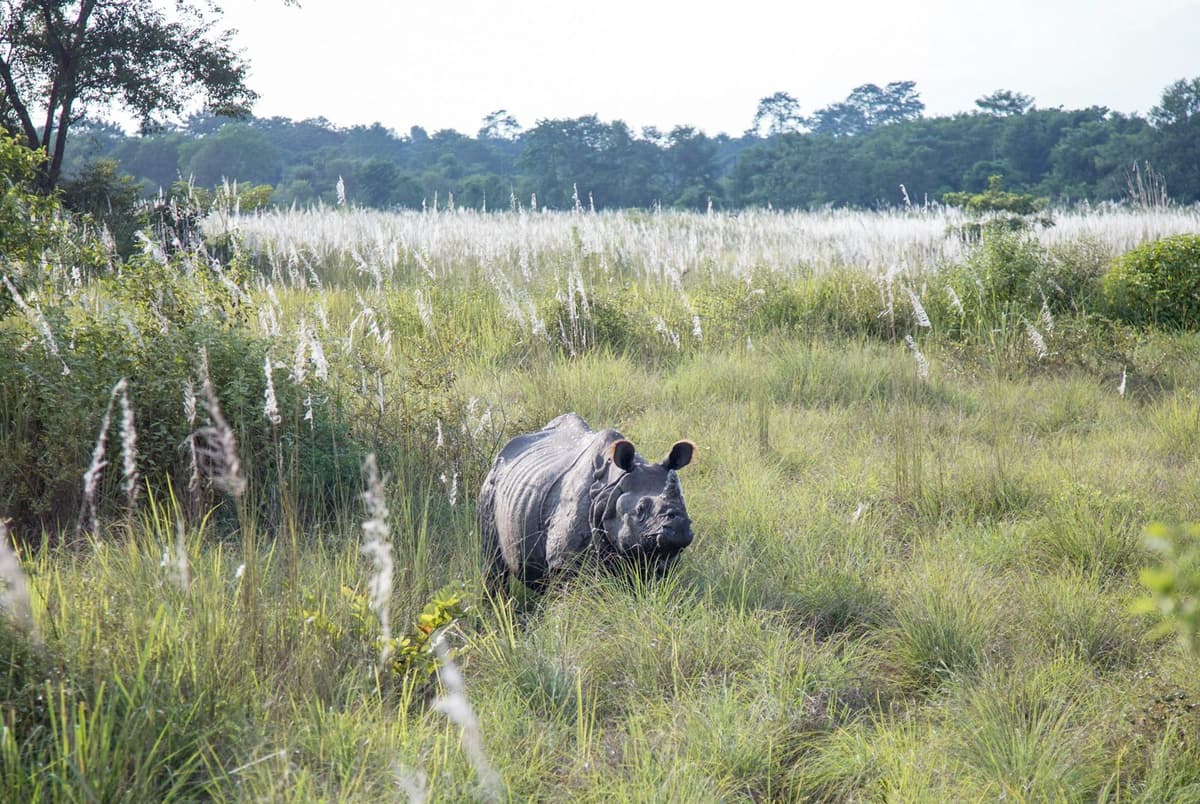
A one-horned rhino at the river edge in Chitwan National Park
A one-horned rhino at the water's edge in Chitwan National Park.

The rest are spread thinly: 38 in Bardiya, 17 in Shuklaphanta and 3 in Parsa. If you want to see a wild rhino in Nepal, Chitwan is where they are.

For the 2021 count, teams on 57 elephants swept the habitat side by side, identifying each rhino. According to the Kathmandu Post, the Department of National Parks and Wildlife Conservation (DNPWC) now plans to replace that method, possibly with genetic sampling, camera traps or both, after pilot studies. No date for the next count has been announced.

Takeaway: 694 for Chitwan and 752 for Nepal, both from 2021, are the official figures. Treat others with caution.

The Chitwan rhino: from crisis to recovery

The park office's own history shows more than 544 rhinos in 2000, falling to 372 by 2005 after poaching during the conflict years. Numbers climbed back as protection improved.

Year of count Rhinos in Chitwan Source
2000 More than 544 DNPWC park office page
2005 372 DNPWC park office page
2011 503 DNPWC park office page
2015 605 DNPWC; NTNC
2021 694 NTNC National Rhino Count 2021

Nationally, the population rose from 645 in 2015 to 752 in 2021, an increase of 107 animals, or 16.6% according to NTNC.

Nepal celebrated 2011 as a zero rhino-poaching year. It then recorded no rhino poached between 16 February 2013 and 16 February 2014, and WWF describes Nepal as "the first country in the world to achieve zero poaching of its three flagship species" (tigers, rhinos and elephants), a feat it dates to 2014. According to WWF, zero rhino poaching held through 2015 and 2016 as well.

The last known poaching in Chitwan was in November 2023, when two rhinos were killed in pits in the Chhaprauli area of the eastern sector.

Ratopati reported on 23 September 2026 that no rhino had been killed by poachers in Chitwan since then, although rhinos had died of natural causes. The park's information officer, Avinash Thapa Magar, credited the cooperation of the park administration, the Nepali Army and local people.

Natural deaths are tracked too. Park figures reported by the Kathmandu Post show 22 rhino deaths in Chitwan in fiscal year 2025-26 (20 inside the park and 2 outside), compared with 30 the year before and 37 in 2021-22.

The species is still listed as Vulnerable on the IUCN Red List (assessment 2019). World Rhino Day falls on 22 September each year; it was first announced by WWF-South Africa in 2010.

Takeaway: the rhinos you see belong to a population that poaching cut sharply within living memory and protection rebuilt.

Tigers and other big mammals

Will I see a tiger in Chitwan?

Probably not. The July 2026 national survey counted 145 tigers in Chitwan National Park and surrounding areas, up from 128 in 2022, and 429 across Nepal. But tigers are shy, mostly active at dawn, dusk and night, and the grass hides them well. Even the Nepal Tourism Board puts it carefully: "some lucky guests get to see the elusive tiger prowling among the tall grass."

Nepal's tiger numbers have grown at each survey: 121 in 2009, 198 in 2013, 235 in 2018, 355 in 2022 and 429 in 2026. The latest survey used camera traps. The tiger is listed as Endangered by the IUCN (assessment 2022).

What else lives in the park?

Beyond rhinos and tigers, the Nepal Tourism Board names gaur, wild elephant, four-horned antelope, pangolin, golden monitor lizard, python, Bengal florican, giant hornbill, leopard, sloth bear, wild dog and small wild cats among the park's animals. In total the park records more than 50 mammal species and more than 525 bird species. For a fuller picture, the park's 2020 checklist, which includes species recorded in and around the park, lists 643 birds and 75 mammals.

Deer are well represented: DNPWC lists spotted deer (chital), hog deer, sambar, barking deer and four-horned antelope.

Which animals can I see, and how rare are they?

No official body publishes sighting rates for Chitwan, and what you see depends on the season, the time of day and luck. The table below shows what the official sources say about where each animal lives, and its global status on the IUCN Red List.

Animal What official sources say IUCN status (year)
Greater one-horned rhino NTB: you might spot rhinos "near river banks or in the city itself" (Sauraha) Vulnerable (2019)
Spotted deer (chital) Listed by DNPWC among the park's deer Least Concern (2015)
Sambar, hog deer, barking deer Listed by DNPWC among the park's deer Sambar Vulnerable (2015), hog deer Endangered (2015)
Mugger crocodile NTB: lives in the park's "swampy areas and numerous oxbow lakes" Vulnerable
Gharial NTB: "a stretch of the Narayani River" holds one of the few remaining populations Critically Endangered (2019)
Gaur Named by NTB among the park's endangered fauna Vulnerable (2016)
Wild elephant Named by NTB among the park's endangered fauna Endangered (2020)
Sloth bear Named by NTB among the park's animals Vulnerable (2020)
Leopard Named by NTB among the park's animals Vulnerable (2025)
Bengal tiger NTB: "some lucky guests" see one Endangered (2022)
Ganges river dolphin Listed among the park's mammals by DNPWC and the park office Endangered (2022)

Takeaway: come for rhinos, deer, crocodiles and birds; treat a tiger as a bonus.

Crocodiles, river dolphins and birds

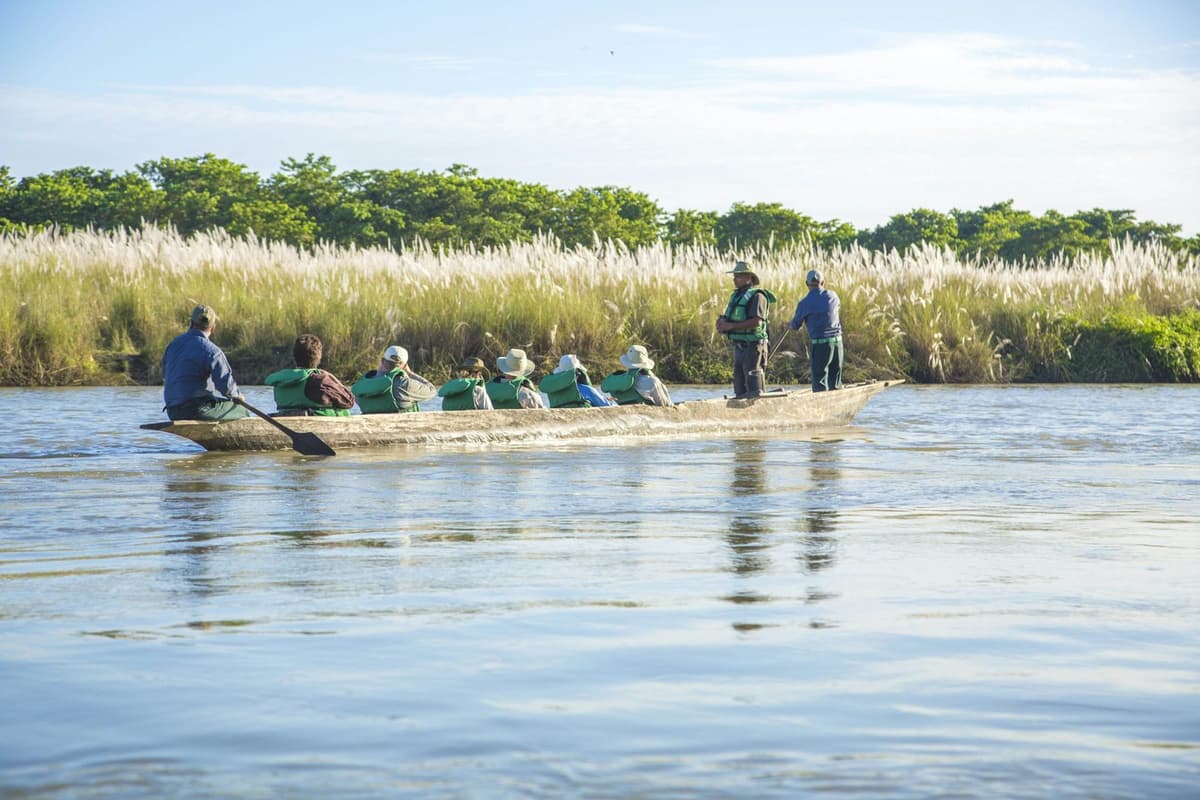
Chitwan has two crocodiles. The Nepal Tourism Board notes that "the swampy areas and numerous oxbow lakes of Chitwan provide home for the marsh mugger crocodiles." Muggers are the broad-snouted ones. NTB's typical Chitwan itinerary includes a "canoe ride to watch the crocodiles and water birds", and canoe rides run on the Rapti and the Budhi Rapti, near the Baghmara Buffer Zone Community Forest.
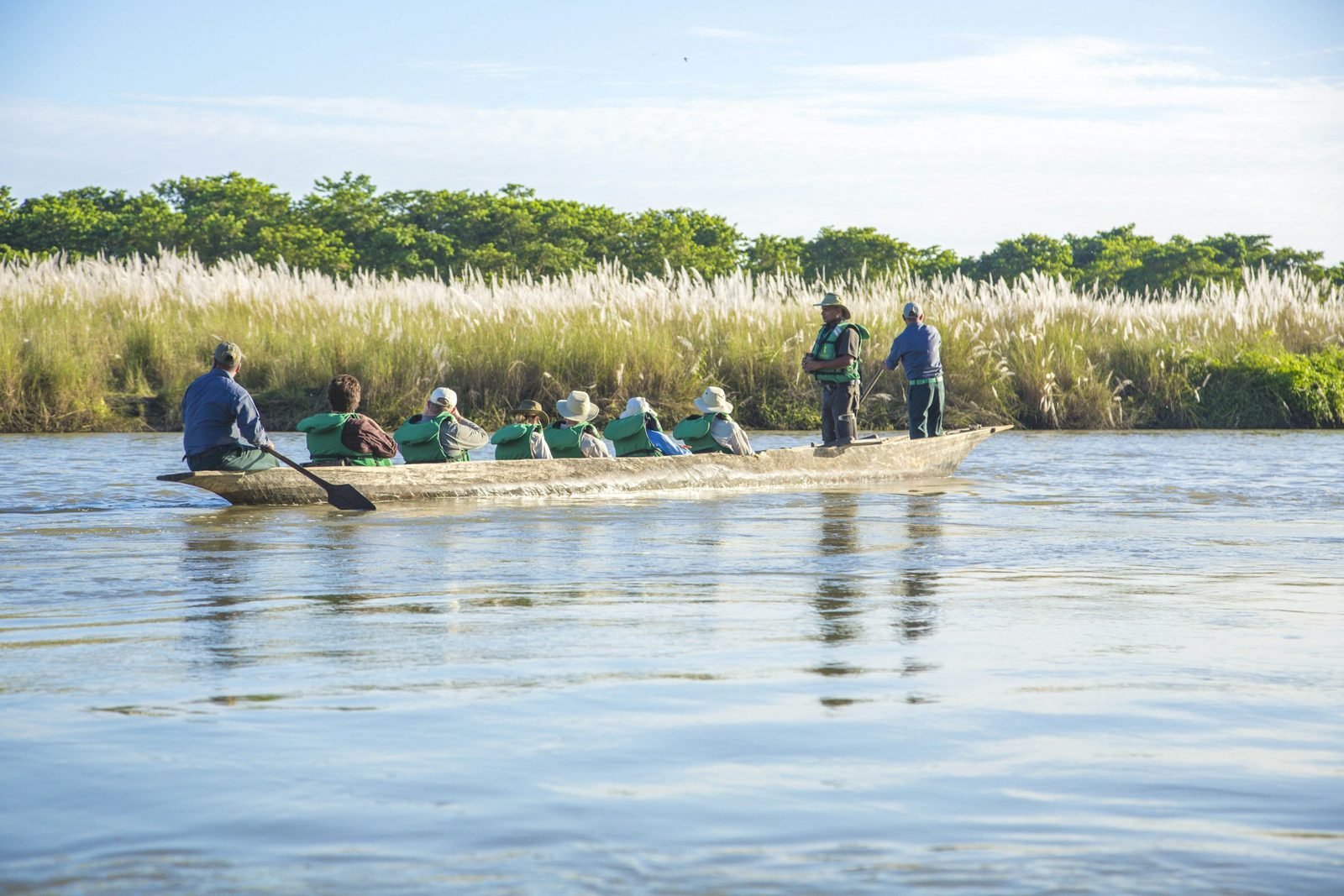
Dugout canoe on a quiet river in Chitwan National Park at dawn
Canoe rides on the Rapti and Budhi Rapti are the calmest way to look for crocodiles and water birds.

The gharial is the long, thin-snouted one. In NTB's words, "in a stretch of the Narayani River are found one of the few remaining populations of the rare and endangered fish-only eating gharial, or Gangetic crocodile." It is listed as Critically Endangered.

The Ganges river dolphin is also listed among the park's mammals, but it is not an animal to plan your visit around.

With more than 525 bird species, Chitwan rewards anyone who brings binoculars. NTB notes summer migrants such as the paradise flycatcher, Indian pitta and parakeets, while winter brings waterfowl, Brahminy ducks, pintails, bar-headed geese, cormorants and migratory birds from Siberia. The Beeshazar and Associated Lakes in the buffer zone have been a Ramsar wetland of international importance since 13 August 2003.

Takeaway: birders should plan at least one early morning on foot or by canoe.

Jeep, walking and canoe safaris: which is best for rhinos?

For rhinos, a jeep safari covers the most ground and gives you the best single chance, while a walking safari with a park-certified guide can bring you closest. A canoe ride is best for crocodiles and birds. The Nepal Tourism Board lists the park's main activities as "jungle safari, jungle walk, canoe ride, jeep drive, experience of Tharu culture".
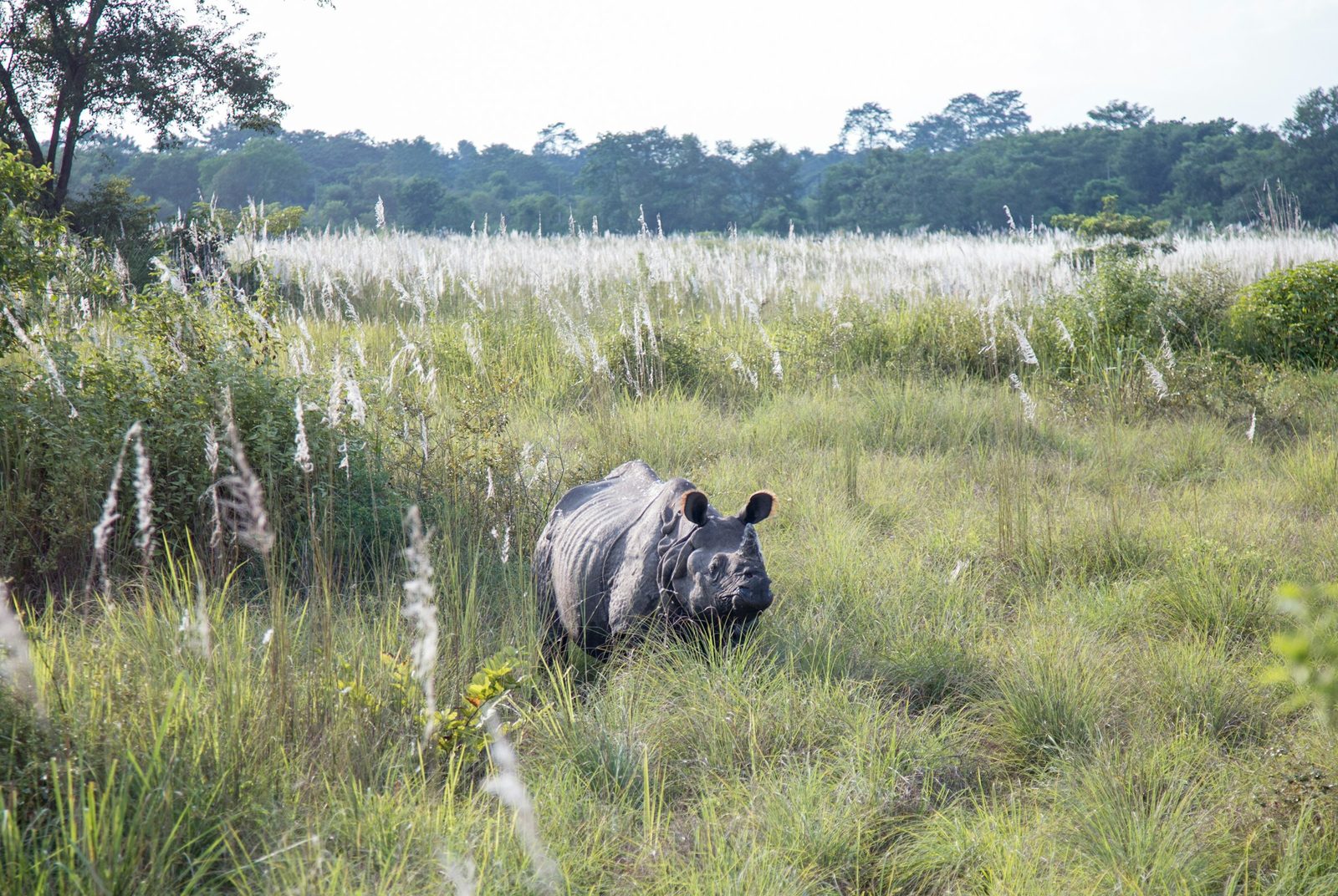
A forest trail in Chitwan National Park
A forest trail inside the park. Walks go only with park-certified guides.
Safari Best for Things to know
Jeep safari Rhinos, deer, covering distance, a chance of tiger or sloth bear Core-park jeep safaris pause each monsoon and normally restart in late September or October; check the status before you book
Walking safari Close rhino views, tracks and signs, birds On our trips you always walk with a park-certified guide. No walking in the park between sunset and sunrise
Canoe ride Mugger crocodiles, gharials, kingfishers and water birds Calm and quiet; usually paired with a walk back
Buffer-zone community forest drive Rhinos and deer when the core park is closed Ran during the 2026 monsoon closure in buffer-zone community forests

Jeep safari status

The core-park jeep safari was suspended on 1 July 2026 for the monsoon. In early October the park said it was preparing to reopen, after August floods delayed the plan, but no restart had been reported by 8 October 2026. In 2025, safaris resumed on 29 September. Check the status before you book.

Walking safari

Walking brings you closest to a rhino, and needs the most care. The park's regulations are clear on timing: "The visitors are strictly prohibited to walk within the park between sunset and sunrise." On our trips you always walk with a park-certified guide.

If you walk, follow these steps:

  1. Listen to your guide's briefing before you enter, and agree on hand signals.
  2. Walk in single file and keep talking to a whisper. Animals hear you long before you see them.
  3. Wear muted greens and browns. Skip perfume and strong insect spray scents if you can.
  4. Never approach a rhino for a photo. Use a zoom lens and let your guide decide the distance.
  5. If your guide tells you to move, move at once and do exactly what they say. They know the ground and the escape routes.

Takeaway: one safari only? Take the jeep for rhinos. With two days, add a walk and a canoe.

Elephants in Chitwan: breeding centre, rules and the 2025 verdict

According to the Kathmandu Post, "elephant rides have not been allowed inside the national park for nearly 15 years." Government elephants are reserved for patrolling, research and anti-poaching work.

On 17 December 2025, a joint bench of Nepal's Supreme Court issued a 62-point order on elephant welfare. It directs alternatives such as bush walks and observation, chain-free management and the registration of privately owned elephants. The Kathmandu Post reports that Sauraha's private elephant numbers have fallen to about 45, from about 90 before Covid, according to the local cooperative's president.

The government's Elephant Breeding Centre at Khorsor, near Sauraha, was set up in 1987, and close to 70 calves have been born there. As of August 2026, entry to both the Elephant Breeding Centre and the Gharial Breeding Centre is free.

The Gharial Breeding Centre

The Gharial Breeding Centre at Kasara was founded by the Government of Nepal in 1978, with NTNC's Biodiversity Conservation Center supporting its management. It sits about 1 km from the park headquarters and also houses marsh muggers and several turtle species. Eggs are collected from the rivers and hatched at the centre, and the young are released after several years. According to Kantipur, more than 2,300 gharials had been released into rivers by mid-2026.

Takeaway: both breeding centres are worth an hour and explain the conservation work behind what you see in the wild.

Best time to see rhinos and other wildlife in Chitwan

October to March is the most comfortable time for wildlife watching. The Nepal Tourism Board gives October to March an average temperature of 25 °C, April to June as hot, up to 43 °C, and July to September as the rainy season. For the wider picture across the country, see our guide to the best time to visit Nepal.

Season Months (NTB) What it means for wildlife
Cool and dry October to March Pleasant mornings, misty starts, winter migrant birds. Jeep safaris normally running once restarted
Hot April to June, up to 43 °C Animals gather near water; grass is shorter after the annual cut, which can help sightings
Rainy July to September Core-park jeep safaris pause; buffer-zone options continue. Lush, leeches, fewer visitors

Grass height matters. DNPWC opens the park for at least a week each year so local people can collect thatch grass. Shorter grass simply means less cover, so animals are easier to pick out once it has been cut.

Time of day matters even more: early morning and late afternoon, when animals move and the heat is lower.

How your visit supports the park and its neighbours

Chitwan National Park covers 952.63 km², with a buffer zone of 729.37 km² declared in 1996 across four districts: Chitwan, Parsa, Makawanpur and Nawalpur. Many safaris run in its community forests, such as the Baghmara Buffer Zone Community Forest near Sauraha, managed by local user groups.

How much park revenue reaches those communities is debated. According to Mongabay (March 2026), DNPWC director general Buddhi Sagar Paudel said that 30 to 50% of the revenue from natural resources in national parks used to go to buffer zone committees, and that after 2015 the share was reduced to 20%.

UNESCO, which inscribed the park as a World Heritage Site in 1984, describes it this way:

"At the foot of the Himalayas, Chitwan is one of the few remaining undisturbed vestiges of the 'Terai' region, which formerly extended over the foothills of India and Nepal. It has a particularly rich flora and fauna."

UNESCO World Heritage Centre, Chitwan National Park

Park fees

The park entry fee is NPR 2,000 per person per day for foreigners, NPR 1,000 for SAARC nationals and NPR 150 for Nepalis; children below 10 enter free. At the Nepal Rastra Bank selling rate of 155.15 on 8 October 2026, NPR 2,000 is about USD 13 and NPR 1,000 about USD 6.50. Plan one permit for each day inside the park.

Takeaway: choosing locally run lodges and community-forest activities is one practical way to support the people who live beside the rhinos.

Planning your wildlife trip

Most people reach Chitwan by road from Kathmandu or Pokhara, or by a short flight from Kathmandu to Bharatpur. Our guide to travelling from Kathmandu to Chitwan compares the routes, and our guide to places to visit in Chitwan covers what to do beyond the safaris.

If you would like us to arrange it, these trips include park-certified guides, permits and safaris:

Not sure which fits? Send us your dates and group size on WhatsApp or through the enquiry form, and we will suggest the option that fits your dates.

For everything else about the park, go back to our full Chitwan National Park guide.

Read next: Nepal tourist places and Sauraha village.

Frequently asked questions

How many rhinos are in Chitwan National Park?

The latest official figure is 694 greater one-horned rhinos in Chitwan National Park, its buffer zone and adjoining forests, from the 2021 National Rhino Count. Nepal as a whole had 752. No newer count has been published. The next one has been postponed while the parks department redesigns the counting method.

What are the chances of seeing a tiger in Chitwan?

Low, though not zero. About 145 tigers live in Chitwan and surrounding areas, according to the July 2026 national survey. They are shy, move mostly at dawn, dusk and night, and stay hidden in tall grass. The Nepal Tourism Board itself says only "some lucky guests" see one. Early-morning jeep safaris give the best, still small, chance.

Is a jeep safari or a walking safari better for seeing rhinos?

A jeep safari covers more ground, so it gives the best overall chance of seeing rhinos and other large mammals. A walking safari is slower but can bring you closer. On our trips you always walk with a park-certified guide. Many visitors do one of each. Check the jeep safari status before you book, because it pauses every monsoon.

What is the best season for wildlife in Chitwan?

October to March is the most comfortable, with an average temperature around 25 °C according to the Nepal Tourism Board. April to June is hot, up to 43 °C, but animals gather near water and the grass is shorter. July to September is the rainy season, when core-park jeep safaris pause. Whatever the month, go early morning or late afternoon.

Is elephant-back safari still offered in Chitwan?

Elephant rides have not been allowed inside the national park for nearly 15 years, according to the Kathmandu Post. Government elephants are used for patrolling, research and anti-poaching. A Supreme Court order of 17 December 2025 directs alternatives such as bush walks and observation, and the registration of privately owned elephants.
Tags
Chitwan National Parkone-horned rhinoBengal tigerNepal wildlifejungle safarigharialSauraha
Share
U
Uncover Nepal Team
Writer at Uncover Nepal
More in PlacesSee all Places

Chitwan Rhinos and Wildlife: What You Can See

16 min read Posted 08 Oct 2026Updated 15 Oct 2026
Chitwan Rhinos and Wildlife: What You Can See

By Uncover Nepal Team · Checked by our Kathmandu travel team · Last checked 8 October 2026

It usually starts with a sound before a sight: a heavy splash in the river, then the snap of reeds. You look across the Rapti in the early light and a grey shape the size of a small car lifts its head, water running off the folds of its armour-like skin. That is the moment most people come to Chitwan for.

The short answer. A Chitwan rhino is the animal you are most likely to see on a safari here. The latest national count, in 2021, found 694 greater one-horned rhinos in Chitwan National Park, its buffer zone and adjoining forests, out of 752 in Nepal. Tigers live here too, along with elephants, sloth bears, gaur, deer, crocodiles and more than 525 bird species, but most of those take more luck.

Below: what you can realistically see, the newest figures for the Chitwan National Park tiger and rhino populations, how each safari works, and when your odds are best. It is part of our Chitwan National Park visitor guide and a good first read on Nepal wildlife.

Key facts

Rhinos in Chitwan (park, buffer zone, adjoining forests)
694 (2021 count) (NTNC; Kathmandu Post 23 Sep 2026; checked 8 Oct 2026)
Rhinos in Nepal
752 (2021 count) (NTNC National Rhino Count 2021; checked 8 Oct 2026)
Next rhino count
Postponed; no newer count published (Himalayan Times 11 May 2026; Kantipur 17 Apr 2026; checked 8 Oct 2026)
Tigers in Chitwan and surrounding areas
145 (survey released July 2026) (Kathmandu Post 29 Jul 2026; IUCN; checked 8 Oct 2026)
Tigers in Nepal
429 (survey released 29 Jul 2026) (DNPWC via Kathmandu Post and IUCN; checked 8 Oct 2026)
Bird species
More than 525 (Nepal Tourism Board; checked 8 Oct 2026)
Mammal species
More than 50 (Nepal Tourism Board; checked 8 Oct 2026)
Park established
1973, Nepal's first national park (DNPWC; checked 8 Oct 2026)
UNESCO World Heritage Site
Since 1984 (UNESCO; checked 8 Oct 2026)
Park entry fee, foreigners
NPR 2,000 per person per day, about USD 13 (NTB; NRB rate 155.15 (8 Oct 2026))

How many rhinos are there in Chitwan?

The 2021 National Rhino Count found 694 greater one-horned rhinos in Chitwan National Park, its buffer zone and adjoining forests, and 752 across Nepal. No newer count has been published; the next one has been postponed.

A one-horned rhino at the river edge in Chitwan National Park
A one-horned rhino at the water's edge in Chitwan National Park.

The rest are spread thinly: 38 in Bardiya, 17 in Shuklaphanta and 3 in Parsa. If you want to see a wild rhino in Nepal, Chitwan is where they are.

For the 2021 count, teams on 57 elephants swept the habitat side by side, identifying each rhino. According to the Kathmandu Post, the Department of National Parks and Wildlife Conservation (DNPWC) now plans to replace that method, possibly with genetic sampling, camera traps or both, after pilot studies. No date for the next count has been announced.

Takeaway: 694 for Chitwan and 752 for Nepal, both from 2021, are the official figures. Treat others with caution.

The Chitwan rhino: from crisis to recovery

The park office's own history shows more than 544 rhinos in 2000, falling to 372 by 2005 after poaching during the conflict years. Numbers climbed back as protection improved.

Year of count Rhinos in Chitwan Source
2000 More than 544 DNPWC park office page
2005 372 DNPWC park office page
2011 503 DNPWC park office page
2015 605 DNPWC; NTNC
2021 694 NTNC National Rhino Count 2021

Nationally, the population rose from 645 in 2015 to 752 in 2021, an increase of 107 animals, or 16.6% according to NTNC.

Nepal celebrated 2011 as a zero rhino-poaching year. It then recorded no rhino poached between 16 February 2013 and 16 February 2014, and WWF describes Nepal as "the first country in the world to achieve zero poaching of its three flagship species" (tigers, rhinos and elephants), a feat it dates to 2014. According to WWF, zero rhino poaching held through 2015 and 2016 as well.

The last known poaching in Chitwan was in November 2023, when two rhinos were killed in pits in the Chhaprauli area of the eastern sector.

Ratopati reported on 23 September 2026 that no rhino had been killed by poachers in Chitwan since then, although rhinos had died of natural causes. The park's information officer, Avinash Thapa Magar, credited the cooperation of the park administration, the Nepali Army and local people.

Natural deaths are tracked too. Park figures reported by the Kathmandu Post show 22 rhino deaths in Chitwan in fiscal year 2025-26 (20 inside the park and 2 outside), compared with 30 the year before and 37 in 2021-22.

The species is still listed as Vulnerable on the IUCN Red List (assessment 2019). World Rhino Day falls on 22 September each year; it was first announced by WWF-South Africa in 2010.

Takeaway: the rhinos you see belong to a population that poaching cut sharply within living memory and protection rebuilt.

Tigers and other big mammals

Will I see a tiger in Chitwan?

Probably not. The July 2026 national survey counted 145 tigers in Chitwan National Park and surrounding areas, up from 128 in 2022, and 429 across Nepal. But tigers are shy, mostly active at dawn, dusk and night, and the grass hides them well. Even the Nepal Tourism Board puts it carefully: "some lucky guests get to see the elusive tiger prowling among the tall grass."

Nepal's tiger numbers have grown at each survey: 121 in 2009, 198 in 2013, 235 in 2018, 355 in 2022 and 429 in 2026. The latest survey used camera traps. The tiger is listed as Endangered by the IUCN (assessment 2022).

What else lives in the park?

Beyond rhinos and tigers, the Nepal Tourism Board names gaur, wild elephant, four-horned antelope, pangolin, golden monitor lizard, python, Bengal florican, giant hornbill, leopard, sloth bear, wild dog and small wild cats among the park's animals. In total the park records more than 50 mammal species and more than 525 bird species. For a fuller picture, the park's 2020 checklist, which includes species recorded in and around the park, lists 643 birds and 75 mammals.

Deer are well represented: DNPWC lists spotted deer (chital), hog deer, sambar, barking deer and four-horned antelope.

Which animals can I see, and how rare are they?

No official body publishes sighting rates for Chitwan, and what you see depends on the season, the time of day and luck. The table below shows what the official sources say about where each animal lives, and its global status on the IUCN Red List.

Animal What official sources say IUCN status (year)
Greater one-horned rhino NTB: you might spot rhinos "near river banks or in the city itself" (Sauraha) Vulnerable (2019)
Spotted deer (chital) Listed by DNPWC among the park's deer Least Concern (2015)
Sambar, hog deer, barking deer Listed by DNPWC among the park's deer Sambar Vulnerable (2015), hog deer Endangered (2015)
Mugger crocodile NTB: lives in the park's "swampy areas and numerous oxbow lakes" Vulnerable
Gharial NTB: "a stretch of the Narayani River" holds one of the few remaining populations Critically Endangered (2019)
Gaur Named by NTB among the park's endangered fauna Vulnerable (2016)
Wild elephant Named by NTB among the park's endangered fauna Endangered (2020)
Sloth bear Named by NTB among the park's animals Vulnerable (2020)
Leopard Named by NTB among the park's animals Vulnerable (2025)
Bengal tiger NTB: "some lucky guests" see one Endangered (2022)
Ganges river dolphin Listed among the park's mammals by DNPWC and the park office Endangered (2022)

Takeaway: come for rhinos, deer, crocodiles and birds; treat a tiger as a bonus.

Crocodiles, river dolphins and birds

Chitwan has two crocodiles. The Nepal Tourism Board notes that "the swampy areas and numerous oxbow lakes of Chitwan provide home for the marsh mugger crocodiles." Muggers are the broad-snouted ones. NTB's typical Chitwan itinerary includes a "canoe ride to watch the crocodiles and water birds", and canoe rides run on the Rapti and the Budhi Rapti, near the Baghmara Buffer Zone Community Forest.

Dugout canoe on a quiet river in Chitwan National Park at dawn
Canoe rides on the Rapti and Budhi Rapti are the calmest way to look for crocodiles and water birds.

The gharial is the long, thin-snouted one. In NTB's words, "in a stretch of the Narayani River are found one of the few remaining populations of the rare and endangered fish-only eating gharial, or Gangetic crocodile." It is listed as Critically Endangered.

The Ganges river dolphin is also listed among the park's mammals, but it is not an animal to plan your visit around.

With more than 525 bird species, Chitwan rewards anyone who brings binoculars. NTB notes summer migrants such as the paradise flycatcher, Indian pitta and parakeets, while winter brings waterfowl, Brahminy ducks, pintails, bar-headed geese, cormorants and migratory birds from Siberia. The Beeshazar and Associated Lakes in the buffer zone have been a Ramsar wetland of international importance since 13 August 2003.

Takeaway: birders should plan at least one early morning on foot or by canoe.

Jeep, walking and canoe safaris: which is best for rhinos?

For rhinos, a jeep safari covers the most ground and gives you the best single chance, while a walking safari with a park-certified guide can bring you closest. A canoe ride is best for crocodiles and birds. The Nepal Tourism Board lists the park's main activities as "jungle safari, jungle walk, canoe ride, jeep drive, experience of Tharu culture".

A forest trail in Chitwan National Park
A forest trail inside the park. Walks go only with park-certified guides.
Safari Best for Things to know
Jeep safari Rhinos, deer, covering distance, a chance of tiger or sloth bear Core-park jeep safaris pause each monsoon and normally restart in late September or October; check the status before you book
Walking safari Close rhino views, tracks and signs, birds On our trips you always walk with a park-certified guide. No walking in the park between sunset and sunrise
Canoe ride Mugger crocodiles, gharials, kingfishers and water birds Calm and quiet; usually paired with a walk back
Buffer-zone community forest drive Rhinos and deer when the core park is closed Ran during the 2026 monsoon closure in buffer-zone community forests

Jeep safari status

The core-park jeep safari was suspended on 1 July 2026 for the monsoon. In early October the park said it was preparing to reopen, after August floods delayed the plan, but no restart had been reported by 8 October 2026. In 2025, safaris resumed on 29 September. Check the status before you book.

Walking safari

Walking brings you closest to a rhino, and needs the most care. The park's regulations are clear on timing: "The visitors are strictly prohibited to walk within the park between sunset and sunrise." On our trips you always walk with a park-certified guide.

If you walk, follow these steps:

  1. Listen to your guide's briefing before you enter, and agree on hand signals.
  2. Walk in single file and keep talking to a whisper. Animals hear you long before you see them.
  3. Wear muted greens and browns. Skip perfume and strong insect spray scents if you can.
  4. Never approach a rhino for a photo. Use a zoom lens and let your guide decide the distance.
  5. If your guide tells you to move, move at once and do exactly what they say. They know the ground and the escape routes.

Takeaway: one safari only? Take the jeep for rhinos. With two days, add a walk and a canoe.

Elephants in Chitwan: breeding centre, rules and the 2025 verdict

According to the Kathmandu Post, "elephant rides have not been allowed inside the national park for nearly 15 years." Government elephants are reserved for patrolling, research and anti-poaching work.

On 17 December 2025, a joint bench of Nepal's Supreme Court issued a 62-point order on elephant welfare. It directs alternatives such as bush walks and observation, chain-free management and the registration of privately owned elephants. The Kathmandu Post reports that Sauraha's private elephant numbers have fallen to about 45, from about 90 before Covid, according to the local cooperative's president.

The government's Elephant Breeding Centre at Khorsor, near Sauraha, was set up in 1987, and close to 70 calves have been born there. As of August 2026, entry to both the Elephant Breeding Centre and the Gharial Breeding Centre is free.

The Gharial Breeding Centre

The Gharial Breeding Centre at Kasara was founded by the Government of Nepal in 1978, with NTNC's Biodiversity Conservation Center supporting its management. It sits about 1 km from the park headquarters and also houses marsh muggers and several turtle species. Eggs are collected from the rivers and hatched at the centre, and the young are released after several years. According to Kantipur, more than 2,300 gharials had been released into rivers by mid-2026.

Takeaway: both breeding centres are worth an hour and explain the conservation work behind what you see in the wild.

Best time to see rhinos and other wildlife in Chitwan

October to March is the most comfortable time for wildlife watching. The Nepal Tourism Board gives October to March an average temperature of 25 °C, April to June as hot, up to 43 °C, and July to September as the rainy season. For the wider picture across the country, see our guide to the best time to visit Nepal.

Season Months (NTB) What it means for wildlife
Cool and dry October to March Pleasant mornings, misty starts, winter migrant birds. Jeep safaris normally running once restarted
Hot April to June, up to 43 °C Animals gather near water; grass is shorter after the annual cut, which can help sightings
Rainy July to September Core-park jeep safaris pause; buffer-zone options continue. Lush, leeches, fewer visitors

Grass height matters. DNPWC opens the park for at least a week each year so local people can collect thatch grass. Shorter grass simply means less cover, so animals are easier to pick out once it has been cut.

Time of day matters even more: early morning and late afternoon, when animals move and the heat is lower.

How your visit supports the park and its neighbours

Chitwan National Park covers 952.63 km², with a buffer zone of 729.37 km² declared in 1996 across four districts: Chitwan, Parsa, Makawanpur and Nawalpur. Many safaris run in its community forests, such as the Baghmara Buffer Zone Community Forest near Sauraha, managed by local user groups.

How much park revenue reaches those communities is debated. According to Mongabay (March 2026), DNPWC director general Buddhi Sagar Paudel said that 30 to 50% of the revenue from natural resources in national parks used to go to buffer zone committees, and that after 2015 the share was reduced to 20%.

UNESCO, which inscribed the park as a World Heritage Site in 1984, describes it this way:

"At the foot of the Himalayas, Chitwan is one of the few remaining undisturbed vestiges of the 'Terai' region, which formerly extended over the foothills of India and Nepal. It has a particularly rich flora and fauna."

UNESCO World Heritage Centre, Chitwan National Park

Park fees

The park entry fee is NPR 2,000 per person per day for foreigners, NPR 1,000 for SAARC nationals and NPR 150 for Nepalis; children below 10 enter free. At the Nepal Rastra Bank selling rate of 155.15 on 8 October 2026, NPR 2,000 is about USD 13 and NPR 1,000 about USD 6.50. Plan one permit for each day inside the park.

Takeaway: choosing locally run lodges and community-forest activities is one practical way to support the people who live beside the rhinos.

Planning your wildlife trip

Most people reach Chitwan by road from Kathmandu or Pokhara, or by a short flight from Kathmandu to Bharatpur. Our guide to travelling from Kathmandu to Chitwan compares the routes, and our guide to places to visit in Chitwan covers what to do beyond the safaris.

If you would like us to arrange it, these trips include park-certified guides, permits and safaris:

Not sure which fits? Send us your dates and group size on WhatsApp or through the enquiry form, and we will suggest the option that fits your dates.

For everything else about the park, go back to our full Chitwan National Park guide.

Read next: Nepal tourist places and Sauraha village.

Frequently asked questions

How many rhinos are in Chitwan National Park?

The latest official figure is 694 greater one-horned rhinos in Chitwan National Park, its buffer zone and adjoining forests, from the 2021 National Rhino Count. Nepal as a whole had 752. No newer count has been published. The next one has been postponed while the parks department redesigns the counting method.

What are the chances of seeing a tiger in Chitwan?

Low, though not zero. About 145 tigers live in Chitwan and surrounding areas, according to the July 2026 national survey. They are shy, move mostly at dawn, dusk and night, and stay hidden in tall grass. The Nepal Tourism Board itself says only "some lucky guests" see one. Early-morning jeep safaris give the best, still small, chance.

Is a jeep safari or a walking safari better for seeing rhinos?

A jeep safari covers more ground, so it gives the best overall chance of seeing rhinos and other large mammals. A walking safari is slower but can bring you closer. On our trips you always walk with a park-certified guide. Many visitors do one of each. Check the jeep safari status before you book, because it pauses every monsoon.

What is the best season for wildlife in Chitwan?

October to March is the most comfortable, with an average temperature around 25 °C according to the Nepal Tourism Board. April to June is hot, up to 43 °C, but animals gather near water and the grass is shorter. July to September is the rainy season, when core-park jeep safaris pause. Whatever the month, go early morning or late afternoon.

Is elephant-back safari still offered in Chitwan?

Elephant rides have not been allowed inside the national park for nearly 15 years, according to the Kathmandu Post. Government elephants are used for patrolling, research and anti-poaching. A Supreme Court order of 17 December 2025 directs alternatives such as bush walks and observation, and the registration of privately owned elephants.
Tags
Chitwan National Parkone-horned rhinoBengal tigerNepal wildlifejungle safarigharialSauraha
Share
U
Uncover Nepal Team
Writer at Uncover Nepal
More in PlacesSee all Places