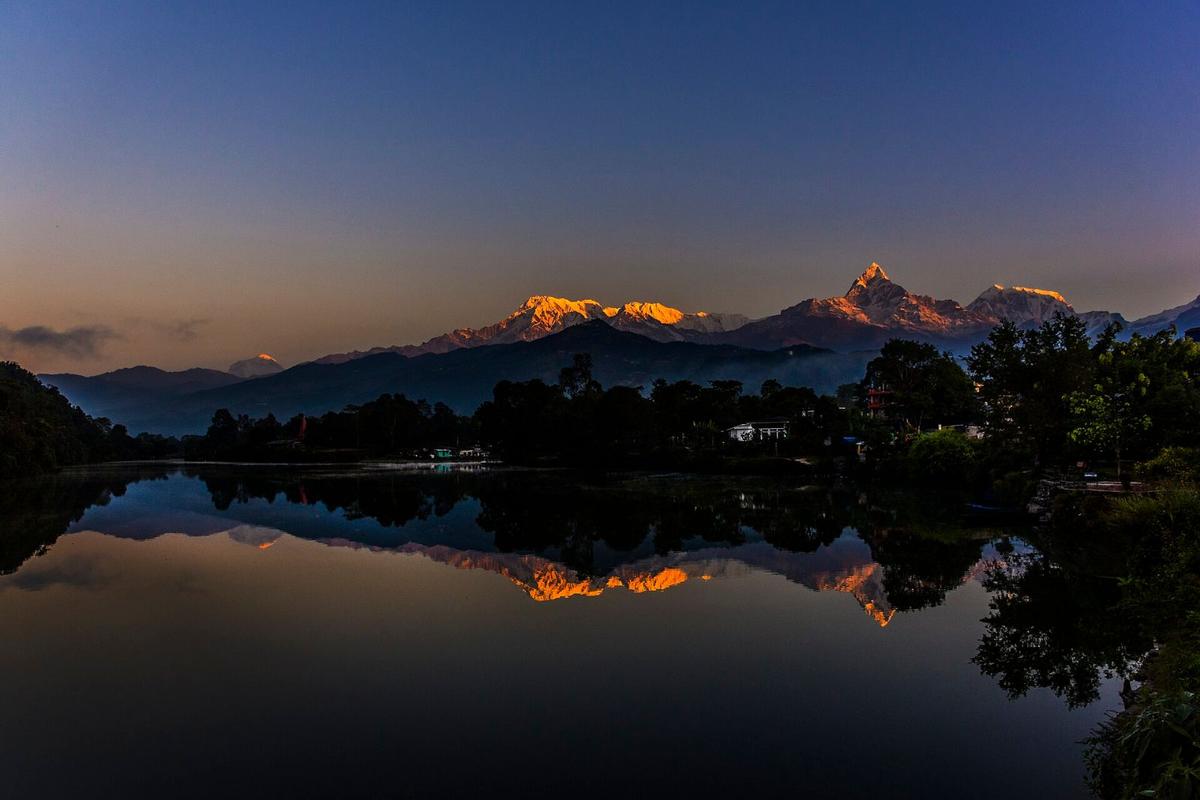
On a clear November morning the Annapurna peaks stand white above Pokhara and lie upside down in Phewa Lake before the first rowing boats push off. Come back in July and the same shore can sit under low grey cloud, with rain on most days of the month. Both are Pokhara, a lakeside city at about 820 m and one of the wettest places in Nepal.
The best time to visit Pokhara is mid October to December. The monsoon has gone, November and December average 1.3 and 1.0 rain days, and the Nepal Tourism Board says the clearest skies come in October and November. February and March are a good second choice. For what to do, see our guide to things to do in Pokhara.
Updated 20 Nov 2026
In this guide
- When is the best time to visit Pokhara?
- Pokhara weather by month
- Autumn in Pokhara: October and November
- Winter in Pokhara: December to February
- Spring in Pokhara: March to May, and the haze
- Pokhara in monsoon: June to September
- The best month for views, paragliding, boating and more
- Festivals in Pokhara, December 2026 to March 2027
- Getting there and practical advice
- Frequently asked questions
- Plan your Pokhara trip with us
Key facts
- Clearest skies
- October and November (NTB, Climate page, checked 21 Nov 2026)
- Wettest month
- July: 941.0 mm of rain, 25.6 rain days (DHM 1991 to 2020 normals, Pokhara Airport, checked 21 Nov 2026)
- Driest month
- December: 11.5 mm of rain, 1.0 rain day (DHM 1991 to 2020 normals, Pokhara Airport, checked 21 Nov 2026)
- Rain in a year
- 3,868.3 mm on 143.2 rain days (DHM 1991 to 2020 normals, Pokhara Airport, checked 21 Nov 2026)
- Coldest nights
- January, mean minimum 7.1 °C (DHM 1991 to 2020 normals, Pokhara Airport, checked 21 Nov 2026)
- Warmest days
- June, mean maximum 30.8 °C (DHM 1991 to 2020 normals, Pokhara Airport, checked 21 Nov 2026)
- Snow
- Not observed in the valley; lowest recorded 0.5 °C (WMO and DHM station data (Wikipedia climate table), checked 21 Nov 2026)
- Monsoon 2026
- Entered Nepal 19 June, fully withdrew 14 October, 12 days later than average (Kathmandu Post and Himalayan Times reporting DHM, checked 21 Nov 2026)
- Sunrise
- 5:11 am in June to 7:02 am in mid January (timeanddate.com, Pokhara 2026, checked 21 Nov 2026)
- Height
- City about 820 m; weather station 827 m (CAAN airport profile and WMO station sheet, checked 21 Nov 2026)
When is the best time to visit Pokhara?
For mountain views and dry days, come between mid October and December. For warmth and rhododendrons on the hill treks, come in March or early April, before the spring haze thickens. Come in the monsoon, June to September, if you are happy with rain on most days, green hills and mountains that show themselves only now and then.
The Nepal Tourism Board (NTB) says "Pokhara is warmer than Kathmandu". It is also far wetter: the airport station averages 3,868.3 mm of rain a year, against 1,502.6 mm at Kathmandu Airport over the same 1991 to 2020 period (WMO), because moist monsoon air is pushed up against the Annapurna range and falls as rain.
"Spring is the time for rhododendrons to bloom while the clearest skies are found after the monsoon in October and November."
Nepal Tourism Board, Climate page, checked 21 November 2026
The takeaway: views mean autumn or early winter, flowers mean spring, green fields mean the monsoon.
Pokhara weather by month
Pokhara's weather by month swings from almost no rain in December to more than 900 mm in July. These are the 30-year averages for the airport station.
| Month | Mean max / min | Rain | Rain days | What it is like, what to do |
|---|---|---|---|---|
| January | 19.9 / 7.1 °C | 21.6 mm | 2.4 | Coolest month, cold mornings. Lake walks and viewpoints |
| February | 22.7 / 9.7 °C | 35.1 mm | 3.8 | Warming and mostly dry. A good all-round month |
| March | 27.1 / 13.1 °C | 63.7 mm | 6.4 | Rhododendrons begin on the hill treks; haze can start |
| April | 30.0 / 16.1 °C | 141.7 mm | 10.5 | Warm, more rain days, forest-fire season building to its peak |
| May | 30.4 / 18.7 °C | 354.7 mm | 18.3 | Hot and hazy, rain on more than half the days |
| June | 30.8 / 21.2 °C | 648.2 mm | 22.2 | Monsoon arrives; the warmest days of the year |
| July | 30.4 / 22.4 °C | 941.0 mm | 25.6 | Wettest month. Green hills, few clear views |
| August | 30.5 / 22.3 °C | 839.4 mm | 24.3 | Still very wet; flying and boating stop on heavy-rain days |
| September | 29.9 / 21.1 °C | 635.0 mm | 19.4 | Rain easing; the monsoon usually leaves in October |
| October | 27.9 / 17.2 °C | 159.2 mm | 8.0 | Skies clear once the monsoon goes. Nepal's busiest month for arrivals in 2025 |
| November | 24.4 / 12.3 °C | 17.2 mm | 1.3 | Clear, dry and mild. Top month for views and trekking |
| December | 21.0 / 8.3 °C | 11.5 mm | 1.0 | Driest month, cool nights, festival week at the year's end |
| Year | 27.1 / 15.8 °C | 3,868.3 mm | 143.2 |
Pokhara Airport station (827 m), DHM 1991 to 2020 normals. Rain days are days with at least 1 mm. Sarangkot and the hills are cooler.
NTB's general figure of 3,345 mm a year names no station or period; the table uses the measured average from the Department of Hydrology and Meteorology (DHM). Temperatures drop as you climb, so dawn at the Sarangkot viewpoint, 1,595 m, is colder than Lakeside.
Autumn in Pokhara: October and November
Autumn is the most reliable season for mountain views. October averages 8.0 rain days and November only 1.3, and NTB names these two months for the clearest skies.
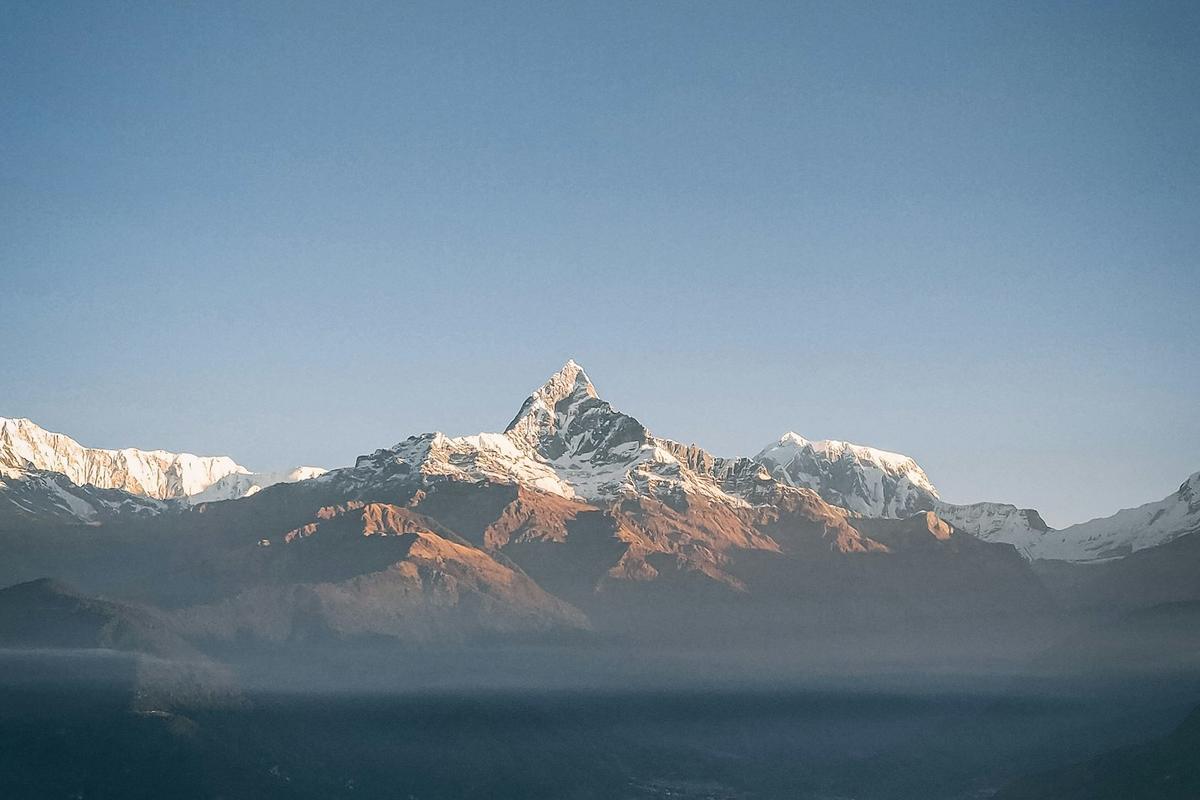
Early October is not always dry. DHM's normal withdrawal date, which it gives for eastern Nepal, is 2 October, yet in every year from 2015 to 2024 the monsoon left there on or after 3 October. In 2026 it left the whole country on 14 October, 12 days later than average. If views are the point, aim for the second half of October or later.
It is also the busiest time. NTB counted 128,443 arrivals in Nepal in October 2025, the top month of the year, and 132,814 in October 2026. These are national figures; we found no monthly count for Pokhara alone.
The takeaway: autumn gives the best odds of clear peaks, so book rooms and flights early.
Winter in Pokhara: December to February
Pokhara in winter is dry and mild by day, with cold mornings and evenings. December is the driest month, with 1.0 rain day, and January the coolest, averaging 19.9 °C by day and 7.1 °C at night. NTB's line fits: "Even in December and January, when winter is at its severest, there are compensating bright sun and brilliant views."
Snow is not observed in the valley, though the hills around it get occasional winter snow. The lowest temperature recorded at the airport station is 0.5 °C. The cold is at dawn: the sun rises at 7:02 am in mid January and sets as early as 5:12 pm in early December. Bring a warm layer, hat and gloves for Sarangkot.
The takeaway: winter suits you if you want dry days and will pack for cold mornings.
Spring in Pokhara: March to May, and the haze
Spring is warm and colourful, but views get hazier as it goes on. March averages 27.1 °C and 6.4 rain days; May reaches 30.4 °C and 18.3 rain days. On the hill treks, a Rastriya Samachar Samiti (RSS) report from Ghorepani notes that "Chaitra-Baishakh is the season for rhododendron blooms", the Nepali months that run roughly from mid March to mid May.
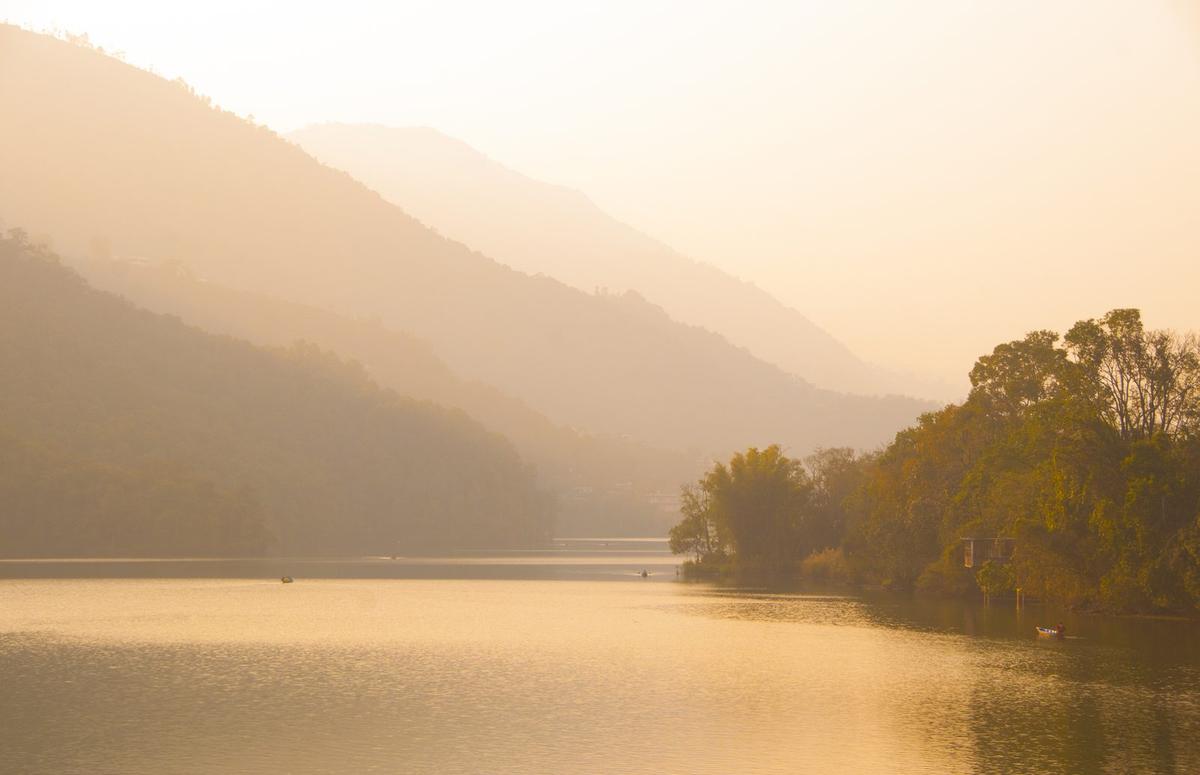
Smoke from forest fires adds to the haze. In April 2024 the Kathmandu Post wrote:
"Now, during the spring, one of the country's peak tourist seasons, the bowl-sized city is blanketed in smog and haze."
Deepak Pariyar, "Air pollution takes its toll on Nepal's tourism capital", The Kathmandu Post, 26 April 2024
It added that poor visibility halted flights at Pokhara International Airport for hours. A forest fire expert told the paper in March 2026 that "the peak of the forest fire season reaches in April-May".
Haze is a reason to plan, not to stay away:
- Come in March, before the April to May fire peak.
- Start early. Do viewpoints and flights first thing, and keep a second morning free.
- Check the air on an air-quality app; a mask helps on smoky days. If you have asthma, bring your inhaler.
The takeaway: spring is for flowers and warmth; for clear peaks, come in March.
Pokhara in monsoon: June to September
Pokhara in monsoon is warm, green and very wet. From June to September the station averages 3,063.6 mm of its 3,868.3 mm a year, with 19.4 to 25.6 rain days a month.
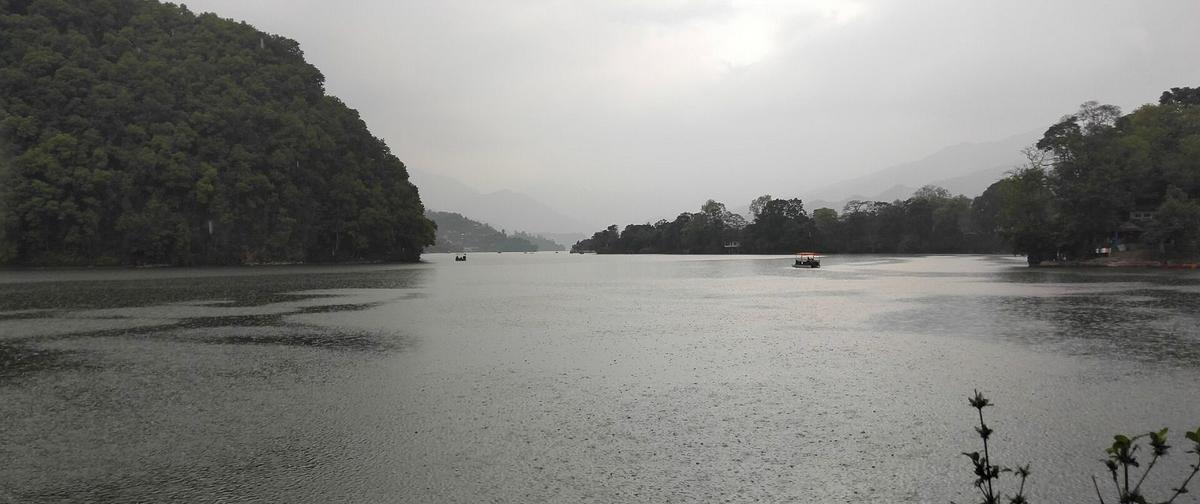
The dates move each year. Nepal's normal monsoon dates are 13 June to 2 October, a reference DHM gives for eastern Nepal. In 2026 the monsoon entered Nepal on 19 June and reached parts of Gandaki Province, where Pokhara lies, by 22 June. June and July 2026 were lighter than normal at Pokhara: DHM recorded 639.5 mm in July against a normal 941 mm, still a lot of rain.
Heavy rain halts paragliding, and on 24 September 2026 night buses, boating and paragliding were suspended in Kaski, Pokhara's district, because of the risk of floods and landslides. We found no seasonal boating ban on Phewa Lake; boating stops on bad-weather days. Kaski's assistant chief district officer warned that "monsoon weather can change suddenly, with unexpected winds, rainfall and lightning posing additional risks".
The takeaway: plan outdoor activities for the morning, keep a spare day, pack a rain jacket, and treat mountain views as a bonus.
The best month for views, paragliding, boating and more
The best month to visit Pokhara depends on what you came for.
- Mountain views: November, then late October and December. For dawn, read our Sarangkot sunrise guide.
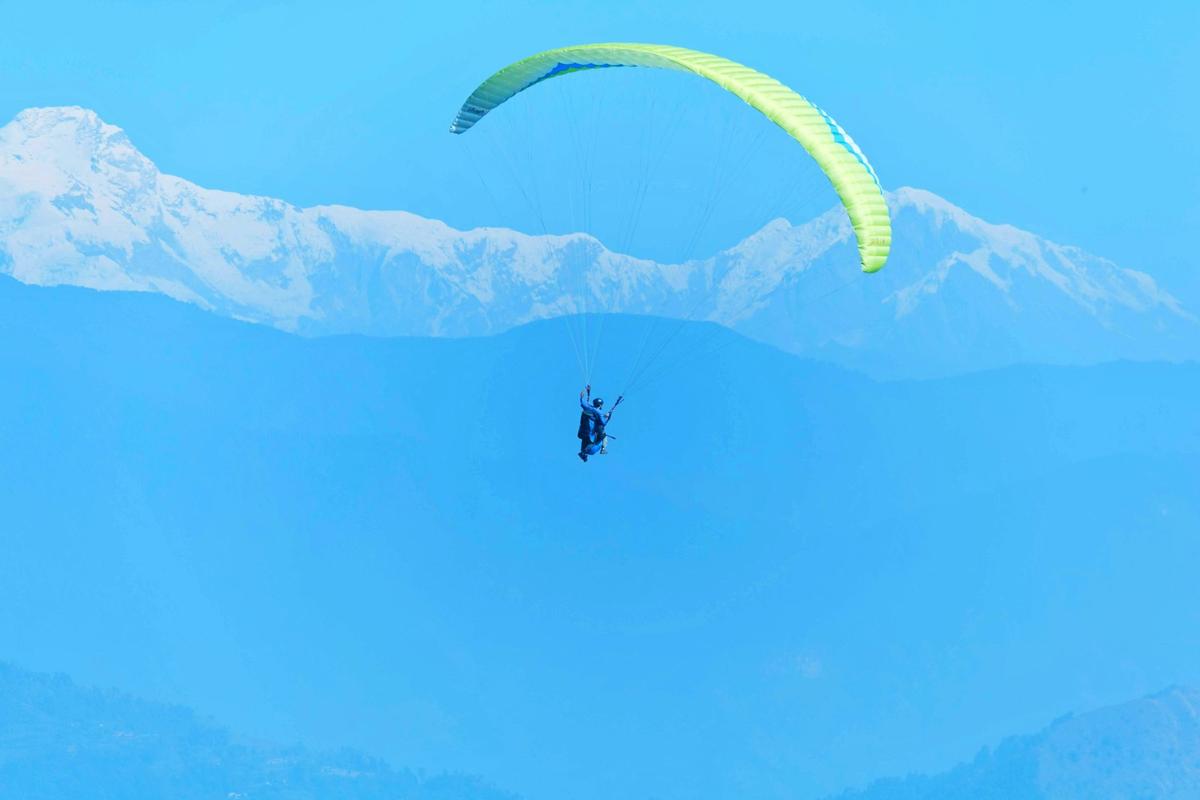
- Paragliding: November to March, the months with the fewest rain days (1.0 to 6.4 a month); late October is good too. Flights launch from the hills above Phewa Lake when the weather allows. See our paragliding in Pokhara guide.
- Boating on Phewa Lake: November and December mornings. Life jackets are compulsory, boating stops at 6 pm, and visitors are advised not to go out after 2 pm when the weather turns. See our Phewa Lake guide.
- Trekking from Pokhara: October and November for clear skies, March and April for rhododendrons on the Poon Hill trails. Our treks from Pokhara guide compares routes. A licensed guide walks with you on every trek we run.
- Fewer foreign visitors: June and July. Nepal had 76,425 arrivals in June 2025 and 70,193 in July, against 128,443 in October. Lakeside can still fill on Nepali and Indian holiday weekends.
Festivals in Pokhara, December 2026 to March 2027
Public holiday dates are from the Ministry of Home Affairs list for 2083 BS (2026 to 2027):
- Christmas, 25 December 2026. A public holiday in Nepal.
- Pokhara Street Festival, usually 28 December to 1 January. Run by the Restaurant and Bar Association Nepal (REBAN) Pokhara along about 3.5 km of Lakeside, on those dates in 2025 to 2026. Confirm the 2026 dates closer to the time.
- Tamu Lhosar, 30 December 2026. The Gurung New Year, a national holiday, which NTB says is "celebrated on the 15th of Poush (December end) to mark the start of the Tamu Sambat", the Gurung calendar.
- Holi, 21 March 2027 in the hill districts, which include Kaski. The festival of colours; the Terai, Nepal's southern plains, marks it on 22 March.
The takeaway: the last week of December is lively, and busy.
Getting there and practical advice
From Kathmandu, the road takes most of a day, often six to nine hours with traffic and roadworks; by air it is about 30 minutes. Our Kathmandu to Pokhara guide compares them. From 21 November 2026 the Prithvi Highway, the main road between the two cities, is closed to traffic from 11 am to 4 pm every day for repair work, including at Ghoptebhir, "until further notice", Chitwan's District Traffic Police Office said (OnlineKhabar, 20 November 2026). If you go by road, leave early, check the road the day before, or fly.
If you trek from Pokhara, altitude matters. Ghorepani sits at about 2,860 m and Poon Hill at 3,210 m, above the height of about 2,450 m (CDC) where altitude sickness can begin. The standard advice:
- Go up slowly. Above 3,000 m, sleep no more than about 500 m higher each night and take a rest day every three to four days.
- Walk slowly, "bistarai, bistarai" (slowly, slowly, in Nepali), drink enough water, skip alcohol early on.
- Know the symptoms: headache, nausea, tiredness, poor sleep. Never go higher with symptoms; go down if they get worse.
- Ask your doctor before the trip about preventive medicine such as acetazolamide.
- Hot garlic soup is a comforting local tradition that helps you drink more, not a proven cure.
- With severe symptoms, descend at once and get help. Our guide arranges a rescue if needed.
Frequently asked questions
What is the best month to visit Pokhara?
November is the best month to visit Pokhara for most people. It averages 1.3 rain days, 24.4 °C by day and 12.3 °C at night, and NTB names October and November for the clearest skies. December is close behind and drier still. Choose March or early April for rhododendrons on the hill treks.
Is Pokhara good to visit in December?
Yes. December is Pokhara's driest month, with 11.5 mm of rain on 1.0 day on average and a mean maximum of 21.0 °C. Nights average 8.3 °C, so bring warm layers for early starts. The Pokhara Street Festival usually runs from 28 December to 1 January, and Tamu Lhosar falls on 30 December 2026.
Does it snow in Pokhara?
No. Snow is not observed in the Pokhara valley, though the surrounding hills get occasional winter snow. The lowest temperature recorded at the airport station is 0.5 °C, in January, and the average January night is 7.1 °C. On clear days you will see snow on the Annapurna peaks, high above the valley.
Can we visit Pokhara in July?
Yes, but expect rain. July is the wettest month, averaging 941.0 mm on 25.6 days, and the mountains are often in cloud. Paragliding and boating stop on heavy-rain days. The cafés, museums and green countryside still make a pleasant stay. Plan outdoor activities for the morning and keep a spare day.
Can you see the mountains from Pokhara?
Yes. On a clear day the Annapurna range is in full view from the city and the lake; NTB says mountains above 6,000 m can be seen unobstructed from 800 m within 28 km. October and November give the clearest skies, while spring haze and monsoon cloud often hide the peaks. Go to a viewpoint at dawn.
Is it cold in Pokhara?
Not by day. Even in January, the coolest month, afternoons average 19.9 °C. Mornings and evenings are cold from December to February, with mean minimums of 7.1 to 9.7 °C, and Sarangkot is colder at dawn. From April to September mean maximums run from 29.9 to 30.8 °C.
Plan your Pokhara trip with us
Start with our guide to things to do in Pokhara, compare the whole country in our best time to visit Nepal guide, and read the Phewa Lake guide before you go.
To plan, see our Pokhara trips, the Pokhara tour by flight and road or the slower Kathmandu, Pokhara and Bandipur tour. Tell us your dates and we will tell you plainly whether those weeks suit what you want to see. Message us on WhatsApp or use the enquiry form on any trip page.