Walk into the square at Boudhanath and the first thing you notice is which way everyone is moving. Monks in maroon robes, grandmothers with prayer beads and families from across the valley all circle the great white dome in the same direction, clockwise, past small shops selling incense, prayer flags and white kata scarves. Above them the gilded tower and its painted eyes look down on a slow, steady river of people.
The best-known Buddha temple in Kathmandu, Nepal is Boudhanath, which UNESCO describes as the largest stupa in Nepal, followed by Swayambhunath on its hill west of the city. Around them stand working Tibetan monasteries such as Kopan, Shechen and Pullahari, and in the old towns you find quieter Newar Buddhist courtyards like Patan's Golden Temple.
This article is part of our guide to places to visit in Kathmandu, which covers the rest of the valley.
Updated 22 Nov 2026
In this guide
- Which Buddha temple in Kathmandu, Nepal to see first
- Newar and Tibetan Buddhism in plain words
- Boudhanath Stupa
- Swayambhunath Stupa
- Tibetan monasteries around Boudha and Kopan hill
- White Gumba: the honest status
- Buddhist sites in old Kathmandu
- Patan's Buddhist viharas
- Pharping and the caves of Guru Rinpoche
- All the sites compared
- How to behave at a stupa or monastery
- Buddhist festival dates, December 2026 to May 2027
- A half-day and a one-day route
- Frequently asked questions
Key facts
- UNESCO status
- Kathmandu Valley World Heritage property, inscribed in 1979 as seven Monument Zones; Swayambhu and Bauddhanath are two of them (UNESCO World Heritage Centre, list 121, checked 23 Nov 2026)
- Boudhanath entry
- Foreign and Chinese visitors NPR 400, SAARC nationals NPR 100, children under 10 free (Nepal Tourism Board heritage fees; Boudhanath Area Development Committee, checked 23 Nov 2026)
- Swayambhunath entry
- Foreign and Chinese visitors NPR 200, SAARC nationals NPR 50, children under 10 free (Nepal Tourism Board heritage fees, checked 23 Nov 2026)
- Where they are
- Boudhanath 8 km east of downtown Kathmandu; Swayambhunath on a hillock 3 km west of Kathmandu (Nepal Tourism Board, checked 23 Nov 2026)
- Golden Temple, Patan
- About NPR 100 for foreign visitors, paid at the gate (reported 2023 and 2026) (Kathmandu Post 2023; The Longest Way Home 2026, checked 23 Nov 2026)
- White Gumba
- No regular public opening; last confirmed opening was ten days in May 2025 (Ratopati and Setopati, May 2025, checked 23 Nov 2026)
- Opening hours
- Not officially published for most sites; hours vary, so check locally or ask us (official monastery and NTB pages read, checked 23 Nov 2026)
- Etiquette
- Walk around stupas and temples clockwise; shoes off in places of worship; leather banned in some temple areas (Nepal Tourism Board cultural etiquette, checked 23 Nov 2026)
- Next Lhosar holidays
- Tamu Lhosar 30 Dec 2026; Sonam Lhosar 7 Feb 2027; Gyalpo Lhosar 9 Mar 2027 (Ministry of Home Affairs 2083 holiday list, checked 23 Nov 2026)
Which Buddha temple in Kathmandu, Nepal should you see first?
See Boudhanath first if you have time for one, because it is the largest stupa in Nepal and the centre of Tibetan Buddhist life in the valley. Add Swayambhunath for its history and its view over the city, then one working monastery such as Kopan and one Newar courtyard in Patan to see how differently Buddhism is lived here.
The valley's Buddhist sites are not a side attraction. UNESCO inscribed the Kathmandu Valley on the World Heritage List in 1979 as seven Monument Zones, and two of those zones, Swayambhu and Bauddhanath, are built around stupas. The UNESCO summary puts the two great stupas in one line:
"The religious ensemble of Swayambhu includes the oldest Buddhist monument (a stupa) in the Valley; that of Bauddhanath includes the largest stupa in Nepal."
UNESCO World Heritage Centre, Kathmandu Valley (list 121), Brief synthesis
When people search for a "Buddha temple" in Kathmandu they usually mean one of four kinds of place, and it helps to know which is which before you go:
- Stupa. A solid dome with a tower on top, built as a monument and walked around, never entered. The Newar word is chaitya, so Boudhanath is also called Khasti Chaitya.
- Gompa. The Tibetan word for a monastery: a prayer hall with statues and wall paintings, monks' or nuns' quarters, and often a school. Kopan and Shechen are gompas.
- Baha and bahi. Newar Buddhist monastery courtyards, set inside the old neighbourhoods of Kathmandu, Patan and Bhaktapur.
- Mahavihar. The formal Sanskrit name for a principal Newar monastery, as in Hiranya Varna Mahavihar, the Golden Temple in Patan.
Newar and Tibetan Buddhism in plain words
Two Buddhist worlds share the Kathmandu Valley, and you will see both in a single day. Newar Buddhism is the older one here: a form of Vajrayana Buddhism practised by the Newar people of the valley, with its own priests, the Vajracharya (who perform rituals for others) and the Shakya, and its own monastery courtyards, the baha and bahi.
Tibetan pilgrims have long come to the valley's stupas, but Tibetan Buddhism's present strength around Boudha dates from the 1950s, when refugees arrived from Tibet and many decided to live around Boudhanath. Lamas then rebuilt in Nepal the monasteries they had lost: Shechen was begun near the stupa in 1980, and Tharlam, a Sakya monastery first founded in Kham in eastern Tibet in 1436, was re-established near Boudhanath in 1981.
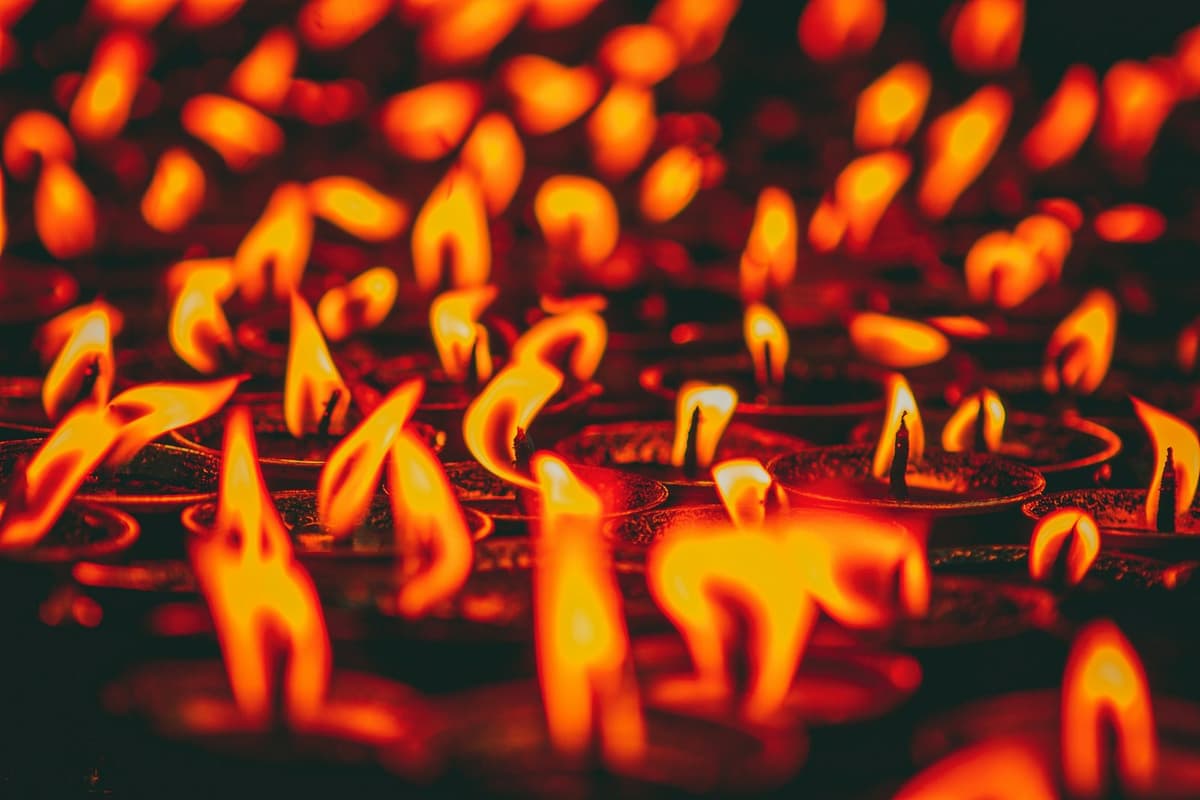
For a visitor, the difference shows up in the buildings. A Newar baha is a brick courtyard in the middle of a neighbourhood, with small stone chaityas, a shrine and daily life going on all around it. A Tibetan gompa is a monastery in the full sense: a large painted prayer hall, monks or nuns in maroon, chanting, drums and butter lamps.
Both traditions also mix with Hindu practice. UNESCO's listing says it directly: "The coexistence and amalgamation of Hinduism and Buddhism with animist rituals and Tantrism is considered unique." At Swayambhu, the temple of Harati, protector of children, is worshipped by Buddhists and Hindus alike. At Pharping, Hindu shrines to Vishnu sit just below a cave where Guru Rinpoche meditated.
There is a third, smaller strand. Kindo Baha, at the southern foot of Swayambhu, was the centre of the Theravada revival in Nepal from the 1920s to the 1940s.
| What to look at | Newar Buddhism | Tibetan Buddhism |
|---|---|---|
| Where you find it | Old-town courtyards in Kathmandu and Patan; Swayambhu | Boudha and the hills north of it; Swayambhu; Pharping |
| Who leads ritual | Vajracharya priests and Shakya families | Lamas, monks and nuns living in the monastery |
| Typical building | Brick baha courtyard with chaityas and a main shrine | Gompa with a large painted prayer hall |
| Good first example | Golden Temple (Kwa Baha), Patan | Kopan Monastery or Shechen, Boudha |
Boudhanath Stupa: the largest stupa in Nepal
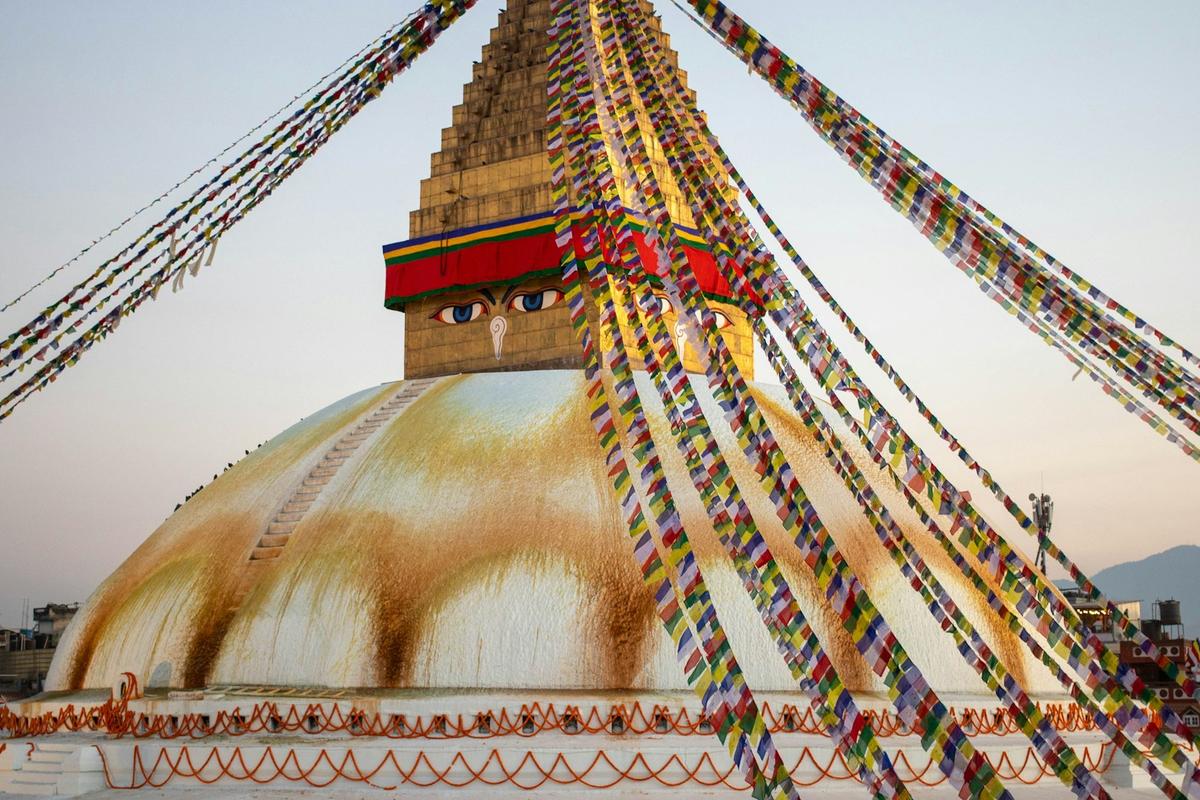
Boudhanath stands 8 km east of downtown Kathmandu, and the Nepal Tourism Board calls it "the largest stupa in the Kathmandu Valley" and "the center of Himalayan Buddhism".
Nobody agrees exactly when it was first built. The Ministry of Culture, Tourism and Civil Aviation dates the first stupa to sometime after AD 600, and the old chronicles disagree on the king, naming either the Licchavi ruler Shivadeva or King Manadeva. Legend fills the gaps: the stupa is said to hold the remains of Kassapa Buddha, and Newar chronicles tell of a flying hen that landed where the chaitya now stands.
The 25 April 2015 earthquake badly damaged the stupa and cracked the spire. It was rebuilt and reopened to the public on 22 November 2016. Today dozens of monasteries surround it, and Boudha is the place to be at Gyalpo Lhosar, the Tibetan and Sherpa new year, when the Sherpa community gathers here to celebrate.
Foreign visitors pay NPR 400, SAARC nationals NPR 100, and children under 10 enter free. The fee is set by the Boudhanath Area Development Committee, whose ticket counter kept 10 am to 5 pm when last reported, in 2022. The ticket covers the stupa area itself; the monasteries around the square are run separately. For the full history and the kora route, read our complete Boudhanath Stupa guide.
Swayambhunath Stupa: the oldest monument in the valley
Swayambhunath rests on a hillock 3 km west of Kathmandu, and UNESCO describes its stupa as the oldest Buddhist monument in the valley. Inscriptions suggest the hill was a Buddhist site by about the 5th century, and the Nepal Tourism Board credits King Manadeva with building it around 460 AD.
Legend says the valley was once a lake; Swayambhu, the "self-existent" one, was born from a lotus that bloomed in the middle of it, and the bodhisattva Manjushri drained the lake with his sword.
The eastern stairway, built by King Pratap Malla in the 17th century, is "exceedingly steep", as the Nepal Tourism Board puts it. If knees or lungs are a worry, there is also a motor road almost to the top, from where it is a short walk.
At the top, look for the pagoda of Harati, the goddess who, the story goes, was an ogress before the Buddha turned her into the caretaker of all children. On the western side, beside the Ring Road, Buddha Amideva Park has three large golden statues of Sakyamuni Buddha, four-armed Chenresig and Guru Rinpoche, built in 2003.
Foreign visitors pay NPR 200, SAARC nationals NPR 50, and children under 10 are free. Visitors call it the Monkey Temple for a reason: keep food in a closed bag and sunglasses on your face, not on your head. The complex was damaged in the April 2015 earthquake. Our Swayambhunath Monkey Temple guide has the full walk around the hilltop.
Tibetan monasteries around Boudha and Kopan hill
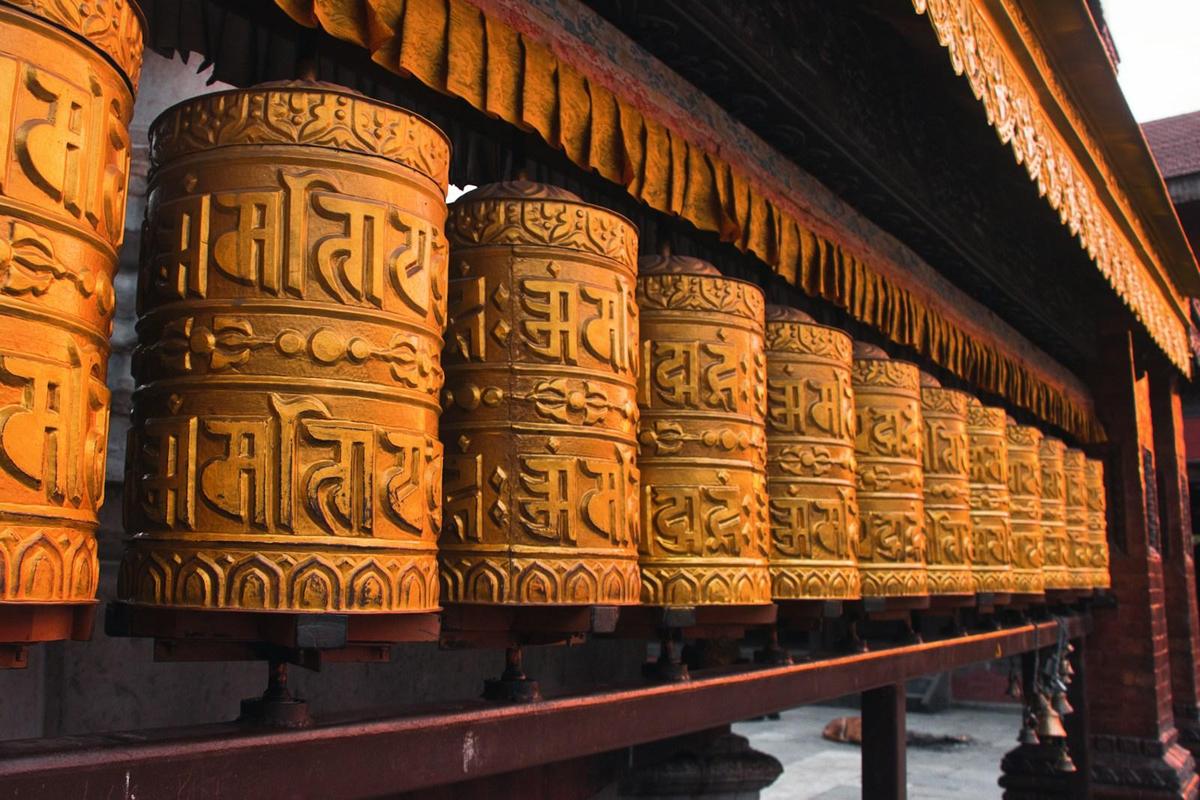
The working Tibetan monasteries most visitors can see are in and above Boudha. Shechen and Tharlam stand near the stupa itself, while Kopan and Pullahari sit on the ridge to the north; Kopan is the lowest of a chain of three monasteries on that ridge and Pullahari the highest.
Kopan Monastery
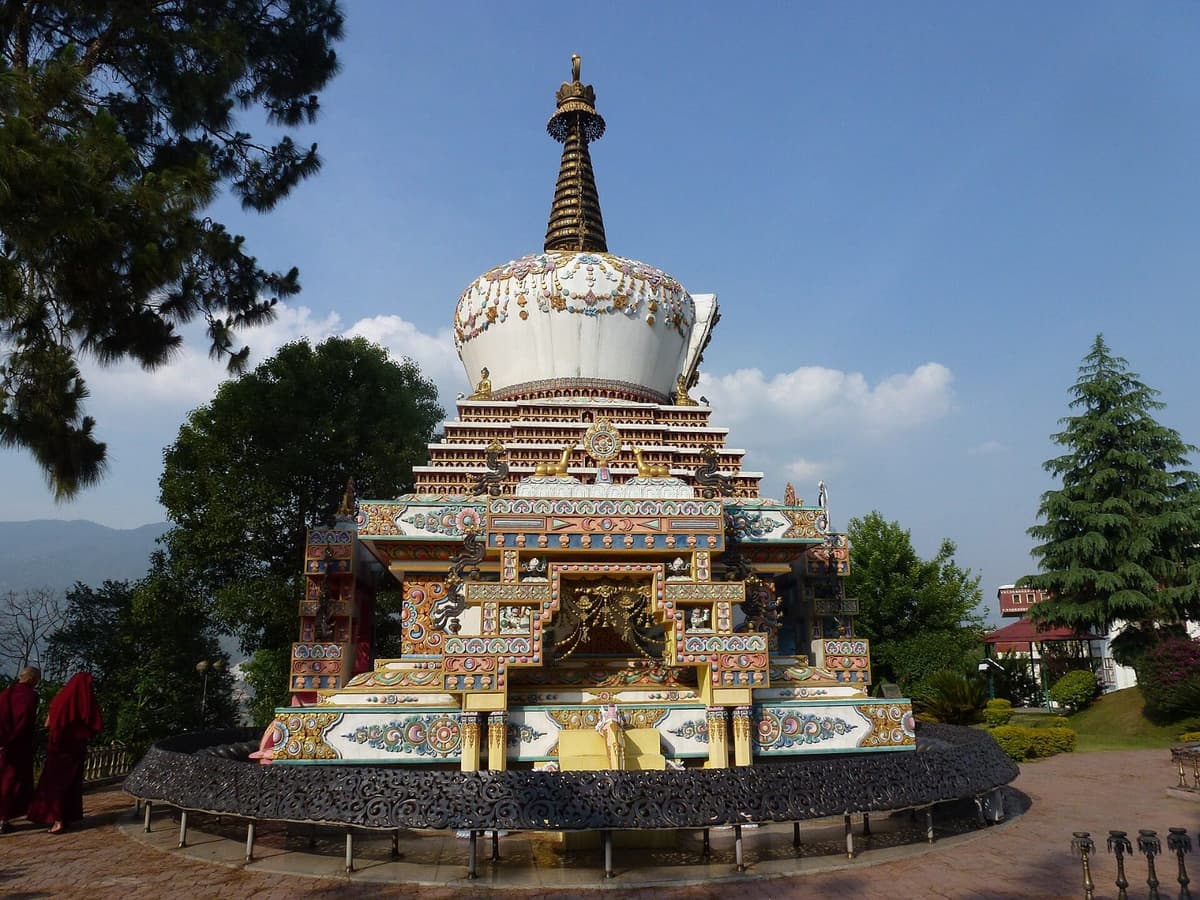
Kopan was established in the late 1960s by Lama Yeshe and Lama Zopa Rinpoche, on a hilltop north of Boudhanath. You can walk up on the path between Boudhanath and Gokarna, or take a taxi.
Kopan is best known abroad for its November Course, a month-long introduction to Buddhism and meditation that has run since 1971. It usually runs through November into December, but Kopan had published no details of a 2026 course when we checked on 23 November 2026, so look at Kopan's own course calendar before planning around it. Day visitors can explore the monastery, and Lonely Planet notes that you can join the morning meditation sessions.
Kopan publishes a clear dress guideline, and it is a good standard for every monastery: shoulders and upper body covered, trousers, long shorts or roughly knee-length dresses, and nothing see-through, skin-tight or printed with slogans. The guest guidelines of Kopan Nunnery also ask for no alcohol, drugs or cigarettes, no hugging or holding hands, and to "be polite, quiet, and mindful of others' needs".
Two dates worth knowing: Kopan has announced stupa consecration ceremonies on 11 December 2026 at the monastery, for a stupa holding relics of Kyabje Lama Zopa Rinpoche, and on 14 December 2026 at the nunnery, for a memorial stupa honouring him and Lama Lhundrup, Kopan's first abbot. Expect crowds on those days. Our Kopan and Boudha monasteries day tour visits Kopan, Pullahari, Shechen and Boudhanath with a licensed guide.
Shechen Monastery
Shechen Tennyi Dargyeling is the large Nyingma monastery near the stupa. Dilgo Khyentse Rinpoche began building it in 1980, and craftsmen worked on it for almost ten years. It carries on the tradition of Shechen Monastery in Tibet, one of the six main Nyingma monasteries, which was destroyed in the late 1950s. Shechen says plainly that visitors cannot stay at the monastery and that there are no retreats for visitors; the Shechen Guest House next door takes guests. Hours are not published, so go with a little time to spare and ask at the gate.
Pullahari Monastery
Pullahari is the highest of the ridge monasteries, in the foothills north of the Great Stupa of Boudhanath. The Third Jamgon Kongtrul Rinpoche accepted the land in 1986, the monastery opened in March 1992, and its first three-year retreat began in March 1994. It belongs to the Kagyu lineage of Naropa, Marpa and Milarepa, and is named after Naropa's monastery, Pullahari, in Bihar, India. It was designed by an American architect turned monk, Lama Tenzing. The Kathmandu Post described it in 2015 as open to all, and its position high on the ridge makes it a quieter, greener stop than anything down in Boudha.
White Gumba (Seto Gumba): the honest status
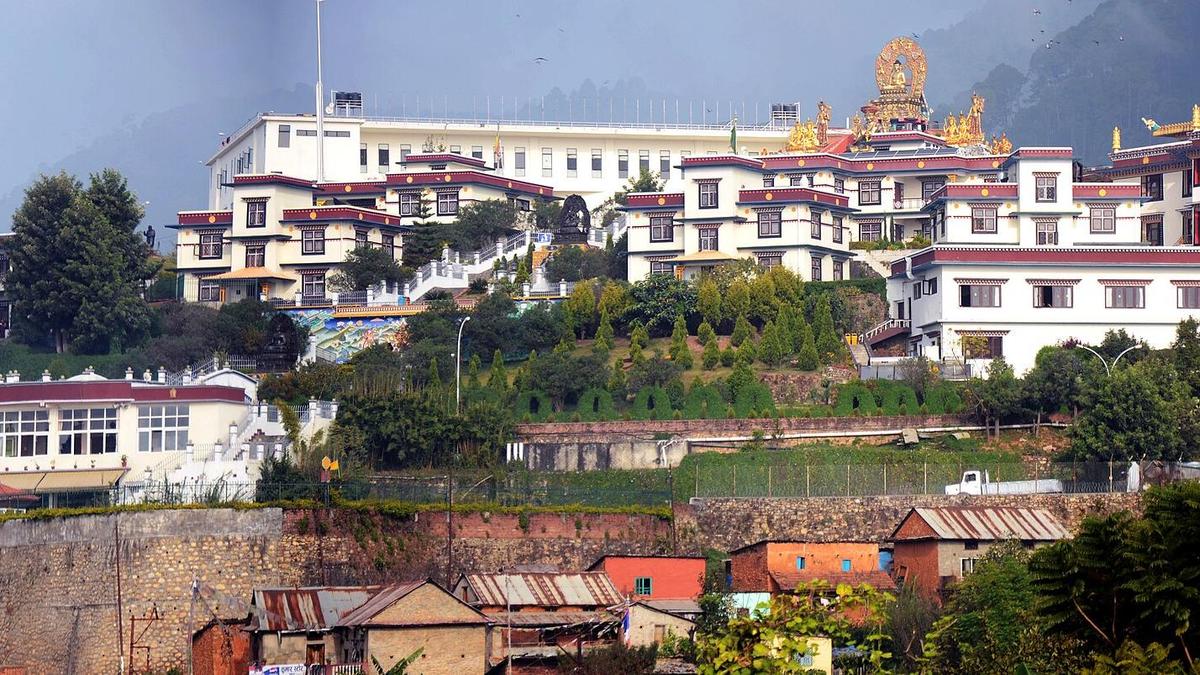
White Gumba is not open to the public on a regular schedule. The Drukpa monastery, also called Seto Gumba or Druk Amitabh Mountain, sits in Nagarjun Municipality outside the Ring Road, north of Swayambhu. It opens only on dates the monastery announces.
The last public opening we can confirm was ten days from about 17 May 2025, from 10 am to 5 pm, and on at least one of those days it closed early, at 2 pm, because the crowds became too large to manage. We found no 2026 opening in English or Nepali news when we checked on 23 November 2026. Older posts that say it opens every Saturday or Sunday are out of date. If an opening is announced, our White Gumba guide is where we update the details. Ask us before you go.
Buddhist sites in old Kathmandu: Kathesimbhu, Itum Bahal and Chabahil
You do not need to leave the city centre to see Newar Buddhism. No entry fee is published for any of these three, and they are easy to fold into a walk through the old town.
- Kathesimbhu (Shree Gha) Stupa. A small copy of Swayambhu near Thahiti Chowk, just south of Thamel, usually dated to the mid-17th century. Legend says it was built with the materials left over from Swayambhu.
- Itum Bahal. One of the largest bahal courtyards in the old town. On its west side stands Kichandra Bahal, dated 1381, and on the north side of the courtyard brass plaques show the demon Guru Mapa.
- Chabahil Stupa. On the Ring Road, on the way out to Boudha. Legend credits Charumati, daughter of the Emperor Ashoka; Licchavi-period chaityas stand around it, and it has been rebuilt several times, most recently after the 2015 earthquake. Lonely Planet ranks it the fourth largest stupa in the Kathmandu area after Boudhanath, Swayambhunath and Kathesimbhu.
These are neighbourhood shrines rather than sights. Walk round clockwise, keep your voice down, and step aside when someone arrives with an offering.
Patan's Buddhist viharas: Golden Temple, Mahabouddha and Uku Bahal
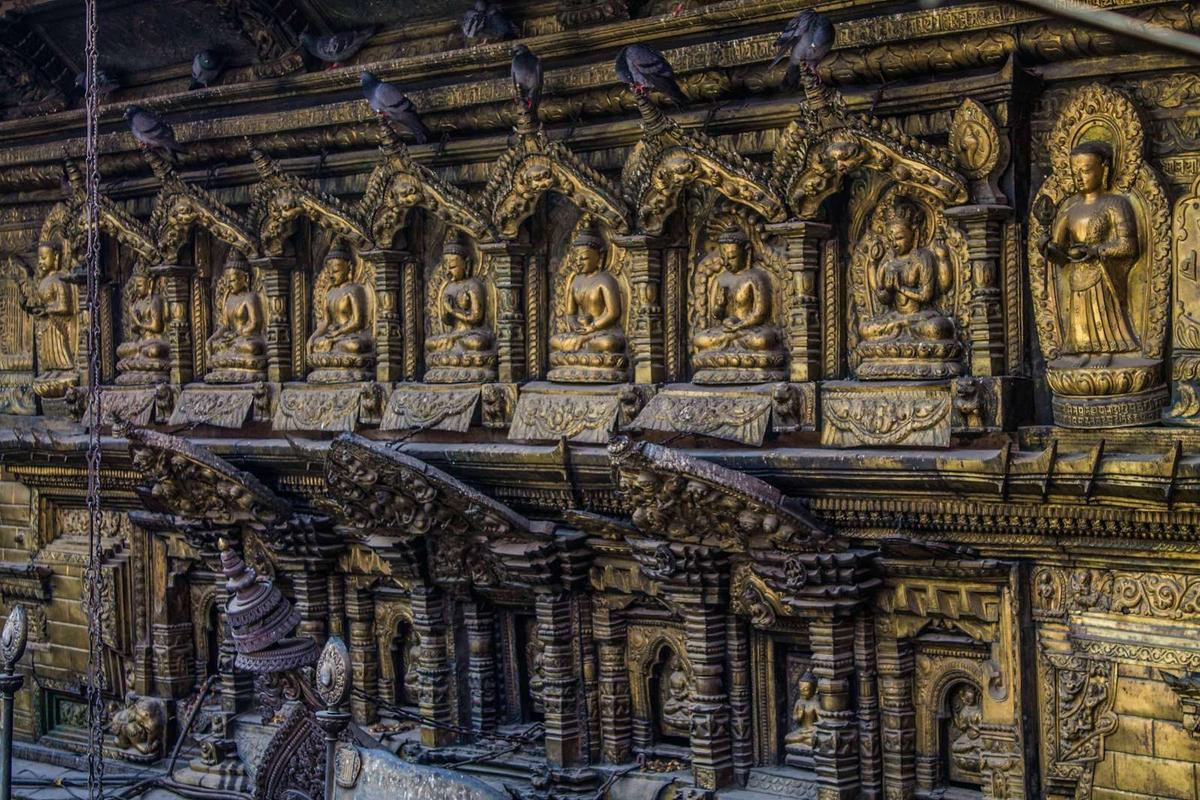
Patan, the old city across the Bagmati from Kathmandu, is the best place in the valley to see Newar Buddhism at work. The three monasteries below are all in the old city near Durbar Square, so they pair well with our Patan Durbar Square guide.
Golden Temple (Hiranya Varna Mahavihar, Kwa Baha)
The Golden Temple's formal name, Hiranya Varna Mahavihar, means the Gold-coloured Great Monastery; locals call it Kwa Baha. It is traditionally dated to the 12th century, when King Bhaskar Varman is believed to have built it. By tradition the principal priest is a boy, always younger than twelve, who serves for one month. The monastery keeps a Prajnaparamita manuscript written in gold ink on black paper, more than eight centuries old, and it organises Patan's Samyak festival.
Foreign visitors pay about NPR 100 at the gate (reported in 2023 and again in 2026). You will be asked to leave leather items such as belts and bags, and your shoes, outside before the inner courtyard; this follows the general rule that leather is not allowed in some temple areas. Ask before photographing the main shrine.
Mahabouddha Temple
Mahabouddha is a tall terracotta temple squeezed into a narrow courtyard. Its design is loosely based on the Mahabodhi Temple at Bodh Gaya in India, and it is usually dated to 1585, though sources give different dates. It was founded by the 16th-century Newar Buddhist Abhayaraja and enlarged by his son Jivaraja, and each of its terracotta bricks carries an image of the Buddha. It had to be rebuilt after the 1934 earthquake. Stand back against the courtyard wall and look up: the tower fills the whole gap of sky.
Uku Bahal (Rudra Varna Mahavihar)
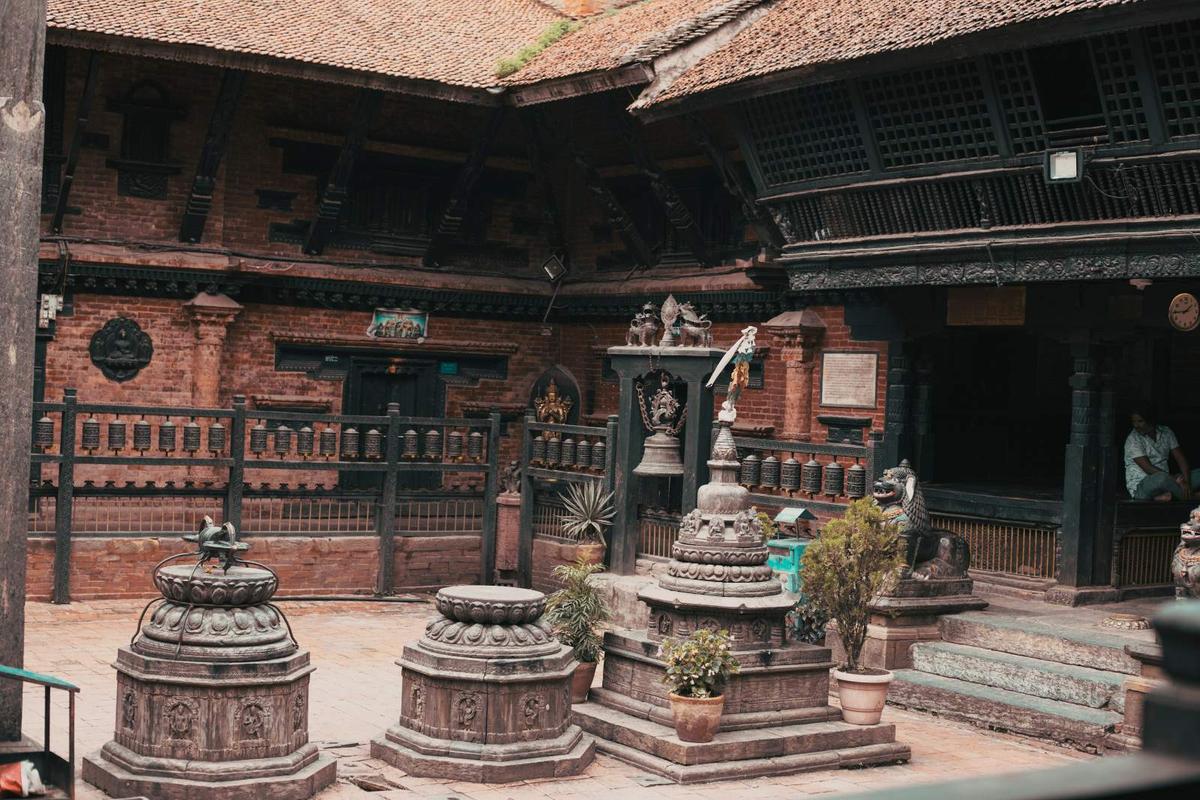
A little south of Mahabouddha, Uku Bahal is attributed to the 6th century and King Shiva Deva, though most of what you see today dates from the 1800s. Its carved roof struts are among the oldest in the valley, and the courtyard is crowded with statues, including Victorian-style British lions and a Rana general.
Pharping: the caves of Guru Rinpoche on the southern rim
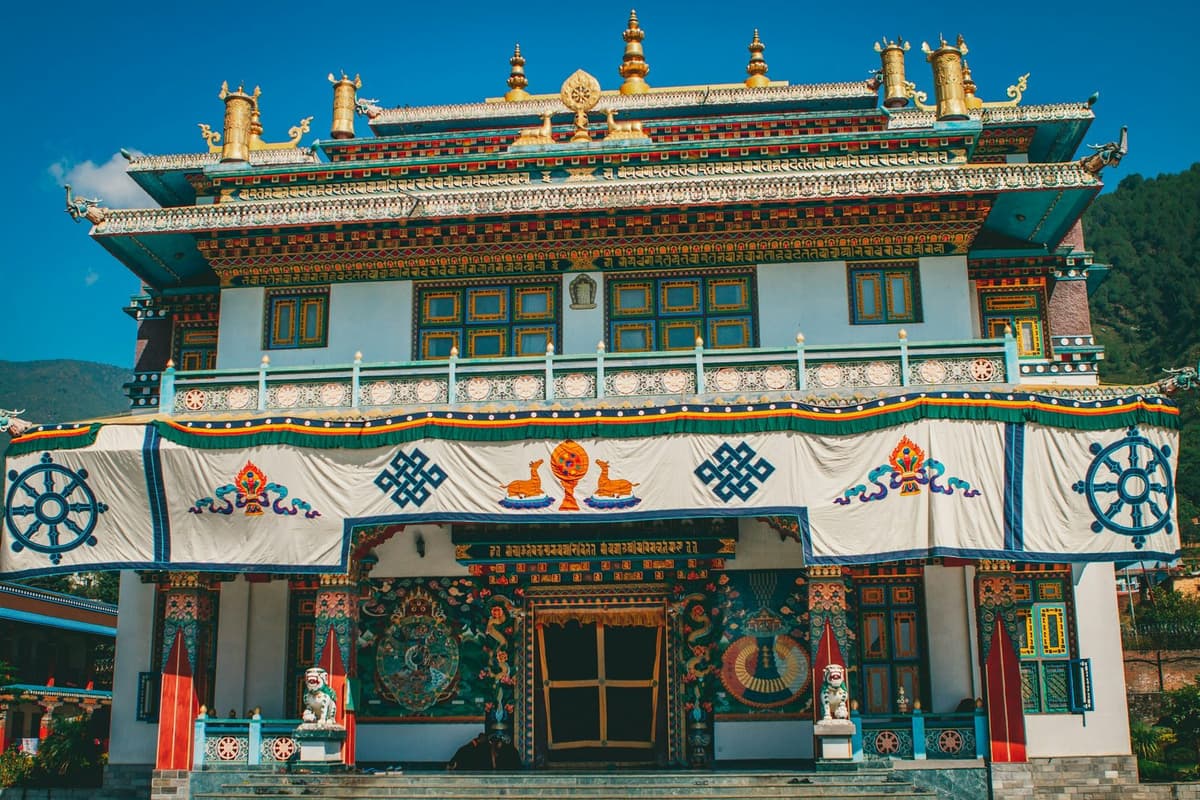
Pharping is a hill town above the Bagmati river on the southern edge of the Kathmandu Valley, and an important place of pilgrimage for Tibetan Buddhists. Guru Rinpoche (Padmasambhava), the great teacher of Tibetan Buddhism, meditated in two caves here: the Asura Cave, the "upper cave", and Yanglesho, the "lower cave".
It is also one of the clearest examples of the valley's shared religion. Shesh Narayan, a Vishnu shrine, sits below the Yanglesho cave, a Vajrayogini temple stands between Yanglesho and the town, and the Hindu temple of Dakshinkali is close by. That makes Pharping easy to combine with Dakshinkali in one trip. The cave entrances are small and you may need to stoop; take your shoes off and go in one or two at a time.
If you want a longer Buddhist pilgrimage day, Namo Buddha lies outside the valley near Panauti in Kavre district. Its legend tells of one of the earlier Buddhas offering his own body to a starving tigress and her cubs.
Kathmandu's Buddhist temples and monasteries compared
Use this table to pick two or three places for your day. Fees are the foreign-visitor rate where an official or reported figure exists; "not published" means we could not find one, not that entry is free. Timing advice is our own, from running these visits.
| Place | Tradition | Area | Foreigner fee | Best time of day | Good for |
|---|---|---|---|---|---|
| Boudhanath Stupa | Tibetan Buddhist centre; Newar name Khasti Chaitya | Boudha, 8 km east of downtown | NPR 400 (SAARC NPR 100) | Early morning or late afternoon, for the kora | First visit, kora walk, people-watching |
| Swayambhunath Stupa | Newar and Tibetan, with Hindu shrines | Hillock 3 km west of Kathmandu | NPR 200 (SAARC NPR 50) | Early morning, before the crowds | History, city views |
| Kopan Monastery | Tibetan (Mahayana) | Kopan hill, north of Boudha | Not published | Morning; hours not published, ask first | Meditation, courses |
| Shechen Monastery | Tibetan (Nyingma) | Boudha | Not published | Hours not published; ask at the gate | A large working Nyingma monastery |
| Pullahari Monastery | Tibetan (Kagyu) | Hills north of Boudha | Not published | Clear mornings | Calm, views over the valley |
| White Gumba (Seto Gumba) | Tibetan (Drukpa) | North of Swayambhu, outside the Ring Road | Opens only on announced dates | Only when an opening is announced | Seeing from the road; check with us |
| Kathesimbhu Stupa | Newar | Thahiti Chowk, south of Thamel | Not published | Any time in daylight | A quick stop on an old-town walk |
| Chabahil Stupa | Newar | Chabahil, on the Ring Road | Not published | On the way to or from Boudha | Legend of Charumati, old chaityas |
| Golden Temple (Kwa Baha) | Newar | Patan | About NPR 100 | Daylight; hours vary, check at the gate | Gilded courtyard, living ritual |
| Mahabouddha Temple | Newar | Patan | Not published | Midday, when light reaches the courtyard | Terracotta architecture |
| Uku Bahal | Newar | Patan, south of Mahabouddha | Not published | Any time in daylight | Old carved struts, odd statues |
| Pharping caves | Tibetan pilgrimage, with Hindu shrines | Southern rim of the valley | Not published | Morning, paired with Dakshinkali | Pilgrimage, Guru Rinpoche caves |
How should you behave at a stupa or monastery?
Walk clockwise around every stupa, shrine and prayer wheel, take off your shoes and hat before entering a prayer hall, cover your shoulders and knees, and leave leather outside where asked. Inside, sit quietly to one side, never on the monks' mats, keep your feet pointed away from the altar, and ask before photographing people or shrines.
The Nepal Tourism Board puts the first rule in one sentence:
"Walking around temples or stupas is traditionally done clockwise."
Nepal Tourism Board, Cultural etiquette
The rest follows from respect for a working place of worship.
- Shoes. Nepalis usually take their shoes off before entering a place of worship. Look for the pile of shoes at the door and add yours.
- Leather. Leather articles are prohibited inside some temple areas. At the Golden Temple you will be asked to leave belts and bags outside.
- Clothes. Skimpy outfits are frowned upon, and men should always wear a shirt in public. Kopan Nunnery recommends bringing a light shawl to cover your shoulders.
- Inside the prayer hall. Walk clockwise, keep silent, take your hat off, and never sit on the floor mats kept for the monks.
- Feet and heads. Do not point your feet at monks, the altar or holy objects. Do not touch anyone's head, including young monks; it is impolite to touch an adult Nepali's head.
- Meeting a lama. It is traditional to offer a kata, the white ceremonial scarf, usually sold near the monastery.
Buddhist festival dates in Kathmandu, December 2026 to May 2027
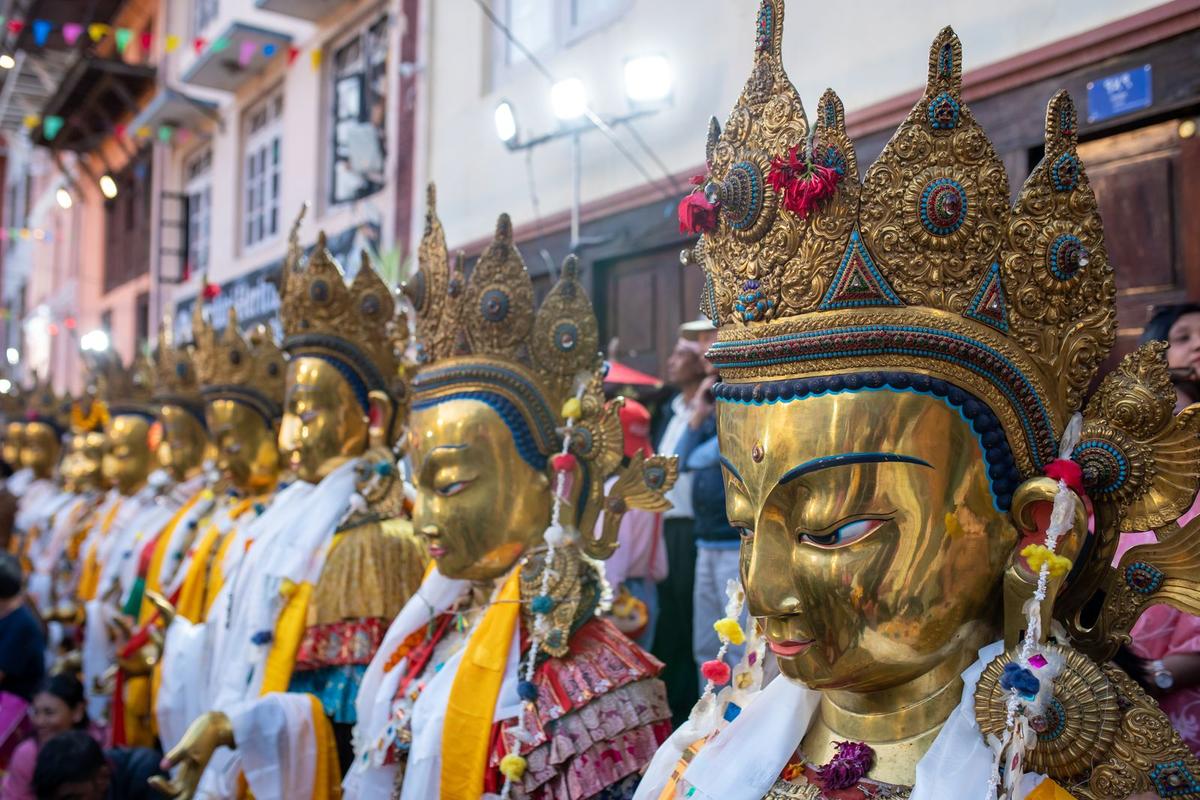
Festival days are the best and the busiest days to visit. Dates below come from the government's holiday list where one exists.
| Festival | Date | Where to see it | Status |
|---|---|---|---|
| Kopan stupa consecrations | 11 Dec 2026 (monastery); 14 Dec 2026 (nunnery) | Kopan | Announced by Kopan |
| Tamu Lhosar (Gurung new year) | Wed 30 Dec 2026 | Gurung communities | National public holiday |
| Samyak Mahadan, Kathmandu | Mid-January 2027 (Magh 1) | Swayambhu Bhuikhel | Planned by Kathmandu Metropolitan City; check closer to the date |
| Sonam Lhosar (Tamang new year) | Sun 7 Feb 2027 | Tamang communities | National public holiday |
| Gyalpo Lhosar (Tibetan and Sherpa new year) | Tue 9 Mar 2027 | Boudhanath | National public holiday |
| Buddha Jayanti (Buddha's birthday) | Baisakh full moon, usually in May | Swayambhunath | 2027 date not yet in a government list |
Lhosar means new year, and the valley marks three of them, all national public holidays: Tamu Lhosar (Gurung), Sonam Lhosar (Tamang) and Gyalpo Lhosar (Tibetan and Sherpa). Gyalpo Lhosar is the one to see at Boudha, where the Sherpa community gathered to celebrate in 2025; in 2026 it fell on 18 February.
The rarest event in the coming year is the Samyak Mahadan, a Newar Buddhist festival of giving, when Buddha images from many monasteries are gathered in one place and the community makes offerings. Kathmandu Metropolitan City plans to hold it at Swayambhu Bhuikhel in mid-January 2027 (Magh 1 in the Nepali calendar), the first in Kathmandu in 22 years. By tradition it is held every 12 years in Kathmandu, every five years in Patan and every year in Bhaktapur. Dates for events like this can move, so check closer to the time.
Buddha Jayanti, the Buddha's birthday, falls on the Baisakh full moon, usually in May; in 2026 it was 1 May. The government confirms each year's date in its spring holiday list, so we will not print the 2027 date yet. The Nepal Tourism Board notes that Swayambhu draws its largest crowds on that day.
On big festival days, keep your phone and wallet in a front pocket or a zipped bag, agree a meeting point in case your group gets separated in the crowd, and expect taxis to drop you some way from the stupa.
A half-day and a one-day Buddhist route
For a half day, stay on the east side: Boudhanath and the monasteries above it. For a full day, cross the valley from Swayambhu in the west, through the old town and Patan, and finish at Boudhanath. Traffic decides how much you fit in, so keep a spare stop you can drop.
Half day: Boudha and Kopan hill
- Start at Kopan Monastery in the morning, when it is quiet; check the day is not a ceremony or course day.
- Continue up the ridge to Pullahari if you want the calmer, higher monastery.
- Come down to Shechen Monastery, near the stupa.
- Finish with the kora around Boudhanath, then tea at one of the rooftop cafés overlooking the dome.
One day: west to east across the valley
- Swayambhunath early, by the eastern stairway or the road to the top.
- Kathesimbhu and Itum Bahal on a short walk through the old town.
- Patan: Golden Temple, Mahabouddha and Uku Bahal, with lunch near Durbar Square.
- Chabahil Stupa on the Ring Road as you head east.
- Boudhanath for the late-afternoon kora.
If you want caves rather than courtyards, make Pharping and Dakshinkali a separate half day on the southern rim. To see both stupas with the valley's other World Heritage sites in one day, our Kathmandu UNESCO World Heritage sites day tour does that with a licensed guide.
Frequently asked questions
Which is the biggest stupa in Nepal?
Boudhanath, on the eastern side of Kathmandu, is the biggest stupa in Nepal. UNESCO's World Heritage listing says the Bauddhanath zone "includes the largest stupa in Nepal", and the Nepal Tourism Board calls it the largest stupa in the Kathmandu Valley. Published height figures disagree with each other, so we do not quote one. It stands 8 km east of downtown Kathmandu.
Which is the oldest stupa in Nepal?
For the Kathmandu Valley, the answer is Swayambhunath: UNESCO says its religious ensemble includes the oldest Buddhist monument, a stupa, in the valley. Inscriptions suggest the hill was a Buddhist site by about the 5th century, and the Nepal Tourism Board credits King Manadeva with building it around 460 AD. UNESCO's wording covers the valley only, so treat claims about all of Nepal with care.
What are the visiting hours of Kopan Monastery?
Kopan Monastery does not publish day-visitor hours on the official web pages we read, so treat fixed times you see online with care. Day visitors can explore the grounds, and Lonely Planet notes you can join the morning meditation sessions. Ask us before your day and we will check with the monastery, especially during the November Course and the December 2026 stupa ceremonies.
Is White Gumba open?
Not on a regular schedule. White Gumba (Seto Gumba, the Druk Amitabh Mountain monastery north of Swayambhu) opens to the public only on dates the monastery announces. The last opening we can confirm was ten days in May 2025, and it closed early at least once because the crowds grew too large. We found no 2026 opening when we checked on 23 November 2026.
What is the entry fee for Boudhanath and Swayambhunath?
Boudhanath charges foreign visitors NPR 400 and SAARC nationals NPR 100; Swayambhunath charges NPR 200 and NPR 50. Chinese nationals pay the same as other foreigners at both, and children under 10 enter free. These are the Nepal Tourism Board's listed fees, checked on 23 November 2026. The Boudha ticket covers the stupa area, not the monasteries around it.
Which direction do you walk around a stupa?
Always clockwise, keeping the stupa on your right. The Nepal Tourism Board's etiquette guidance says walking around temples or stupas "is traditionally done clockwise", and the same goes for prayer wheels and shrines inside a gompa. If you stop for a photo, step to the outer edge of the path so you do not block the people walking the kora behind you.
Plan your Buddhist temple visit with us
Boudhanath and Swayambhunath are easy to see on your own; the monasteries, the Patan courtyards and Pharping are where a licensed guide earns their place, because opening days change and much of the meaning is in the details. For the rest of the valley, go back to our places to visit in Kathmandu guide. If you would like us to arrange the day, these are the trips that cover these sites:
- Kopan, Pullahari, Shechen and Boudhanath monasteries day tour
- Kathmandu UNESCO World Heritage sites day tour
- Cultural and heritage tours in Nepal
Send us a WhatsApp message or use the enquiry form with your dates, and our Kathmandu team will help you plan.