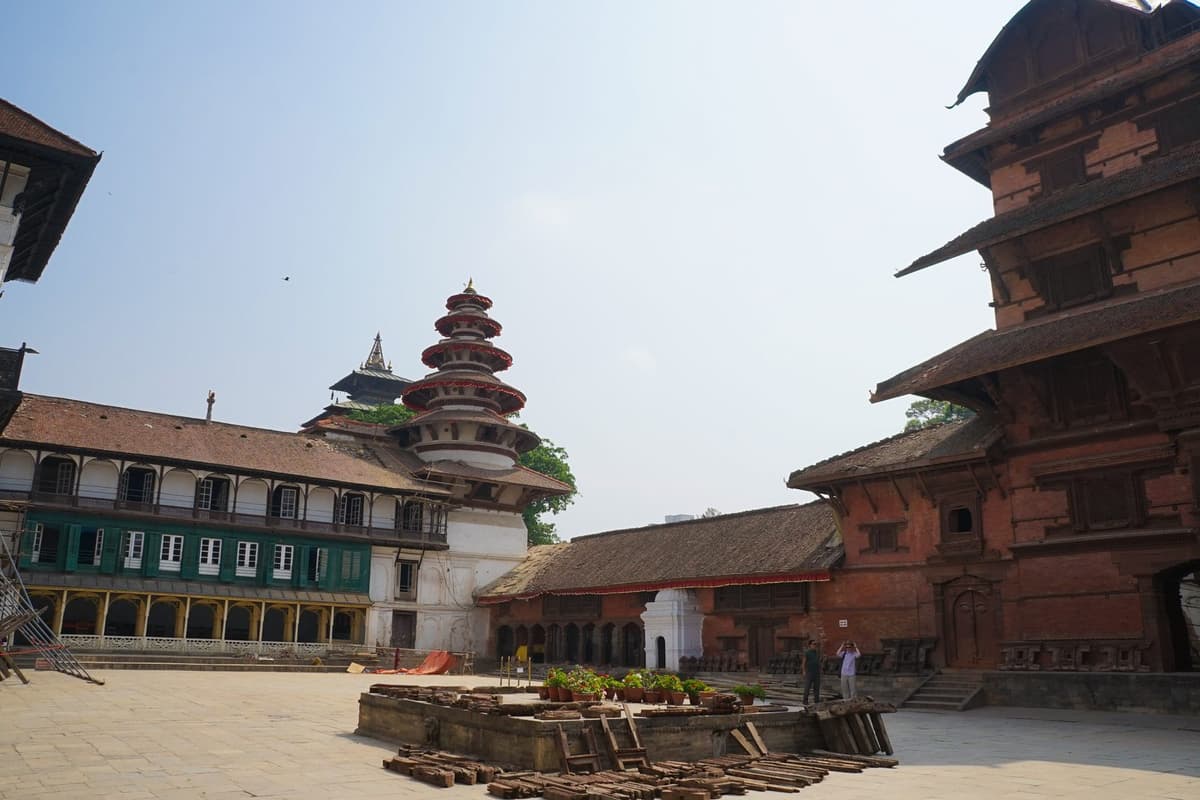
Beside the palace gate in Kathmandu Durbar Square, a figure of Hanuman stands cloaked in red under an umbrella. Pigeons lift off the temple plinths outside, and handicraft sellers lay out their mats on the brick. Step through the gate and the noise of the square drops away: you are in a wide paved courtyard, with a nine-storey tower rising at its edge.
By Uncover Nepal Team · Checked by our Kathmandu travel team · Last checked 9 November 2026
Hanuman Dhoka in Kathmandu is the old royal palace on Kathmandu Durbar Square: courtyards, towers and museum rooms built by Malla and Shah kings from roughly the 15th to the 20th century. Your Durbar Square ticket covers the palace museum, according to the Nepal Tourism Board. Our guide to places to visit in Kathmandu sets it beside the rest of the city.
Key facts
- What it is
- Kathmandu's royal palace, built roughly 15th to 20th century; main builders Mahendra Malla, Pratap Malla, Prithvi Narayan Shah (Hanumandhoka Durbar Museum Development Committee (9 Nov 2026))
- UNESCO
- In the Kathmandu Durbar Square (Hanuman Dhoka) zone, one of seven monument zones of the Kathmandu Valley property, inscribed 1979 (UNESCO World Heritage Centre; museum committee history page (9 Nov 2026))
- Ticket
- NPR 1,000 foreign; NPR 500 SAARC, including Indians; Nepalis and under-10s free (Nepal Tourism Board fee table (9 Nov 2026))
- Includes
- The Tribhuvan Museum in the palace, per NTB (Nepal Tourism Board fee table (9 Nov 2026))
- Museum hours
- 9 am to 5 pm; ticket counter 9 am to 4:30 pm (Museum committee ticket page, updated 5 Nov 2026 (9 Nov 2026))
- Open square
- Can be entered at any time (ekantipur, 5 Sep 2025 (9 Nov 2026))
- Courtyards
- More than ten; four open to the public (Museum committee (9 Nov 2026))
- Basantapur Tower
- Nine storeys, built 1770; reopened 20 May 2025 (ECS Nepal, April 2012; Lonely Planet; Setopati, 20 May 2025 (9 Nov 2026))
In this guide
- Hanuman Dhoka Kathmandu: what is the palace and who built it?
- Hanuman Dhoka Durbar Square: is the palace the same as the square?
- Which courtyards can you see inside the palace?
- What is the Basantapur Tower?
- How was the palace rebuilt after the 2015 earthquake?
- What is inside the palace museum?
- Which temples stand around the palace?
- How do you plan a visit: ticket, hours and timing?
- What is the best route through the palace, step by step?
- Frequently asked questions
- Plan your visit
Hanuman Dhoka Kathmandu: what is the palace and who built it?
Hanuman Dhoka is the palace where Kathmandu's kings lived and ruled, first the Malla kings of the city and later the Shah kings of Nepal. It grew from about the 15th to the 20th century, so what you walk through is a set of courtyards from different reigns joined together. The museum committee names three main builders: Mahendra Malla, Pratap Malla and Prithvi Narayan Shah.
Why is it called Hanuman Dhoka?
Dhoka means gate, and the palace takes its name from the Hanuman statue at its main gate. The museum committee records when it arrived:
"...Pratap Malla installed an icon of Hanuman in front of the main gate in 1672 A.D."
Hanumandhoka Durbar Museum Development Committee, history page, checked 9 November 2026
Hanuman is the monkey god of the Ramayana, the loyal servant of Rama. The ticket counter is right beside the statue.
Malla kings, Shah kings and a Rana hall
The museum names Ratna Malla, in 1482, as the first king of an independent Kathmandu. Mahendra Malla built the Taleju temple, which rises over the palace walls, and the Jagannath temple on the square. Pratap Malla added the Hanuman statue, the Kal Bhairav and Seto Bhairav images, and two residential courtyards, Sundari Chowk and Mohan Chowk.
After Prithvi Narayan Shah took the valley, he built the nine-storey Basantapur Tower and the towers around Lohan Chowk. In 1908 the Rana prime minister Chandra Shumsher added the Gaddi Baithak, a white hall in European style facing the square.
Hanuman Dhoka Durbar Square: is the palace the same as the square?
No. The palace is the walled complex of courtyards behind the Hanuman gate; Kathmandu Durbar Square is the open square of temples around it. People use "Hanuman Dhoka" for both, and UNESCO's own list names Kathmandu's Durbar Square zone after Hanuman Dhoka. One ticket covers the square and the palace museum.
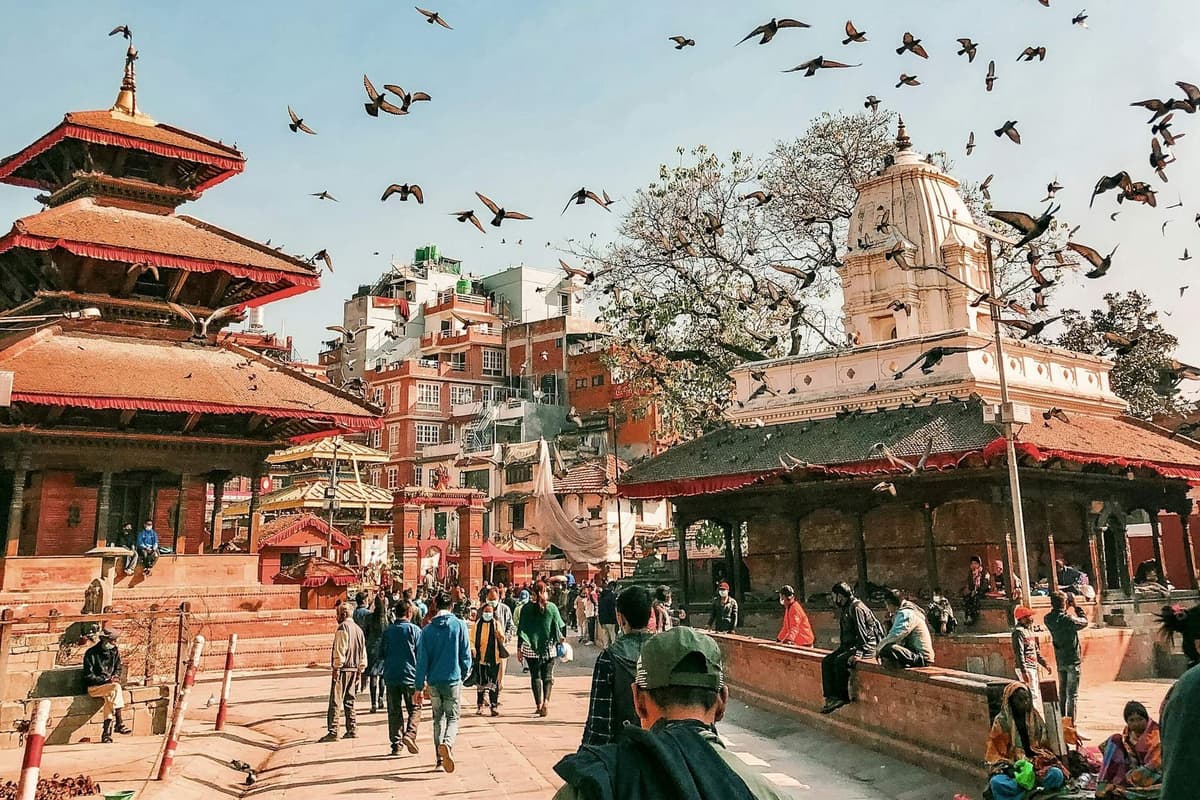
The zone is one of seven in the Kathmandu Valley World Heritage property, inscribed in 1979:
"Located in the foothills of the Himalayas, the Kathmandu Valley World Heritage property is inscribed as seven Monument Zones."
UNESCO World Heritage Centre, Kathmandu Valley, checked 9 November 2026
The open square can be entered at any time, early morning or after dark; the palace keeps set hours. For the square's temples, the Kumari Ghar and Kasthamandap, read our Kathmandu Durbar Square visitor's guide. This article stays inside the palace walls.
The valley's other royal squares, Patan Durbar Square and Bhaktapur Durbar Square, are monument zones in the same property, each with its own palace and ticket.
Which courtyards can you see inside the palace?
The palace has more than ten courtyards, and the museum committee says four are open to the public; ECS Nepal wrote in 2012 that there were once more than forty. The visitor route can change while restoration continues, so ask at the counter what is open on the day. These four are worth knowing by name.
| Courtyard | Built by, and when | What to look for |
|---|---|---|
| Nasal Chowk | The main courtyard, where Shah kings were crowned | Pratap Malla's Narsingha statue (1673); the Basantapur Tower above |
| Mohan Chowk | Around 1650, the Malla kings' residential courtyard; credited to Pratap Malla | A private royal court, built for daily life rather than ceremony |
| Sundari Chowk | Pratap Malla's residential courtyard | A stone Kaliya-damana: Krishna subduing the serpent Kaliya |
| Lohan Chowk | Prithvi Narayan Shah | Four red towers named for the valley's four old cities |
Nasal Chowk: the coronation courtyard
Nasal Chowk is the large courtyard you reach through the Hanuman gate, and it is where the Shah kings were crowned. King Birendra's coronation was held here in 1975, as Desmond Doig described in Nepali Times, and the practice continued up to King Gyanendra in 2001. Look for the Narsingha statue, Vishnu in his man-lion form, which Pratap Malla set up in 1673, then look up at the Basantapur Tower rising over the courtyard.
Mohan Chowk and Sundari Chowk: the Malla royal quarters
Mohan Chowk was built around 1650 (sources give both 1649 and 1650) as the residential courtyard of the Malla kings, and Sundari Chowk was another of Pratap Malla's private courts, with its stone Kaliya-damana. You may be able to walk in, or only look in from a doorway, depending on the route that day. Ask at the counter rather than trusting an older guidebook.
Lohan Chowk and its four towers
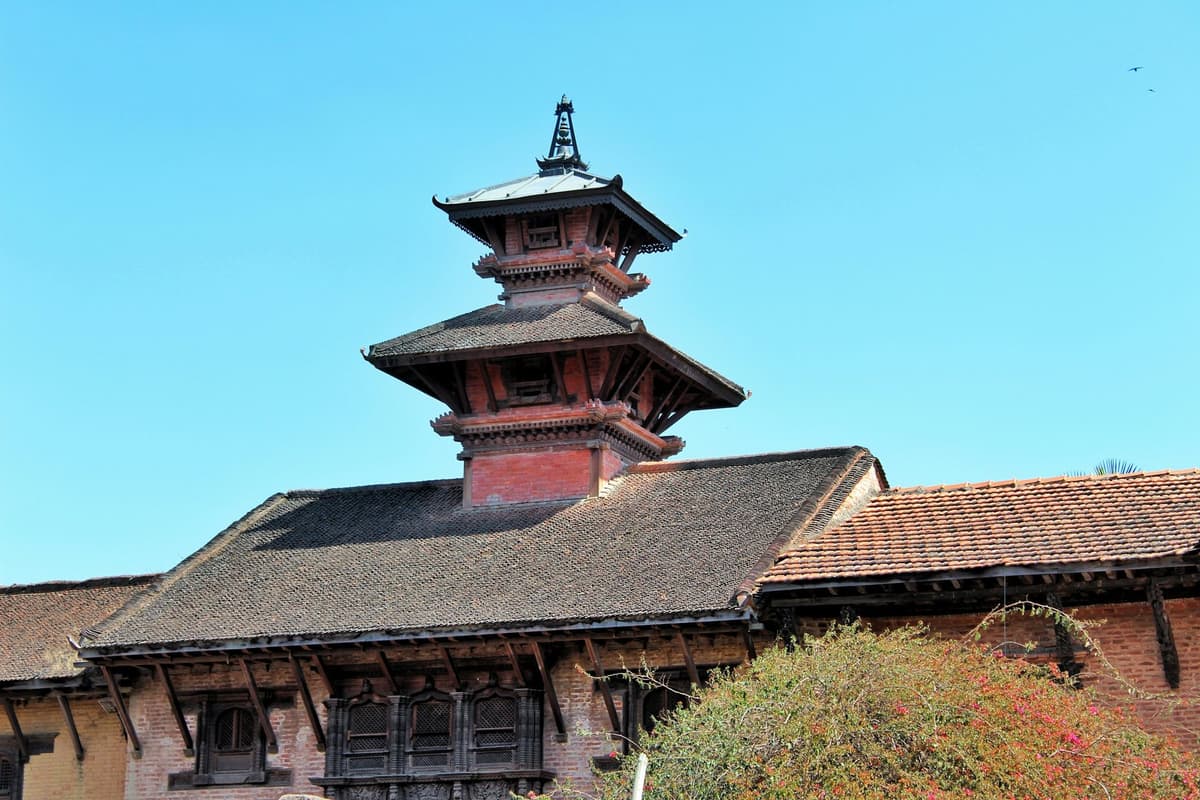
Prithvi Narayan Shah had four red towers built around Lohan Chowk, each named for one of the valley's old cities: the Basantapur Tower for Kathmandu, the Kirtipur Tower, the Bhaktapur Tower (also called Lakshmi Bilas) and the Patan or Lalitpur Tower. Having taken the valley, the new king put its four cities into the architecture of his palace.
What is the Basantapur Tower?
The Basantapur Tower, also called the Nautalle Durbar or Nine-Storey Palace, is the great tower of Hanuman Dhoka. It was built for Prithvi Narayan Shah, and both ECS Nepal (2012) and Lonely Planet date it to 1770. ECS adds that, according to Prithvi Narayan Shah's own inscription, the Basantapur palace was built as a pleasure pavilion.
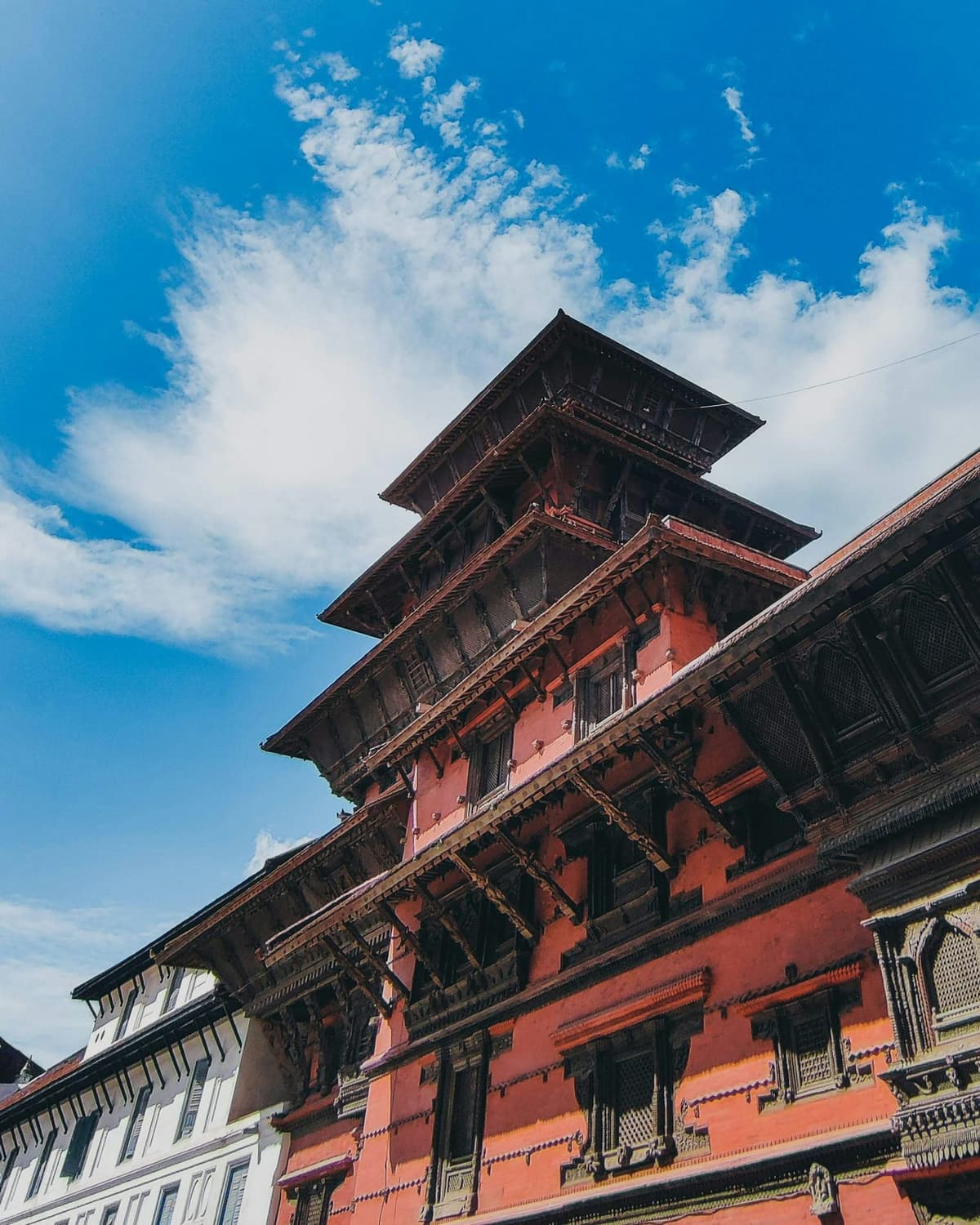
It stands where the palace meets Basantapur, the open square beside the old temples. From Basantapur you see its carved windows and stacked roofs from below; from Nasal Chowk you see it rising over the courtyard. Its upper tiers collapsed in the 2015 earthquake. It reopened to the public on Tuesday 20 May 2025, International Archaeology Day, when the Minister for Culture, Tourism and Civil Aviation, Badri Prasad Pandey, inaugurated it. Whether its upper floors are open on a given day is not published, so ask at the counter.
How was the palace rebuilt after the 2015 earthquake?
The palace has been rebuilt piece by piece since the 2015 earthquake, with different partners on different buildings. The two projects visitors notice most are the Basantapur Tower, restored with Chinese aid and reopened in May 2025, and the Gaddi Baithak, the Rana-era hall facing the square, rebuilt with the engineering firm Miyamoto and ICOMOS Nepal.
China Daily called the Basantapur Tower restoration China's first large-scale heritage aid project in Nepal. A Hebei heritage institute took on design and management from November 2016, the design was approved in April 2017, and the tower was handed back to Nepal after an eight-year project, as reported in January 2025.
The Gaddi Baithak, built in 1908, cracked in 2015. The rebuilding, with the Department of Archaeology, drew debate over the design of its balcony, and the hall was reported reopened by April 2022. We have not confirmed whether visitors can go inside at present.
Across the World Heritage Sites of Kathmandu, Patan and Bhaktapur, 174 heritage structures were damaged. By May 2025, 134 had been rebuilt, 16 were in progress and 24 had not been started, according to Department of Archaeology figures reported by The Rising Nepal. Expect some scaffolding and stacked timber, and treat it as part of the story.
What is inside the palace museum?
The palace museum is a set of galleries inside the palace, run by the Hanumandhoka Durbar Museum Development Committee. The committee mentions three memorial museum galleries, and the Nepal Tourism Board lists the Durbar Square ticket as including the Tribhuvan Museum. Ask at the counter which galleries are open on the day.
We say that because the last dated report we found, from around 2021, said the Tribhuvan, Mahendra and Birendra galleries were still closed, and we could not find a newer one. A gallery of jewellery and statues found in a chest during excavation, called the Gargahana (jewellery) Museum, opened in December 2020 for the committee's tenth anniversary.
Which temples stand around the palace?
Several of the square's most important temples were built by the same kings as the palace, and your ticket lets you see them all from outside on the same visit. The ones to know are the Taleju and Jagannath temples, the Kal Bhairav and Seto Bhairav images and the Kumari Ghar. Taleju itself opens only on one day of the year.
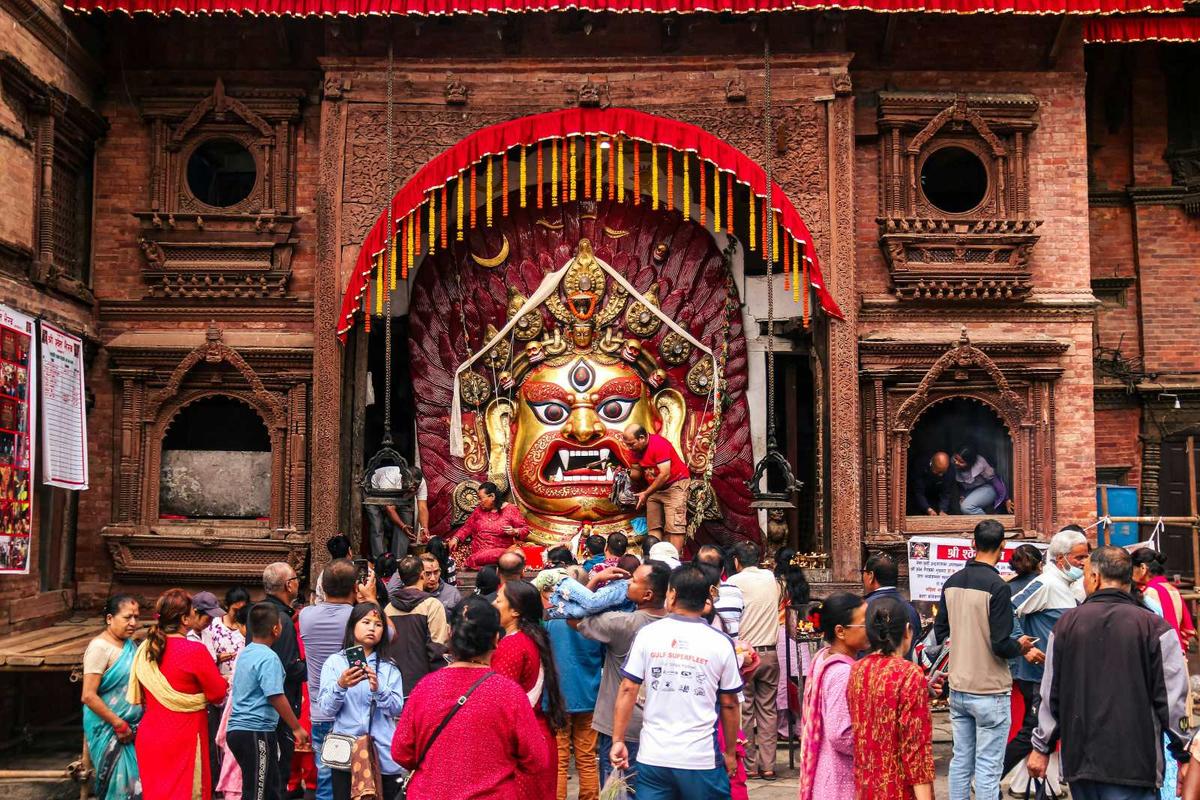
- Taleju temple. Temple of the Mallas' royal goddess, built in 1564 under Mahendra Malla, as reported. It opens only on Maha Navami, during Dashain.
- Jagannath temple. Built by Mahendra Malla, per the museum; Lonely Planet says it "may actually date back to 1563" and notes its erotic roof-strut carvings. Nobody knows why such carvings exist; The Kathmandu Post (2020) lists ideas from lightning protection to Tantric belief.
- Kal Bhairav. The image of Bhairav, Shiva in his fierce form, installed by Pratap Malla.
- Seto Bhairav. Another of Pratap Malla's works, a gilded mask on the palace wall.
- Kumari Ghar. Home of the Living Goddess, built in 1757 by Jaya Prakash Malla. She appears at the window a few times a day, with no fixed timetable. Never photograph her.
Our guide to temples in Kathmandu covers these and the valley's other big temples one by one.
How do you plan a visit: ticket, hours and timing?
You buy one Durbar Square ticket, and according to the Nepal Tourism Board it covers the palace museum too. The counter is in the Tribhuvan Sadan building beside the Hanuman statue. The museum is open 9 am to 5 pm, and the counter sells tickets until 4:30 pm. Keep the ticket with you.
| Item | Detail | Source (checked) |
|---|---|---|
| Foreign visitors | NPR 1,000 | NTB fee table (9 Nov 2026) |
| SAARC visitors, including Indians | NPR 500 | NTB fee table (9 Nov 2026) |
| Nepali visitors | Square free; museum NPR 100, students NPR 50 | Museum committee (9 Nov 2026) |
| Children under 10 | Free | NTB fee table (9 Nov 2026) |
| Included | The square and the Tribhuvan Museum, per NTB | NTB fee table (9 Nov 2026) |
| Museum hours | 9 am to 5 pm; counter 9 am to 4:30 pm | Museum committee (9 Nov 2026) |
| Open square | Any time | ekantipur, 5 Sep 2025 (9 Nov 2026) |
Indians pay the SAARC rate because the NTB fee table has no separate Indian column. Kathmandu Metropolitan City sets the fee.
When is the best time to go?
October and November are the most comfortable months; the Nepal Tourism Board says "the clearest skies are found after the monsoon in October and November". At Kathmandu's airport station, November averages 23.6 °C by day, 8.4 °C at night and 6.4 mm of rain (1991 to 2020 normals). The monsoon normally runs from 13 June to 2 October, and July averages 384.1 mm, so in summer go in the morning: the museum is indoors.
Indra Jatra and Dashain
Indra Jatra is the square's own festival. In 2026 it was held in late September at Basantapur, with the chariots of Ganesh, Bhairav and Kumari, and ended on 29 September with the Nanicha Yah procession and the lowering of the Indra pole. Indra Jatra 2027 is expected on Tuesday 14 September 2027; the official list is not out yet. Festival days are crowded, so plan the museum for another day if you can.
What is the best route through the palace, step by step?
Start at the Hanuman statue, go through the main courtyard to the towers and the museum, and finish back outside among the temples. Buy your ticket first and ask at the counter which courtyards and galleries are open that day. Where the museum's own signs differ from this route, follow them.
- Start at the Hanuman statue. Buy or show your ticket at the counter beside it, and ask which courtyards and galleries are open.
- Go through the gate into Nasal Chowk. Find the Narsingha statue and picture the coronations held here, up to King Gyanendra's in 2001.
- Look up at the Basantapur Tower. See how it joins the older palace wings, and ask whether its upper floors are open.
- Find Lohan Chowk. Match each of the four towers to its city: Kathmandu, Kirtipur, Bhaktapur and Patan.
- Walk the museum galleries that are open. Look for the jewellery gallery.
- See Mohan Chowk and Sundari Chowk if they are on the route. Look for the Kaliya-damana in Sundari Chowk.
- Come back out and walk the outside. Pass Seto Bhairav, Kal Bhairav, the Jagannath temple and the walls of Taleju, then the Kumari Ghar, and finish in Basantapur under the nine-storey tower.
Frequently asked questions
Can I see Kathmandu's UNESCO sites in one or two days?
Yes. All seven monument zones of the Kathmandu Valley World Heritage property can be reached in one long day by vehicle, and two days lets you see them at an easier pace. Our day tour covers all seven in one day and our two-day tour adds a night in Bhaktapur; choose by how much time you have.
How many days do I need in Kathmandu?
We suggest one full day to see several of the main sites, and two to three days for the three Durbar Squares, the big stupas and a hike on the valley rim. Hanuman Dhoka on its own fits into a morning or an afternoon. Add a day if you are starting a trek, so you can rest and sort your gear.
What are the best day trips and day hikes from Kathmandu?
Patan and Bhaktapur are the classic first day trips. Further out, Changu Narayan is about 12 km east, Doleshwor Mahadev about 20 km away, Dakshinkali about 22 km and Nagarkot about 32 km, usually 1.5 to 2 hours by road. The uphill walk from Changu Narayan to Nagarkot takes about 4 to 5 hours. Our guide to Kathmandu day trips has the full list.
How much is the Hanuman Dhoka ticket, and does it include the museum?
Foreign visitors pay NPR 1,000 and SAARC visitors, including Indians, NPR 500; children under 10 go free. The Nepal Tourism Board lists this Kathmandu Durbar Square ticket as including the Tribhuvan Museum in the palace, so you do not buy a second ticket. Nepalis enter the square free and pay NPR 100 for the museum.
What are the opening hours of Hanuman Dhoka?
The palace museum is open from 9 am to 5 pm, and the counter beside the Hanuman statue sells tickets from 9 am to 4:30 pm, according to the museum committee's page updated in November 2026. The open square can be entered at any time. Closed days are not published, so ask at the counter if you are planning around a holiday.
Plan your visit
Hanuman Dhoka is easy to visit on your own with the ticket and hours above. If you would rather have the day arranged, our three Durbar Squares tour of Kathmandu takes in Hanuman Dhoka, Patan and Bhaktapur. The Kathmandu UNESCO World Heritage day tour reaches all seven monument zones in one full day, and the two-day tour of all seven Kathmandu UNESCO sites covers the full set at a slower pace.
For the rest of your time in the city, our guide to places to visit in Kathmandu gives the bigger picture.
Send us your dates on WhatsApp or through the enquiry form, and tell us how many days you have in Kathmandu. We will tell you honestly what fits and send a quote.
Your Nepal visa and international flights are your own arrangements; official visa information is on the Nepal Tourism Board tourist-visa page.