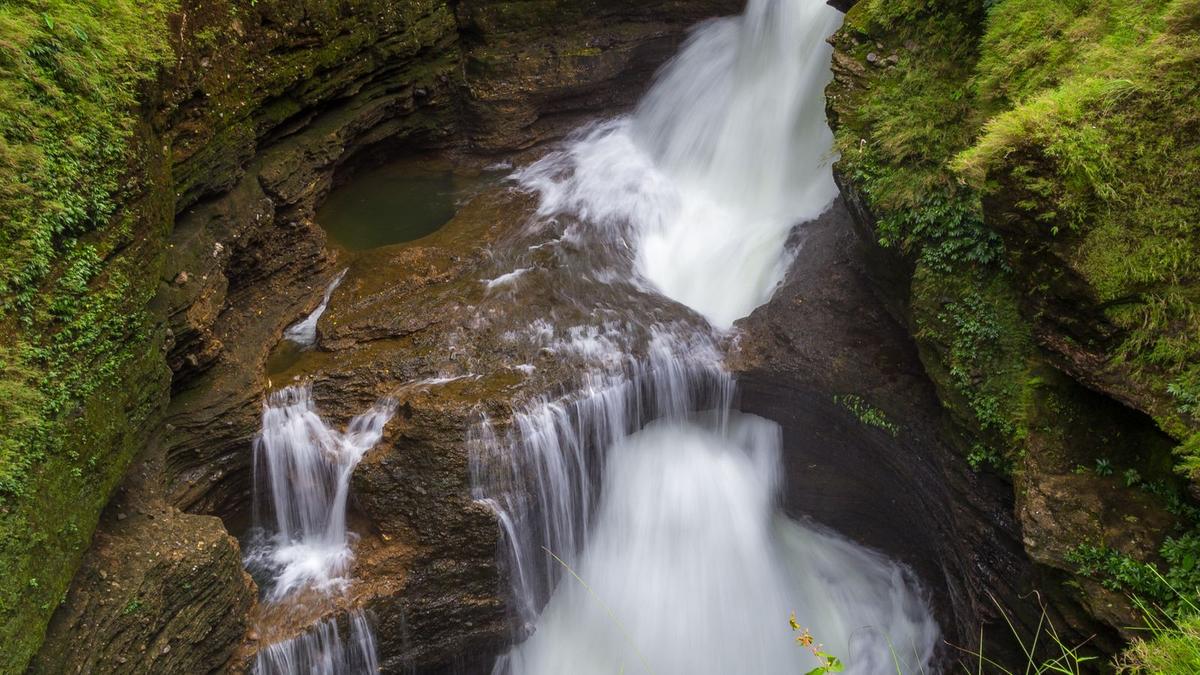
You hear Davis Falls before you see it. Step through the gate off the Siddhartha Highway and the Pardi stream, which has just left Phewa Lake, drops into a narrow gorge of wet, mossy rock and simply disappears into the ground. Straight after the monsoon the noise is loud enough that people stop talking and point.
By Uncover Nepal Team · Checked by our Kathmandu travel team · Last checked 9 November 2026
If you search for Davis Fall Pokhara, you will also see it written Devi's Fall; locally it is Patale Chhango. It is the point where water from Phewa Lake plunges into a gorge and runs underground, about 2 km south-west of Pokhara Airport, opposite Gupteshwor Mahadev Cave. It is a short, worthwhile stop on any list of things to do in Pokhara.
Key facts
- Other names
- Devi's Fall, Davi's Fall; Nepali name Patale Chhango, "Fall of the Netherworld" (Nepal Tourism Board; Lonely Planet (9 Nov 2026))
- Location
- About 2 km south-west of Pokhara Airport on the Siddhartha Highway (Nepal Tourism Board; Lonely Planet (9 Nov 2026))
- Ward
- Pokhara Metropolitan City ward 17, Chhorepatan; the cave opposite is in the same ward (Pokhara Metropolitan City tourism website; Gupteshwor Mahadev Cave website (9 Nov 2026))
- Where the water comes from
- Phewa Lake; the Pardi Khola stream vanishes underground at the falls (Nepal Tourism Board; Lonely Planet (9 Nov 2026))
- Who runs the gate
- Chhorepatan Secondary School, which has collected the entry fee since 2035 BS (about 1978) (RSS via Onlinekhabar, 4 Aug 2023 (9 Nov 2026))
- Ticket
- City tourism website: NPR 30, not broken down by visitor type. Last press report of the gate's own rates: NPR 100 for most foreign visitors. Check at the gate (Pokhara Metropolitan City tourism website, undated; RSS via Onlinekhabar, Aug 2023; The Longest Way Home, Oct 2026 (9 Nov 2026))
- Opening hours
- 6 am to 6 pm (Pokhara Metropolitan City tourism website, undated (9 Nov 2026))
- Strongest flow
- After the monsoon rains; much smaller outside the monsoon (Lonely Planet; The Longest Way Home, Oct 2026 (9 Nov 2026))
- Across the road
- Gupteshwor Mahadev Cave, a Shiva shrine carved by the same water (Nepal Tourism Board; Lonely Planet (9 Nov 2026))
In this guide
- What is Davis Fall in Pokhara?
- Where is Davis Falls, and how do you get there?
- What does the Davis Fall Pokhara ticket cost, and when is it open?
- What is it like inside the gate?
- When is the best time to see Davis Falls?
- Is Davis Falls safe?
- What is Gupteshwor Mahadev Cave, across the road?
- What else is near Davis Falls?
- How do you fit Davis Falls into a Pokhara day?
- Frequently asked questions
- Plan your visit
What is Davis Fall in Pokhara?
Davis Fall is a short, powerful waterfall where the stream draining Phewa Lake drops into a rock gorge and disappears underground. It is not tall or wide. What makes it worth the stop is watching a whole stream vanish into the rock, and the cave across the road where you can see the same water from below.
The water here has done more than make a waterfall. The Nepal Tourism Board puts it plainly:
"The fall cuts through the rocks to create complex caves and tunnels on its path."
Nepal Tourism Board, "Davi's Fall & Gupteshwar" (undated page, read 9 November 2026)
Gupteshwor Mahadev Cave, on the other side of the highway, is one of those caves. The same page calls it "one such cave carved by Devi's Fall".
Why it has so many names
You will see it written Davis Falls, Devi's Fall, Davi's Fall and, online, simply Devis Fall. They are all the same place. The Nepal Tourism Board heads its page "Davi's Fall" and uses "Devi's Fall" further down, Lonely Planet writes "Devi's Falls", and Pokhara Metropolitan City's tourism website uses "Davis Falls". The Nepali name, Patale Chhango, is translated by the Nepal Tourism Board as "Fall of the Netherworld", which fits a waterfall that drops into the earth. If you ask a local for directions, it is worth knowing both names.
Where the water comes from
The water comes from Phewa Lake. The lake is held back by a dam, and its outflow becomes the Pardi Khola, a small stream (khola means stream or river in Nepali) that reaches the falls at Chhorepatan. Lonely Planet describes the spot as "the point where the Pardi Khola stream vanishes underground".
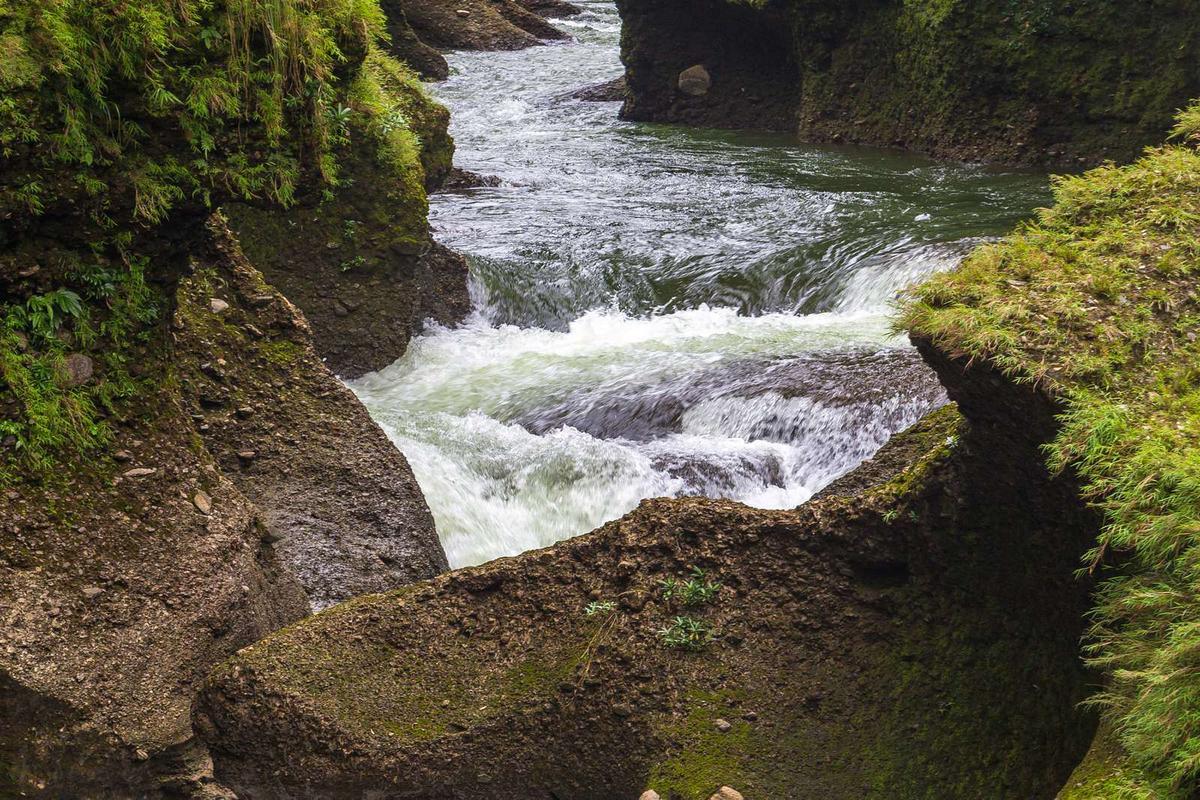
The dam itself has a history. Phewa's dam was first built in 1961 with the Indian government's assistance, was washed away in 1974, and a new dam was completed in 1982, according to The Kathmandu Post. When the monsoon fills the lake and the stream, the falls get louder.
If you have already spent time on the water, our guide to Phewa Lake in Pokhara covers boating rules and the lake's shoreline.
The name story: treat it as a legend
The popular story, told by the Nepal Tourism Board, is that a Swiss visitor was swept away here in 1961 and the falls took the family name. Accounts differ on the details: the city's tourism website mentions a Swiss couple, and Lonely Planet tells its version as "one of the many local legends". Who was swimming, who drowned and who did the naming all change depending on which source you read. So treat it as a local legend, not a record. The year, 1961, comes from the Nepal Tourism Board.
Where is Davis Falls, and how do you get there?
Davis Falls is on the Siddhartha Highway in Chhorepatan, ward 17 of Pokhara Metropolitan City, about 2 km south-west of Pokhara Airport. From Lakeside it is a short taxi ride south. The gate is right on the highway, and Gupteshwor Mahadev Cave is directly across the road, so one stop covers both.
The Siddhartha Highway is the road south towards Butwal, so if you leave Pokhara that way, you pass the falls on your way out. The "Pokhara Airport" in the official directions is the old airport in town. Pokhara International Airport, which began operations on 1 January 2023, is a different place, so do not measure from it when you read a map.
Getting there, step by step
- Take a taxi from Lakeside. Tell the driver "Davis Falls" or "Patale Chhango". Agree the fare before you get in, and ask whether they will wait while you visit the falls and the cave.
- Or cycle or ride a scooter. The route follows the main road south out of town. The highway carries buses and trucks, so this suits confident riders only.
- Get dropped at the gate. The ticket counter is at the entrance on the highway side.
- Cross carefully to the cave. The cave entrance is opposite. Cross where traffic is slowest and do not rush between buses.
Getting to Pokhara first
If you are still in Kathmandu, Pokhara is most of a day by road, often six to nine hours, or about 30 minutes by air.
What does the Davis Fall Pokhara ticket cost, and when is it open?
Pokhara Metropolitan City's tourism website lists the ticket at NPR 30 and the hours as 6 am to 6 pm, without a breakdown by visitor. When the news agency RSS last reported the gate's own rates in August 2023, most foreign visitors paid NPR 100, and a travel guide updated in October 2026 still lists NPR 100. Check the board at the gate.
Davis Falls entry fees by visitor type
| Visitor type | Fee as last reported | Source (checked 9 Nov 2026) |
|---|---|---|
| Third-country (most foreign) visitors | NPR 100 | RSS via Onlinekhabar, 4 Aug 2023; The Longest Way Home, updated 19 Oct 2026 |
| Indian nationals | NPR 80 | RSS via Onlinekhabar, 4 Aug 2023 |
| Nepali citizens | NPR 40 | RSS via Onlinekhabar, 4 Aug 2023 |
| Students (discounted rate) | NPR 20 | RSS via Onlinekhabar, 4 Aug 2023 |
| Listed by the city, visitor type not stated | NPR 30 | Pokhara Metropolitan City tourism website, undated page |
Two things about that table. First, the 2023 report says "Indian", not "SAARC", so do not assume the NPR 80 rate applies to visitors from other South Asian countries; ask at the counter. Second, the school does not publish its rate card online, and the city's single figure does not say who it applies to, so treat all of these as a guide and check the board at the gate.
Who runs the gate, and where the money goes
The gate is run by Chhorepatan Secondary School, which has collected entry fees at Patale Chhango since 2035 BS (about 1978), according to RSS. The ticket money pays for the site's upkeep and for teachers' salaries. In 2023 Pokhara Metropolitan City said it wanted a say in how the site is managed, but we found no report of a change since. So your ticket helps fund a local school.
Opening hours
Pokhara Metropolitan City's tourism website gives the hours as 6 am to 6 pm. The school does not publish its own hours online, so treat that as a guide. The practical answer is to go in good daylight, when the ticket counter is staffed and you can see where you are putting your feet. Carry small notes for the tickets.
What is it like inside the gate?
Inside the gate you look down into the gorge as the stream drops and disappears into the rock. It is a short visit: a path, a view of the falls and the worn gorge walls. There is not much more to it than that, which is why the cave opposite is the natural next stop.
Here is how a visit usually goes:
- Buy your ticket at the counter on the highway side.
- Walk in to the gorge. Follow the path to where you can look down at the falls, and stay on it.
- Find where the water goes. Watch the stream reach the lip and drop out of sight. This is the moment the whole place is about.
- Look at the rock. The gorge walls are worn smooth and often covered in moss, which shows how long the water has been working on them.
- Cross to the cave. If you want to see the same water from underneath, the cave across the road takes you down to a view of the falls from below (when the inner section is open).
Be honest with yourself about what you are coming for. If you expect a tall Himalayan waterfall, this is not it. It is a small, strange, loud piece of geology in the middle of a busy town, and that is the charm.
When is the best time to see Davis Falls?
The best time to see Davis Falls in full flow is during and just after the monsoon, when the stream is at its strongest. Lonely Planet says that after monsoon rains "the sound of the water plunging over the falls is deafening". The falls flow all year, but they are much smaller outside the monsoon season.
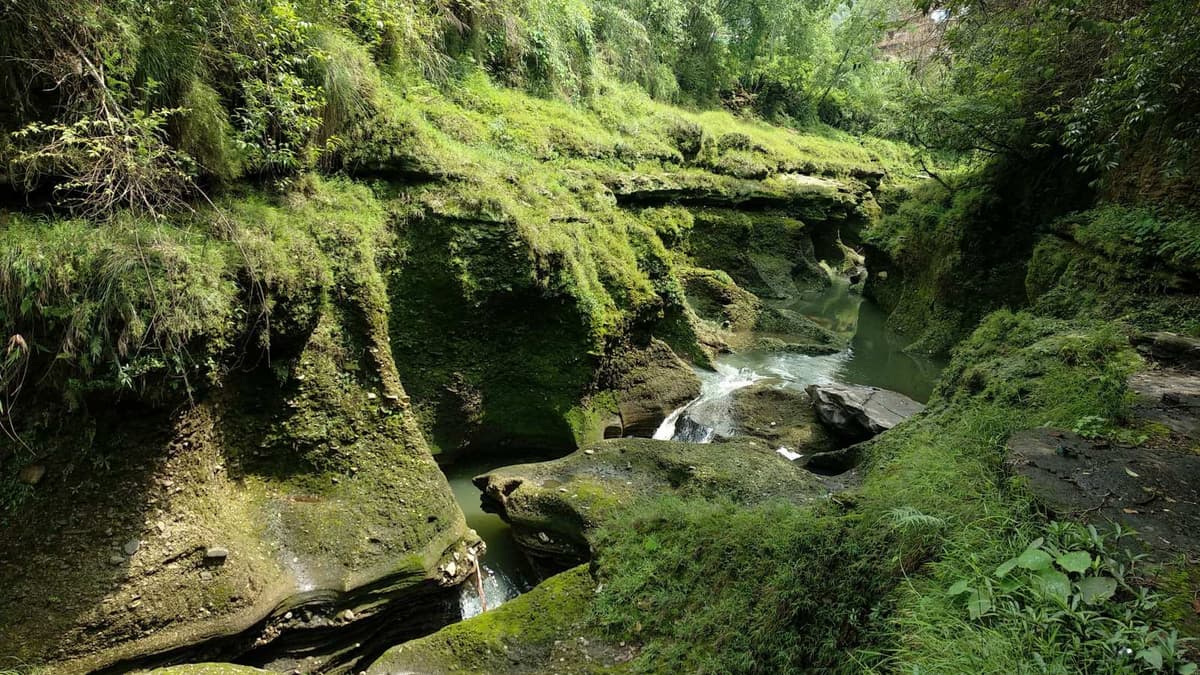
The trade-off is the cave. The inner part of Gupteshwor Mahadev Cave, the section that reaches the view of the falls, usually closes in the rainy season. So the monsoon gives you the loudest falls and the least of the cave, and the dry months give you the opposite.
Season by season
The figures below are 1991 to 2020 normals from the Pokhara Airport weather station, so they describe Pokhara town.
| Season | Pokhara weather (station normals) | What the falls are like |
|---|---|---|
| Monsoon (about mid-June to early October) | June 648.2 mm of rain, July 941.0 mm; June 30.8/21.2 °C, July 30.4/22.4 °C | Strongest flow, loud and full of spray. The cave's inner section usually closes |
| Autumn (October to November) | October 27.9/17.2 °C; November 24.4/12.3 °C, 17.2 mm of rain | Easing as the rain stops. Days are often clearer |
| Winter (December to February) | December 21.0/8.3 °C, 11.5 mm of rain | Little rain, so a much smaller flow |
| Spring (March to May) | No station figures in our sources | Outside the monsoon, so expect a smaller flow, as in winter |
Temperatures are average daily highs and lows. Pokhara gets 3,868.3 mm of rain in a normal year, and the Nepal Tourism Board says 80 per cent of Nepal's rain falls in the monsoon months of June to September. That is why the difference at the falls is so large.
What about November 2026?
The 2026 monsoon fully withdrew on 14 October, and November is normally one of Pokhara's driest months, so expect a smaller flow than at the monsoon peak. The falls run all year, so there is still something to see. If you visit now, you also have a better chance that the cave's inner section has reopened. No reopening notice has been published, so ask at the cave gate.
Is Davis Falls safe?
Davis Falls is safe to visit if you stay on the path and behind any barrier, and treat the water with respect. The danger is the water itself: the stream is fast, and the gorge it drops into leads underground. People have gone missing while swimming in the Pardi stream, and there have been reports of people falling into the falls.
We are not telling you this to scare you. But even when the falls look small and calm in the dry months, treat the water with care.
What is Gupteshwor Mahadev Cave, across the road?
Gupteshwor Mahadev Cave is a Hindu cave shrine directly opposite Davis Falls, carved by the same water. Inside is a large stalagmite worshipped as a Shiva lingam, and a further section leads down to a view of the falls from below. The Nepal Tourism Board says it is "seldom missed by tourists to Davi's Fall".
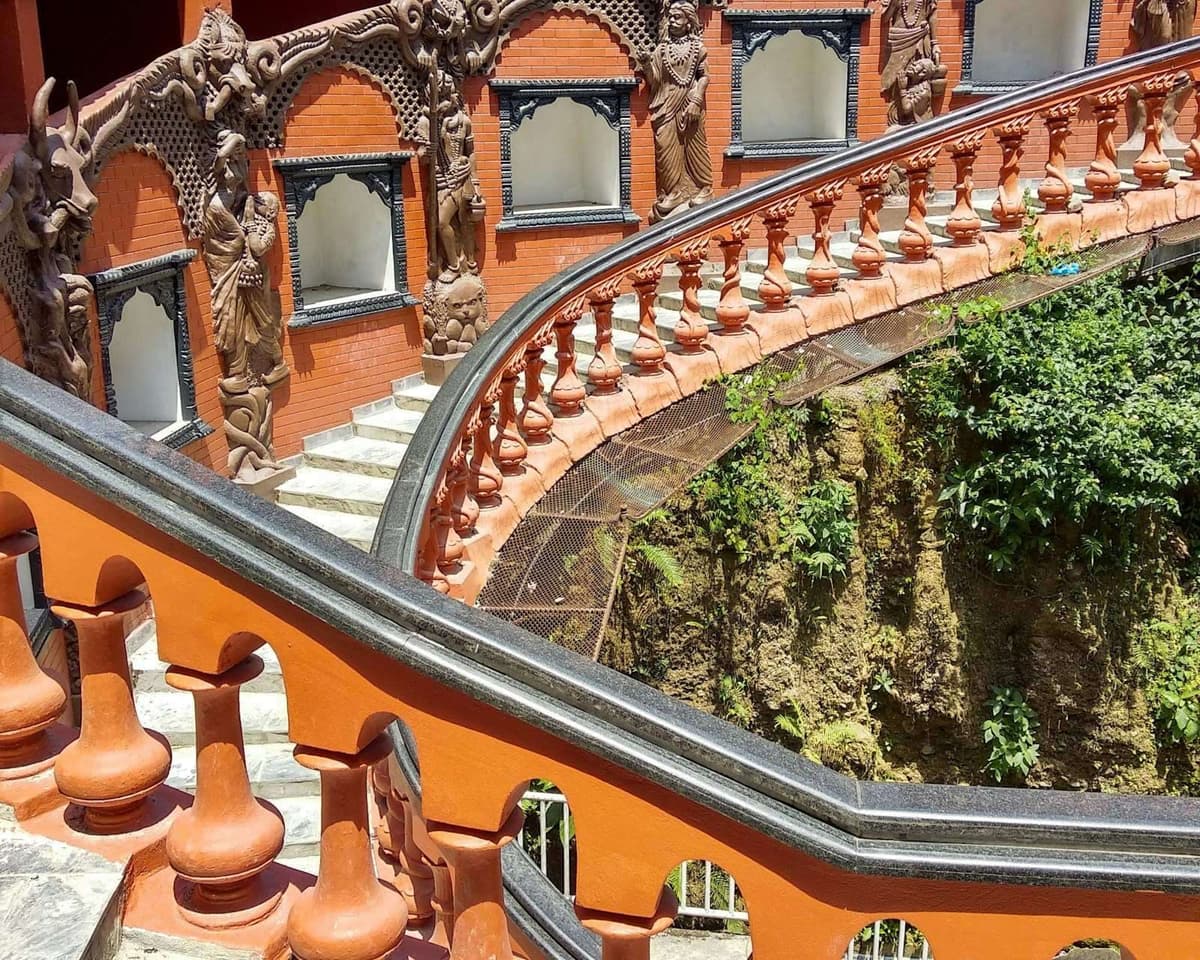
Lonely Planet sums it up in one line: "Across the road from Devi's Falls, this venerated cave contains a huge stalagmite worshipped as a Shiva lingam." You go down by a large spiral staircase; the cave's own website says the main entrance was not built until 1991. Beyond the shrine, a metal staircase and a tunnel lead to a damp cavern next to the falls.
A few practical points, briefly:
- Run by: the Gupteshwor Mahadev Cave Management Committee, based at Pokhara-17 Chhorepatan.
- Hours: the cave's own website gives both 6 am to 7 pm and 7 am to 6 pm, so plan on roughly 7 am to 6 pm.
- The inner section: it usually closes in the rainy season. After the monsoon it normally reopens; ask at the gate.
- Tickets: sold at the entrance, with separate rates for Nepali and foreign visitors. The committee does not publish them online, so check at the counter.
- Footing: the metal staircase and the rock near the waterfall are slippery. Lighting is minimal in places, so a head torch helps.
The cave deserves more space than this, and it is a good half of the reason to make the trip.
What else is near Davis Falls?
Several of Pokhara's quieter sights sit within a short ride of the falls, on the south side of town. Tashiling Tibetan settlement is just past the falls, the World Peace Pagoda is on the hill above Phewa Lake, and the International Mountain Museum is not far away. You can build a relaxed half-day around them.
Tashiling Tibetan settlement
Tashiling, at Chhorepatan, sits just past the falls on the road south. It was set up in the mid-1960s, and it has the Shree Dhargyaling Monastery and the Tashiling Handicraft Center. Walking over after the falls is an easy way to see a different side of Pokhara. Be polite with cameras around homes and the monastery.
World Peace Pagoda
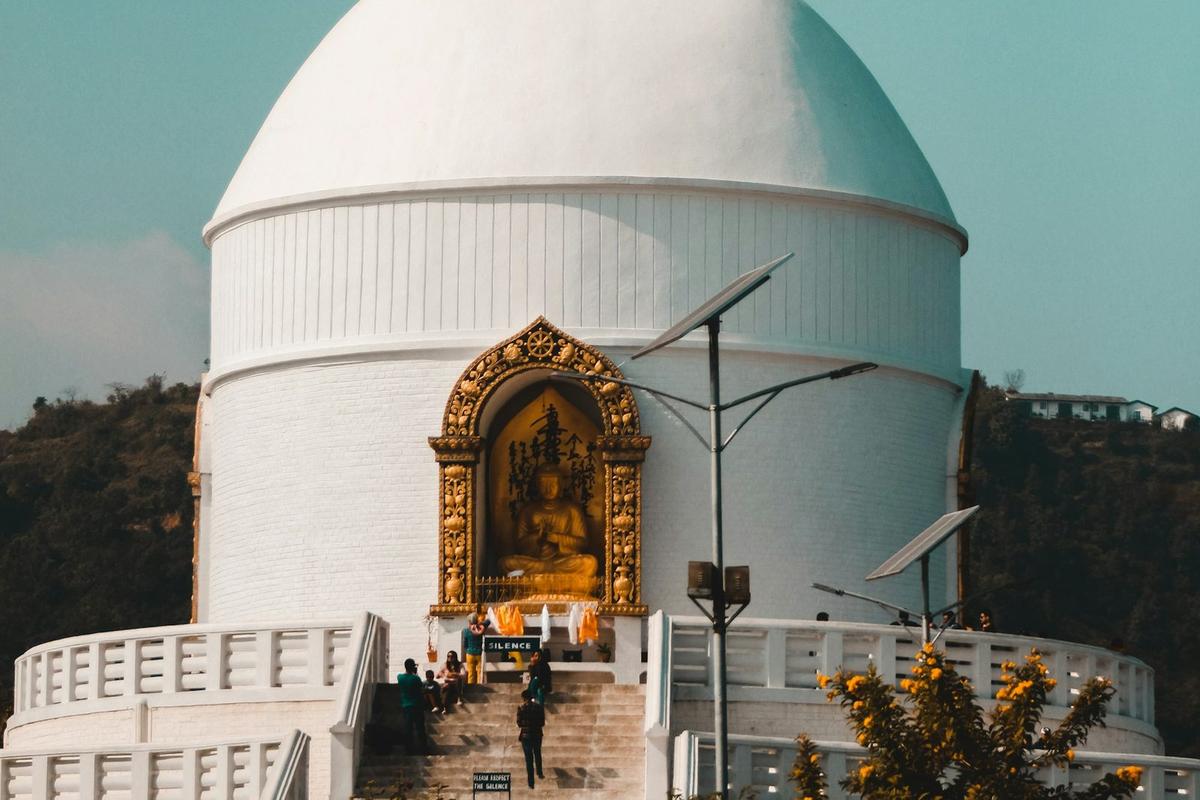
The World Peace Pagoda stands on the hill above Phewa Lake. It was inaugurated in 1999 and is about 35 m tall. Pokhara Metropolitan City lists it as free to visit, from 6 am to 6 pm. Our guide to the World Peace Pagoda in Pokhara covers getting there and what to expect at the top.
International Mountain Museum
The International Mountain Museum is about 1.5 km south of Pokhara Airport at Rato Pairo, according to the Nepal Tourism Board. It was set up by the Nepal Mountaineering Association and covers mountain people, the world's mountains and mountain activities.
Mahendra Cave and Bat Cave
These two caves are across town at Batulechaur, so they do not combine as easily with the falls. See the questions below for what each is like.
How do you fit Davis Falls into a Pokhara day?
The easiest way is a half-day loop on the south side of town: Davis Falls and Gupteshwor Mahadev Cave together, then Tashiling, then the World Peace Pagoda. Start in the morning, while it is cooler, and you have the rest of the day free for Lakeside or an afternoon on the water.
A simple half-day order
- Morning: Davis Falls. Go early, while the day is still cool.
- Gupteshwor Mahadev Cave. Cross the road and go down to the shrine and, if it is open, the inner section to the falls.
- Tashiling. A short walk or ride to the settlement and its handicraft centre.
- World Peace Pagoda. Head up the hill for the view over the lake. The climb is warm in the middle of the day, so take water.
- Back to Lakeside. Finish with a boat on Phewa Lake, keeping in mind that all water activities on the lake stop at 6 pm.
Pairing it with a sunrise
If you are up early for sunrise at Sarangkot, at 1,595 m (5,233 ft) on the ridge above the lake, you can drive down, have breakfast, and do the falls and the cave the same morning. That makes for a full but easy day.
Frequently asked questions
Are Davis Falls and Gupteshwor Cave worth visiting?
Yes, as a pair. Davis Falls on its own is a short stop: you watch Phewa Lake's outflow drop into a gorge and vanish underground. Gupteshwor Mahadev Cave, across the road, turns it into something memorable, because you go down to a Shiva shrine and, outside the rainy season, to a view of the same falls from below. The falls are much smaller in the dry months, so set your expectations by season.
What are the Bat Cave and Mahendra Cave like?
Both are in Batulechaur, Pokhara ward 16. Mahendra Cave was found by locals in the early 1950s and later named after King Mahendra; it is a short, lit walk past limestone formations to a small Shiva shrine. The Bat Cave is about ten minutes' walk away. It is unlit, narrow in places, home to thousands of bats, and has a single tight exit that needs some climbing. Carry a torch, and check the small fees at each gate.
How do I get from Pokhara to Muktinath or Jomsom?
By road, for now. Regular Pokhara to Jomsom flights were suspended in mid-October 2026, and we found no restart announcement as of 9 November 2026; last winter they resumed in March. The road runs via Beni, and the 76 km Beni to Jomsom section is landslide-prone (rain blocked it from 24 to 27 September 2026). Plan for a long day on a mountain road and check conditions first. Our Muktinath Temple guide covers the visit itself.
How do I get from Pokhara to Lumbini or Chitwan?
Both are road journeys south. Lumbini is 169 km away: a travel guide updated in October 2026 gives six to seven hours by bus, getting off at Buddha Chowk and taking a short local bus on to Lumbini Bazaar. For Chitwan, the tourist bus to Sauraha takes about five to six hours (the same guide's Chitwan page, January 2026), longer on bad road days. Our Pokhara to Lumbini guide has the details.
How many days should I spend in Pokhara?
Two or three days is enough for most people who want the lake, a sunrise viewpoint such as Sarangkot, Davis Falls and the caves without rushing. Add more if you plan to paraglide, rest after a trek, or simply enjoy the lake. If Pokhara is the start or end of a trek, build in at least one spare day for weather and recovery.
Plan your visit
Davis Falls is an easy stop to add to any stay in Pokhara, and best combined with the cave across the road and the other sights on the south side of town. For the full picture of the city, from the lake to the viewpoints, see our guide to things to do in Pokhara.
Two of our trips already include Davis Falls and Gupteshwor Mahadev Cave on their Pokhara sightseeing day:
- The Bandipur and Pokhara Lakeside tour over 4 days adds the old hill town of Bandipur on the way, with the falls and the cave on day three.
- The Australian Camp and Pokhara tour over 3 days pairs a night at Australian Camp, with its mountain views, with the falls, the cave and the World Peace Pagoda the next day.
If neither fits your days, tell us your dates on WhatsApp or through our enquiry form and we will suggest an honest plan, even if that means a shorter trip.
Your Nepal visa and international flights are your own arrangements; official visa information is on the Nepal Tourism Board tourist-visa page.