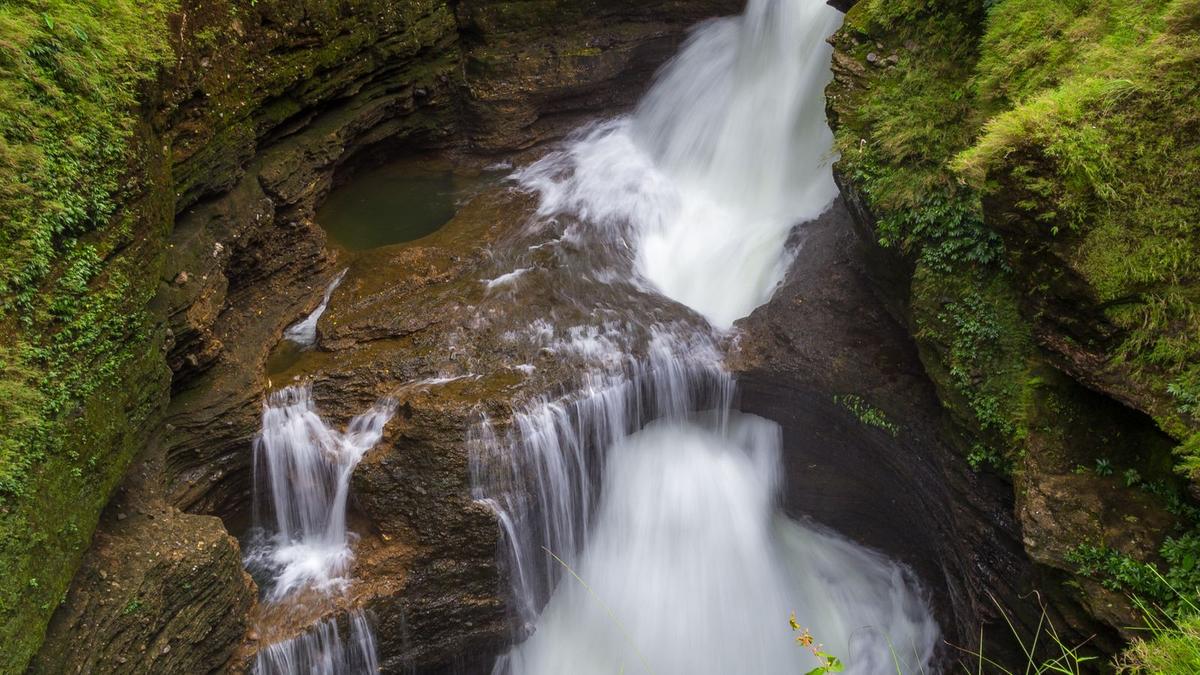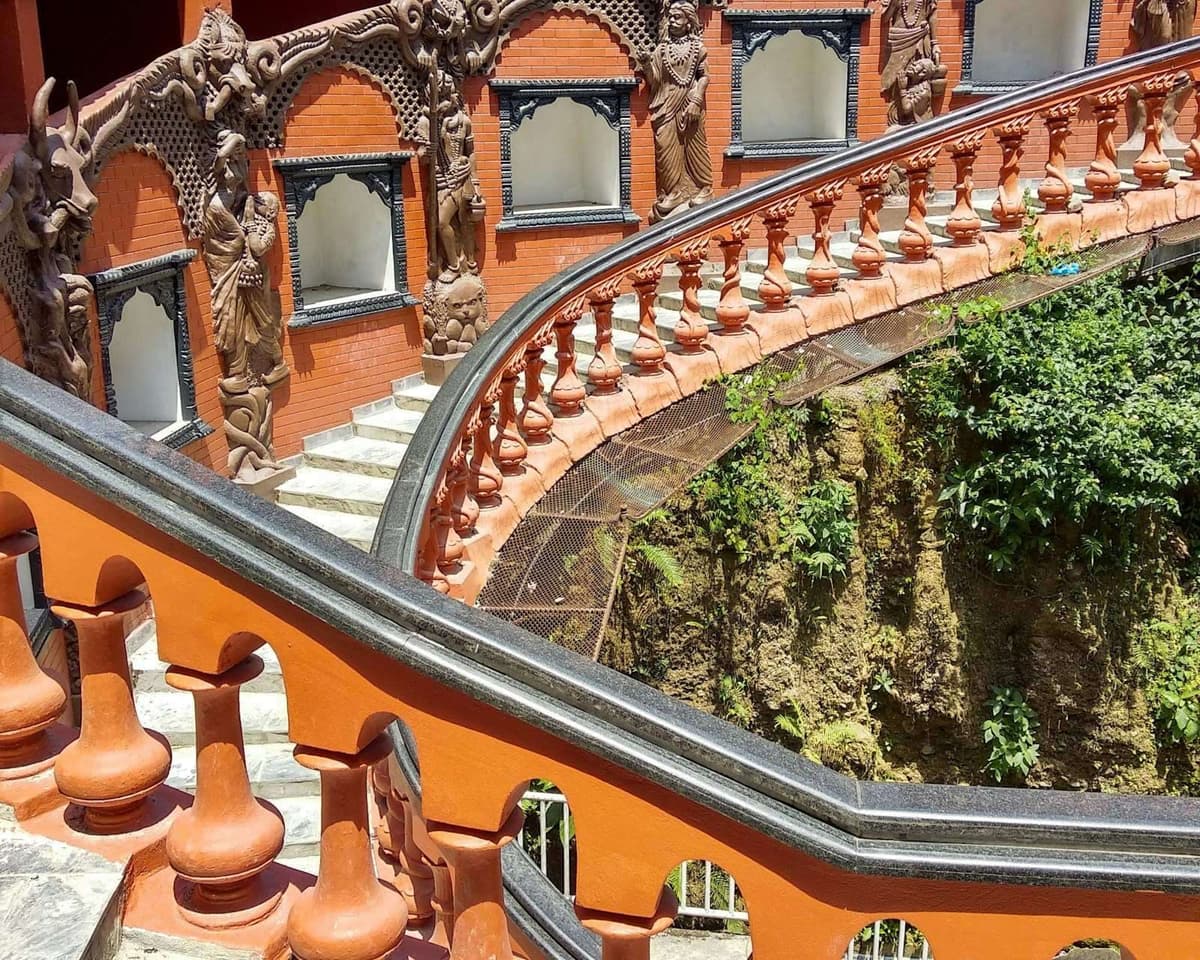
Across the Siddhartha Highway from Davis Falls, a wide spiral staircase with orange railings and carved figures curls down into a pit of mossy rock. The air turns damp as you go down. Somewhere below the shrine, out of sight, water from Phewa Lake is still falling through the dark. This is Gupteshwor Mahadev Cave.
By Uncover Nepal Team · Checked by our Kathmandu travel team · Last checked 9 November 2026
Gupteshwor Mahadev Cave is a working Shiva shrine in Chhorepatan, in the south-west of Pokhara, where a large stalagmite is worshipped as a Shiva lingam. Behind the shrine, a low tunnel leads to a damp cavern beside the underground fall of Davis Falls. It is one of the stops in our guide to things to do in Pokhara.
Key facts
- What it is
- A Hindu cave shrine to Shiva; a large stalagmite inside is worshipped as a Shiva lingam (Lonely Planet; Nepal Tourism Board (9 Nov 2026))
- Where
- Chhorepatan, Pokhara ward 17, across the road from Davis Falls, about 2 km south-west of Pokhara's old airport on the Siddhartha Highway (Pokhara Metropolitan City tourism office; Nepal Tourism Board; cave website (9 Nov 2026))
- Who runs it
- Gupteshwor Mahadev Cave Management Committee, phone 061-450587 (Cave website, Opening Time and home pages (9 Nov 2026))
- The way in
- A large spiral staircase; the main entrance was not built until 1991 (Cave website, About page (9 Nov 2026))
- Opening hours
- About 7 am to 6 pm; the same website also gives 6 am to 7 pm (Cave website, home and Opening Time pages (9 Nov 2026))
- Tickets
- Sold at the counter by the entrance, with separate rates for Nepali visitors, foreign visitors and students; not published online, so check at the counter (Cave website; Ratopati (news agency report quoting the committee), May 2026 (9 Nov 2026))
- Inner section
- A tunnel behind the shrine to a damp cavern by the falls; about 140 m long, according to the cave website (Lonely Planet; cave website (9 Nov 2026))
- Monsoon
- The inner part closes in the rainy season; the rest stays open all year (Cave website, Opening Time page (9 Nov 2026))
- Photos
- Not allowed at the main shrine (Cave website, About page; The Longest Way Home, Oct 2026 (9 Nov 2026))
- Total length
- Published figures range from about 2 km to about 3 km; only part is open to visitors (Cave website; Showcaves; Nepal Traveller, Jul 2026 (9 Nov 2026))
In this guide
- What is Gupteshwor Mahadev Cave?
- Where is the cave and how do you get there?
- What is inside, section by section?
- How does the cave reach Davis Falls?
- Is the inner cave open in the monsoon?
- How should you behave inside the shrine?
- When is the best time to visit?
- Is it safe, and who should skip the inner section?
- How does it compare with Mahendra Cave and the Bat Cave?
- What else is close to the cave?
- Frequently asked questions
- Plan your visit
What is Gupteshwor Mahadev Cave?
Gupteshwor Mahadev Cave is a Hindu cave shrine dedicated to Shiva in Chhorepatan, in the south-west of Pokhara. Lonely Planet describes a huge stalagmite inside that is worshipped as a Shiva lingam. Local families come here to pray, and most people who visit Davis Falls cross the road to see it too.
The Nepal Tourism Board puts it simply:
"The sacred shrine dedicated to Shiva is popular among the local residents and is seldom missed by tourists to Davi's Fall."
Nepal Tourism Board, "Davi's Fall & Gupteshwar", read 9 November 2026
You share the staircase with people bringing offerings and with visitors heading for the waterfall at the end of the tunnel. If you have already been to Pashupatinath Temple in Kathmandu, Gupteshwor is a very different kind of Shiva shrine: small, underground and dim, with the sound of water somewhere beyond it.
The name, and why you see three spellings
Mahadev is one of Shiva's names. You will see the cave written as Gupteshwor, Gupteshwar and Gupteswar. The Nepal Tourism Board uses Gupteshwar; the committee's own website address uses Gupteshwor. They are all the same place.
There is also a Gupteshwar cave in Kushma, Parbat district; news about that cave is not about this one.
When was it found, and how big is it?
Accounts of when the cave was found differ. The cave's own website says it was "allegedly" discovered centuries ago by local men clearing grass, while national newspapers and a cave database give much later dates. What is certain is that the entrance and its spiral staircase were built in 1991, according to the cave's own website.
The length is just as unsettled. The cave is often called one of Nepal's longest caves. Published lengths range from about 2 km to about 3 km, and only part of it is open to visitors.
Where is the cave and how do you get there?
The cave is in Chhorepatan, Pokhara ward 17, about 2 km south-west of Pokhara's old airport on the Siddhartha Highway. Its entrance is directly across the road from the Davis Falls gate. From Lakeside it is a short taxi ride south, and it pairs naturally with the falls and the World Peace Pagoda in one outing.
From Lakeside
Ask for Davis Falls or Chhorepatan. The falls gate and the cave entrance face each other across the highway. It is a busy road, so cross with care and agree a pick-up point with your driver before you go in.
Coming from Kathmandu, Pokhara is most of a day by road, often six to nine hours, or about 30 minutes by air.
What is inside, section by section?
A visit has four parts: the spiral staircase down from the road, the main shrine with its stalagmite lingam, a low tunnel behind the shrine, and a damp cavern where the underground waterfall comes into view. The first two stay open all year. The last two depend on the season and the water.
| Section | What you see | Underfoot | Good to know |
|---|---|---|---|
| Spiral staircase | A wide curving staircase with carved figures, built with the main entrance in 1991 | Steps that can be wet | Take it slowly when wet |
| Main shrine | A large stalagmite worshipped as a Shiva lingam, and a cow statue set over a Shiva lingam at the first sight inside | Shared with worshippers | No photos at the main shrine |
| Tunnel behind the shrine | A narrow passage; some sections need crouching | Damp, slippery patches | Lighting is a string of small bulbs, so bring a head torch |
| Waterfall cavern | A metal staircase leading down to a view of the waterfall; about 140 m long, according to the cave website | Slippery metal stairs and rocky ground | Closed in the rainy season |
The main shrine
The shrine is the reason local people come, so be ready to wait your turn. Sources disagree on exactly how far in it is, so we will not give a distance. Photos are not allowed here, and caretakers enforce it, according to both the cave's website and a travel guide updated in October 2026.
The tunnel and the waterfall cavern
Lonely Planet describes clambering "through a tunnel behind the shrine, emerging in a damp cavern" next to the falls. The cave's website says this second section ends at a view of the waterfall, reached by a metal staircase leading downwards, and warns that it is slippery. This is the part people remember, and the part to skip if you are not steady on wet metal steps.
How does the cave reach Davis Falls?
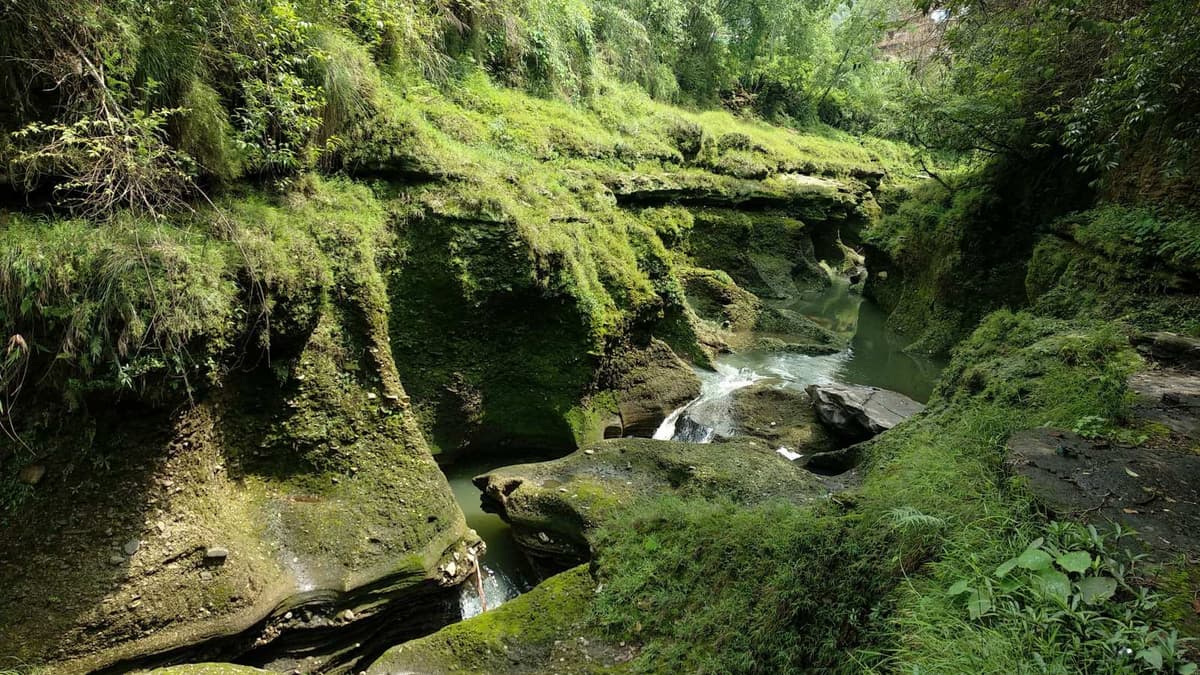
Davis Falls, called Patale Chhango in Nepali, is where the stream from Phewa Lake drops into a gorge and disappears underground. Over time the water has cut caves and tunnels through the rock, and Gupteshwor is one of them. The inner section of the cave ends at a view of that same water, from below.
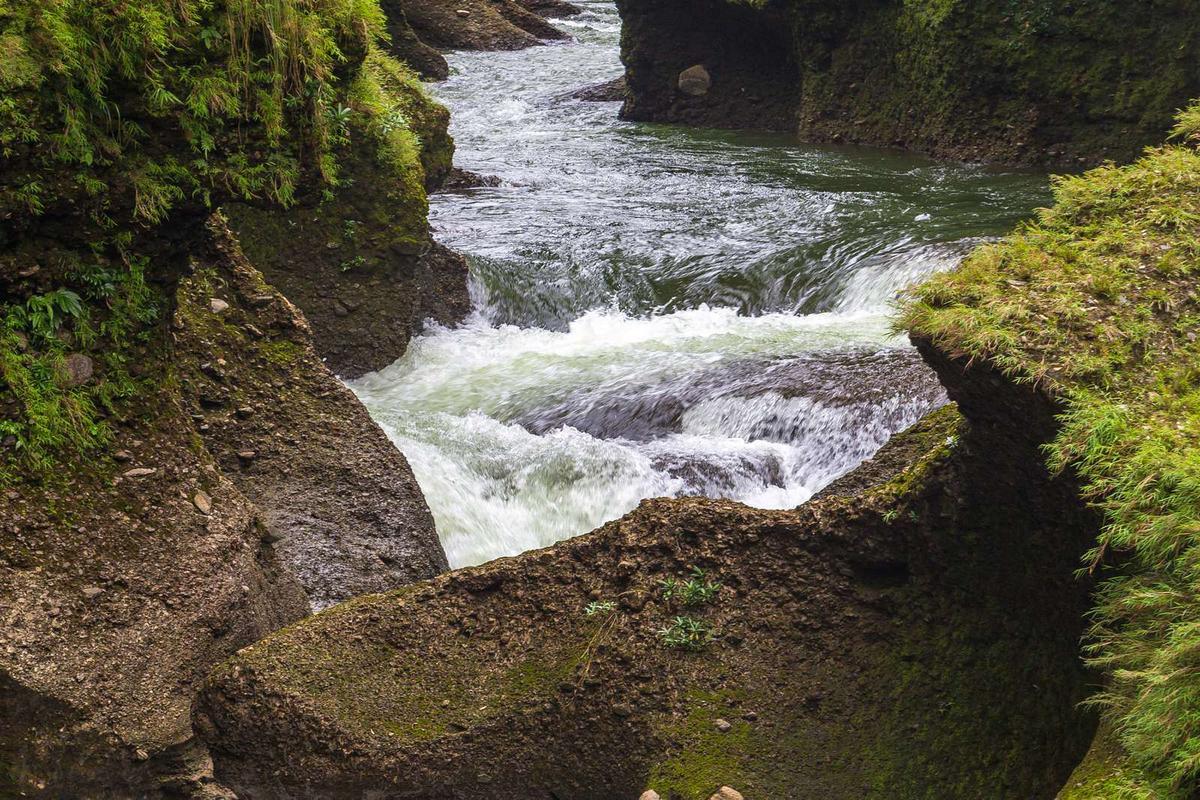
Pokhara Metropolitan City's tourism office and the Nepal Tourism Board both say the source of the waterfall is Phewa Lake and that the fall cuts complex caves and tunnels on its path; Gupteshwor, on the other side, is one such cave carved by Devi's Fall, another name for Davis Falls. Lonely Planet calls the falls the point where the Pardi Khola stream vanishes underground.
The city translates Patale Chhango as "fall of the netherworld". In the cavern at the end of the tunnel, with the vanished water beside you in the half-dark, the name makes sense.
Two names, one legend
The popular story, told by the city's tourism office and the Nepal Tourism Board, is that a Swiss visitor was swept away at the falls in 1961 and the falls took the family name. Accounts differ on the details, so treat it as a local legend. The cave itself is named for Shiva, not for the story.
Seeing the falls from both sides
The best way to understand the place is to do both: look down into the gorge from the falls side, then cross the road and come up under it from the cave. Our Davis Falls guide covers the falls side in detail.
The two sites have separate gates and separate tickets. Chhorepatan Secondary School has collected entry fees at Patale Chhango since about 1978, according to a 2023 report by the national news agency. When that agency last reported the rates (August 2023), the school at the gate charged NPR 100 for most foreign visitors, NPR 80 for Indian visitors, NPR 40 for Nepali citizens and NPR 20 for students. A travel guide updated in October 2026 still lists NPR 100 for foreigners. Check at the gate.
Khabarhub, a Nepali news site, described the cave's view of the falls as being "from beneath the natural bridge on the Siddhartha Highway". In other words, the road you crossed to get here runs over the water you are looking at.
Is the inner cave open in the monsoon?
Not always. The committee closes the inner part during the rainy season; the rest stays open all year. Nepal's monsoon normally runs from about 13 June to 2 October, on Department of Hydrology and Meteorology figures. The 2026 monsoon withdrew on 14 October, but we found no reopening notice yet, so ask at the gate.
The committee's Nepali text adds that roughly half of the inner section may stay closed because of water. An older entry on the Showcaves database, based on 2010 information, lists the rear cave as closed from June to September. Take that as a pattern, not a calendar, because the decision depends on how much water is coming through.
The numbers explain why. At Pokhara Airport, July brings 941.0 mm of rain in an average year and November only 17.2 mm, on the Department of Hydrology and Meteorology's 1991 to 2020 normals. All of that water feeds the stream that runs through the cave.
The trade-off
The monsoon and the weeks after it are when Davis Falls is at its most dramatic. Lonely Planet says that when the stream is at full bore after monsoon rains, the sound of the water plunging over the falls is deafening. Visit in the rains and you get the loudest falls but possibly only the shrine section of the cave; in the dry months you get the whole cave and a quieter fall.
How should you behave inside the shrine?
Treat Gupteshwor as a working temple first and a sight second. Keep your voice down near the shrine, put your camera away where photos are not allowed, give people who are praying room, and follow what the caretakers and signs ask. Any rules about shoes, bags or offerings come from the committee, so follow the signs on the day.
Here is the visit, step by step:
- Buy your ticket at the counter by the entrance. The rates are not published online, so check them there.
- Ask whether the inner section is open before you start down, especially in the weeks after the monsoon.
- Walk down the spiral staircase slowly. The steps can be wet, and the stairs are busy on holidays.
- Put your phone or camera away before the main shrine. Photos are not allowed there, and the caretakers enforce it.
- Let people who are praying go first. Do not stand in front of the lingam to look, and wait your turn if someone is making an offering.
- Follow the signs and staff on shoes, offerings and where to stand. We have not found a published rule on these, so the people on duty that day are the authority.
- Switch on your head torch for the tunnel and crouch where the roof drops. Keep one hand free for the rock.
- Stay on the lit path and follow staff directions. Do not wander off the lit route.
When is the best time to visit?
For the whole cave, including the inner section, come after the monsoon has ended and the committee has reopened the tunnel; confirm at the gate. For Davis Falls at its loudest, come at the end of the rains and accept that the inner cave may be shut. Early in the day is usually quieter than the afternoon.
Festival days
Maha Shivaratri is the festival to know. Nepal Traveller describes the cave coming alive with devotees offering prayers and lighting lamps at Shivaratri. The festival falls on the night of Trayodashi or Chaturdashi in the dark half of Falgun; in 2027 that is 6 March 2027 in published Nepali calendars (Falgun 22, 2083 BS), a public holiday. Mondays in the monsoon month of Shrawan are also special to Shiva devotees across Nepal, so the shrine can be busier then too.
Crowds
On a single day, Sunday 24 May 2026, 6,078 people bought tickets, 4,472 of them foreign visitors, according to figures the management committee's chairman gave in a news agency report carried by Ratopati. If you want space at the shrine, go close to opening time and do the falls afterwards.
Is it safe, and who should skip the inner section?
The staircase and shrine are an easy visit for most people. The inner section is different: lighting is minimal, some parts need crouching, and the metal staircase and rocky ground near the waterfall are slippery. A travel guide updated in October 2026 notes that accidents have happened there, so take it slowly or skip it.
Who should skip the inner section
- Anyone unsteady on wet stairs, or recovering from a knee or ankle injury.
- People who are uneasy in tight, dark spaces. The shrine section alone is still worth the visit.
- Families with small children who would need carrying through the low parts of the tunnel.
- Anyone in sandals or smooth-soled shoes.
Near the falls, the bigger risk is the water itself. People have drowned in the Pardi stream that feeds the gorge. Do not swim in it, and never climb down towards the water on either side of the road.
What to bring
- A head torch or small torch. Lighting in the inner section is minimal.
- Shoes with good grip for wet rock and metal stairs.
- Cash for the ticket counter.
- Something to keep your phone dry in the cavern near the falls.
- A light layer that covers shoulders and knees for the shrine.
How does it compare with Mahendra Cave and the Bat Cave?
Gupteshwor is a temple cave with a waterfall at the end. Mahendra Cave, at Batulechaur in Pokhara ward 16, is a short, lit walk past limestone formations to a small Shiva shrine. The Bat Cave, about ten minutes' walk from Mahendra Cave, is unlit, narrow in places and home to thousands of bats.
| Gupteshwor Mahadev Cave | Mahendra Cave | Bat Cave (Chamero Gufa) | |
|---|---|---|---|
| Where | Chhorepatan, ward 17, across the road from Davis Falls | Batulechaur, ward 16 | About ten minutes' walk from Mahendra Cave |
| Lighting | Dim electric bulbs; a head torch helps | Lit | Unlit; carry or rent a torch |
| What is inside | Shiva shrine; a tunnel to a cavern by the falls | Limestone formations; a small Shiva shrine | Thousands of bats; narrow passages |
| Effort | Staircase; crouching and slippery metal stairs in the inner section | Easy walk on a made foot track | Narrow in places; the single narrow exit needs some climbing |
| Ticket | Not published online; check at the counter | Small fee; check at the gate | Check at the gate |
| Best for | A temple visit plus the hidden side of Davis Falls | A short, easy cave with children | People happy in tight, dark spaces |
Mahendra Cave was found by locals in the early 1950s and later named after King Mahendra, according to Republica and Nepal Traveller (July 2026). If you only have time for one cave, Gupteshwor is the one that connects to something else you will see that day.
What else is close to the cave?
Davis Falls is directly across the road, and the Tashiling Tibetan settlement is just past the falls. Our own Pokhara tours pair the cave with the falls and the World Peace Pagoda. Phewa Lake, which feeds the falls, and the Sarangkot viewpoint above it round out a full sightseeing day.
Davis Falls
The falls are the other half of this visit, with their own gate and ticket on the other side of the highway. Look down into the gorge there after you have seen the water from below in the cave.
Tashiling Tibetan settlement
Lonely Planet places the falls just before the Tashi Ling Tibetan camp on the road south. The settlement was set up in the mid-1960s, according to the Central Tibetan Relief Committee.
World Peace Pagoda
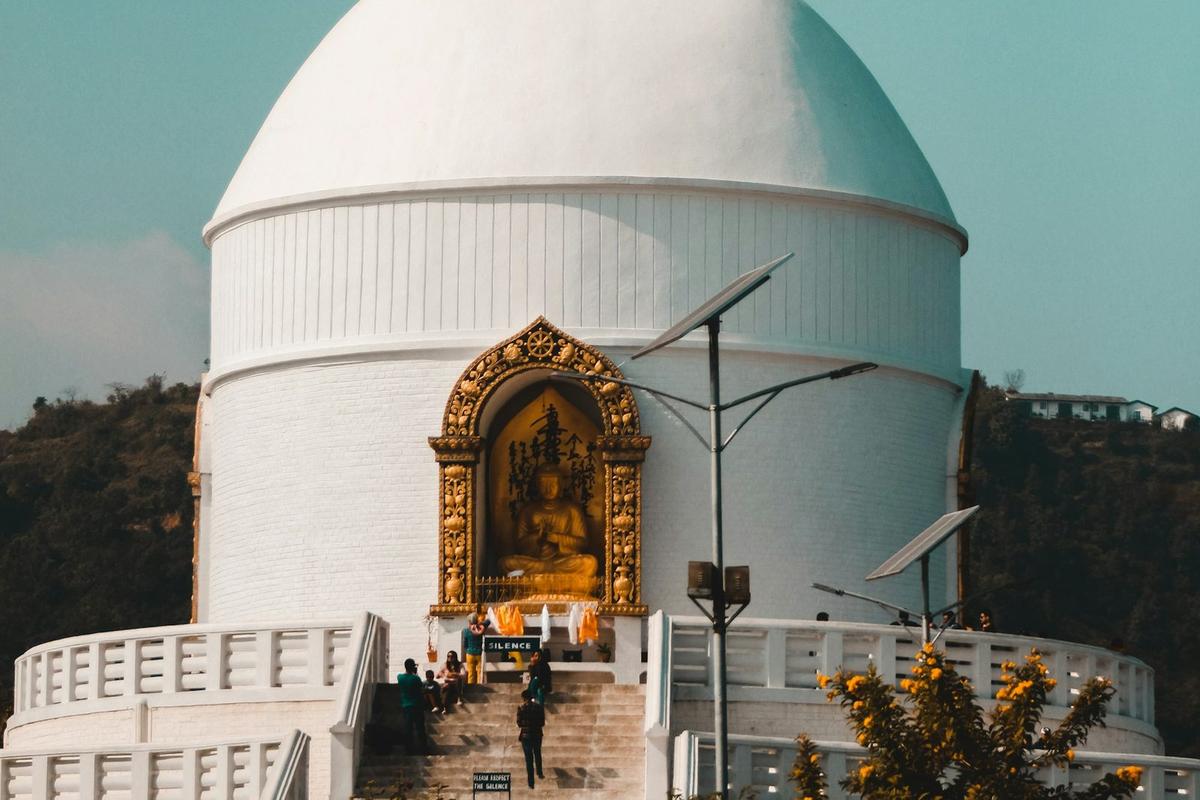
The World Peace Pagoda is a white Buddhist stupa about 35 m tall, inaugurated in 1999. It is free to visit and open from 6 am to 6 pm, according to Pokhara Metropolitan City. Our World Peace Pagoda guide covers the ways up, including the boat crossing and the forest trail.
Phewa Lake and Lakeside
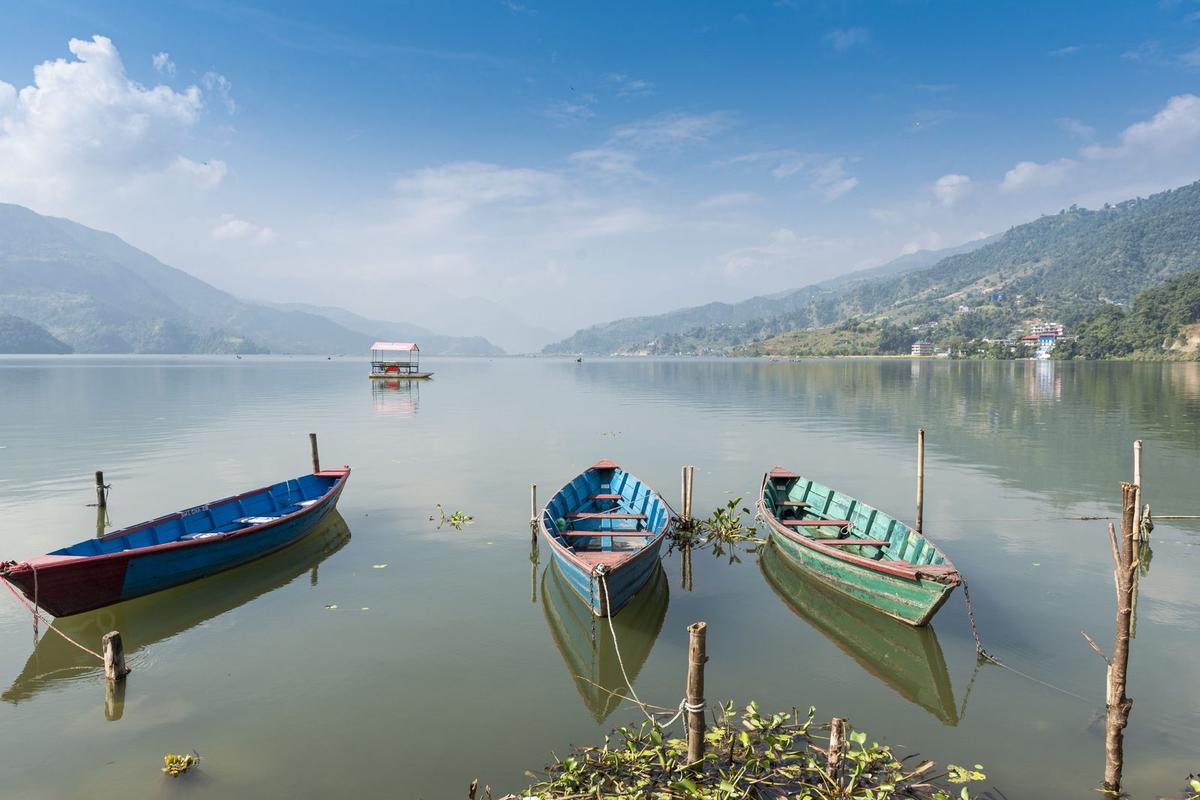
Phewa Lake is the source of Davis Falls, so the water you hear in the cave starts here. Under a district order of June 2026, everyone on the lake must wear a life jacket and all water activities stop at 6 pm. Our Phewa Lake guide covers boating, the 2026 safety rules, Tal Barahi Temple and the walks around the shore.
Sarangkot
Sarangkot, at 1,595 m (5,233 ft), is a popular sunrise viewpoint above the lake and one of Pokhara's paragliding take-off points. See our Sarangkot guide for sunrise, how to get up from Lakeside and paragliding.
Frequently asked questions
Are Davis Falls and Gupteshwor Cave worth visiting?
Yes, if you see them together. On their own, each is a short stop; together they explain each other, because the cave's inner section ends at a view of the water that vanishes at the falls. Go after the monsoon if you want the full cave, and at the end of the rains if you care more about a loud waterfall. They have separate gates and tickets.
What are the Bat Cave and Mahendra Cave like?
Mahendra Cave, at Batulechaur in Pokhara, is a lit, short walk past limestone formations to a small Shiva shrine, and it suits families. The Bat Cave is about ten minutes' walk away and is a different experience: unlit, narrow in places, home to thousands of bats, with a single narrow exit that needs some climbing. Carry or rent a torch, and check fees at each gate.
What is in the International Mountain Museum?
The International Mountain Museum, set up by the Nepal Mountaineering Association, has three exhibition halls covering mountain people, the world's mountains including all fourteen 8,000 m peaks, and mountain activities, plus a library and an audio-visual room. It is at Rato Pairo, 1.5 km south of the old Pokhara Airport. In October 2025 the museum's director gave its fees, in a national news agency report carried by Onlinekhabar, as NPR 750 for foreign visitors, NPR 350 for SAARC visitors, NPR 150 for Nepali citizens and NPR 80 for students. Check at the gate.
What are the opening hours of Gupteshwor Mahadev Cave?
Plan for about 7 am to 6 pm. The cave's own website gives two different sets of hours, 7 am to 6 pm on one page and 6 am to 7 pm on another, so do not count on the wider window. The inner section can be closed even when the shrine is open, so ask at the counter before you start down.
Can you take photos inside Gupteshwor Cave?
Not at the main shrine. Photos are not allowed at the main Shiva shrine, and caretakers enforce the rule. The spiral staircase at the entrance is outside the shrine and a good place for pictures. In the inner section, follow the signs and staff on the day, and keep your phone protected from spray near the waterfall.
Is Gupteshwar Mahadev Cave open during the monsoon?
Partly. The shrine section stays open all year, but the committee closes the inner part, the tunnel to the waterfall, during the rainy season because of water. Nepal's monsoon normally runs from about mid-June to early October. After the rains, ask at the gate or call the committee on 061-450587 to check whether the inner section has reopened.
Plan your visit
Gupteshwor Mahadev Cave fits into any day in Pokhara, but it is best seen as part of a loop with Davis Falls and the World Peace Pagoda. Two of our trips include that loop. The Bandipur Pokhara and Lakeside tour gives you a full sightseeing day that starts at Sarangkot for sunrise, then takes in the falls, the cave, the World Peace Pagoda and the Batulechaur caves. The Australian Camp and Pokhara tour adds a short overnight walk in the foothills, then the rest of the day at the falls, the cave and the pagoda.
For the rest of the city, from the lake to the viewpoints, start with our guide to things to do in Pokhara. If you are not sure how many days you need or which trip fits, send us your dates on WhatsApp or through the enquiry form and we will tell you honestly.
Your Nepal visa and international flights are your own arrangements; official visa information is on the Nepal Tourism Board tourist-visa page.