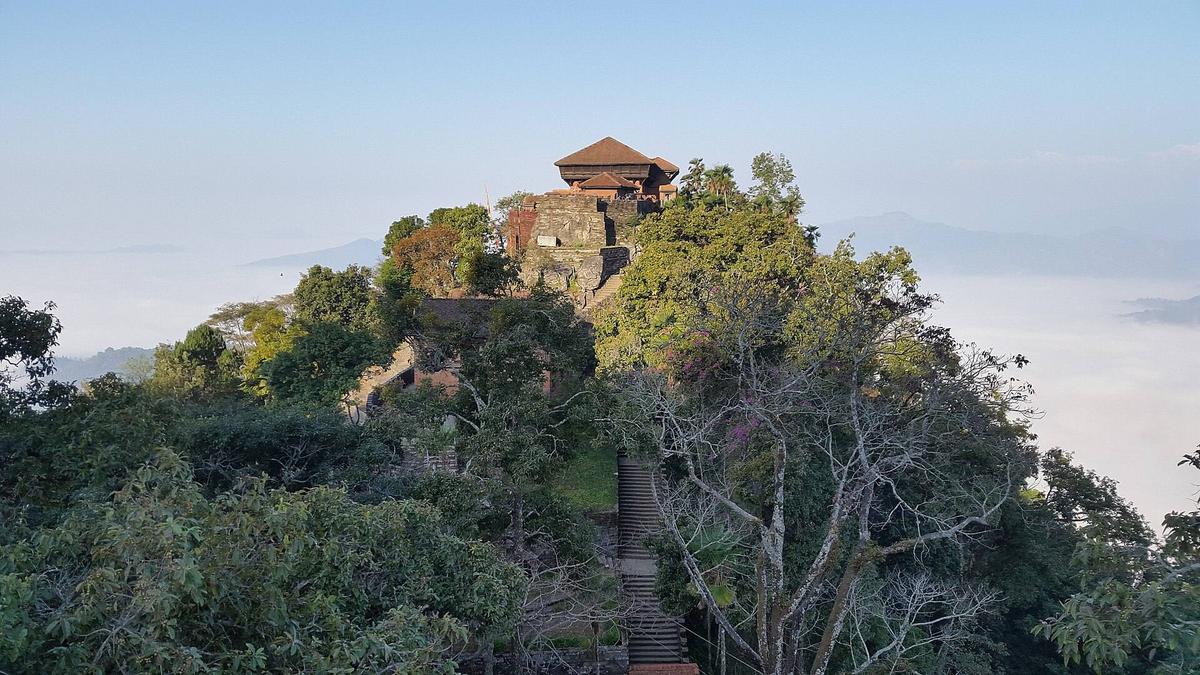
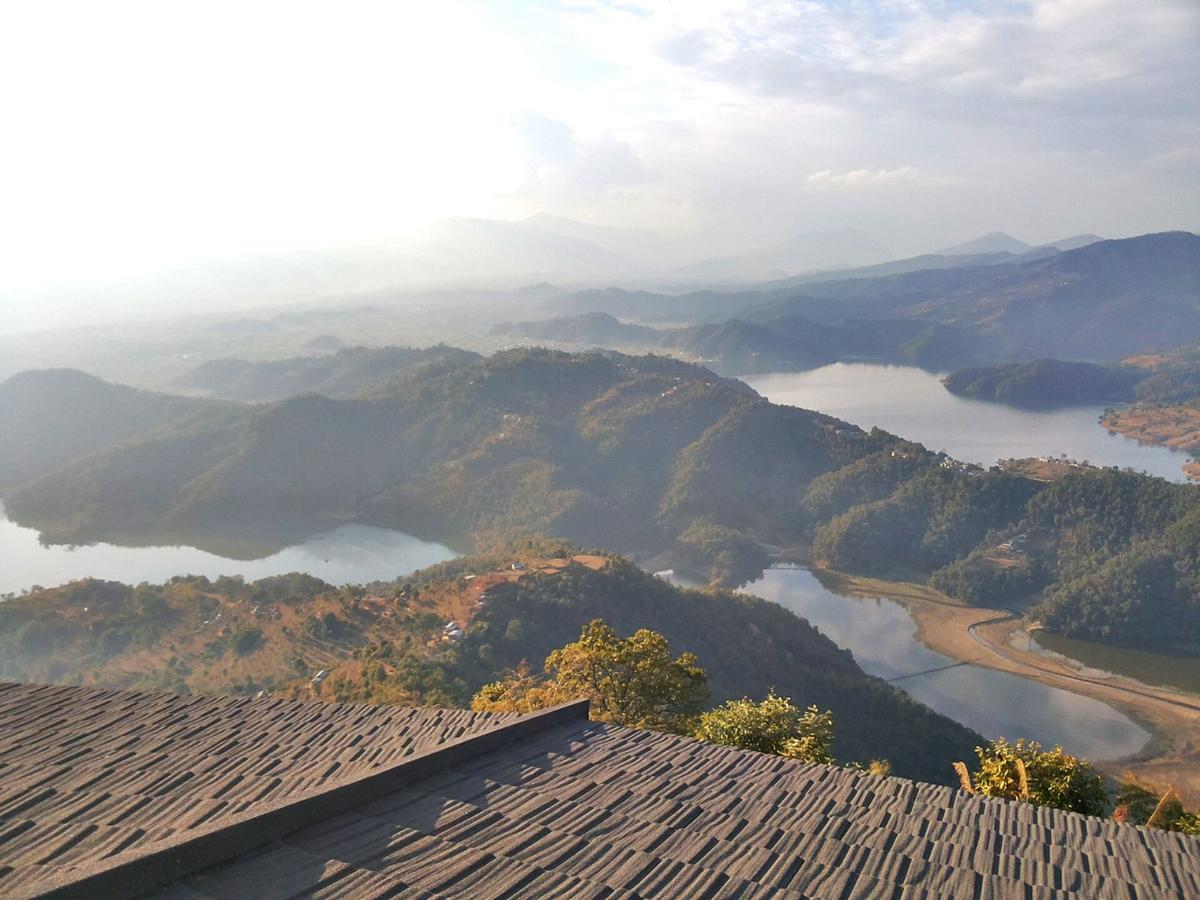
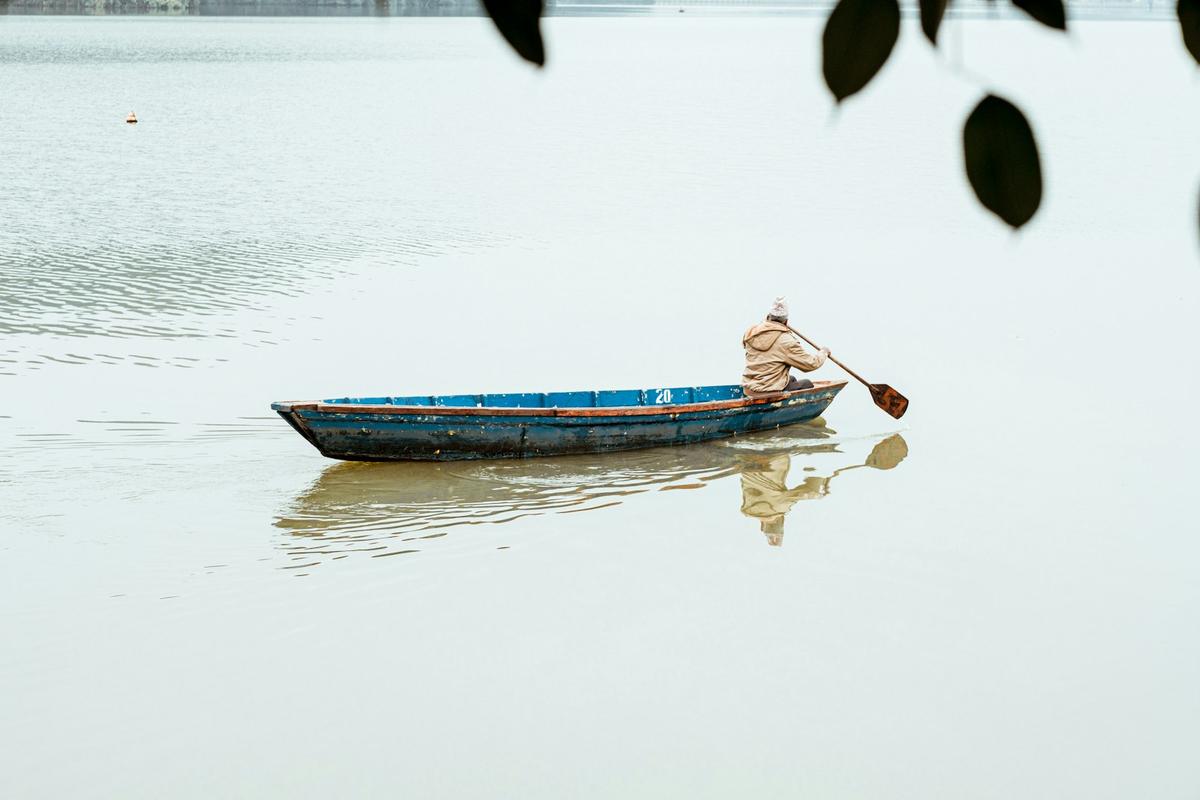
At Begnas Tal, the small bazaar by the dam at the lake's west end, wooden rowing boats wait along the shore for their turn on the water. Fish from the lake is sold fresh by the water, and the hills around it are covered in sal and chilaune forest. Locals still cross by boat, as villagers here did long before the roads came.
Begnas Lake is the second-largest lake in the Pokhara Valley after Phewa, about 16 km by road east of Lakeside, and one of the quieter things to do in Pokhara. Entry is free. Come for a rowing boat, an unhurried shoreline, the ridge between the lakes and Rupa Lake next door.
Key facts
- Where
- Eastern side of Pokhara, Pokhara Metropolitan City, Ward 31 (Kathmandu Post 9 Jun 2025; Pokhara Metropolitan City tourism site, checked 22 Nov 2026)
- Size in the valley
- Second-largest lake in the Pokhara Valley, after Phewa (NARC Fishery Research Station; Ramsar site document, checked 22 Nov 2026)
- Surface area
- About 3.3 square kilometres (328 hectares in a 2007 government survey) (NARC; Ramsar site document 2016, checked 22 Nov 2026)
- Deepest point
- About 10 m (2007 survey) (NARC Fishery Research Station, checked 22 Nov 2026)
- Altitude
- About 650 m above sea level, lower than Pokhara (about 820 m) (FAO/UNDP project report 1980; Pokhara figure is the Uncover Nepal standard figure, checked 22 Nov 2026)
- Entry fee
- Free (Pokhara Metropolitan City tourism site, checked 22 Nov 2026)
- Protected status
- Part of the Lake Cluster of Pokhara Valley, Ramsar Site no. 2257, designated 2 February 2016 (Ramsar Sites Information Service, checked 22 Nov 2026)
- Distance
- About 15 km out of Pokhara (NTB); about 16 km by road from Lakeside (Nepal Tourism Board; OpenStreetMap routing, checked 22 Nov 2026)
- Boat hire
- NPR 700 an hour for a rowing boat, per the boat committee's chair in December 2025; rates can change (Tourism Info Nepal 3 Dec 2025, checked 22 Nov 2026)
- Life jackets
- Compulsory on Phewa and the other lakes under a District Administration Office notice of 3 November 2026 (Republica 4 Nov 2026, checked 22 Nov 2026)
In this guide
- Where is Begnas Lake, and what is it like?
- Begnas vs Phewa: which lake suits you?
- Boating on Begnas Lake: how it works and what it costs
- What are the best things to do at Begnas Lake?
- Rupa Lake: the smaller lake next door
- How far is Begnas Lake from Pokhara, and how do you get there?
- Is Begnas Lake safe for boating and swimming?
- When is the best time to visit Begnas Lake?
- Why Begnas is a protected wetland
- Where to stay near Begnas Lake
- Plan your Begnas day with us
- Frequently asked questions
Where is Begnas Lake, and what is it like?
Begnas Lake lies on the eastern side of Pokhara, in Ward 31 of Pokhara Metropolitan City, about 15 km out of the city by the Nepal Tourism Board's reckoning. It is a freshwater lake among forested hills, with a small bazaar and the boats at its western end, and far fewer visitors than Phewa.
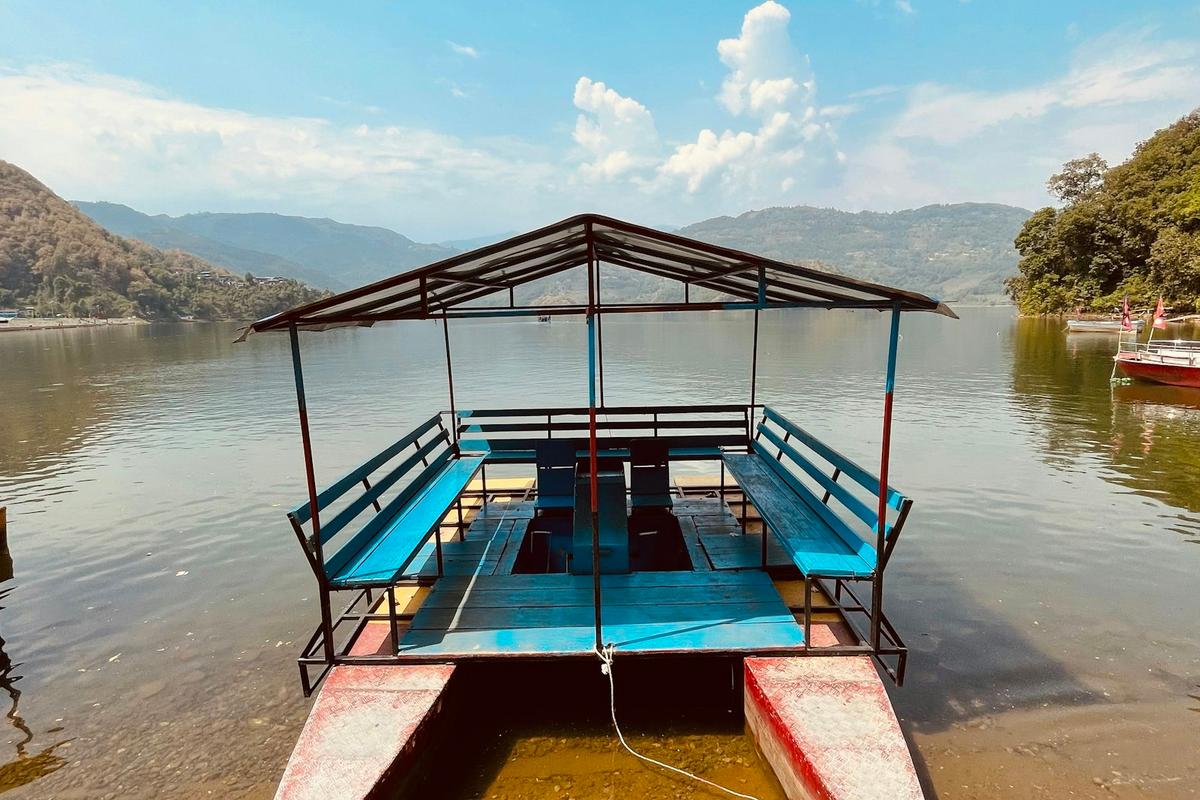
This corner of the valley was once its own town, Lekhnath, which became part of Pokhara Metropolitan City in 2017. The ward chair told RSS in 2023 that the Lekhnath area is also known as the garden of seven lakes. The city lists Begnas as free and open around the clock; that is the lakeshore, so ask at the counter about boat hours.
Most visitors arrive at Begnas Tal, the small bazaar by the dam at the west end, where the boats and the buses are. It is small and simple, and fish from the lake is sold by the water. Around the lake are sal and chilaune forest and, on the north-east slopes, rainfed farmland.
The quiet has a cost for the people who live from the lake: boatmen and hoteliers have told reporters that visitor numbers have fallen over the past decade, and most visitors are now Nepali. For you, that means space on the water.
It is still a working lake, used for irrigation, commercial fish farming and recreation, and home to local fishing families, including the Jalari community. Before roads reached villages such as Majhthana and Saimarang, the lake was the road, with boats carrying people on towards Lamjung.
Is Begnas Lake natural or man-made?
Begnas is a natural, permanent freshwater lake, listed by Ramsar under that wetland type. What is man-made is the outlet. The lake's level is regulated by a dam at its western end, at Bhandare; the outlet stream, the Khudi Khola, was dammed in the late 1980s. The boat area at Begnas Tal sits right beside it, at the spot mapped as Khudi Ko Muhan, the mouth of the Khudi.
How big and how deep is Begnas Lake?
Begnas covers about 3.3 square kilometres (328 hectares in a 2007 government survey), and it is about 10 m at its deepest (2007 survey). It sits at about 650 m above sea level, lower than Pokhara itself, which sits at about 820 m. You will see other figures online; we use the government survey and the Ramsar site document, and leave out national rankings that are repeated without a source.
Begnas vs Phewa: which lake suits you?
Choose Phewa if you want the island temple, Lakeside cafés and paddleboards on your doorstep. Choose Begnas if you want a rowing boat, a quiet shore and fewer people, and you do not mind a drive of about 16 km each way. The city's tourism office calls Begnas "a quieter alternative to Phewa Lake", and that is a fair summary.
| Begnas Lake | Phewa Lake | |
|---|---|---|
| Size in the valley | Second-largest | Largest |
| Open water (NARC, 2007 survey; newer Phewa surveys differ) | 328 ha | 523 ha |
| Deepest point (NARC, 2007 survey) | About 10 m | 24 m |
| Altitude (FAO/UNDP report, 1980) | About 650 m | About 740 m |
| From Lakeside | About 16 km by road | On the doorstep |
| Temple | A small Barahi shrine on the north shore | Tal Barahi, on its island |
| Boats | Rowing boats from Begnas Tal, run on a rota | Rowing boats, kayaks and paddleboards from Lakeside |
| Kayak or paddleboard hire | We found no reliable source that it operates now | Yes, along the Lakeside shore |
| Boating hours rule | Life jackets compulsory (November 2026 notice); we found no published cut-off time | No boating after 6 pm under a June 2026 directive |
| Feel | Quiet, mostly Nepali visitors | Busy, the centre of Pokhara tourism |
The Phewa figures come from the same 2007 survey, so the two compare fairly, but Phewa has been surveyed again since; our complete guide to Phewa Lake has the newer numbers and its own safety rules. In practice most people do both: Phewa is where you stay and eat, and Begnas is the morning you set aside for something slower. With only a day or two in Pokhara, Phewa will fill them. With a third day, Begnas is the change of pace.
Boating on Begnas Lake: how it works and what it costs
Boats are hired at Begnas Tal, by the dam at the west end of the lake. Local boatmen work through their own operators' committee and take customers on a rota. In December 2025 the committee's chair, Rabiraj Kandel, put the rate at NPR 700 an hour for a rowing boat (Tourism Info Nepal); check at the counter.
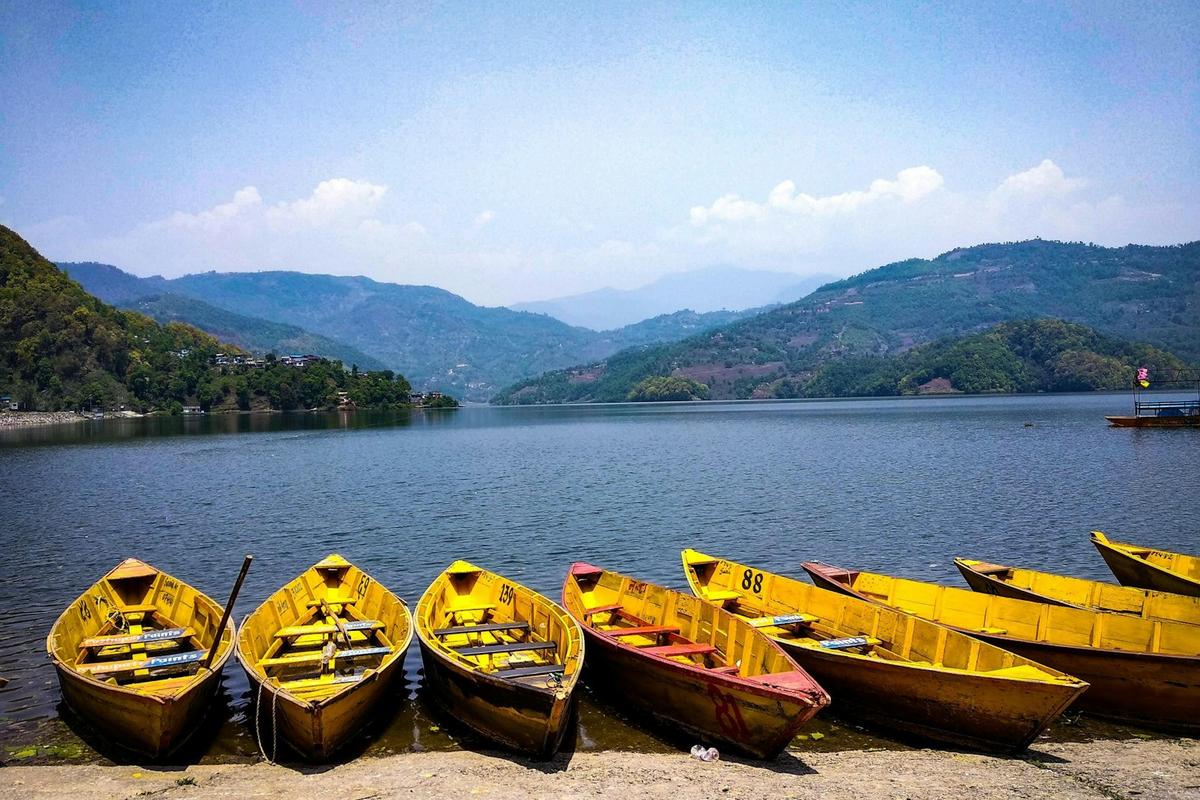
The same report gave NPR 1,500 for a pedal boat. That is the latest dated figure we found; we could not locate an official city rate notice, and rates can change, so treat it as a guide, paid on the spot. The report also counted 280 boats and about 200 registered operators, a couple of hundred local boatmen sharing the work in turn.
"The other two lakes, Begnas and Rupa, are located 15 km out of Pokhara. Less visited but no less beautiful, both these lakes are excellent for boating and fishing."
Nepal Tourism Board, Boating in Pokhara page, checked 2026
A rowing boat is the way to see Begnas. The boatman rows, and you can ask to go along the shore or across to the north side, where the Barahi shrine stands; if you want to stop there, agree the time before you set off. Motorboats have been contested, including in court: the committee introduced them in 2021, and the High Court in Pokhara issued an interim order in February 2024 to stop motorboats running without permission. Plan on a rowing boat. We also found no reliable source that kayak or paddleboard hire operates on Begnas now; for paddling yourself, Phewa is the lake.
How to hire a boat at Begnas, step by step
- Go to the boat area at Begnas Tal, beside the dam.
- Ask the rate at the counter and agree the time and fare before you get in.
- Put on a life jacket and fasten it; they are compulsory under the November 2026 district notice.
- Count the people. Never board an overloaded boat; the boat that capsized on Begnas in 2018, killing eight people, was carrying twice its capacity.
- Stay off the water in strong wind, rain or lightning; the same notice warns against going out in them.
- Be back on shore well before dark.
What are the best things to do at Begnas Lake?
The best things to do at Begnas Lake are simple: row out on the water, visit the small Barahi shrine on the north shore, walk up to the ridge between Begnas and Rupa for the view over both lakes, watch birds along the quieter edges, and eat fish from the lake at the bazaar. None of it is rushed.
Row out to the Barahi shrine
Begnas has its own small Barahi shrine on the far, north shore, reached by boat or on foot. It is not Tal Barahi, the island temple on Phewa, though the ward chair has described a link between the two. Local people visit at full moon, at Teej and on each Sankranti, the first day of a Nepali month, with special pujas at Chaite and Bada Dashain. Take your shoes off at the shrine and ask before photographing people at prayer.
Walk up to Sundari Danda and the view tower
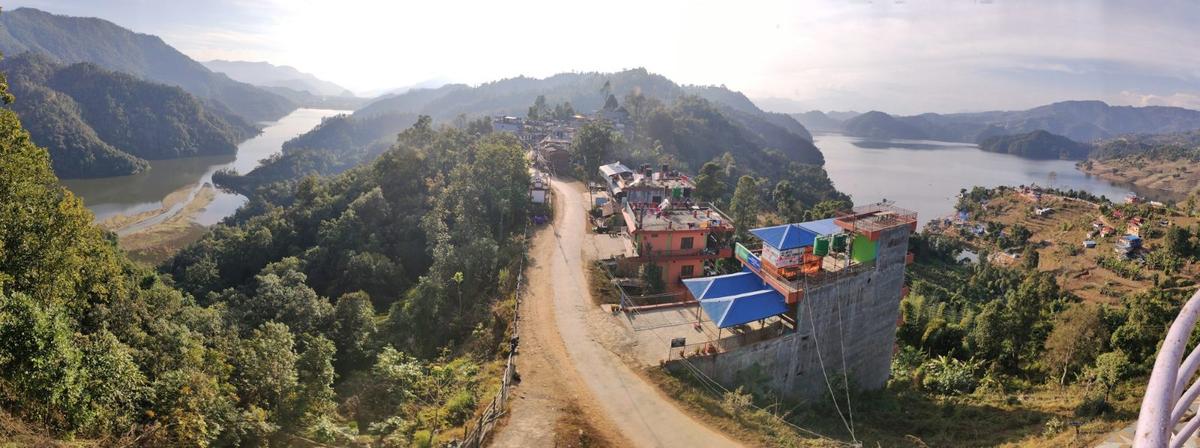
Sundari Danda, the ridge between Begnas and Rupa, is where you see both lakes at once. It has a small view tower with a Begnas and Rupa information centre. In 2023 the ticket was NPR 50 for foreigners, with part of the income going to lake conservation and a local school; it may have changed since.
From Begnas Tal bazaar the view tower is about 3.7 km on foot by mapped paths, or 4.6 km by road. Nearby is Pachbhaiya, a forested ridge and village area about 3.4 km on foot from Begnas Tal by mapped paths. We give no walking times because we could not source them; take water and go in the cooler part of the day. Sundari Danda is a lakes view first; for the classic sunrise ridges, see our guide to viewpoints around Pokhara.
Watch birds along the shore
The city's tourism office recommends Begnas for bird watching. The Ramsar site document records 168 bird species around the nine-lake cluster, and the Ramsar listing names globally threatened migrants such as the critically endangered Baer's pochard. Those records are for the whole cluster, not Begnas alone, and we would not promise you a rare duck. European otters have also been recorded in Begnas and Rupa. Go early, take binoculars, and ask your boatman to keep to the edges.
Fish, fish farms and the fishing families
The government's Fishery Research Station in Pokhara began in 1962 as the Lake Development Centre, and its largest farm site, 8.5 ha, is at Begnas. Cage fish farming was trialled here in the late 1970s, and pearl farming trials have also been run at Begnas.
A 2026 survey reported 17 fish species in Begnas, 11 of them native, from sahar and katle to farmed tilapia and carp. A Begnas Fish Festival ran from 30 October to 9 November 2026, organised by the Hotel and Restaurant Association Lekhnath; we have not seen dates for next year. Fish from the lake is sold fresh by the shore, and if lake fish is on a menu at the bazaar, that is the lunch to have.
Rupa Lake: the smaller lake next door
Rupa Lake lies south of Begnas, on the border of Pokhara Metropolitan City and Rupa Rural Municipality, about 9 km by road from Begnas Tal bazaar. It is a little over a square kilometre of open water, well under half the size of Begnas, a few metres deep, and looked after by a community cooperative.
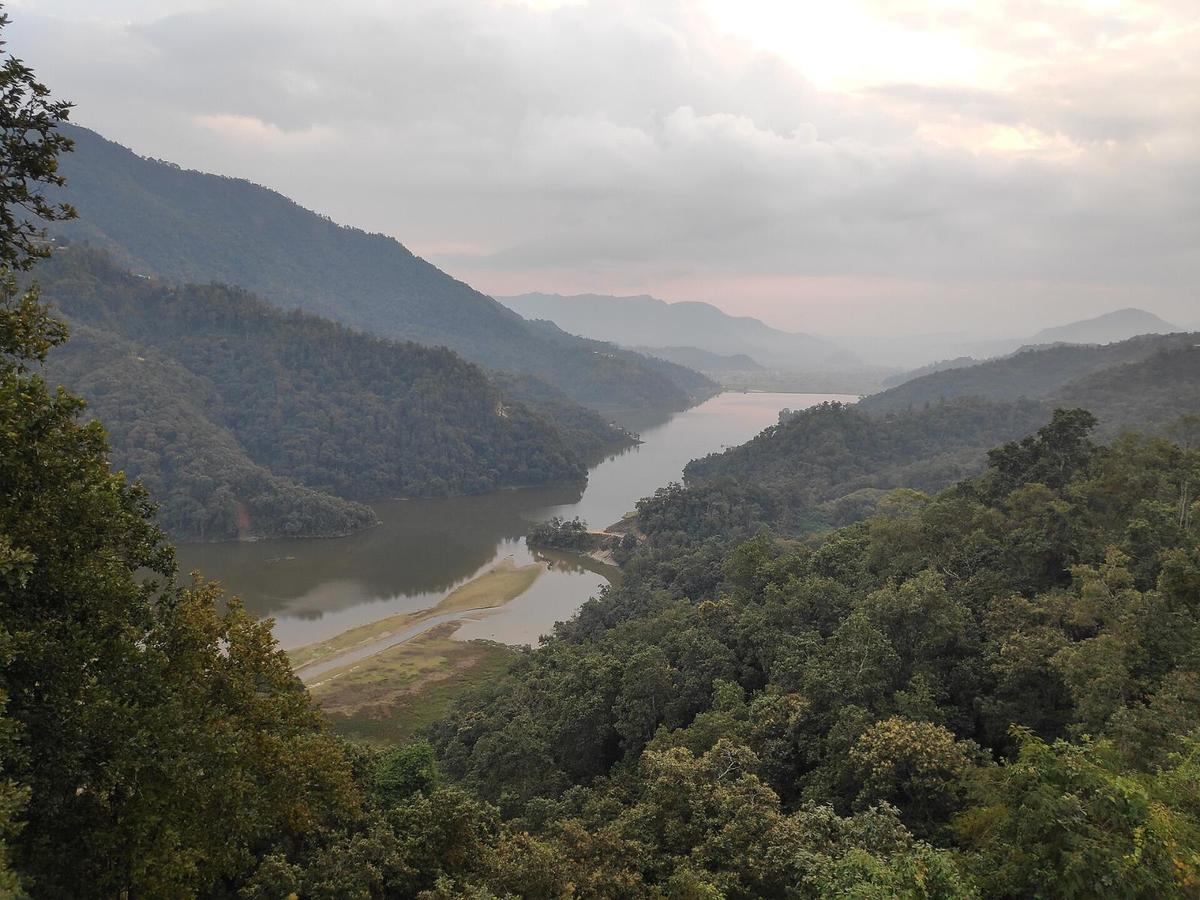
Rupa sits at about 600 m, slightly lower than Begnas, between forested hills. What makes it worth the extra road is the way it is looked after. The lake is managed by the Rupa Lake Restoration and Fishery Cooperative, and the Ramsar file calls the work "exemplary among the conservation measures carried out by the local communities".
"the Rupa Lake Restoration and Fishery Cooperative, organized by over 600 households, earns more than USD 56,000 per year from fishing."
Ramsar Sites Information Service, Lake Cluster of Pokhara Valley, 2016
Rupa is good for birds too: the Ramsar file records over 100 bird species there, from a 1990s survey. A government restoration project is building a new dam to enlarge the lake, with work under way in 2026; until we can confirm it is finished, expect construction and ask locally which paths are open.
Can you see Begnas and Rupa in one day?
Yes, with an early start. Begnas Tal to the Rupa Lake area is about 9 km by road, and the view tower on Sundari Danda sits on the ridge between them, 4.6 km by road from Begnas Tal. A sensible order is a morning boat on Begnas, lunch at the bazaar, then the ridge and Rupa in the afternoon. On foot, Begnas Tal to Rupa is about 8.1 km by mapped paths; treat it as a full outing and start early.
How far is Begnas Lake from Pokhara, and how do you get there?
Begnas Lake is about 16 km by road from Lakeside and about 13 km from Pokhara International Airport. The Nepal Tourism Board puts it at 15 km out of Pokhara. You can go by taxi, private car or local bus; the road runs east along the Prithvi Highway and then up the Talchowk to Begnas road.
| From | Distance | How |
|---|---|---|
| Lakeside (Baidam) | About 16 km by road | Taxi, private car, or local bus from the old bus park |
| Pokhara International Airport | About 13 km by road | Taxi or car; 25 to 35 minutes, per the Pokhara Chamber of Commerce |
| Old domestic airport | 14.0 km by road | Taxi or car |
| Mahendrapul | 14.3 km by road | Taxi or car |
| Prithvi Chowk | 13 to 14 km by road | Taxi, car or local bus |
| Talchowk | 3.5 km | Last stretch of the Begnas road |
| Begnas Tal to Rupa Lake | About 9 km by road | Taxi or car; 8.1 km on foot by mapped paths |
| Begnas Tal to Sundari Danda view tower | 4.6 km by road, 3.7 km on foot | Taxi or car, or a hill walk |
| Kathmandu | Most of a day by road, often six to nine hours with traffic and roadworks; about 30 minutes by air | Tourist bus, car or domestic flight to Pokhara, then as above |
Road distances measured on OpenStreetMap routing on 22 Nov 2026; Prithvi Chowk and Talchowk from RSS; airport drive time from the Pokhara Chamber of Commerce.
By taxi or private car
A taxi or hired car is the easiest way, especially if you add Rupa and the ridge. The Pokhara Chamber of Commerce puts the drive from the airport at 25 to 35 minutes; from Lakeside it is a little longer, depending on traffic. We found no dated taxi fare, so agree the fare before you set off, or use a ride-hailing app that shows it first, and ask for a return fare with waiting time.
By local bus
Local buses run from Pokhara's old bus park to the Begnas bus park at the lake's west end. One 2026 travel guide puts the ride at about 40 minutes, then a 5-minute walk, with frequent buses back; the chamber of commerce gives 40 to 60 minutes. Pay the conductor; fares are small, and we found no dated figure. Ask the conductor about the last bus back.
Road works on the Begnas road
The Talchowk to Begnas road has been under widening, with reconstruction still reported in December 2025, so expect dust and diversions on the last stretch.
Is Begnas Lake safe for boating and swimming?
Boating on Begnas is a gentle outing when you follow the rules: wear a life jacket, which is compulsory under the District Administration Office notice of 3 November 2026, never overload a boat, and stay off the water in wind, rain or lightning. Swimming is different. We found no formal ban, but we advise against swimming.
The Kaski District Administration Office notice covers Phewa and the other lakes in the area. It makes life jackets mandatory, requires boats to be registered, bars children under 16 from operating kayaks or surf boats without parental supervision, and warns against operating boats, kayaks and surf boats in strong wind, rain or lightning. The life-jacket rule is not new: the district made it mandatory on Phewa and Begnas in 2013, after four people died in a capsize on Begnas that April.
On 8 September 2018 a boat carrying 10 people, twice its capacity, capsized on Begnas during a Teej gathering; eight people died and two survived. Overloading is the risk to watch on festival days.
Swimming is where people get into trouble. In June 2025 a man went missing while swimming in Begnas, and Armed Police Force divers recovered his body on 9 June. On 3 October 2026 a 25-year-old man drowned while swimming in the lake. In both cases divers from the Armed Police Force's Kalika battalion in Pokhara were called to the lake; we know of no staffed rescue post at Begnas.
Staying safe on the water, step by step
- Wear a life jacket for the whole trip and fasten it, even if you can swim.
- Check the number of people in the boat before you get in; if it looks full, wait for the next one.
- Stay seated while the boat is moving.
- Look at the sky before you leave. If wind, rain or lightning is coming, do not go out.
- Agree your return time with the boatman and be back on shore well before dark.
- Do not swim from the boat, from the shrine or from the shore.
- If someone falls in, throw something that floats, keep sight of them and shout for the nearest boat; do not jump in unless you are trained.
- Tell your hotel where you are going before you set off.
When is the best time to visit Begnas Lake?
The best time to visit Begnas Lake is October and November, when the Nepal Tourism Board says "the clearest skies are found after the monsoon", followed by the dry winter months. December is the driest month, with 11.5 mm of rain on 1.0 rain day on average. July is the wettest, with 941.0 mm.
The figures below are 1991 to 2020 normals for the Pokhara Airport station, at 827 m. Begnas, at about 650 m, lies lower and has no separate figures, so read them as a guide.
| Month | Average high (°C) | Average low (°C) | Rain (mm) | Rain days |
|---|---|---|---|---|
| January | 19.9 | 7.1 | 21.6 | 2.4 |
| February | 22.7 | 9.7 | 35.1 | 3.8 |
| March | 27.1 | 13.1 | 63.7 | 6.4 |
| April | 30.0 | 16.1 | 141.7 | 10.5 |
| May | 30.4 | 18.7 | 354.7 | 18.3 |
| June | 30.8 | 21.2 | 648.2 | 22.2 |
| July | 30.4 | 22.4 | 941.0 | 25.6 |
| August | 30.5 | 22.3 | 839.4 | 24.3 |
| September | 29.9 | 21.1 | 635.0 | 19.4 |
| October | 27.9 | 17.2 | 159.2 | 8.0 |
| November | 24.4 | 12.3 | 17.2 | 1.3 |
| December | 21.0 | 8.3 | 11.5 | 1.0 |
Pokhara Airport station, 827 m, DHM and WMO 1991 to 2020 normals. Rain days are days with at least 1 mm.
Pokhara gets 3,868.3 mm of rain a year on average, and most of it falls between June and September. In 2026 the monsoon arrived on 19 June and fully withdrew on 14 October; boating is possible in dry spells, but not in strong wind, rain or lightning.
Spring gets wetter as it goes, from 63.7 mm in March to 354.7 mm in May. Winter lows average 7.1 °C in January, so bring a layer for the boat. Whatever the month, go in the morning, with time in hand if the weather turns. For month-by-month detail on the whole valley, see our guide to the best time to visit Pokhara.
Why Begnas is a protected wetland
Begnas is one of nine lakes listed together as the Lake Cluster of Pokhara Valley, Ramsar Site no. 2257, designated on 2 February 2016 and covering 26,106 ha. The nine are Phewa, Begnas, Rupa, Khaste, Dipang, Maidi, Gunde, Neurani and Kamalpokhari.
"Lake Cluster of Pokhara Valley comprises nine lakes of noted beauty along the Pokhara Valley in the mid-hill region of Nepal. Each lake supports significant biodiversity, provides important ecosystem services and sustains local livelihoods."
Ramsar Sites Information Service, Lake Cluster of Pokhara Valley, 2016
The site document names Phewa, Begnas and Rupa as the major lakes, and lists what threatens Begnas: eutrophication, sedimentation, solid-waste pollution, invasive aquatic plants, heavy tourism pressure, encroachment, building on the shore, and road and tourism infrastructure. The 2016 file noted that the invasion of water hyacinth was "quite visible" on Begnas. We found no newer report, so we cannot say how much has changed. For a visitor, the response is simple: take your rubbish back with you, do not feed fish or birds, and spend your money at the lake, with the boatmen and fishing families who depend on it.
Where to stay near Begnas Lake
There are a few lakeside resorts and family guesthouses around Begnas, but most visitors stay in Lakeside and come for the day. Staying at the lake gives you quiet evenings and an early boat; staying in Lakeside gives you choice of food, shops and transport.
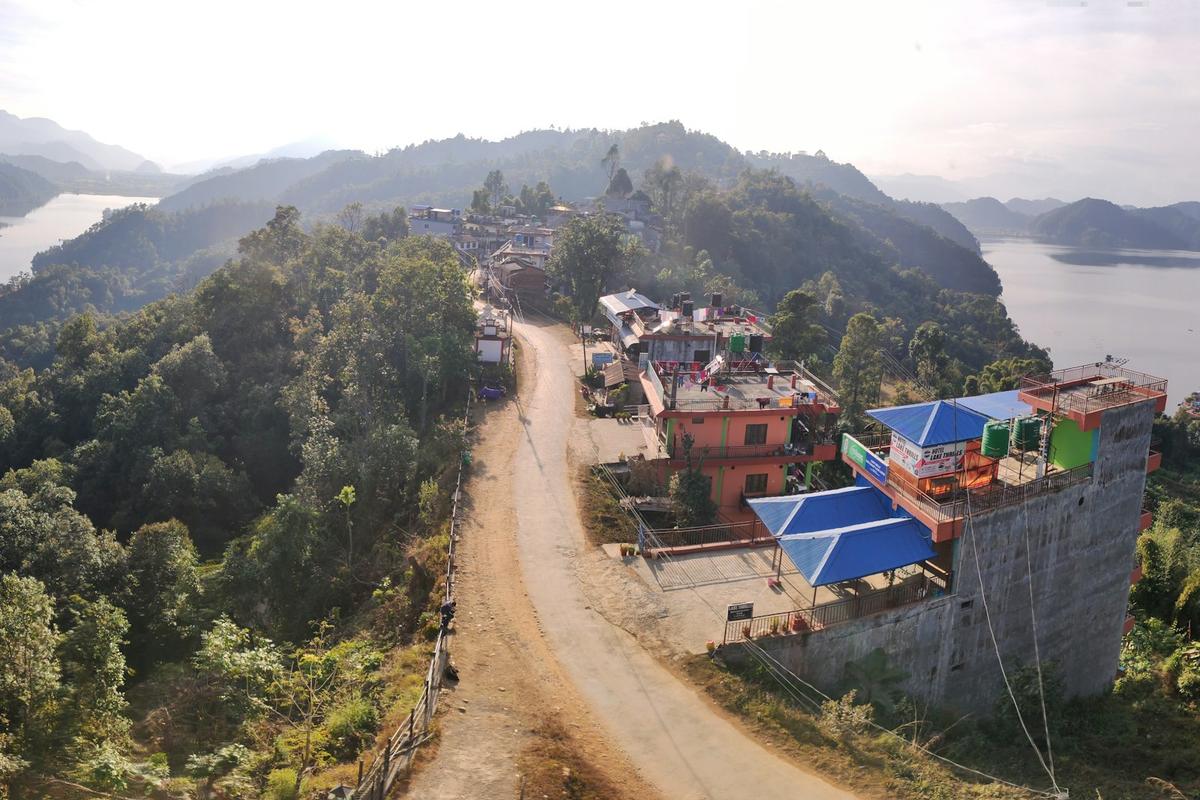
The bazaar is small and simple, so evenings by Begnas are quiet, with your guesthouse kitchen the main place to eat. That suits a birdwatcher planning a dawn start or anyone after a break from busy Lakeside, and suits less well if you want a different restaurant every night. Our guide to the Lakeside area covers the neighbourhoods in town. We do not recommend particular hotels here; ask us if you would like a suggestion for your dates.
Plan your Begnas day with us
Begnas is easy to fit into a stay in Pokhara, and three of our trips leave room for it. On the Kathmandu, Pokhara and Bandipur relaxed tour, day 5 is a free day in Pokhara that can include quieter Begnas Lake. On the Kathmandu and Pokhara premium retreat, a trip to Begnas is one of the options on day 3. On the Pokhara luxury escape, a quiet excursion to Begnas Lake is one of the optional choices on day 2. In each case it is optional, so mention it when you enquire.
If you are coming from Kathmandu, allow most of a day by road, often six to nine hours with traffic and roadworks, or about 30 minutes by air. Since 21 November 2026 the Prithvi Highway has been closed to traffic from 11 am to 4 pm daily for construction, until further notice; that affects the drive between Kathmandu and Pokhara, including the relaxed tour's return drive, but not the short drive from Lakeside to Begnas.
For everything else in the valley, from sunrise viewpoints to caves and paragliding, start with our guide to things to do in Pokhara. If you have a question about Begnas, Rupa or how to fit them into your days, send us a WhatsApp message or an enquiry, and our Kathmandu team will reply with an honest answer.
Frequently asked questions
How far is Begnas Lake from Pokhara?
Begnas Lake is about 16 km by road from Lakeside and about 13 km from Pokhara International Airport; the Nepal Tourism Board puts it at 15 km out of Pokhara. The Pokhara Chamber of Commerce gives 25 to 35 minutes by car or taxi from the airport; from Lakeside allow a little longer, depending on traffic.
How do I get to Begnas Lake from Pokhara by bus or taxi?
Take a taxi or private car from Lakeside, or a local bus from the old bus park to Begnas bus park. One 2026 travel guide puts the bus ride at about 40 minutes, then a 5-minute walk to the lake. There is no published taxi fare, so agree the fare first or use a ride-hailing app that shows it. A car with waiting time makes it easy to add Rupa Lake.
Can you swim in Begnas Lake?
We found no formal ban on swimming in Begnas Lake, but we advise against it. A man drowned while swimming there in June 2025, and a 25-year-old drowned on 3 October 2026. We know of no staffed rescue post at the lake; in both cases Armed Police Force divers were called in from their Pokhara battalion. Enjoy the lake from a boat, with a life jacket on, which is compulsory.
Begnas Lake or Phewa Lake: which is better?
Neither is better; they suit different moods. Phewa is the larger lake, with the Tal Barahi island temple, Lakeside cafés and paddleboards. Begnas, the second-largest, is quieter, with rowing boats, fishing families and a small bazaar; the city's tourism office calls it "a quieter alternative to Phewa Lake". With a day or two, stay with Phewa; with a third day, add Begnas and Rupa.
How much does boating cost at Begnas Lake?
In December 2025 the chair of the local boat operators' committee put the rate at NPR 700 an hour for a rowing boat and NPR 1,500 for a pedal boat, as reported by Tourism Info Nepal. We found no official city rate notice, and rates can change, so check at the counter at Begnas Tal and agree the fare and time before you get in. Life jackets are compulsory.
How deep and how big is Begnas Lake? Is it man-made?
Begnas is a natural freshwater lake of about 3.3 square kilometres (328 hectares in a 2007 government survey), and about 10 m at its deepest. It is not man-made, but its outlet, the Khudi Khola, was dammed in the late 1980s, and a dam at Bhandare at the western end regulates the water level. It sits at about 650 m above sea level.
Last checked 22 Nov 2026 by our Kathmandu travel team.