



Four treks share the word "Annapurna", and most first-time visitors to Nepal end up choosing between them. They are not four versions of the same walk. One is a long weekend on stone staircases through rhododendron forest. One crosses a 5,416 m pass. Two sit in between, and the right answer depends far more on your calendar, your knees and your appetite for altitude than on which one has the best photos.
This guide compares the Annapurna Base Camp trek, the Annapurna Circuit, the Ghorepani Poon Hill trek and the Mardi Himal trek on the things that actually decide the choice: days on the trail, highest sleeping point, how hard the walking is, what you see, and what can go wrong in each season. The altitudes and durations below are the figures we use when planning our own departures. Where a number varies with the route you choose, we give the range rather than a single tidy figure.
The short answer: Ghorepani Poon Hill is 4–5 days to 3,210 m and easy to moderate. Mardi Himal is 5–7 days to 4,200 m and moderate. Annapurna Base Camp is 7–11 days to 4,130 m and moderate. The Annapurna Circuit is 12–18 days and crosses Thorong La at 5,416 m, which makes it the hard one. All four start from or near Pokhara, all four are teahouse treks, and all four need the same Annapurna Conservation Area permit.
The four Annapurna treks at a glance
All four treks start from or near Pokhara, all four are teahouse treks (you sleep in lodges, not tents), and all four sit inside the Annapurna Conservation Area, Nepal's largest protected area at roughly 7,629 sq km, established in 1992. That is why all four need the same conservation permit. Beyond that they diverge quickly.
| Trek | Days | Highest point | Difficulty |
|---|---|---|---|
| Poon Hill | 4–5 | 3,210 m | Easy to moderate; steep steps |
| Mardi Himal | 5–7 | 4,200 m (sleep 3,580 m) | Moderate; open ridge |
| Annapurna Base Camp | 7–11 | 4,130 m | Moderate; stone steps |
| Annapurna Circuit | 12–18 | 5,416 m | Hard; a 5,416 m pass |
The table gives days on the trail, not days of travel, and the Circuit figure is the classic route on foot — road transfers at both ends routinely cut it to 10–14 days of walking. Three things are worth pointing out. First, the jump from Poon Hill to Annapurna Base Camp is not just a few more days; it is almost a kilometre more altitude, which is the difference between "no acclimatisation needed" and "you need a sensible ascent schedule". Second, the Circuit's highest point is 1,286 m above base camp. That single number explains most of the difference in how the two treks feel.
Third, and this is the one people get wrong when they book flights: days on the trail are not days of holiday. Every trek here needs travel at both ends, and most itineraries add a night in Pokhara before and after. A "seven-day trek" is comfortably a ten-day trip once you have counted arrival, the drive or flight to Pokhara, the trailhead transfer and a spare day at the end. Count backwards from your return flight, not forwards from your arrival.
Ghorepani Poon Hill: the short, low, classic one
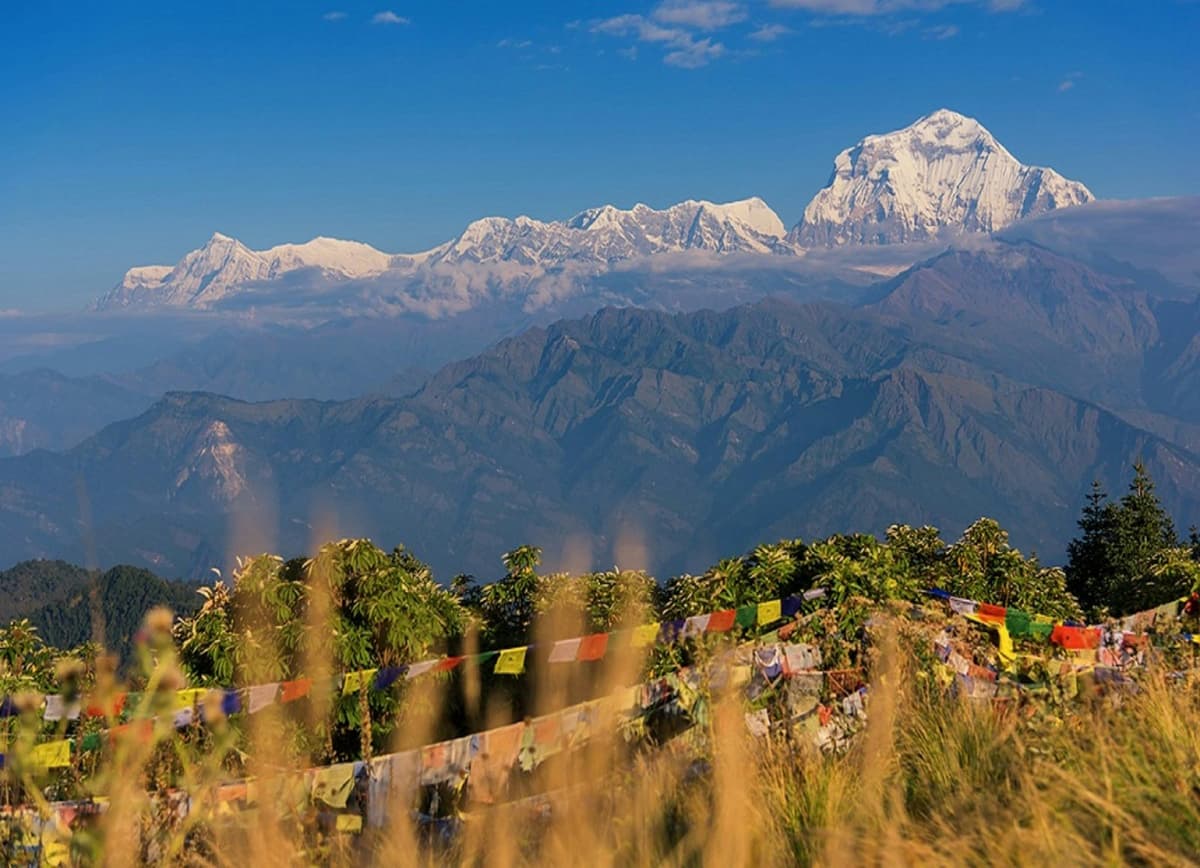
Poon Hill is a viewpoint at 3,210 m above the village of Ghorepani (2,874 m), and the trek that carries its name is a four- to five-day loop out of Pokhara (820 m) through the villages of the lower Annapurna foothills. You climb it in the dark, arrive for sunrise, and watch the light hit the Annapurna and Dhaulagiri ranges with Machhapuchhre, Annapurna South and Nilgiri also on the skyline.
It is the trek we recommend most often to people with a week or less in Nepal, to families with children who walk well, and to anyone who has never trekked before and wants to find out whether they like it. The altitude is low enough that altitude sickness is a minor concern rather than a planning constraint, and the highest overnight stop is Ghorepani itself, below the viewpoint.
The honest caveat is the staircase. The stone steps up to Ulleri are the hardest part of the trek and the reason people are surprised by how tired they are on day one. "Easy" here means low altitude and short days, not flat. The reward for the effort is the rhododendron forest between Ghorepani and Ghandruk, which is at its best in March and April when Nepal's national flower is in bloom.
Be realistic about the sunrise itself. It is a pre-dawn start in the cold, by head torch, up a stepped path, and in October and November you will be doing it alongside a good number of other people. It is still worth it — the panorama is the widest you will get anywhere on this list for the effort involved — but it is not a private moment on an empty hill, and anyone expecting solitude should look at Mardi Himal instead.
The classic version is the Ghorepani–Ghandruk loop, which adds the Gurung village of Ghandruk (1,940 m) on the return. Because Ghandruk is also on the way to Annapurna Base Camp, Poon Hill is frequently bolted onto the front of an ABC trek to add two or three days and a sunrise.
One more point in its favour: it is the only trek on this list that works comfortably in almost any month. The altitude is low enough that winter is cold rather than dangerous, and the days are short enough that even a wet week is survivable. If your travel dates are fixed and awkward, this is usually the trek that still fits.
Mardi Himal: the ridge walk with the big view
Mardi Himal follows a single ridge east of the Annapurna Base Camp valley, climbing from forest into open alpine ground with Machhapuchhre almost directly ahead for most of the upper section. The ladder of camps is easy to remember: Forest Camp at about 2,550 m, Low Camp at roughly 2,970 m, Badal Danda at 3,210 m, and High Camp at about 3,580 m, which is where most people sleep highest. From High Camp a day walk continues to the Upper Viewpoint at around 4,200 m; the mountaineering base camp higher up, at roughly 4,500 m, is not part of the standard teahouse route.
It is a good middle option: fewer days than Annapurna Base Camp, considerably higher than Poon Hill, and quieter than either because it was opened to teahouse trekking more recently. The trade-off is that the upper ridge is exposed. In wind or snow the section above High Camp can be closed off by the lodge owners, and in the monsoon the trail is often in cloud all day.
The lodges are smaller and fewer than on the Poon Hill or ABC routes, and the upper ones are simple — stone buildings on an open ridge, not village guesthouses. In peak weeks that matters: beds at High Camp are a genuine constraint, and it is the main practical argument for going with an operator who books ahead rather than turning up and hoping.
If your fitness is decent but your time is tight, and you want to sleep above 3,500 m without committing to the base camp valley, this is usually the answer. You can read the day-by-day version on our Mardi Himal trek page.
Who should not pick it: anyone whose mental image of the trip is arriving somewhere — a base camp, an amphitheatre of peaks, a destination with a name on it. Mardi Himal is a ridge and a view, and the view is the whole point. If you want villages, culture and people along the way, the Poon Hill loop and the Circuit both give you far more of that.
Annapurna Base Camp: into the Sanctuary
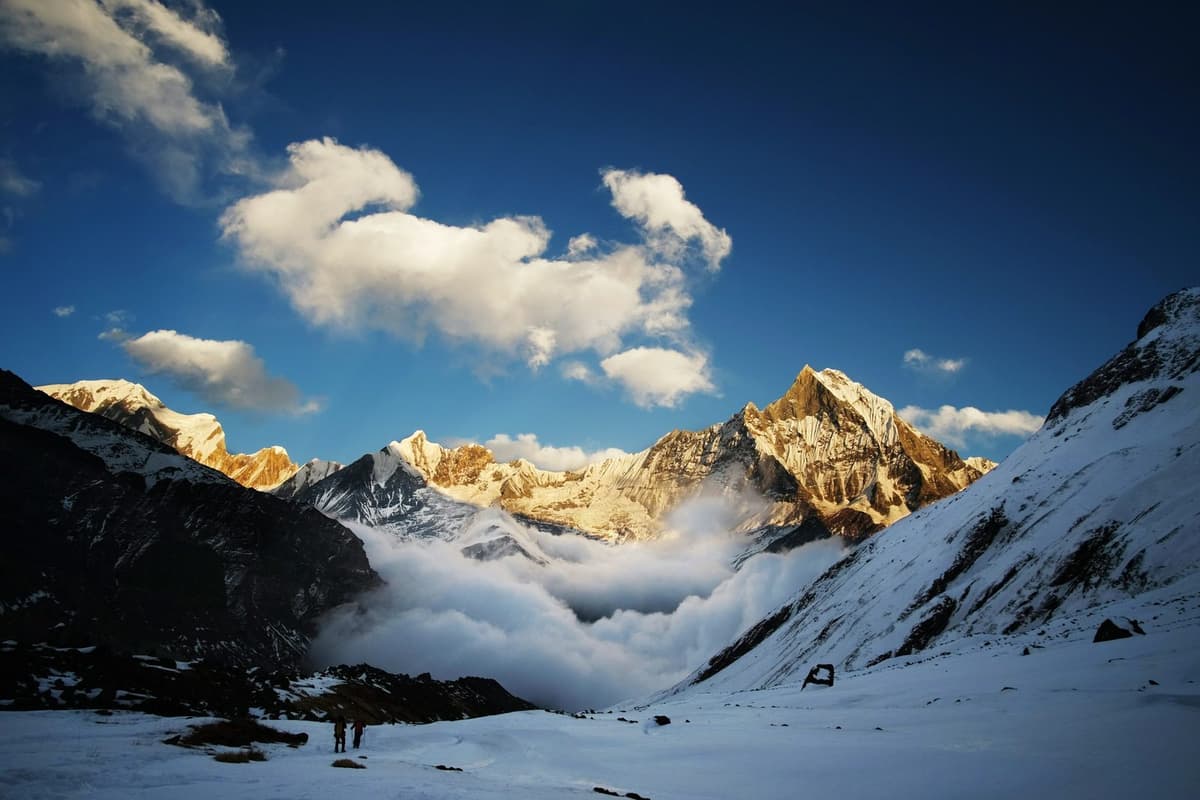
The Annapurna Base Camp trek walks up a gorge into the Annapurna Sanctuary, a high glacial amphitheatre ringed by peaks, with base camp itself at 4,130 m. Annapurna I (8,091 m, the tenth-highest mountain on Earth) anchors the far wall; Machhapuchhre (6,993 m, sacred and officially unclimbed) guards the entrance. Machhapuchhre Base Camp, usually shortened to MBC, sits at about 3,700 m and is the last stop before ABC; most itineraries sleep there and walk up for sunrise, or push through to sleep at base camp itself.
Depending on where you start (Nayapul, Siwai or Jhinu are the common trailheads) the round trip is roughly 70–95 km, walked over 7–11 days at 5–13 km a day. The villages come in a well-known order: Ghandruk, Chhomrong (about 2,170 m, the last proper village and the gateway to the upper valley), Sinuwa, Bamboo, Dovan, Deurali, MBC, then ABC. Jhinu Danda's hot springs are the traditional reward on the way down.
The difficulty is moderate and there is no technical climbing, but the trail is famous for its stone steps. The descent from Chhomrong to the river and the climb back out to Sinuwa is the section people remember, and you do it in both directions — there is no loop here, so the way back is the way you came. Anyone who can walk five or six hours a day for several days in a row, with a reasonable pack, can do this trek on a sensible schedule.
What separates a good ABC trek from a miserable one is usually not raw fitness but how fast the itinerary climbs above 3,000 m. The upper valley is narrow and the lodges are spaced where the terrain allows, not where acclimatisation would prefer, so a compressed itinerary can put you 900 m higher in a single day without much choice in the matter. That is the question to ask of any ABC plan before you book it, and it is covered in more detail below.
Two seasonal notes matter more here than on the other three. The stretch between MBC and ABC carries avalanche risk in winter and after heavy snow; guides and lodge owners know when it is closed, and independent trekkers sometimes do not. And in peak autumn and spring weeks, bed space at MBC and ABC can genuinely run out, because there are only so many lodges in a valley that narrow. Our Annapurna region listing has the current itineraries we run into the Sanctuary.
Annapurna Circuit: around the massif and over Thorong La
The Circuit does what its name says: it goes around the Annapurna massif rather than into it. The traditional start is Besisahar (760 m) in the sub-tropical Marsyangdi valley, and the route climbs north through Chame (2,670 m) to Manang (3,540 m), the key acclimatisation village, before the crux: Thorong La at 5,416 m, the highest point of the trek and one of the highest trekking passes anywhere. The descent lands you at Muktinath (3,760 m), a pilgrimage temple sacred to both Hindus and Buddhists, then down the Kali Gandaki through Jomsom (about 2,700 m) and back to Pokhara.
It is the only trek here that changes climate zone underneath you. You start in terraced farmland with banana trees, walk up through pine and then juniper, cross a pass in snow, and come down the other side into the dry, wind-scoured, high-desert landscape on the edge of Mustang. Nothing else on this list gives you that range, and for a lot of people it is the reason to choose the Circuit over the shorter treks.
The classic Circuit took 12–18 days. Roads now reach well into both valleys, so many itineraries drive to Chame or Dharapani and out from Jomsom, cutting the walking to 10–14 days. Whether that is an improvement is a matter of taste; the lower villages were part of the trek's appeal, and the upper section is where the drama is.
It is walked anti-clockwise for a reason. Approaching Thorong La from Manang gives a gradual climb with room for acclimatisation days, whereas the Muktinath side rises too steeply to acclimatise safely. Tilicho Lake (about 4,920 m, often described as one of the highest lakes of its size in the world) is the popular side trip from Manang and adds two to three days — and, usefully, extra time high before the pass.
Pass day is the crux. You start before dawn, climb for several hours in cold and often wind, and then descend for a long time on tired legs. It is not technical, but it is a serious day at serious altitude, and the whole itinerary before it exists to prepare you for it. It is also weather-dependent in a way the other three treks are not: snow can close Thorong La, and when it does there is no quick alternative. Build at least one spare day into a Circuit trip, and treat it as part of the plan rather than a luxury.
The western end has its own rhythm. The Kali Gandaki is known for a wind that builds through the middle of the day, so walking in that section is an early-morning business — expect starts that feel absurd on holiday and make complete sense by eleven o'clock.
Which Annapurna trek should you choose?
| Trek | Best for | Main risk | Best months |
|---|---|---|---|
| Poon Hill | A first trek, family groups, under a week | The Ulleri steps on day one | Mar–Apr; Oct–Nov |
| Mardi Himal | Fit walkers short on time | Wind or snow on the upper ridge | Oct–Nov; Mar–Apr |
| Annapurna Base Camp | 10–14 days, inside the range | Going up too fast; snow above MBC | Oct–Nov; Mar–May |
| Annapurna Circuit | Two to three weeks, past altitude | Weather closing the pass | Oct–Nov; Mar–May |
The useful way to run this decision is to start from the constraint you cannot change. For most people that is the number of days, and days alone will narrow four options down to one or two. If your dates are flexible but your altitude experience is limited, start from the high point instead. If both are open, choose on what you want to look at: a panorama, a mountain, an amphitheatre, or a journey.
- If you have five days or fewer, it is Poon Hill. Nothing else fits, and it is a genuinely good trek rather than a consolation prize.
- If you have about a week, Mardi Himal gives you the highest viewpoint per day of walking. Poon Hill plus a rest day in Pokhara is the gentler alternative.
- If you have ten days to two weeks, Annapurna Base Camp is the obvious choice, with or without Poon Hill on the front.
- If you have three weeks and have trekked at altitude before, the Circuit is the bigger journey. If you have not been above 4,000 m before, ABC first is not a bad idea.
- If altitude worries you, Poon Hill removes the question almost entirely. On the other three, the schedule is the safety margin: ask how many nights the itinerary spends between 3,000 m and the high point.
- If you are walking with children or with someone of mixed fitness, Poon Hill is the only one of the four where a slow day costs you nothing. On the others, a slow day either compresses the next one or pushes you higher than you wanted to sleep.
How to read an Annapurna trek itinerary before you book
Itineraries for all four of these treks are sold with a day count and a difficulty word, and neither tells you much. Three checks tell you far more.
Check the sleeping altitudes, not the high points. What makes people ill is where they sleep, not where they stand for ten minutes. The widely used guidance from the Wilderness Medical Society is straightforward:
Above 3,000 m, do not increase your sleeping elevation by more than about 500 m per day, and include a rest day — no gain in sleeping elevation — every three to four days.
Very few commercial Himalayan itineraries follow that to the letter, because the lodges are where they are and the terrain does not negotiate. But it gives you a yardstick. Lay an itinerary's overnight altitudes end to end and look at the jumps above 3,000 m. On the ABC route the pinch point is the run from Deurali to MBC and on to base camp. On the Circuit it is the days above Manang and the pass itself. On Mardi Himal it is the climb to High Camp. If an itinerary makes one of those jumps look small, it is either giving you an extra night or it is being optimistic.
Check what the day count includes. Some operators count the Kathmandu arrival day and the Pokhara transfer days; some count only walking days. A "10-day ABC trek" can mean ten days of walking or six. Ask which, and ask where the road transfers sit — a drive to a higher trailhead saves a day of walking but also skips the gentle altitude gain that came with it.
Check for a spare day. On Poon Hill you will almost never need one. On Mardi Himal a bad-weather day at High Camp can cost you the viewpoint. On the Circuit, a closed pass costs you the trek. A trip with no contingency day is a trip that turns any weather problem into a missed flight.
And treat the word "moderate" as a description of terrain, not of effort. On these trails moderate means no ropes, no crampons and no technical skill — it does not mean easy, and on the ABC route in particular it involves several thousand stone steps in each direction.
Best season for each Annapurna trek
Spring (March to May) and autumn (September to November) are the main seasons for all four treks, and for the same reasons: stable weather, clear mornings, and lodges fully open. Autumn tends to have the sharpest views; spring has the rhododendron forest and warmer nights lower down. Both are busy, and on the Annapurna Base Camp route in particular, lodge space at MBC and ABC can run out in peak weeks.
Winter (December to February) is cold and often clear, and it affects the four treks very differently. Poon Hill and Mardi Himal remain very doable with proper clothing, and the views on a cold clear morning are as good as they get. Annapurna Base Camp is possible but carries the avalanche caveat above, and some upper lodges run a reduced service. The Circuit is a different proposition altogether, because Thorong La can be closed by snow for days at a time and the contingency you need is measured in days, not hours.
The monsoon (June to August) brings rain, cloud, leeches on the lower trails and landslide risk on the roads. Treks still run, and the hills are startlingly green, but you should expect to see less of the mountains and plan around that rather than hoping for the best. If monsoon is your only window, the trans-Himalayan section of the Circuit beyond Thorong La sits in the rain shadow and stays comparatively dry — which is one reason the Jomsom side sees summer traffic when the southern valleys are under cloud.
Shoulder weeks are worth a thought too. Early September and late November on either side of the autumn peak, and late February or early June on either side of spring, trade a little weather reliability for markedly quieter lodges. On Mardi Himal and ABC, where beds are the constraint, that trade can be a good one.
Annapurna trek permits and the guide rule
All four treks lie inside the Annapurna Conservation Area, so all four require the Annapurna Conservation Area Permit (ACAP), issued in Kathmandu or Pokhara and checked at points such as Birethanti, Ghorepani and Chhomrong. The TIMS trekker registration card has been required, waived and inconsistently enforced in the Annapurna region over recent years, and the rules change; if you trek with a registered agency, the agency handles both and you do not need to track the current state of play yourself.
On guides: since April 2023 Nepal's tourism authorities have pushed independent trekkers towards using a licensed guide through a registered agency. Enforcement and interpretation have varied by area and by year, and some sources report that the Annapurna region still admits solo trekkers, whereas restricted areas such as Upper Mustang have always required a guide. We would not describe it as an absolute ban, but we would recommend a licensed guide on all four treks for the practical reasons above: they know when the upper Mardi ridge is closed, when the MBC–ABC section is unsafe, and when Thorong La is not worth attempting.
Two practical points that follow from all of this. First, whatever the rules say in the month you travel, check them close to departure rather than trusting an article — this one included. Requirements in Nepal have changed more than once at short notice. Second, once permits have been issued they are non-refundable, as set out in our booking policy, so a permit bought for a trek you later change is money spent.
Insurance deserves a line of its own. For anything above Poon Hill, make sure your policy covers trekking to the altitude you will actually reach — check the number in the policy against the high point in the table above — and that it covers helicopter evacuation. In the upper Sanctuary and above Manang, a helicopter is not a luxury option; it is the evacuation route.
Frequently asked questions
Is Annapurna Base Camp harder than the Annapurna Circuit?
No. The Circuit is the harder trek because of its length and because Thorong La (5,416 m) is nearly 1,300 m higher than base camp. ABC is harder on the legs per day because of the stone steps, but it is shorter and lower.
Can a beginner do Annapurna Base Camp?
Yes, with preparation and a schedule that does not rush the section above 3,000 m. Fit first-time trekkers complete it regularly. If you have never done multi-day walking, Poon Hill or Mardi Himal first is a sensible test.
How fit do I need to be?
For Poon Hill, fit enough to walk four to five hours a day on steep steps. For Mardi Himal and ABC, fit enough to do five to six hours a day for several consecutive days and to repeat it when you are tired. For the Circuit, all of that plus one very long day at over 5,000 m. Hill walking with a day pack is the training that transfers best; flat gym cardio on its own does not prepare your legs for descending stone steps.
Do I need to worry about altitude sickness on Poon Hill?
Much less than on the others. The viewpoint is 3,210 m and you sleep lower at Ghorepani. Symptoms are possible for some people at that height, but it is not the planning constraint it becomes on the ABC, Mardi Himal or Circuit treks.
Can I combine Poon Hill with Annapurna Base Camp?
Yes, and it is common. The Poon Hill loop passes through Ghandruk, which is on the ABC route, so adding it costs two or three days and gives you extra time at moderate altitude before the higher section.
What is the highest point on the Annapurna Circuit?
Thorong La pass at 5,416 m. Manang (3,540 m) is where you acclimatise before it, and Muktinath (3,760 m) is where you land after it.
Which direction should I walk the Circuit?
Anti-clockwise, from Besisahar through Manang and over Thorong La to Muktinath. The eastern side climbs gradually enough to acclimatise; the western side is too steep to do safely in reverse.
Do all four treks need the same permit?
All four need the Annapurna Conservation Area Permit. Whether a TIMS card is also required has changed several times and is inconsistently enforced; an agency will handle whatever is current when you trek.
Is Mardi Himal a good first trek at altitude?
It is a reasonable one. You sleep at about 3,580 m at High Camp, which is high enough to find out how your body handles altitude but well below the Circuit's pass. The catch is that the upper ridge is exposed, so a first-timer should treat the Upper Viewpoint as a bonus rather than a guarantee.
Do I sleep in tents on any of these?
No. All four are teahouse treks: you sleep in lodges run by local families, with meals provided. Rooms are simple and get simpler with altitude, and the highest lodges on the ABC and Mardi Himal routes are basic by design. You do not need camping equipment for any of the standard routes.
Which trek has the best mountain views?
That depends what you mean. Poon Hill gives the widest panorama for the least effort. Annapurna Base Camp puts you inside a ring of peaks. Mardi Himal gives you Machhapuchhre close up for days. The Circuit gives you everything from sub-tropical valley to high desert, which is a different kind of view.
If you are still undecided, tell us how many days you have, whether you have been above 3,000 m before, and which month you are travelling, and we will tell you plainly which one fits. You can reach us through the contact page, or browse the full set of treks first.